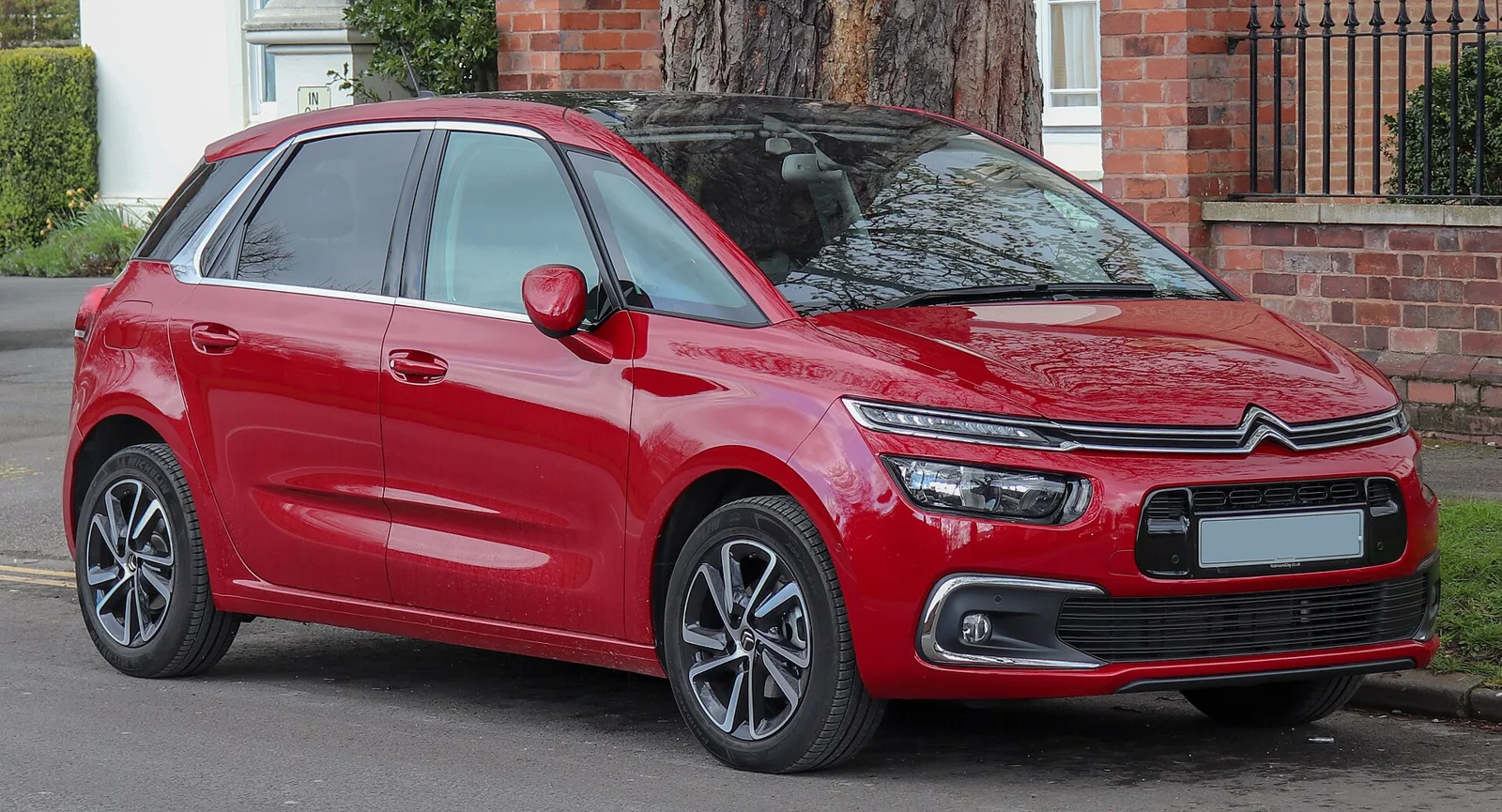
A compact MPV on the new EMP2 platform, sold first as the C4 Picasso and then as the C4 SpaceTourer until 2022.
Introduced in June 2013 on the EMP2 platform, the C4 Picasso II offered two body lengths and a mix of petrol and diesel units. Citroen renamed it the C4 SpaceTourer in May 2018, and production ran to 30 June 2022.
The Citroen C4 Picasso II was a compact MPV built between 8 June 2013 and 30 June 2022, first under the Picasso name and then as the C4 SpaceTourer. It was the first PSA vehicle built on the new EMP2 platform, and it came in short and long bodies with petrol and diesel engines.
Where did the C4 Picasso II come from?
The Picasso name reached the brand's MPVs in 1998, when the Xsara Picasso was shown at the Paris Motor Show. From then on, the MPV versions of Citroen's chevron models carried it, with a model name added to show their place in the range, so the large people carrier became the C4 Picasso.
The C4 Picasso II had first appeared as the Technospace show car at the 2013 Geneva Motor Show. That show car represented the production model at 99%, and sales began on 8 June 2013.
The Picasso name was dropped in 2018, but the family MPV it carried stayed on sale until 2022.
What did the EMP2 platform change?
The C4 Picasso II was the first PSA vehicle built on EMP2, the Efficient Modular Platform. Developing that single new base required an investment of 630 million euros, and the car was not derived from the older PF2-based C4 II.
The C4 II sat on the PF2 base that the Peugeot 3008 I also used. The new platform gave an average weight saving of 140 kg, which helped the entry diesel claim only 98 g of CO2/km.
What made the short and long bodies different?
There were two lengths. The short body carried the internal code B78 and was styled by Frederic Soubirou, while the long body, code B787 and styled by Olivier Vincent, took the Grand C4 Picasso name. Each had its own front end, with headlights split into two parts.
Both kept the panoramic windscreen, which had been well regarded on the first C4 Picasso. Both also had reduced overhangs.
What was on the dashboard?
Both bodies shared a dashboard built around two screens. A 7-inch touchscreen grouped the vehicle's functions together with the air conditioning controls, while a second screen mounted higher up, 12 inches on some trims, showed speed and engine speed on the left.
The right-hand side of the upper screen carried radio, photos, GPS and other information. Buyers could also pick one of three graphic themes for the 30 cm screen: Cubic, Graphic or Eliptic.
How did the 2016 facelift change the car?
The 2016 facelift gave both bodies one shared front end, together with new wheels and body colours. The first two trim levels received rear lights with a 3D effect, though not the same design as the top version's.
The instrument clusters were redrawn and the multimedia graphics modernised. New equipment included smartphone integration, a hands-free tailgate and adaptive cruise control able to bring the car to a halt on automatic models. The trim range was cut to three: Live, Feel and Shine.
Why did Citroen drop the Picasso name?
Citroen dropped the name because it was costly. Royalties that ran into several million euros a year went to the Picasso family, and the brand had used the name for 20 years. It announced the change on 26 February 2018.
The C4 Picasso was the last Picasso left in the range, since the C3 Picasso had gone in 2017. From 1 May 2018 the Picasso models were renamed the C4 SpaceTourer and the C4 Grand SpaceTourer, names that now grouped the brand's family models.
What engines did the C4 Picasso II offer?
At launch every engine was a 1.6 L unit meeting Euro 6. The petrol choices were the naturally aspirated VTi 120 and the turbocharged THP 155, while the diesels were the HDi 92 and the modified e-HDi 115.
The petrol pair was matched to 5-speed and 6-speed manual gearboxes. The diesels came with a manual or an automated gearbox. The e-HDi 115 was based on the 110 or 112 PS DV6 of the previous generation, and the HDi 92 claimed 3.8 L/100 km of fuel use.
Changes in 2014 and 2016
In 2014 the VTi 120 gave way to a 1.2 L PureTech 130 with a 6-speed manual. The THP 155 rose to 165 PS, with the EAT6 automatic replacing its manual gearbox. The HDi 92 reached 100 PS, the HDi 115 went to 120 PS, and a new 2.0 BlueHDi of 150 PS arrived, claiming 110 g of CO2/km.
Two new 1.2 L PureTech engines followed in 2016: one with 110 PS and a five-speed manual, the other with 130 PS and the EAT6 automatic.
Euro 6.2 changes from autumn 2018
The Euro 6.2 standard reshuffled the range again. The PureTech 110 was dropped from the SpaceTourer, the PureTech 130 gained a particulate filter, and the THP 165 gave way to a PureTech 180 with EAT8, on the Grand SpaceTourer only. The BlueHDi 100, 120 and 150 were replaced by the BlueHDi 130 and the BlueHDi 160.
Engine line-up at a glance
| Engine | Power | Gearbox | Notes |
|---|---|---|---|
| 1.6 VTi 120 | 120 PS | 5-speed manual | Naturally aspirated petrol, 2013 launch, replaced in 2014 |
| 1.6 THP 155 | 155 PS, then 165 PS from 2014 | 6-speed manual, then EAT6 automatic | Turbocharged petrol |
| 1.6 HDi 92 | 92 PS, then 100 PS from 2014 | 5-speed manual or ETG6 at launch; 5-speed manual only from 2014 | 98 g/km of CO2 claimed, 3.8 L/100 km |
| 1.6 e-HDi 115 (HDi 115) | Sold as the 115 at launch, 120 PS from 2014 | 6-speed manual or ETG6 at launch; EAT6 from 2014 | Modified DV6 from the previous generation |
| 1.2 PureTech 130 | 130 PS | 6-speed manual from 2014; EAT6 from 2016; BVM6 and EAT8 from 2018 | Petrol, particulate filter from autumn 2018 |
| 1.2 PureTech 110 | 110 PS | 5-speed manual | Added in 2016, dropped from the SpaceTourer in 2018 |
| 2.0 BlueHDi 150 | 150 PS | 6-speed manual or automatic | 110 g/km of CO2 claimed, from 2014 |
| 2.0 BlueHDi 160 | 160 PS | 8-speed EAT8 | Introduced with the SpaceTourer names, removed in September 2021 |
| PureTech 180 | 180 PS | EAT8 | Grand SpaceTourer only, from 2018 until July 2019 |
How many were built, and when did production end?
Production totalled 732,000 C4 Picasso II and C4 SpaceTourer vehicles, of which 352,000 were the long version. The brand had already built half a million of the car by 2017.
The C5 Aircross replaced it and SpaceTourer sales fell. In May 2019 Citroen simplified the short version, going as far as ending its sale in some export markets.
From July 2020 the short version was sold only from stock, and its production ceased at the end of summer 2020. Brand director Vincent Cobee said the long version would still be built for a few more years.
The 2.0 BlueHDi 160 was removed from the catalogue in September 2021, as it was on many other former PSA models, including the C5 Aircross, the Peugeot 308, 3008 and 508, and the Opel Grandland. The final years focused on the PureTech 130 and BlueHDi 130 engines.
The long version's career ended in April 2022. Production, delayed by shortages across the car industry, was due to end in July of that year.
Did the C4 Picasso II win awards?
Among many international awards, the European Golden Steering Wheel named it the best car in the MPV category. The car took 69% of the votes in that category on its own, a figure given without further detail.
A Chinese copy of the Grand C4 Picasso also exists, called the Sinogold GM3.
What trims and special editions were offered?
The first trim list read Attraction, Comfort, Intensive and Exclusive, with a Feel Edition listed at the end. After the 2016 facelift the range became Live, Feel and Shine. Special series arrived in Rip Curl and Origins guises.
- C4 and Grand C4 Picasso Rip Curl: based on the C4 Live, with 17-inch diamond-cut Zephyr alloy wheels, tinted rear windows, onyx black door handles and Rip Curl stickers on the front doors.
- C4 SpaceTourer Rip Curl (Live +): colour head-up display, onyx black side trim and mirror casings, a 7-inch Connect Nav touchscreen and grey 17-inch Curve wheels.
- C-Series: reversing camera, 7-inch Connect Nav touchscreen and 17-inch diamond-cut wheels.
- Origins Edition Collector: a 2019 limited series that marked Citroen's centenary, with an 'Origins since 1919' sticker.