One body that worked as a light van or a five-seat family car, sliding doors, a 1997 raid and Argentine production that ran until 2026.
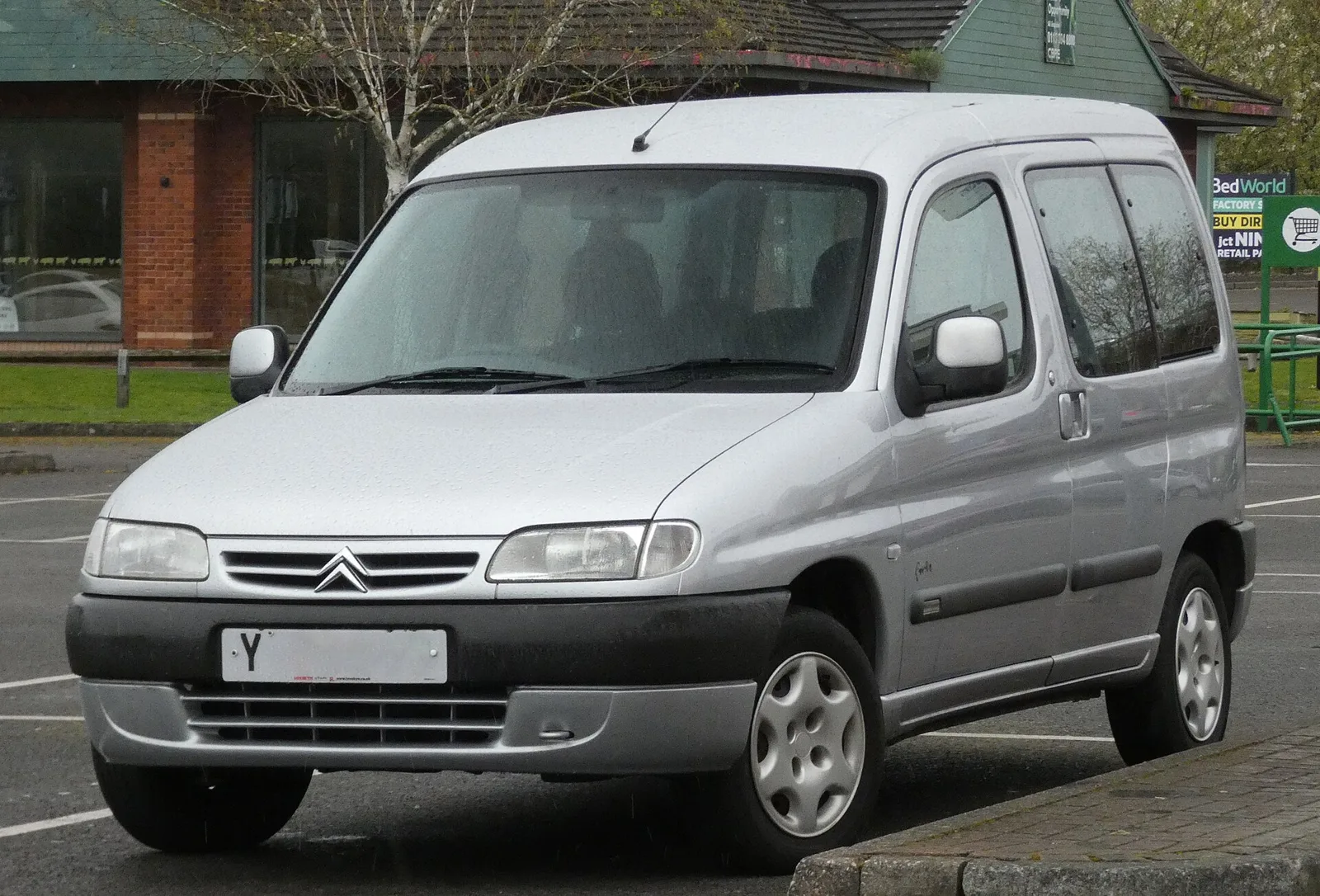
The Citroen Berlingo I was a light van and family car launched in 1996, sold alongside the Peugeot Partner I. Its ludospace body carried five people or a load, and it was built in Europe until 2013 and in Argentina until 2026. Sliding doors, the Ushuaia adventure version and an electric model marked its later years.
The Citroen Berlingo I and its Peugeot Partner I twin were built from 1996 to 2026, and together they turned a clever idea into a segment. Both shared one body that worked as a light van or as a five-seat family car. European production stopped in 2013, but the model carried on in Argentina until spring 2026.
Where did the Berlingo come from?
PSA wanted to replace vans whose design dated back to the late 1970s, and it chose a new idea: the ludospace, a light commercial vehicle that could carry a family as well. The Berlingo and Partner arrived in 1996 on a platform based on the Citroen ZX, with front ends that echoed the Saxo and the 106. They replaced the C15, a derivative of the 1978 Visa, and the Peugeot 205 F, which dated from 1982.
The one-box body was the key. The rear section was not grafted onto a saloon front, so the whole vehicle formed a single monovolume shape. Buyers gained generous interior space for a sensible price, while the maker got more out of its factories by selling more of the same model.
One body, two roles, and a model built for three decades, in Europe and then Argentina.
How did the ludospace take off in 1996?
The Berlingo Van reached the public in summer 1996, and it was shown with the five-seat family version at the Paris Motor Show that October. The family models had a painted bumper on some trims, better interior materials and paint choices, and a tailgate with the option of hinged doors. A 1.8 litre petrol engine was available as well.
The ludospace segment never stayed exclusive to Citroen for long. Rivals quickly saw the appeal, and PSA had to respond. Three Citroen concepts were shown alongside the family car, including the Berline Bulle.
Why did Renault's Kangoo force a sliding door?
Renault's Kangoo arrived with a sliding rear side door, a feature Citroen had left out at launch. The Kangoo sold well, so PSA needed an answer. Engineers had to add a sliding door without changing the vehicle's profile, because the front door was kept wide enough for a disabled passenger. The door appeared in spring 1999, placed on the right-hand side for safety reasons.
Renault then fitted a second sliding door to its Kangoo, on the left. Citroen followed with its own second door, first as an option and later as standard on the Multispace trim.
Which engines powered the Berlingo I?
Early in 2000 the range gained a 2.0 HDi of 90 PS (66 kW; 89 hp), sitting beside the 1.9 diesel of 71 PS (52 kW; 70 hp). On petrol, a 16-valve 1.6 TU engine of 110 PS (81 kW; 108 hp) arrived from the Xsara as the more powerful option above the 1.4i 75, replacing a short-lived 90 PS XU unit.
The following year the 1.9 diesel was adapted to new European emissions standards. Its XUD9 became a DW8, with capacity moving from 1,905 cc (116.3 cu in) to 1,868 cc (114.0 cu in), yet the model kept the 1.9 D badge. Because the DW was a very close evolution of the original XUD, its character changed little.
What changed during the 2002 facelift?
The phase 2 update in November 2002 brought a new front with large headlamps overhanging the bonnet, plus a revised dashboard. The body colour that once spread across the dashboard and seat belts was dropped. Standard ABS and airbags reached the Multispace, while the front crash zone was reinforced.
The rear end barely changed, apart from plastic monograms that gave way to chrome ones. The update also brought multiplexed wiring. Later, in 2006, the older 2.0 HDi and 1.9 diesel engines were dropped to meet Euro 4 rules, and the 1.6 HDi took their place.
What was the Berlingo like to live with?
The five-seat versions were roomy, and the load area could be enlarged easily. With the rear bench folded, the cargo volume reached 3 m3, and rear headroom remained at about 98 cm, while a traditional saloon offered no more than 80 cm. The vehicles used the same dashboard and trim as the commercial versions.
From 2000 the Modutop option, developed with a specialist partner, added 100 litres of storage in a thermoformed plastic cell above the living space. It came with portholes above each seat, a CD holder, individual pockets at the front and a folding trolley called the Modubox. Versions with a fabric sunroof, which recalled the 2CV, lasted until the 2002 facelift.
Which Berlingo variants should buyers know?
The Peugeot Partner Ushuaia, built from 2001 to 2008, was the adventure version. It measured 4.14 m (13.6 ft) long, 1.72 m (5.6 ft) wide and 1.87 m (6.1 ft) high, and its wheels were of larger diameter, with a raised ground clearance and underbody protection. Its name changed to Ushuaia Grand Raid in 2003.
Other markets sold the same vehicle as Patagonica, Escapade, VTC or Indiana. The Ushuaia also had a reinforced front bumper, wheel-arch extensions and protective grilles over the lamps. Its signature appeared on the dashboard, the floor mats and the front wings.
What did the Berlingo X-TR add?
The Berlingo X-TR appeared in October 2003 to give the range an all-terrain flavour. Its kit included a limited-slip diff, a little more ground clearance, 15-inch wheels with hubcaps borrowed from the C3 Pluriel, and a silver guard low on the nose.
The X-TR remained a front-wheel-drive vehicle. Genuine four-wheel drive came from Dangel on request, and the Berlingo Dangel was a true 4x4 with a transfer case, differential lock and sump guard.
Which trims made up the family range?
The phase 2 range brought six trim levels. The base Premiere finition came with a driver's airbag, ABS and a right-hand sliding door, and it was followed by Bivouac, Tonic, Multispace, Multispace Pack and the top Collection.
Options grew with each step. The Pack Plus added electric front windows and central locking with a remote, while the tailgate and a second sliding door were available on the base trim. The Collection took every option except the wheels, and air conditioning moved between standard and optional depending on the trim.
How did the Berlingo First come about?
In 2008, after new models arrived, the family versions were dropped. The commercial Berlingo I was cut to a single trim level and renamed the Berlingo First, as the single trim.
The Berlingo First came with a maintenance-free battery, a steering wheel adjustable for height, mirrors set from within the cabin, intermittent wipers, hinged glass rear doors and a right-hand sliding door. Optional extras included metallic paint, fog lamps, air conditioning and a CD radio.
What safety kit came with the Berlingo?
The Berlingo First carried ABS with REF, an airbag and a laminated windscreen as standard. The Multispace trim, the heart of the range, brought side airbags, fog lamps and trays fitted behind the front seats.
The base trim had a driver's airbag, and the Bivouac trim added one for the passenger.
What was the electric Berlingo like?
An electric version appeared in 1998 as the successor to the C15 Electrique. It was offered in commercial form. Top speed reached 95 km/h (59 mph), and one charge gave a range of 95 km on the CEN cycle. Nine hours were needed to recharge its 27 batteries, which were housed under the bonnet and the floor.
An LPG version, based on the 1.4-litre petrol engine, was also offered. From 2010 a further electric Berlingo was sold, with much of the production ordered by the French postal service. The vehicles were assembled at a plant in Solesmes, in the Sarthe, until 2013.
Which chassis and suspension did the Berlingo use?
The chassis came from the ZX and was improved in 2002 to meet safety standards, earning four stars in the Euro NCAP crash test. Its front axle gave precise steering and respectable road manners for a vehicle taller than it was wide.
The rear suspension came from the Peugeot 405 estate and was designed to resist sagging under load, which kept the squat that C15 owners knew well to a minimum. Maximum payload for the commercial versions was 600 or 800 kg, and the weight distribution made the van feel better loaded than empty.
Did diesel dominate Berlingo sales?
Diesel engines accounted for more than 85% of Berlingo sales. In 2005 the 1.6 HDi replaced the 2.0 HDi in its 90 PS form and the naturally aspirated 1.9 diesel in a more modest 75 PS form. Both older engines were removed in 2006.
The 75 PS version of the 1.6 HDi, at 55 kW (74 hp), was exclusive to the Berlingo.
How did Argentina keep the Berlingo going?
Argentine production ran from 1998 to 2026, in three phases. Most cars were sold locally, and the rest went to other Mercosur markets. Brazil's sales stopped, returned in 2018 and ended again at the close of 2020, while Uruguay sold this older version beside newer imported generations.
A June 2021 update gave the civil Multispace more locally made parts, including the double-hinged rear opening that the commercial version used. A January 2023 facelift added a rounder Citroen logo and a new grille, and the commercial Partner received a similar treatment.
When did production end for good?
Civil versions stopped selling in 2025, while the commercial vehicles continued for a while. The same year, exports beyond Argentina ended as Uruguayan sales of this generation stopped. Manufacturing finally ceased in spring 2026, after Argentina eased its rules on imported vehicles.
The third generation, imported from Europe, replaced the first-generation Berlingo and Partner directly. The Peugeot Partner Rapid, made in Brazil, started shipping to Argentina too, giving buyers a cheaper option.
How did the 1997 Master Rally raid involve the Berlingo?
PSA believed the Berlingo could become a new landmark for Citroen. As with the 2CV and AX, a raid was seen as the way to prove it. The Master Rally, running from Paris to Moscow via Samarkand, was to be one of the last appearances of the ZX Rallye-Raid.
Competitors did not use their own cars. Citroen supplied 150 red 1.9 D Berlingos, and after the event they were resold as used vehicles. The idea of a raid through the former USSR had long appealed to Citroen, since the Croisiere Jaune, first meant to cross the USSR, was barred from doing so when the country banned access.
The cars set off from the Chateau de Vincennes on 22 August 1997. They reached Venice on 24 August, Turkmenbashi on 26 August and Samarkand on 30 August, then arrived in Moscow on 7 September. The finish celebrated Ari Vatanen's victory in the Master Rally, and it remains the last raid Citroen has organised.
Key figures at a glance
| Feature | Detail |
|---|---|
| Production in Europe | 1996 to 2013 |
| Europe phases | 1996-2002, 2002-2006, 2006-2013 |
| Production in Argentina | 1998 to 2026 |
| Argentina phases | 1998-2010, 2010-2023, 2023-2026 |
| Electric top speed | 95 km/h (59 mph) |
| Electric range | 95 km on the CEN cycle |
| Partner Ushuaia length | 4.14 m (13.6 ft) |
| Modutop capacity | 100 litres |