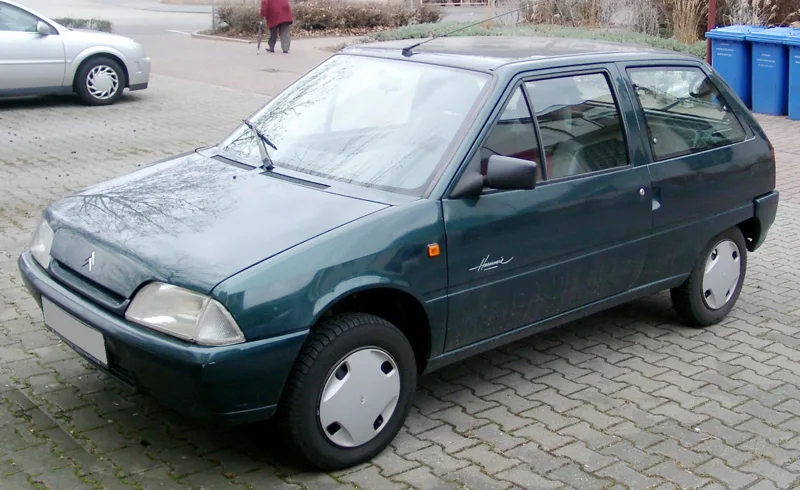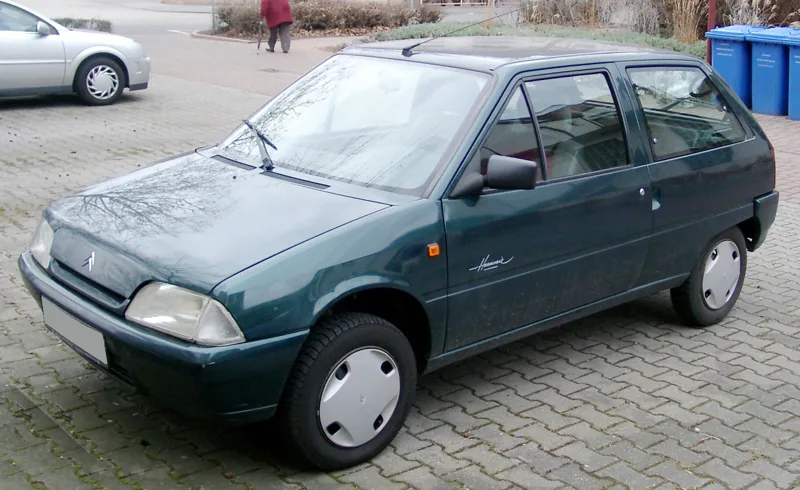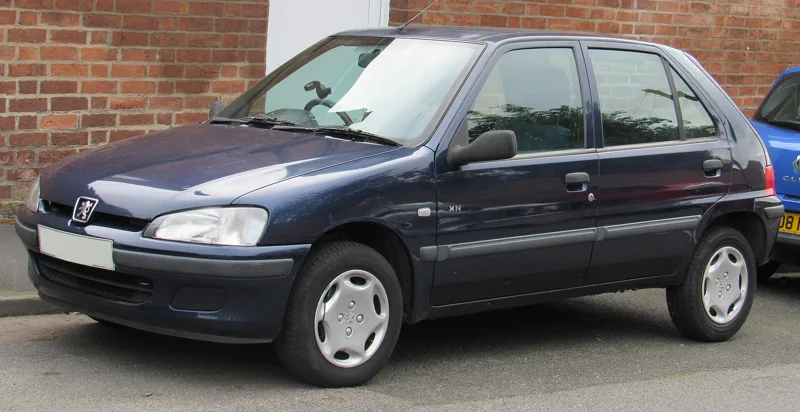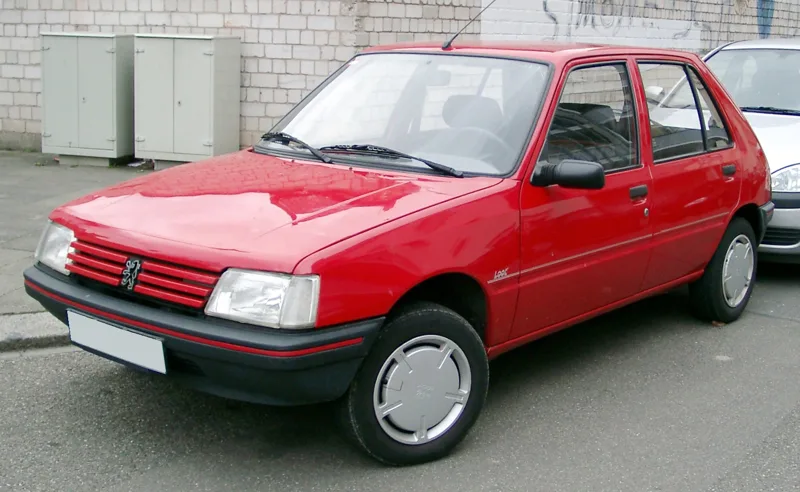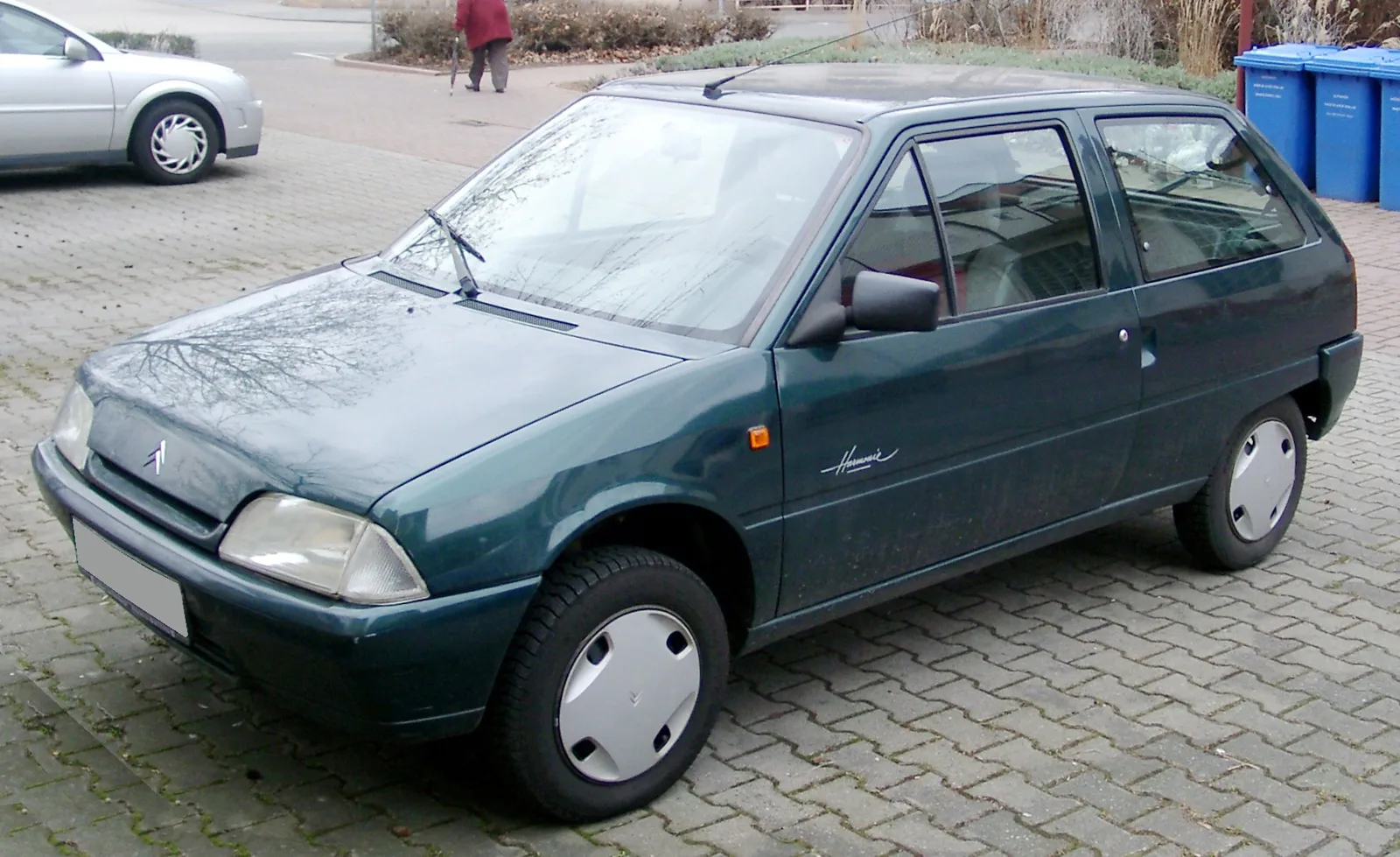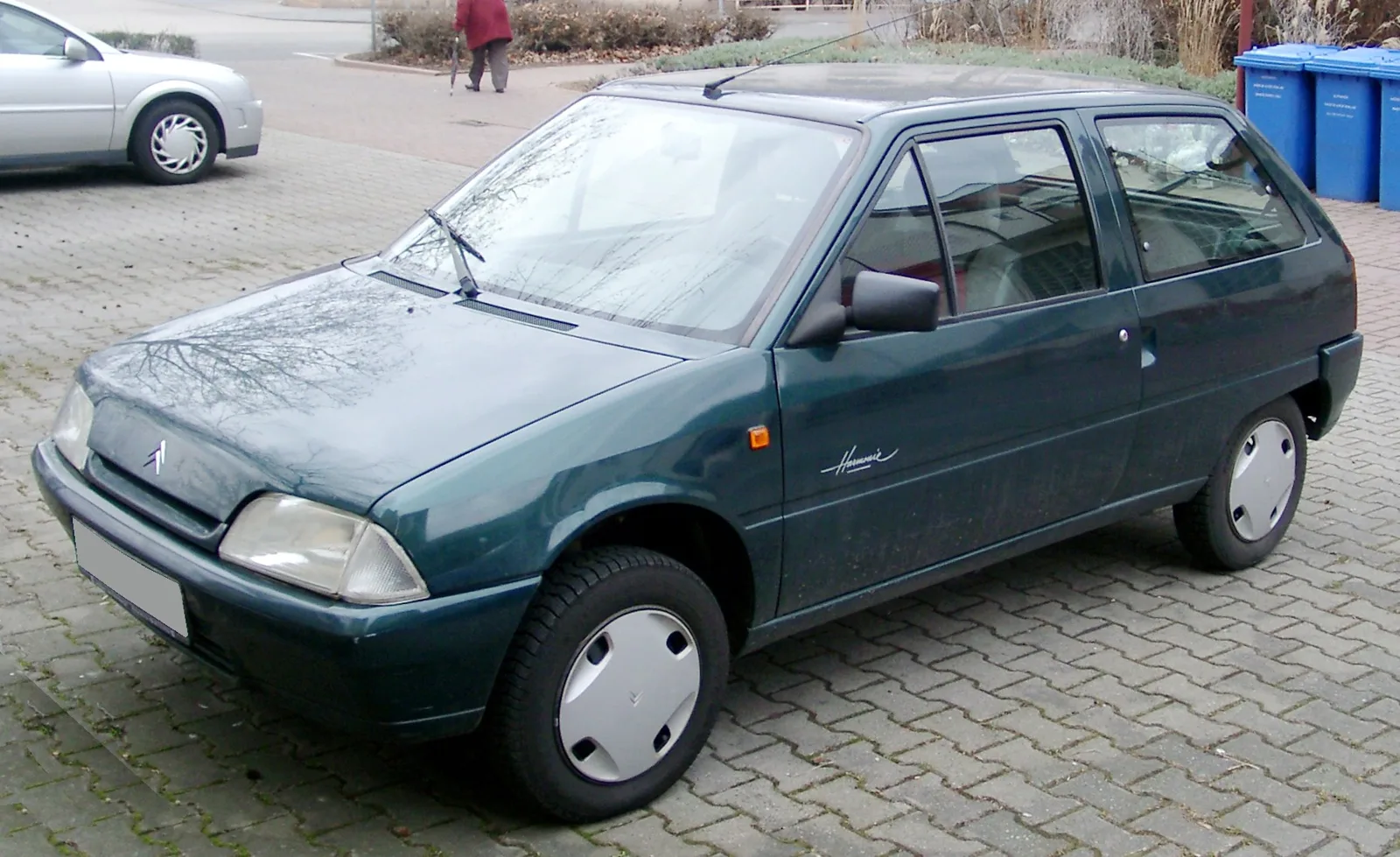
A lightweight Citroen supermini from 1986 set against the Peugeot 106 that was developed from its platform: design, engines, sporting versions, electric variants and the buyer each suited.
The Citroen AX and Peugeot 106 were superminis that shared a platform and a lightweight design approach. The AX was launched in 1986 and built until 1998, with 2,561,432 made. The 106 was launched in 1991 as an entry-level Peugeot and developed from the AX platform.
The Citroen AX and the Peugeot 106 were two superminis that shared a platform and a design philosophy. The AX was launched by Citroen in 1986 as a light, economical hatchback, and it was built until 1998. The 106 appeared in 1991 as Peugeot's entry-level car, and it was developed from the AX platform.
This comparison covers why the two were close rivals, how each came about, the weight and design choices behind them, their engines and sporting versions, their electric variants and which buyer each car suited on the facts available.
Why were the Citroen AX and Peugeot 106 rivals?
They were rivals because they were sold in the same supermini market, and because they came from the same platform family. The 106 grew out of the AX platform, so the two cars were closely related rather than simple competitors from different engineering traditions.
The 106 was also aimed directly at the Renault Clio, which had gone into production a year earlier. That placed it against a new benchmark rather than against its own sibling, and the AX's later years saw Peugeot's car take on more of the market that the AX had served.
The two carmakers were part of the same wider group. The Peugeot 106 was positioned as the entry-level Peugeot beneath the 205, while the AX was the entry-level Citroen. Their shared origins meant each maker was filling a similar role in its own range.
One lightweight Citroen built for economy; one Peugeot built on its platform and tuned for rally pedigree.
How did the two cars come about?
Development of the AX began in 1983. It was first intended to form the basis of a Talbot sister model to replace the Samba, but the falling popularity of the Talbot brand and the success of the Peugeot 205 led Peugeot to axe that plan. The AX was launched at the 1986 Paris Motor Show to replace the Visa and the LNA.
The AX went on sale in left-hand drive markets from 2 October 1986, first as a three-door hatchback. A five-door version followed in 1987, and right-hand drive models for the UK arrived in August 1987. With the 2CV's final demise in 1990, the AX became the smallest model in the Citroen range.
The 106 was launched in September 1991 as a three-door hatchback in continental Europe, and it reached the UK two months later. A five-door derivative followed in August 1992, and production ended in July 2003. Its body was built on the AX foundations, which gave the two cars a common base.
The AX had a memorable marketing campaign filmed in China, starring the actress Janet Mas and an elderly gentleman known as Mr. Wong. The 106 had no comparable campaign in the material available, so the two makers marketed their cars in very different ways.
How did the two cars differ in weight and design?
The AX was designed for lightness and economy. Its drag coefficient was 0.31, and its basic version weighed 640 kg (1,411 lb). Plastic panels in non-load-bearing areas and thin steel where loads allowed helped keep the weight down, and the engineers also worked to reduce engine friction.
The AX also had fully independent suspension with unusually long wheel travel. Optional self-coloured plastic bumpers came from the Eco 2000 project, and the production car was far more conventional than the original one-box prototype, which had reacted poorly in focus groups.
The 106 used MacPherson struts at the front and compact transverse torsion bars at the rear, as did the AX and the 205. Its trims ranged from the basic XN and mid-range XR to the top XT and sporty XSi, and many UK cars were special editions with names such as Graduate, Inca, Aztec and Independence.
The 106's right-hand drive models had limits that the AX also shared. Power steering was not available on Phase I right-hand drive cars, and air conditioning was never an option on right-hand drive 106s, because of the space taken up by the blower motor and the wiper motor.
What engines did the two cars use?
The AX launched with 1.0, 1.1 and 1.4-litre TU-series belt-driven overhead cam engines. A 1.4-litre diesel arrived in 1988, and it was replaced by a 1.5-litre in September 1994. The early 1.0 and 1.1 cars had carburettors that were replaced by fuel injection after the emissions rules tightened.
The 106 started with 1.0, 1.1 and 1.4 petrol engines, with a 1.4-litre diesel added in August 1992. Late in 1994 the diesel was replaced by a 1.5-litre with more torque. The 1.0 and early 1.1 cars also had carburettors at first, and those were later replaced by fuel injection.
In 1989 a naturally aspirated diesel AX, with a 1,360 cc all-aluminium engine, returned 2.7 litres per 100 kilometres, which allowed a journey of over 1,000 miles on 10 imperial gallons and earned a place in the Guinness Book of Records as the most economical production car.
The AX also had a four-wheel drive variant, the AX 4x4, which was sold only with five doors and not in the UK. A separate AX Pistes Rouges 4WD, built between 1992 and 1994 with a French Dangel system, was a rarer model.
Which car had the stronger sporting versions?
The AX's first performance version was the AX Sport of 1987, with a 1.3-litre engine, twin carburettors and 95 PS (70 kW; 94 bhp). It wore white steel wheels, much like the Peugeot 205 Rallye. Later models included the AX 14 GT, with 85 PS (63 kW; 84 bhp), and the 1992 GTi with 100 PS (74 kW; 99 bhp).
The 106's most famous sporting model was the Rallye, which was built as a homologation special for the 1300 cc rally class. It weighed 825 kg (1,819 lb) and had steel wheels, with power steering, central locking and electric windows omitted to save weight. The S1 used a 1.3-litre engine of 100 PS (74 kW), and the later S2 used a 1.6-litre with 103 PS (76 kW).
The 106 also gained a 1.6-litre GTI with 120 hp after its facelift, and it raced in the Nurburgring 24 Hours each year from 1993 to 2003. Its best result was 11th at Spa in 1998, and Olympic decathlete Daley Thompson won his class at Thruxton in 1993 in a Peugeot.
The AX's sporting record is more modest in the material available. The material gives no race record for the AX comparable with the 106's Nurburgring and Spa results.
How did the electric versions compare?
Citroen worked with Heuliez to build an electric AX, and 374 examples of the AX Electrique were produced between December 1993 and 1996. It used 20 nickel-cadmium batteries, a 20 kW motor with a nominal 11 kW output, and an estimated range of around 75 km (47 mi). It sold for 80,000 French Francs when new.
Peugeot's 106 Electrique followed in 1995, also built with Heuliez and using nickel-cadmium batteries. It had a top speed of 56 mph (90 km/h) and an official range of 100 km (62 mi). Peugeot had expected to sell 15,000 to 20,000 a year, but only 6,400 were sold between 1995 and 2003, most of them to the French Administration.
Both electric cars were small, niche products for administrations and specialist buyers. Their modest range figures show how limited early electric cars were, and neither became a mass-market product.
Which car sold more?
The AX sold 2,561,432 cars in total, and its production at Vigo in Spain ended in May 1997 after 812,000 units had been built there. Production ended in December 1998, after a 12-year run, when the Saxo took over its role.
The 106's total is not given in the material available, so the two sales records cannot be compared directly. The 106 was built from 1991 to 2003, which is a longer production window than the AX's, though the figure for its volume is missing.
The AX also appeared in other forms, including the Proton Tiara built in Malaysia between 1996 and 2000. That wider reach shows how the platform was used beyond its home markets.
Which buyer suits each car?
On the facts given, the AX suits a buyer who wants a light, economical Citroen supermini with independent suspension, long wheel travel and a rare record of economy. The 106 suits a buyer who wants a Peugeot supermini with a sharp sporting option, a Rallye with real rally pedigree and a longer production window.
A buyer who values economy and comfort would look at the AX. Its weight, its drag figure and its diesel record made it a credible choice for long-distance and low running costs, and its five-door and 4x4 options widened its appeal.
A buyer who wants a sharper driving experience would look at the 106. The Rallye and the GTI gave it an identity that the AX's sporting versions did not match in the material available, and the car's motorsport record adds to that story.
Neither car is shown to be better across the board. The AX has the better economy record and the more distinctive suspension, while the 106 has the stronger sporting identity and the longer production run. The better choice depends on whether the buyer values economy or sporting character.
Specifications at a glance
| Feature | Citroen AX | Peugeot 106 |
|---|---|---|
| Launch | 2 October 1986, left-hand drive; UK August 1987 | September 1991; UK two months later |
| Production ended | December 1998 | July 2003 |
| Cars built | 2,561,432 | No figure given |
| Body | Three-door, later five-door; five-door 4x4 variant | Three-door, later five-door |
| Drag coefficient | 0.31 | No figure given |
| Basic weight | 640 kg (1,411 lb) | Rallye 825 kg (1,819 lb) |
| Engines | 1.0, 1.1, 1.4 TU; 1.4 and 1.5 diesel | 1.0, 1.1, 1.4 petrol; 1.4 and 1.5 diesel |
| Sporting version | AX Sport 95 PS (70 kW; 94 bhp); GTi 100 PS (74 kW) | Rallye S2 1.6 L 103 PS (76 kW); GTI 120 hp |
| Electric version | AX Electrique, 374 built, about 75 km range | 106 Electrique, 6,400 sold, 100 km range |
| Motorsport | No figure given | Nurburgring 24 Hours 1993 to 2003; Spa best 11th |