A compact family car with a Bauhaus-inspired look, a Trnava-built platform shared with the Peugeot 207, and a recall history that ran through its UK life.
Citroen's compact five-seat family car was built in Slovakia from 2008 to 2017. Buyers chose from petrol and diesel engines, a 2012 facelift and several special editions, and the car was later succeeded by the C3 Aircross SUV as the range moved toward SUVs.
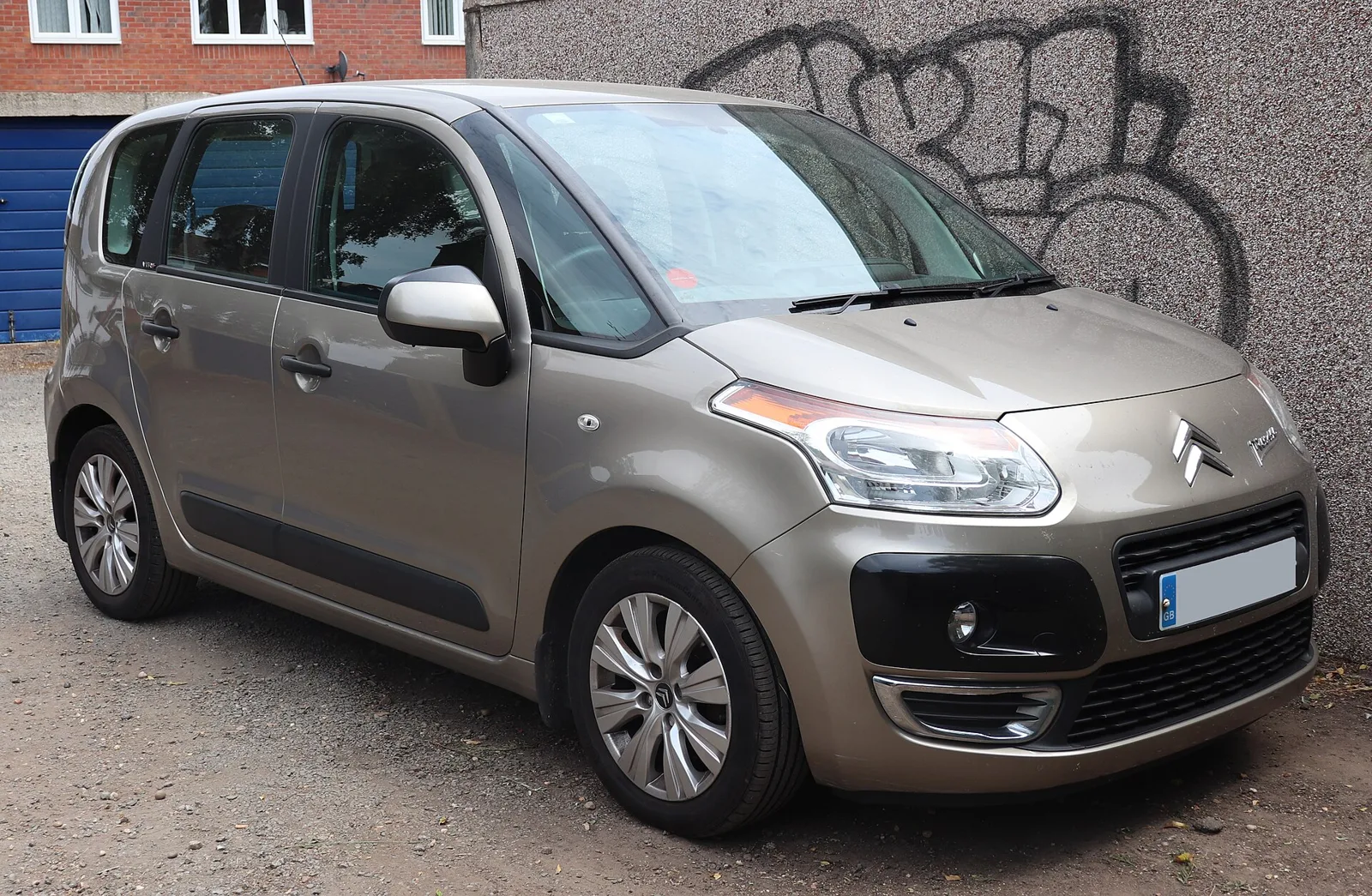
The Citroen C3 Picasso was a five-door mini MPV that the French maker built from 2008 to 2017. It was the mini MPV version of the Citroen C3, the successor to the Xsara Picasso, and its production was concentrated at a single plant in Slovakia. Buyers got five seats, a flexible boot and a distinctive wraparound windscreen.
This guide covers the car's origins and Slovak production, the trims and prices in Spain and the UK, the engine line-up and gearbox changes, the Euro NCAP result, the recall history, the reviews, the limited editions, the 2012 facelift, the advertising, and the successor. A specification table and frequently asked questions close the piece.
Where did the Citroen C3 Picasso come from?
The C3 Picasso was first shown as a concept named Drooneel at the 2008 Paris Motor Show, and it was unveiled to the world as a production car at the same show. It was aimed at rivals such as the Opel Meriva, Nissan Note, Renault Modus and Ford Fusion, and it succeeded the Citroen Xsara Picasso in the company's range.
The global car rode on a platform derived from the Peugeot 207 SW, so it had a wheelbase comparable to that car. Citroen also sold a Brazilian derivative, the C3 Aircross, which was a more SUV-styled car. Its successor sold in Latin America from 2010 to 2020, and a more urban Brazilian C3 Picasso was built from 2011 to 2015.
A Slovak-built mini MPV with a Bauhaus-inspired look, a flexible five-seat cabin and a UK recall history.
Where was the C3 Picasso built?
The C3 Picasso was assembled from December 2007 at the PSA Trnava Plant in Slovakia. In July 2008 the company announced that Trnava would be the sole manufacturing site for the model, and the plant was expected to build 28 cars per hour at the time.
Citroen presented the finished car to the Slovak press and public on 25 September 2008, before the world unveiling at the Paris show in October. The car reached French showrooms in February 2009 at 14,950 euros, and other European markets followed in March 2009.
The same plant also built the Peugeot 207, so the two cars shared production as well as a platform. The parent company PSA Peugeot Citroen pooled manufacturing and engineering across brands, and sometimes rebadged vehicles to make shared products more efficient.
What trims and prices did the C3 Picasso offer?
In Spain the car launched in 2009 with three trims: LX, SX and Exclusive. The LX was the most basic and least expensive, with a 71 kW; 96 PS (95 bhp) VTi engine at 12,590 euros. The Exclusive topped the range with an 82 kW; 110 PS (110 bhp) HDi Airdream diesel at 18,650 euros.
The UK launch on 9 April 2009 started at 11,495 pounds sterling for the 1.4-litre VTi, the most basic model. The most expensive UK car was the Exclusive with a 1.6-litre HDi diesel, priced at 15,595 pounds. Official fuel figures for those cars ranged from 6.4 L/100 km (37 mpg-US; 44 mpg-imp) to 4.6 L/100 km (52 mpg-US; 62 mpg-imp).
The Exclusive was consistently the most expensive trim in each market, and it had the widest choice of engines and features. It was the only model with roof rails and a folding front passenger seat, which opened up the storage space across the whole cabin apart from the driver seat. Extras included tinted windows, rear parking sensors, automatic wipers, a leather and chrome interior, a pollen filter and dual-zone climate control.
What engines did the C3 Picasso use?
The C3 Picasso used petrol and diesel engines, including the 1.4-litre and 1.6-litre VTi petrols and 1.6-litre HDi diesels. On the 1.6-litre VTi the Exclusive and VTR+ reached 0-97 km/h (0-60 mph) in 10.6 seconds. Their top speed was 188 km/h (117 mph), and output stood at 89 kW; 122 PS (120 bhp).
The petrol engines were developed by PSA Peugeot Citroen and BMW, and the range also included a 1.6-litre diesel and two 1.6-litre HDi Airdream units. Early cars came with a five-speed manual gearbox, and that remained the case until 2011.
How did the gearbox and efficiency change after 2011?
From 2011 the range gained a six-speed manual and an automated EGS6 manual gearbox, along with an eco start-stop system and regenerative braking on some models, mainly in Germany. The Airdream engine became more efficient, and the car also received low-rolling-resistance tyres across the range.
Citroen said those changes lowered CO2 emissions, and the California Energy Commission estimated that such tyres could save 1.5 to 4.5% of fuel in a typical car. The EGS6 automatic was not offered in the UK at first because of the exchange rate and costs, but a small number were privately imported for insurance classification, and it then became an option on the 1.6-litre VTi.
Starting with June 2015 production, the older petrols were replaced by a 1.2-litre Pure Tech 110, a three-cylinder unit making 82 kW (110 hp) with a five-speed manual, and rated at 115 g/km of CO2. A 73 kW (98 hp) BlueHDi 100 diesel with a five-speed manual replaced the earlier diesels, and the EGS6 automatic was dropped.
How safe was the C3 Picasso?
The Euro NCAP programme tested a Confort model with 90 bhp (67 kW; 91 PS), equipped with a speed limitation device but no electronic stability control. The car scored four of five stars, which was fewer than most rivals released around the same time.
The front-end results were mixed. The bumper scored all available points, but the car lost marks for a poor level of protection for pedestrians struck by the bonnet. Adult and child protection inside the cabin scored highly, although the forward-facing child restraints were penalised, as an infant hit by an airbag can be seriously hurt.
Whiplash protection was the weakest area. The driver seat scored nothing in two of the three tests, and then lost points for the position of its unadjusted head restraint. Standard kit covered ABS, EBD, child locks, central locking and two front airbags, and electronic stability control became standard across the range later on.
Which recalls affected the C3 Picasso in the UK?
The UK recall record included several campaigns. On 20 June 2010, 611 cars built between January and March 2010 were recalled over incorrectly routed fuel pipes that could chafe against the heat shield. On 24 August 2010 the 13,234 Picassos sold in the UK were called back over windscreen trim that could deteriorate and detach.
In May 2011 all 24,091 UK cars were recalled for a safety modification after an investigation by the BBC consumer programme Watchdog. The brake pedal had been moved to the right for right-hand drive, but it was still linked to a mechanism on the passenger side, so a passenger could operate the brakes. Watchdog later found the same problem in other Citroen models and in some Renault and Peugeot cars.
On 2 September 2011, 8,815 cars built between January and May 2011 for the UK were recalled because the battery cable was too short and could lead to gearbox failures and engine stalls. The faulty earth return cable was replaced, and the model kept selling well in the UK.
How did reviewers rate the C3 Picasso?
Reviewers praised the ergonomics, the Bauhaus-inspired styling, ease of use and the amount of space. The interior drew criticism for feeling cheap, and the petrol engines were called sluggish, while the diesels were judged smoother and better at carrying the car's weight. The turning circle was described as tight, and visibility was good enough that one reviewer compared the cabin to a greenhouse.
The dashboard used three monitors. CNET found the speed gauge clear and close to the driver's line of sight, but it described the other two screens as unreadable and potentially dangerous to use on the move. Some critics also complained about wind noise at speed, and a screenwash bottle that could freeze in cold weather and blow a fuse.
What awards did the C3 Picasso win?
Top Gear magazine named the C3 Picasso Family Car of the Year in 2008, before it was on sale in the UK. The magazine's editorial director later admitted the choice was a gamble, because the model did not arrive in the UK until the following year.
When the car launched in 2009 it picked up further honours, including Best MPV at the What Car? awards, Scottish MPV of the Year, the Best Supermini MPV title from Auto Express and the Design of the Year prize at the Fleet World Honours.
The car was nominated for European Car of the Year in 2010 but finished seventh, with the lowest overall score of any candidate. A JD Power survey in 2011 ranked it top among MPVs, scoring 83.1% for satisfaction and giving five stars overall, although its exterior quality earned only three stars.
What limited editions were made?
The 90th Anniversary edition arrived in August 2009, marking 90 years of Citroen. It was the UK's third limited-edition model, sold at the Exclusive price with a MyWay satnav, leather upholstery and a commemorative badge. It came with 1,000 pounds of extras and was limited to 150 cars in the UK.
Blackcherry followed in November 2010, based on the VTR+ with the 1.6-litre HDi diesel. It was replaced in January 2012 by Code Red and Code White, which kept the same engine but had obsidian black bumpers and 17-inch alloy wheels. Other trims included the Rossignol collections, the French Millennium range and the Passion Bleus edition for the 2012 European Football Championship.
The Music Touch trim arrived in France in January 2013, created with Samsung and Universal Music Group. It came with a free white Samsung Galaxy Tab with 16 GB of storage, plus chrome trims, mirror covers and white pearlescent paint.
What did the 2012 facelift change?
The facelift debuted at the 2012 Paris Motor Show on 27 September 2012, and it reached Spain in November 2012 and the UK in December 2012. The Spanish launch had four trims, from the Attraction at 12,250 euros with a 95 bhp (71 kW; 96 PS) VTi to the Exclusive at 18,475 euros with a 115 bhp (86 kW; 117 PS) HDi.
The updated car brought the eMyWay satnav with a reversing camera option, LED daytime running lamps, fog lamps with cornering lights, two new paint colours in pearlescent white and ink blue, and the new Citroen badge on the grille.
What did the C3 Picasso advertising show?
The DOG advert was made by the French agency H Suresnes and released in June 2010. It showed a dog built from household items such as a purse, goggles, a hairdryer and shoes, which was invited into the boot by a family leaving for a holiday, with room for everyone inside.
The Ghostbusters Reloaded campaign, produced by Euro RSCG Paris, showed three futuristic ghost hunters in a C3 Picasso fighting a monster made of bicycles, suitcases and tyres. Once defeated, the monster broke apart and its parts fitted into the boot. The strapline read The Spacebox.
What replaced the C3 Picasso?
The C3 Aircross was launched in Brazil and Argentina in September 2010 as a mini SUV based on the C3 Picasso, with raised suspension, chrome roof bars and a rear-mounted spare tyre. The Geneva Motor Show in March previewed a European successor, the C-Aircross Concept.
The production C3 Aircross launched in late 2017 and introduced the SUV designation to the Citroen range. Auto Express reported that the new car took its design cues from the concept and moved the family from MPV to SUV styling.
What are the Citroen C3 Picasso specifications?
| Specification | Detail |
|---|---|
| Body | Five-door mini MPV, five seats |
| Production | 2008 to 2017; 657,807 built at Trnava, Slovakia |
| Entry petrol (UK launch) | 1.4-litre VTi |
| 1.6-litre VTi | 89 kW; 122 PS (120 bhp) |
| 0-97 km/h (0-60 mph) | 10.6 seconds, 1.6-litre VTi Exclusive and VTR+ |
| Top speed | 188 km/h (117 mph), 1.6-litre VTi |
| Facelift diesel | HDi, 115 bhp (86 kW; 117 PS) |
| 2015 petrol | 1.2-litre Pure Tech 110, 82 kW (110 hp), CO2 115 g/km |
| 2015 diesel | BlueHDi 100, 73 kW (98 hp) |
| Transmission | Five-speed manual; six-speed manual and EGS6 automatic from 2011; EGS6 dropped after 2015 |
| Boot | 385 litres (13.6 cu ft) or 500 litres (18 cu ft); 1,506 litres (53.2 cu ft) with seats folded |
| Roof rack capacity | 60 kg (132 lb) |
| Service interval | Every two years or 32,000 km (20,000 miles) petrol; 20,000 km (12,000 mi) diesel |
| Euro NCAP | Four of five stars |