Seven engines, twin-scroll turbos, a folding-roof coupe-cabriolet and a model range trimmed in line with the brand's later strategy.
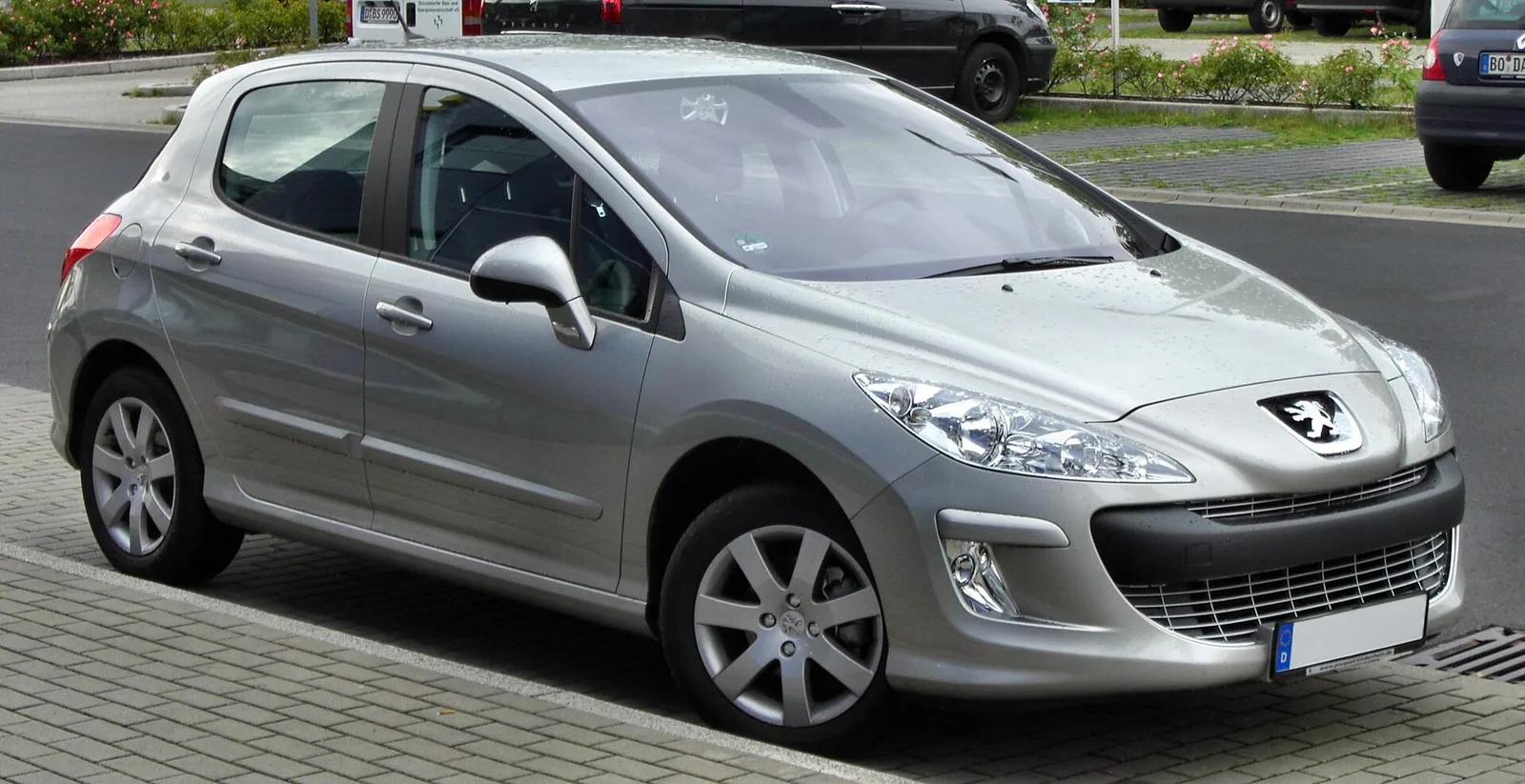
Built between 2007 and 2015, the Peugeot 308 I came as a five-door hatchback, an estate (SW) and a folding-roof coupe-cabriolet (CC). Its engine range ran from a 70 kW 1.4-litre petrol to a 128 kW turbo at launch, and production of the CC ended in March 2015.
The Peugeot 308 I was a compact-class car from Peugeot, built between 2007 and 2015. The same floor pan carried the Peugeot 3008, the Peugeot RCZ and the Citroen C4, and the line-up eventually included a folding-roof coupe-cabriolet called the 308 CC.
When did the Peugeot 308 reach the market?
The 308 was officially presented on 5 June 2007 in Barcelona, and marketing began on 20 September 2007. The estate version, the 308 SW, followed in May 2008 and could be ordered with a panoramic glass roof. The three-door hatchback stayed in the range until production was stopped in mid-2010.
The 1.6-litre THP 175 engine, producing 129 kW (175 PS), came with a radiator grille insert with straighter lines, a front apron with sportier elements.
In April 2010 the Peugeot 408 arrived. It is a saloon version of the 308, built in China and also offered in South America. Early in 2012 a 308 saloon was added to the same markets.
A compact Peugeot with a folding-roof coupe-cabriolet, five-star crash protection and a neck-heating system.
Which engines did the 308 offer?
The range had four petrol and three diesel engines. The petrol units were a 1.4-litre with 70 kW, a 1.6-litre with 88 kW, and two 1.6-litre turbos with 110 kW and 128 kW. The diesels were a 1.6 HDi with 66 kW and 80 kW, and a 2.0-litre with 100 kW.
At launch four of the seven engines were paired with a five-speed manual, while the two stronger diesels and the strongest petrol engine had six-speed gearboxes. The options were a four-speed automatic for the 1.6-litre petrols, a six-speed automatic with manual gate for the 2.0-litre diesel, and the electronically controlled six-speed manual ESG6 for the 80 kW diesel.
The twin-scroll turbochargers came from a specialist supplier, which was unusual for this class. They gave the turbo petrol engines from 103 kW upwards the pulling character normally associated with diesels.
What was the 308 CC?
The 308 CC was a four-seat coupe-cabriolet with an electro-hydraulically retractable metal roof, which opened and closed at the push of a button in 20 seconds. It was introduced in April 2009 and took its inspiration from the 308 RCZ concept.
Because of its construction the CC was longer and lower than the standard 308. It measured 4,440 mm (174.8 in) overall against 4,276 mm (168.3 in), and stood 1,426 mm (56.1 in) tall against 1,498 mm (59.0 in). Its kerb weight of 1,555 kg (3,428 lb) reflected extra stiffening and the more elaborate roof structure.
The boot held 226 litres with the roof open and 403 litres with it closed. The roof could be operated when stationary or while driving at up to 12 km/h, and the CC's tail carried a split matt-black diffuser and a spoiler.
How safe was the 308 CC?
The CC earned five stars in the Euro NCAP adult occupant test. When a rollover risk was detected, extendable bars rising behind the rear head restraints, together with reinforced windscreen pillars, formed a protective cell within milliseconds.
Each front seat carried a chest and pelvis side airbag. The CC also had a head side airbag, a feature described as unique to the 308 CC worldwide, so that all body areas were protected whatever the seating position.
All CC models came with ABS, electronic brake force distribution and an electronic stability programme as standard. The eCall system, sold as Peugeot Connect SOS, placed an emergency call automatically when the seatbelt pretensioners or airbags fired, sending the vehicle's location and connecting the driver by phone.
That service was available in ten European countries at the time, and the EU took up the subject in 2011. In April 2015 it entered EU legislation as a regulation.
What made the CC's interior special?
The CC had its own instrument dials, which were white rather than black and referred to the world of watchmaking. Its leather steering wheel had a flattened underside and a matt chrome ring, and the centre console was finished in black high-gloss lacquer.
The console held the folding-roof controls, simultaneous operation of all four window lifts, the Airwave settings and the menu for the satellite navigation system. Buyers who ordered navigation could also follow the roof's movement as a small animation on the display.
Airwave is the name Peugeot gave to a system that uses warm air from the front head restraints to heat the back of the head and the neck. This neck heating was otherwise found only in higher price segments. Combined with automatic air conditioning, heated front seats and a wind deflector, it made open-top driving far more comfortable.
Full leather equipment was available on request, extending from the seats to the dashboard and the door and rear trim, with a U-shaped covering on the console.
How did the CC's engines and gearboxes change?
The CC launched with a 1.6-litre petrol engine and a 2.0-litre HDi diesel. From July 2009 a revised 1.6 HDi with 82 kW and a 1.6-litre turbo with 110 kW arrived, and in May 2010 the 1.6 THP was revised to 115 kW.
Both diesels had six-speed manual gearboxes, and the 2.0-litre could take a six-speed automatic, as could the 110 kW turbo petrol. In October 2010 a 147 kW version of the 1.6-litre turbo followed, along with a 120 kW 2.0-litre diesel. Both of these later engines were also used in the Peugeot RCZ.
Engine versions and production dates
| Engine | Output | Production |
|---|---|---|
| 1.6 16V VTi | 88 kW (120 PS; 118 hp) | 03/2009 to 08/2013 |
| 1.6 16V THP | 110 kW (150 PS; 148 hp) | 07/2009 to 05/2010 |
| 1.6 16V THP | 115 kW (156 PS; 154 hp) | 05/2010 to 03/2015 |
| 1.6 16V THP | 147 kW (200 PS; 197 hp) | since 10/2010 |
| 1.6 16V HDi FAP | 82 kW (112 PS; 110 hp) | 07/2009 to 10/2015 |
| 2.0 16V HDi FAP | 103 kW (140 PS; 138 hp) | 03/2009 to 04/2011 |
| 2.0 16V HDi FAP, six-speed automatic | 120 kW (163 PS; 161 hp) | 10/2010 to 03/2015 |
What changed in the 2009 and 2011 updates?
The 2009 update came in March as a technical revision. It kept the design but brought the 2.0-litre HDi FAP to Euro 5 standard at 103 kW (140 PS). Fuel use dropped to 5.3 litres per 100 km (53.3 mpg-imp; 44.4 mpg-US), and CO2 output to 139 g per km.
The 308 SW HDi 110 with 80 kW (109 PS) dropped from 134 g to 130 g of CO2 per kilometre, thanks to low-rolling-resistance tyres. The 110 kW THP, with a new six-speed manual, used 7.0 litres per 100 km (40.4 mpg-imp; 33.6 mpg-US).
The 2011 facelift was shown at the Geneva Motor Show and went on sale from 7 May 2011. It added LED standing and daytime running lights and clear-glass headlamps, while the rear changed very little.
The 1.6 e-HDi, first seen in the Peugeot 508, joined the range in 2011 with a manual gearbox or the automated ESG. Paired with ESG and stop-start, it managed 3.7 litres per 100 km (76.3 mpg-imp; 63.6 mpg-US) with 98 g of CO2 per km.
How much did the 308 cost in late 2011?
In December 2011 the five-door started at 17,050 euros, the SW at 18,250 euros and the coupe-cabriolet at no less than 25,950 euros. A navigation system costing 950 euros had been added to the options list back in 2009. The prices were quoted about seven months after the facelift went on sale.
What came after the first 308?
The successor, which kept the 308 name, arrived in September 2013 as a fastback saloon, offered only with five doors, and the SW estate followed in May 2014. The CC was discontinued in March 2015 as the last model of the first 308 generation.
No successor to the CC was planned at first, because the brand strategy called for a smaller model range.