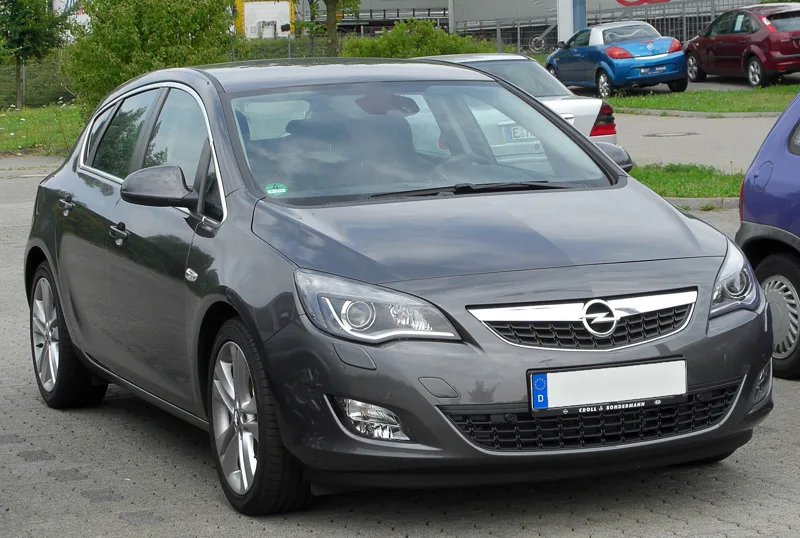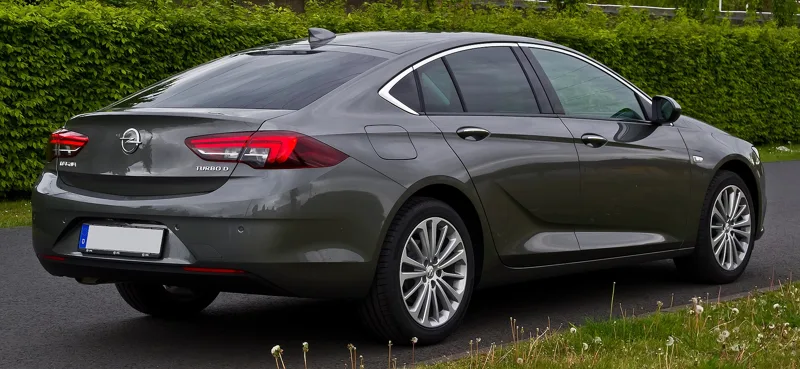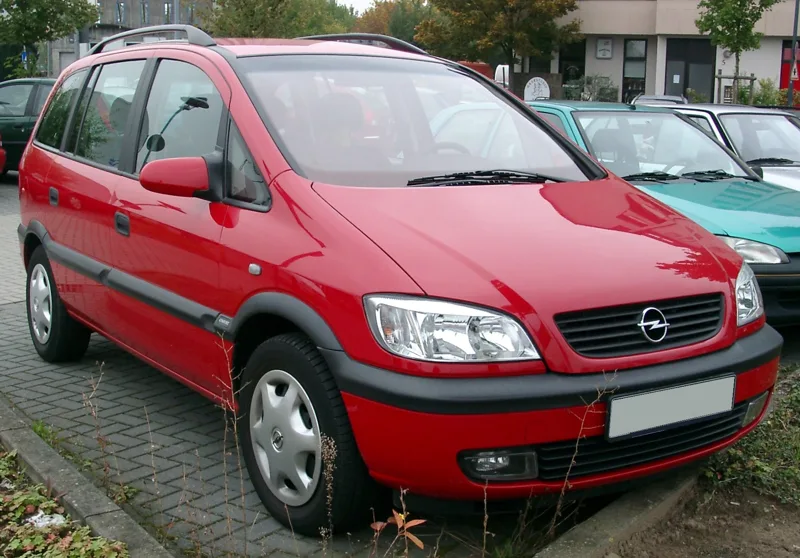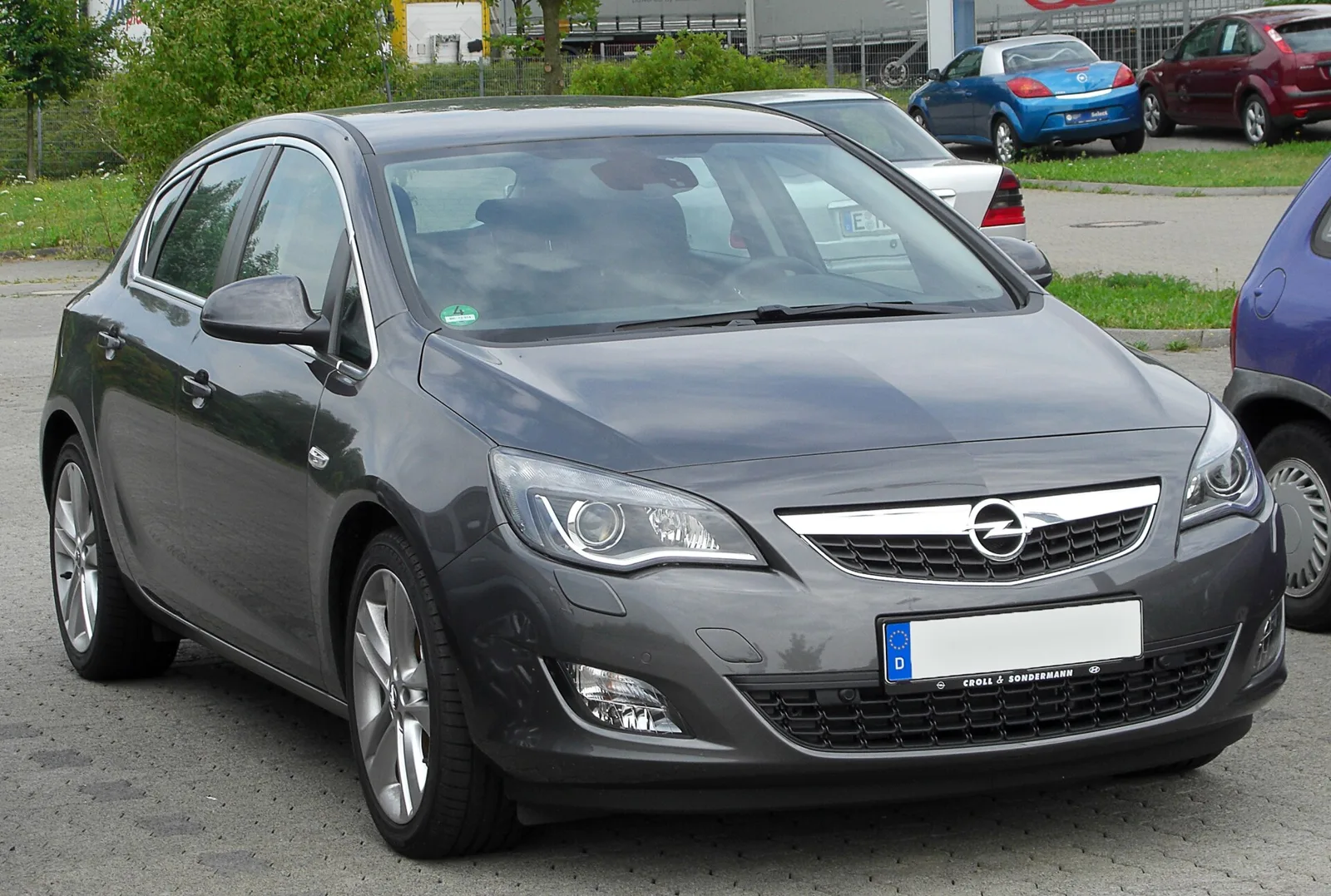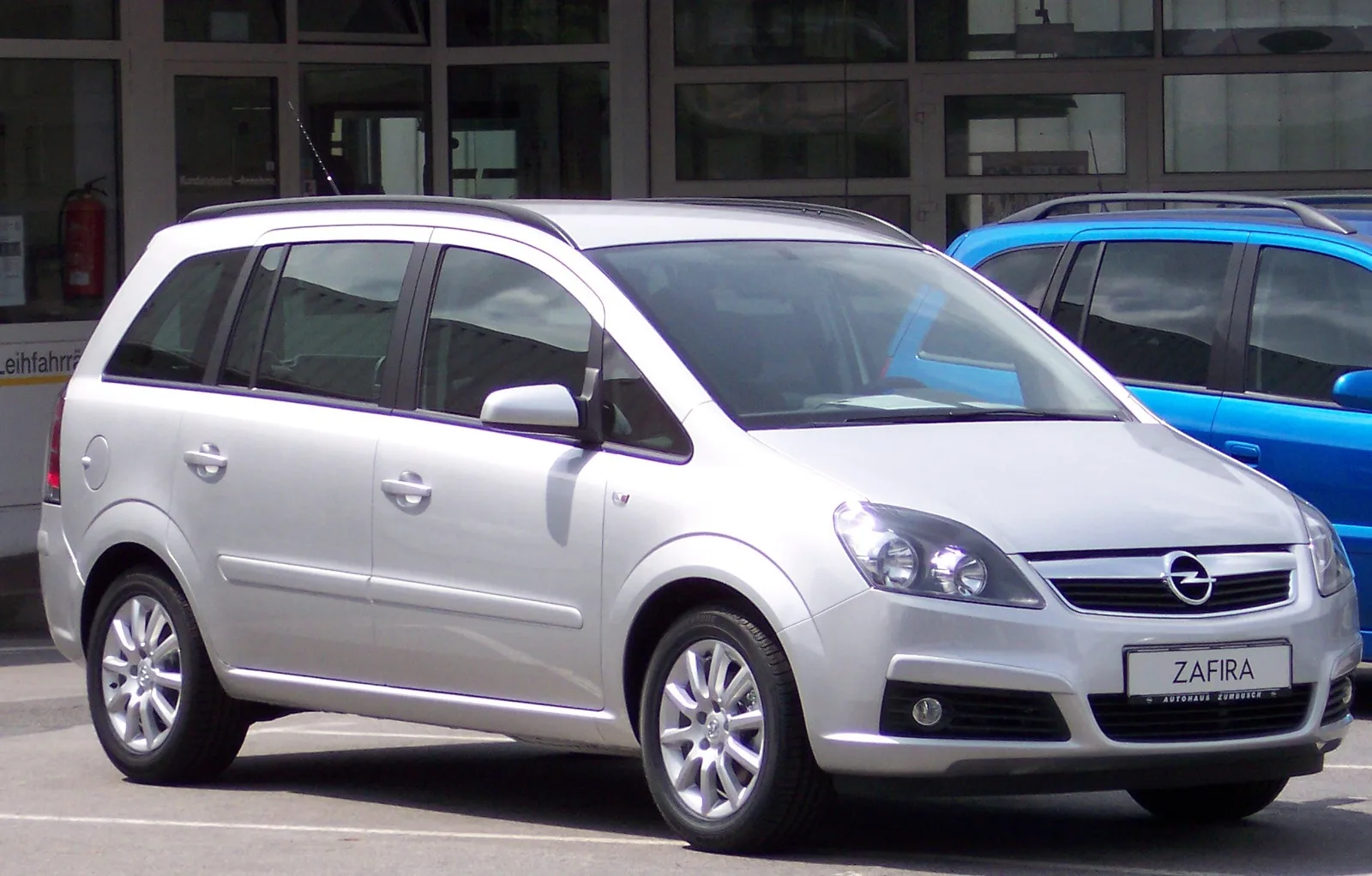
The second-generation Zafira, a seven-seat people carrier built on the Astra H platform from 2005 to 2014.
The Opel Zafira B was a seven-seat mid-size people carrier from Opel, built from 2005 to 2014. At launch it came with petrol and diesel engines from a 1,598 cc 1.6 up to a 2.0 turbo producing 200 PS (197 hp), and its Flex-7 seating allowed several layouts.
The Opel Zafira B was the second generation of Opel's mid-size people carrier, built from 2005 to 2014. It rode on Astra H underpinnings and used the Flex-7 system to offer seven seats in a flexible layout. It was bigger than the car it replaced, and it became the more compact and economical choice once the third generation arrived.
Where did the Zafira B come from?
Opel was already developing the people carrier version of the Astra H when that car was still new. Camouflaged prototypes were spotted on the road in late spring 2004. The Zafira B debuted at the 2005 Geneva Motor Show, and production began shortly afterwards, with sales starting later that summer.
The new car grew 15 cm in length over its predecessor. That took it away from the segment the first Zafira had occupied, and it was positioned as an alternative to higher-segment models without competing with them head on.
Rivals moved too. The Citroen Xsara Picasso had been the first Zafira's direct competitor, but it no longer matched the new Opel. Almost at the same moment Citroen introduced the seven-seat C4 Picasso, which sat considerably higher than the streamlined Xsara-based people carrier.
A people carrier that grew 15 cm, borrowed its family look from the Astra H and kept seven seats in play.
How was the Zafira B styled?
Outside, the Zafira B made no attempt to hide its relationship with the Astra H. The front lamps were trapezoidal, and so was the grille with its chrome bar. Below it sat a bumper with three horizontal trapezoidal air intakes, the outer two housing the fog lamps. The side view was modernised but showed no major distinguishing features.
At the back, new square lamp units had plastic panels divided by a light-coloured grille. A chrome bar split the tailgate and linked the two lamps, and the bumper shield looked heavier than before. The glass panoramic roof sat on a cross-shaped frame that housed the courtesy lights and five storage drawers.
Inside, the Flex-7 system gave the seven seats a high degree of modularity. Engineers had refined it to add rear-seat roominess and load capacity. The cabin looked sober but more modern, and ergonomics had received special attention. The centre console was topped by a display and carried the air vents and the controls for air conditioning and the hi-fi. The dashboard used round instruments framed in chrome.
Load space depended on how the seats were arranged. The boot held 270 litres with seven seats, 645 litres with five and 1,820 litres with only two.
How did the platform and chassis work?
The body structure was very robust, and that earned the car five stars in Euro NCAP tests for frontal and side impact. The Zafira B took its platform and mechanics from the Astra H, specifically from the estate, whose wheelbase was 9 cm longer than the saloon and coupe versions.
The suspension geometry carried over. A MacPherson strut sat at the front and a rear axle with interconnected wheels and longitudinal arms at the back. Discs were fitted on all four wheels, ventilated at the front, along with ABS and ESP. The steering was rack-and-pinion with electro-hydraulic assistance.
What engines did the Zafira B use at launch?
At its debut the Zafira B was offered with six engines. Three were petrol units derived from Opel and GM production, and three were diesels of Fiat origin.
| Engine | Output | Displacement |
|---|---|---|
| 1.6 16v | 105 PS (104 hp) | 1,598 cc (97.5 cu in) |
| 1.8 16v | 140 PS (138 hp) | 1,796 cc (109.6 cu in) |
| 2.0 16v Turbo | Up to 200 PS (197 hp) | 1,998 cc (121.9 cu in) |
| 1.9 CDTI | 100 PS (99 hp) and 120 PS (118 hp) | 1,910 cc (116.6 cu in), single overhead camshaft |
| 1.9 CDTI 16v | 150 PS (148 hp) | 1,910 cc (116.6 cu in), twin overhead camshafts |
| 2.2 petrol | Up to 150 PS (148 hp) in some markets, including Germany | 2.2 litres, direct injection |
The 1.9 CDTI diesels used common-rail injection. The 1.9 with twin overhead camshafts was the strongest diesel at 150 PS (148 hp). The 2.2-litre direct-injection petrol was offered in Germany and some other markets rather than across the range.
The 2.0 turbo sat at the top of the petrol line-up with up to 200 PS (197 hp). The 1.6 and 1.8 came with a five-speed manual, while the rest used a six-speed. A robotised gearbox was available only with the 140 PS (138 hp) 1.8 16v. An automatic was offered only with the 120 PS (118 hp) 1.9 CDTI.
What trim levels did the Zafira B come in?
The launch range had three trim levels: Club, Enjoy and Cosmo. Club was the entry grade, fitted to the 1.6 and 1.8 petrol engines and to the 101 PS (100 hp) 1.9 CDTI. Its standard equipment included ABS, ESP, traction control, twin front airbags, side airbags and a car radio. The door mirrors were electrically adjustable and heated, the driver's seat adjusted for height, and rear head restraints were fitted. It had no head airbags.
Enjoy added head airbags and air conditioning, which Club lacked. It was offered with every engine except the 2-litre turbo and the 150 PS (148 hp) 1.9 CDTI. Cosmo, the top grade, was offered with every engine and added alloy wheels and fog lamps.
The option list included an alarm, xenon headlamps, leather upholstery and satellite navigation. Club could not take the last four. Parking sensors, self-levelling suspension and metallic paint were available across the range, and buyers of lower grades could add Cosmo equipment for extra money.
How did the Zafira B change during its life?
The first addition was the Zafira 1.6 EcoM, previewed at the 2005 Frankfurt Motor Show. This bi-fuel petrol and methane version reached many European markets between November 2005 and spring 2006. Its engine was a detuned 1.6 from the Family I range, and its output dropped from 105 PS (104 hp) to 97 PS (96 hp). Later in the year it was detuned again, to 94 PS (93 hp).
In 2006 the sporty Zafira 2.0 Turbo OPC arrived. It used the same turbocharged 2-litre as the Astra H OPC and produced 240 PS (237 hp). It was described as the fastest mid-size people carrier in the world.
The restyle was previewed at the Bologna Motor Show at the end of 2007. Externally it changed the fog lamp housings, the grille and the rear lamp graphics. The 1.6 petrol rose to 115 PS (113 hp), and a new 1.7 CDTI with 110 PS (108 hp) replaced the 101 PS (100 hp) 1.9 CDTI. The 2-litre turbo was dropped from the Italian price list at that point, though it stayed on sale in other markets. Cosmo versions also lost their roof rails. The updated car went on sale in February 2008.
In 2009 the Club trim was dropped, and the 120 PS (118 hp) 1.9 CDTI gave way to a 1.7 CDTI of 125 PS (123 hp). That year brought two eco models. The Zafira EcoM Turbo used a turbocharged bi-fuel 1.6 that produced 150 PS (148 hp). The 1.8 GPL-Tech ran on petrol at 140 PS (138 hp), or on LPG at 136 PS (134 hp).
Between late 2010 and early 2011 the OPC and the 150 PS 1.9 CDTI left the European lists. The GPL-Tech was cancelled in Italy in 2011. In 2010 the 115 PS 1.6 petrol had been updated to meet Euro 5 rules, and the naturally aspirated EcoM and LPG versions left some European price lists that year, though they stayed on sale in Italy.
The third-generation Zafira was shown at the 2011 Frankfurt Motor Show, but the Zafira B stayed in production beside the new Zafira Tourer, as the economy and more compact model. For model-year 2012 it took the name Zafira One, known as the Zafira Family in Germany. Its range then was the 115 PS 1.6, the 140 PS 1.8 and the 1.7 CDTI in 110 PS and 125 PS outputs.
What safety campaigns affected the Zafira B?
The Zafira B's reputation suffered from fires. In November 2015 the London Fire Brigade issued an alert after a spike in reports of fires involving the model. That December, UK safety officials asked Vauxhall to start a full safety recall, because of a worrying number of fires that were attributed, or alleged, to improper repairs.
The fires continued, including on cars already recalled. A second full recall was announced in May 2016. Owners were told not to use the fan at the speeds controlled by the resistor pack, which contained a solder-based thermal fuse considered unreliable, until the second recall, starting in August 2016, had been carried out. In May 2018 a criminal investigation into Vauxhall's handling of the fires and recalls was opened in the UK.
Fires were not confined to the UK. On 31 August 2019 a Zafira caught fire in a parking garage in Cork, Ireland, causing major damage. On 7 January 2020 a spontaneous fire in a Zafira at Stavanger Airport, Sola, destroyed more than 200 cars in a parking garage. No one was harmed in either incident.
Where was it built and sold?
Assembly took place at Bochum in Germany and at Gliwice in Poland. Gliwice production ran from 12 September 2005 to 19 July 2010. Opel sold the car across Europe except the UK, and also in Singapore and Japan.
Other badges carried the car elsewhere. It was the Vauxhall Zafira in the United Kingdom, the Chevrolet Zafira in Mexico and the Subaru Traviq in Japan.
How did production end?
Production of the Zafira One ceased at the end of 2014. Sales ended in March 2015 to clear the remaining stock. The Zafira Tourer sat a step above the B in size and price, which left the older model as the economy choice.