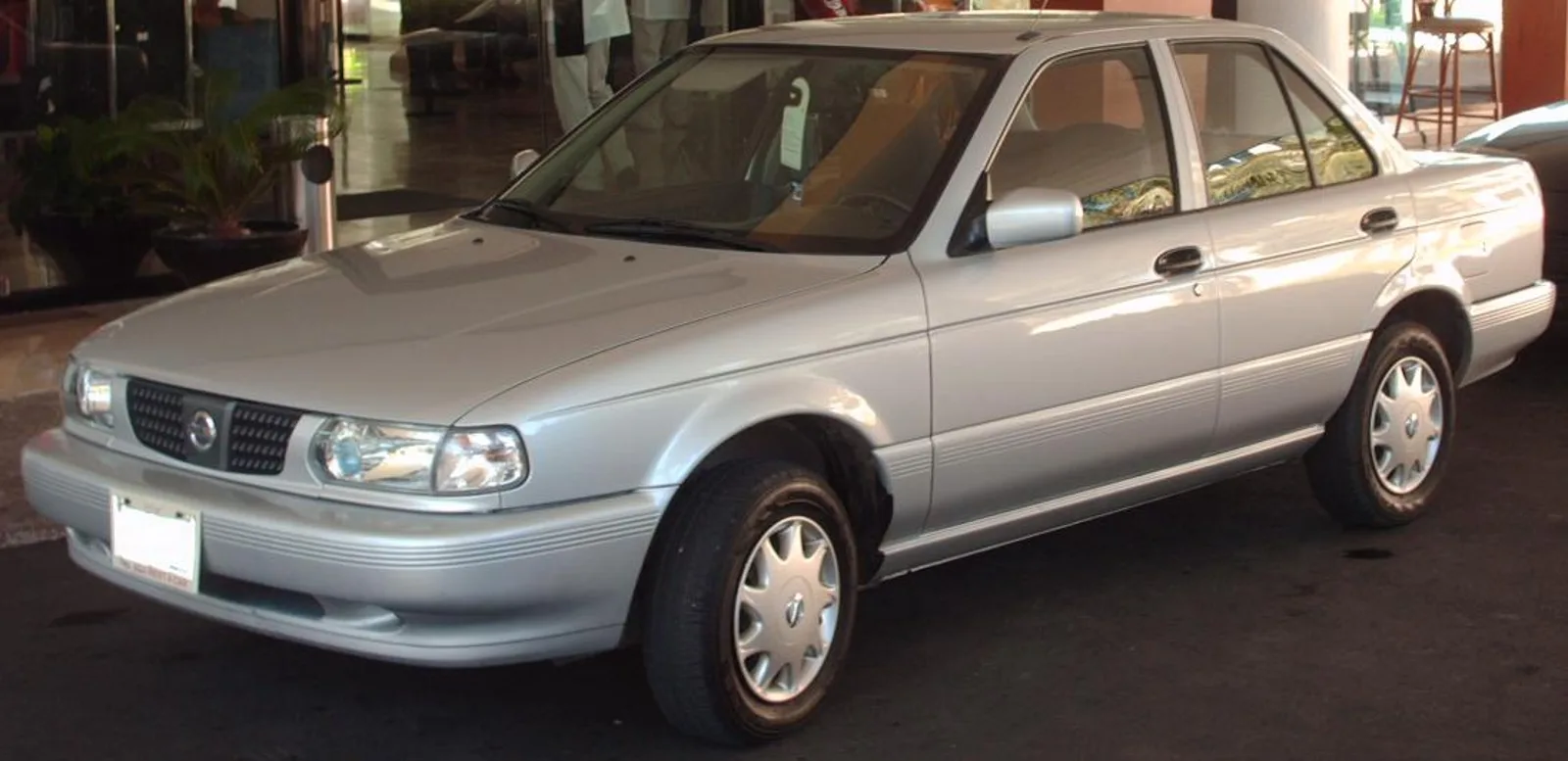
Robust, frugal and cheap to maintain, the Tsuru carried Mexican drivers for three decades before its final edition in 2017.
Built by Nissan Mexicana from 1984 until 2017, the Tsuru ran mostly on four-cylinder engines of 1.4 to 1.6 litres, was a favourite of taxi drivers, and scored zero stars in a 2013 Latin NCAP test. Its Chilean counterpart, the V16, stayed on sale until May 2010.
The Nissan Tsuru was a low-cost saloon that Nissan Mexicana built from 1984 and that became a fixture of Mexican taxi ranks. It replaced the Datsun Violet, and its robustness and frugal fuel use won buyers quickly. The car stayed in production in Mexico until 2017.
When did the Tsuru first go on sale in Mexico?
The Tsuru arrived in April 1984 to replace the Datsun Violet 160J and 180J. Nissan picked the Sunny because it sat lower in the market than the Stanza models that had replaced the 160J, and those were bigger and dearer than the Mexican market required. Young buyers from the middle and upper classes were asking for modern cars such as the Volkswagen Caribe and Atlantic, and the Tsuru answered that demand.
The first range had two saloon bodies, a 5-door estate, and a fastback coupe with three doors, the Tsuru Samurai. The engine was a 4-cylinder 1.5-litre E15 with a choice of 4-speed or 5-speed manual gearboxes, or a 3-speed automatic. Its success was immediate, thanks to its robustness and fuel consumption that was exceptionally low for the time.
A cheap, robust car that became a taxi-rank staple in Mexico, and then scored zero stars in a crash test.
What were the early versions of the Tsuru like?
The luxury trim, shown at launch, came with alloy wheels, velour seats, a tape-deck stereo and tinted windows.
In 1985 the Tsuru Samurai received a new front grille, and the saloons gained larger rear lights. In 1986 the Tsuru received a new 1.6-litre E16 engine, which increased power without greatly affecting fuel consumption, and its bumpers were redesigned in a more enveloping shape.
In 1987 the Nissan Ninja Turbo arrived on the Tsuru Samurai. It used a 1.6-litre turbocharged engine fed by a carburettor, and it was recognised by its black side stripes and golden wheel caps.
How did the Tsuru II differ from the first car?
The Tsuru II arrived in the last quarter of 1987 with a bigger, roomier and more angular body, while its mechanics remained practically the same as the previous generation. Hydraulic steering was one of its key innovations, offered on the equipped versions.
The luxury Tsuru II added electric mirrors, air conditioning and electric windows, along with door linings in leather-look material with a map pocket. A sunroof was offered in special cases, and the 2-door and 4-door saloons and the estate were all kept in the line-up.
The Hikari Coupe and the Ninja Turbo legacy
The Tsuru Samurai was discontinued with the Tsuru II, but in 1988 Nissan introduced the Sunny Coupe, which was named the Hikari Coupe. The Hikari came with two engines: a carburettor-fed E16 like the other Tsuru II versions, and the Turbo E16T from the earlier Ninja Turbo.
In 1991 and 1992 the Hikari received electronic fuel injection, and its name changed to Hikari EGI. The Tsuru II was in production until 1991, which reinforced the image of robustness that the model was known for. During 1988 a Tsuru II saloon with a turbo engine and a carburettor was also offered, inherited from the Ninja Turbo, but very few units were built.
Third generation: the Tsuru from 1992 to 1995
The third generation appeared in the last quarter of 1991 as the 1992 model, with a 4-cylinder 1.4-litre engine producing 88 hp (66 kW; 89 PS) through a carburettor. It was the second generation to offer electric window lifts and electric door locks on its luxury models, a success for the time, since until then only cars from higher segments offered those features in the country.
A new 4-speed automatic gearbox was one of the improvements. From 1992 to 1995 the Tsuru competed with models such as the Volkswagen Golf, and it was sold in austere form as the Nissan Tsuru GS, in mid-level equipment as the Nissan Tsuru GST, which became the typical Mexican version, and in luxury form as the Nissan Tsuru GSX.
In 1993 Nissan added the Tsubame, an estate with a different look but the same mechanics as the Tsuru. It was called Nissan Sunny California or Nissan AD Wagon in other markets. Fuel injection then arrived on the 1.6-litre engine used throughout the Tsuru line, lifting its output to 93 hp (69 kW; 94 PS).
For the 1994 model year the Tsuru was redesigned slightly, with new headlights, grille and rear lights. The 1.6-litre engine gained 16 valves with valve timing control, lifting power to 115 hp (86 kW; 117 PS). As a response to the Volkswagen Golf GTI, Nissan also introduced the Tsuru 2000 GSR, which fitted the SR20DE, a DOHC engine of 1,998 cc producing 140 hp (104 kW; 142 PS) at 6,400 rpm, inside a 2-door coupe. Its segment treated it as the reference for the period it was sold.
Why did Nissan cut the Tsuru range in 1995?
Sales fell considerably after the error of December 1994, and Nissan reorganised the range around two basic versions, the GSI and GSII. Those two became the versions sold from then on, and all the earlier variants gradually disappeared from the price list.
To replace the better-equipped versions, Nissan launched the Sunny B14 as the Nissan Sentra, a car in a higher segment than the Tsuru, offered as a 4-door saloon and as a 2-door coupe that kept its Japanese name, Nissan Lucino. The Tsuru itself was stripped of stabiliser bars, side protection bars, anti-noise lining, a centre console and seats with adjustable headrests.
The GSII incorporated door interior linings, hydraulic steering and wider tyres. A new GA16DNE engine then cut costs by dropping the valve timing control, which reduced power to 105 hp at 5,500 rpm. Over time the Tsuru got back some items it had lost, including a stereo, bumpers in body colour, air conditioning and automatic transmission. It also received two redesigns.
How did the Tsuru sell in the later years?
In 2001 Nissan Mexicana reached one million Tsuru sold in its history, and in February 2009 it announced the sale of the 1.5 million Tsuru in Mexico. For 2010 the GSI was the austere version, and it now received the full wheel caps that had previously been reserved for the GSII, along with an AM/FM/CD radio and an alarm system.
In 2011 the automatic transmission was dropped, and the gearbox received a new Renault-origin clutch in place of the earlier mechanically operated one, along with small gear adjustments for better fuel economy. Sales then declined as the new Nissan Versa arrived, and speculation grew that the model would be discontinued.
How did the Tsuru end its run in Mexico?
In late 2016 Nissan officially announced that it would stop building the model in 2017, because new vehicle safety rules were due to take effect in Mexico in 2019. The B13 generation was discontinued in Mexico in 2017, and buyers were pointed towards the Versa, Note and March.
In early 2017 Nissan Mexico launched a final edition called Buen Camino at a high price. It had a blue interior and exterior, a chrome-finished exhaust and extra comfort equipment, but no improvement in driving or safety terms. Buyers received a commemorative key ring and a letter of thanks.
The Tsuru as a Mexican taxi staple
The Tsuru was a frequent choice of taxi drivers in Mexico City. It was also a frequent majority choice in Cuernavaca and across the state of Morelos, mainly because the car was made at the Nissan plant in that state.
In the country's largest cities, Guadalajara, Monterrey and Tepic, the Tsuru stood out as a rental vehicle with low maintenance costs. Interior space and robustness at an affordable price were the qualities that made it a favourite, as with taxi drivers.
What was the Sentra B13 like in Bolivia?
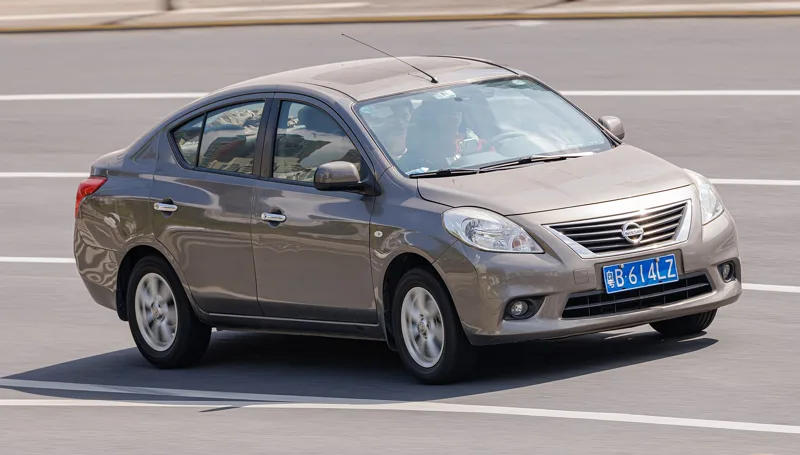
The Nissan Sentra B13 has been sold in Bolivia since 1992, and the B11 and B12 were sold there as the Nissan Sunny. All three versions were made in Mexico, and the Sentra B13 came with a 1.6-litre 16-valve engine.
Some units made in Japan as the Sunny, and some from the United States, were brought in by private owners. The Japanese versions had 1.3-litre and 1.5-litre engines, with front-wheel drive or four-wheel drive. Imported Sentra units came only with a 5-speed manual gearbox.
The AD Wagon (Y10) estate was sold officially in Bolivia in its luxury version only. The 2-door Sentra B13 was never sold there, and the National Police used Sentra B13 patrol cars. More used Sunny B13 units imported from Japan were sold than the Sentra version the importers brought in from Mexico.
Why was the V16 so popular in Chile?
In Chile the car was one of the most popular models through the 1990s, 2000s and 2010s, largely because its spare parts were compatible and cheap. Shared taxis and long journeys were its main jobs, given its economical fuel consumption.
In May 2010, new Chilean safety regulations led to the Nissan V16 being withdrawn from sale, and the Tiida Sedan took its place. The Tiida was more expensive to maintain because its parts were more modern and less durable than those of the V16, and sales did not match those of the V16 in Chile.
The Chilean rules required airbags and programmed deformation. Nissan Chile said it preferred to withdraw the V16 than to adjust it to the standard, yet V16 cars remain in circulation. Two models were sold, the B3801 and the B3802, which varied in equipment in the same way as the GSI and GSII.
Who imported the Nissan Tsuru into Chile?
In Chile Nissan was imported by three companies: Cidef, Difor and Marubeni. Cidef was the importer that brought in the range in 1998, and its line-up included several saloon and estate variants.
The 1998 list included the Ex/Kai, a taxi favourite of the period thanks to its low price, along with the Ex Saloon STD, the Ex Saloon EQ, the station wagon known as Tsubame or AD Wagon Y10, the Ex Saloon and the Super Saloon.
How safe was the Nissan Tsuru?
The Latin NCAP 1.0 test carried out in 2013 gave the Nissan Tsuru 0 stars out of 5. The car had no minimum safety standards, and it had no ABS brakes or airbags. It was considered one of the most unsafe cars in the world, and its sale has begun to be banned in some markets.
Latin NCAP said the car should leave the Latin American market immediately, because it had the highest fatality index among the fatal accidents it took part in, with more than 4,100 deaths between 2007 and 2012, an average of 331 a year in Mexico alone. Mexico published an official standard in April 2017 requiring at least 2 airbags and ABS brakes in all models.
Nissan Tsuru specifications at a glance
| Specification | Detail |
|---|---|
| Mexican launch | April 1984, replacing the Datsun Violet 160J and 180J |
| First-generation engine | 4-cylinder 1.5-litre (91.5 cu in) E15 |
| 1986 engine | 1.6-litre (97.6 cu in) E16 |
| Third-generation engine | 1.4-litre (85.4 cu in), 88 hp (66 kW; 89 PS), carburettor |
| 1993 engine power | 1.6-litre (97.6 cu in) with fuel injection, 93 hp (69 kW; 94 PS) |
| 1994 Tsuru 2000 GSR | SR20DE DOHC, 1,998 cc, 140 hp (104 kW; 142 PS) at 6,400 rpm |
| Basic GA16DNE | 1,597 cc 16-valve DOHC, 105 hp (78 kW; 106 PS) |
| Gearboxes | Manual 4-speed or 5-speed, 3-speed automatic, later 4-speed automatic |
| Mexican sales | One million by 2001; 1.5 million by February 2009 |
| Latin NCAP 1.0 (2013) | 0 stars out of 5 |
| Mexican end | Discontinued 2017; final edition Buen Camino |