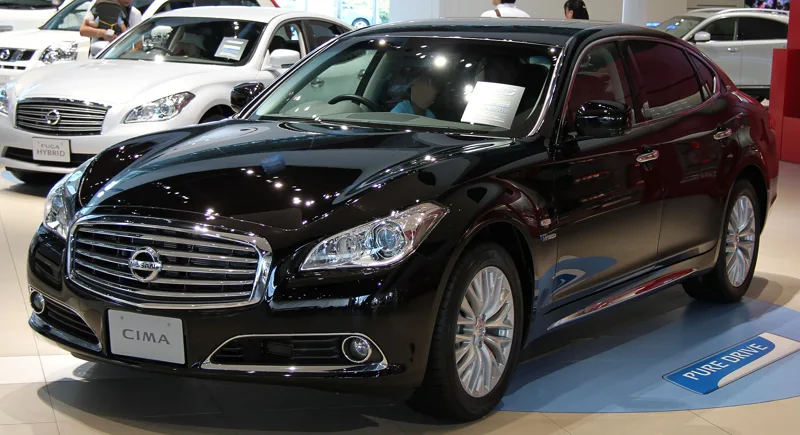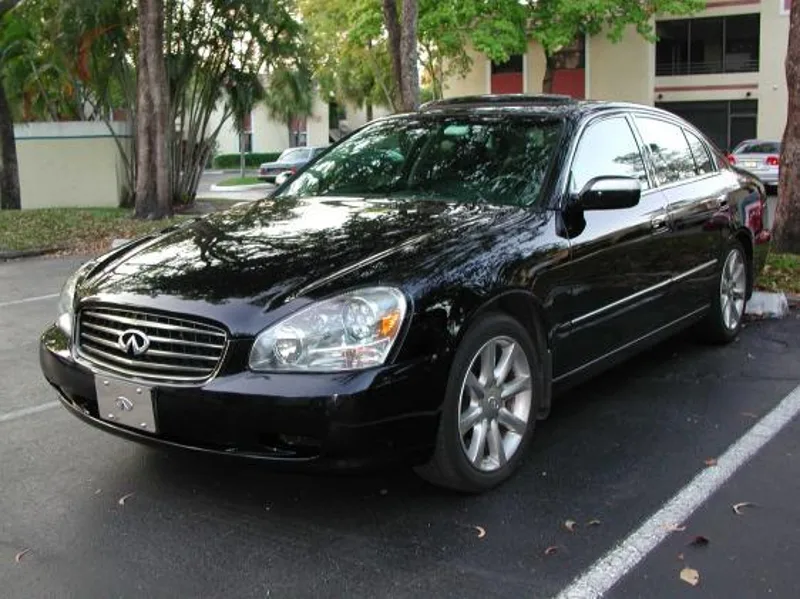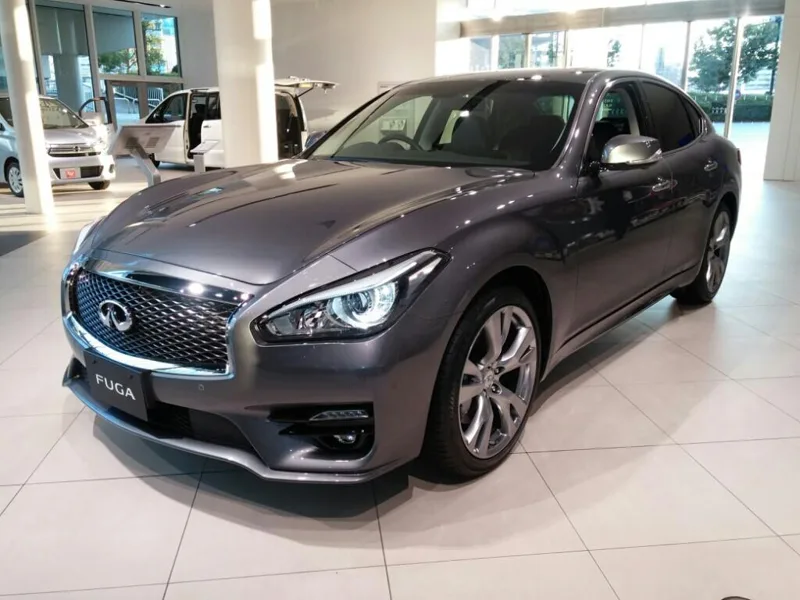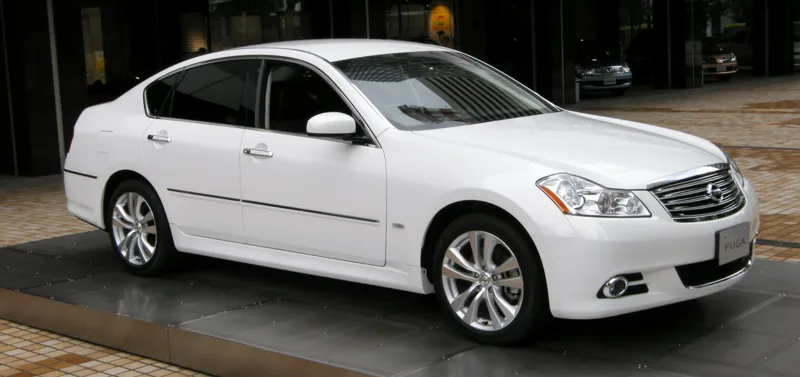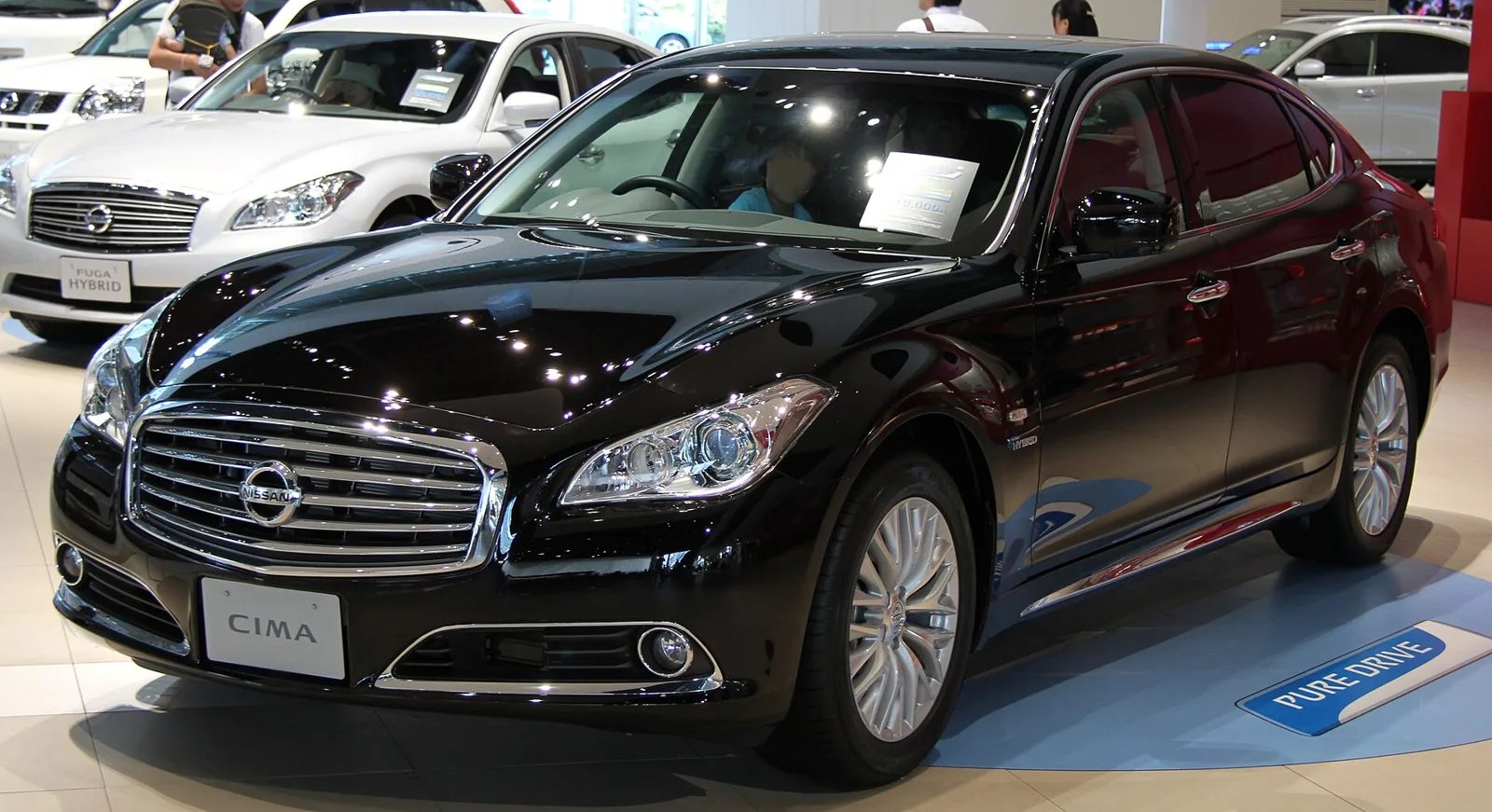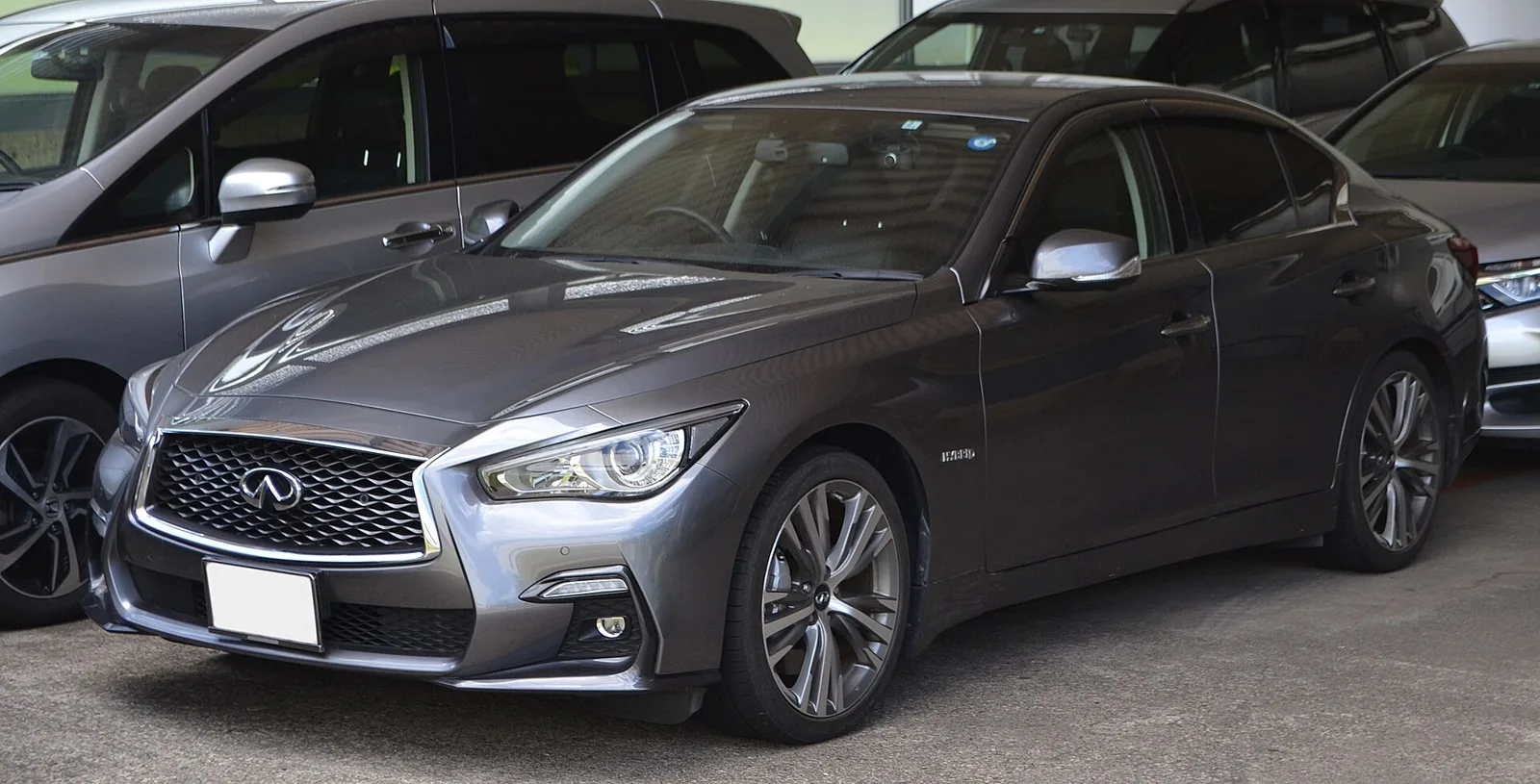
Nissan's luxury Skyline saloon from 2014, sold first as a hybrid, then with a 2.0 litre turbo four, a 3.0 litre V6 and the 405 PS 400R.
The Skyline Sedan V37 was a Nissan luxury saloon built at Tochigi from 2014. It launched as a hybrid with a VQ35HR petrol engine and an HM34 motor, then added a 2.0 litre turbo four, a 3.0 litre V6 twin-turbo in 2019 and the 405 PS 400R.
The Skyline Sedan V37 is Nissan's luxury saloon, remodelled in February 2014 and assembled at the Tochigi factory. It arrived as a hybrid, the first hybrid Skyline, and a turbo four joined it in May 2014 as the cheaper option.
Later years brought a twin-turbo V6 and the 405 PS 400R, before the hybrid was dropped in 2022 under tighter noise rules. Its Infiniti dress drew mixed reactions in Japan, and a 2021 newspaper report that the Skyline was being dropped was officially denied.
How did the V37 replace the V36?
The predecessor V36 came with two petrol V6s, one a 2.5-litre and the other a 3.7-litre. The new car began with a hybrid only, pairing the VQ35HR petrol engine with an HM34 motor. That combination was borrowed from the Fuga and Cima hybrids, and the turbo four was added later to fill the lower price band.
The older 2.5-litre car stayed on sale for a while after a specification change, until the new turbo arrived and ended its production in fiscal 2014. The four-cylinder marked the first Skyline with that layout since the eighth-generation R32 sedan's 1.8-litre GXi, five generations back.
Overseas, North American buyers got a 3.7-litre petrol engine that was later swapped for a 3.0-litre twin-turbo, while Europe and South Korea offered a 2.2-litre diesel. Japan took the hybrid first, because it was seen as the best mix of economy and performance.
She said no such decision had been made, adding that the company would never abandon the Skyline.
Why did the V37 wear Infiniti badges?
In markets where Infiniti sells luxury cars, the V37 went on sale as the Infiniti Q50. Infiniti has no presence in Japan, so Japanese customers bought the car through Nissan showrooms. Until the July 2019 update, though, the car still bore Infiniti identity on components like the cylinder-head cover and the hubcap centres.
The formal model name stayed Skyline. Much of the advertising left the Nissan logo out and credited NISSAN MOTOR CORPORATION, a move that pointed away from Nissan and towards Infiniti. The idea was to show that the V37 had been engineered for world markets and could pass as an international luxury sedan.
There was a boardroom quarrel behind the naming. A plan to retire the Skyline name met resistance from senior Japanese executives, led by Toshiyuki Shiga, who opposed one global name for the Q50 that would also cover Japan. Andy Palmer, then vice president, and other foreign executives favoured a single name worldwide. Shiga countered that uniform naming might look as if the Japanese market was being brushed aside. CEO Carlos Ghosn settled it by keeping the Q50's basic styling and the Skyline name for Japan alone.
Miho Terada, the regional product manager who handled domestic planning, described the intended buyer as a man in his early forties. He had a working spouse and a daughter, held a management job at a foreign-owned firm, and thrived in a punishing workplace. He lived in a high-rise apartment block in central Tokyo.
What was the hybrid powertrain?
The hybrid combined its petrol engine with a one-motor, two-clutch arrangement that Nissan named Intelligent Dual Clutch Control. A seven-speed automatic with a manual mode handled the shifting. The earlier Y51-based system had been built with a generous durability cushion, because Nissan had no hybrid track record at the time.
For the V37 that cushion was trimmed, which allowed more output and sharper acceleration response. Clutch timing and control were revised, and the motor and battery were both strengthened. Peak motor torque reached 290 Nm (214 lb ft), a gain of 20 Nm (15 lb ft), and the battery's short-term output rose to 75 kW (102 PS; 101 hp), which is 15 kW (20 PS) more. Fuel economy improved too, and transmission friction fell by 6 percent.
What did the 2.0-litre turbo change?
The turbo four used a Daimler engine that is close to the M274 unit found in the Mercedes-Benz E250. Turbocharging lets it produce 350 Nm (258 lb ft) even at low revs, matching the hybrid's petrol unit, and its JC08 economy of 13.6 km/L was roughly one fifth better than the outgoing 2.5-litre car.
Peak power of 211 PS (155 kW; 208 hp) was below the 225 PS (165 kW; 222 hp) of the old 2.5-litre. Where the M274 runs lean-burn stratified combustion, this engine uses stoichiometric combustion, a choice made for a livelier feel, which leaves its economy behind the M274. The gearbox is a seven-speed automatic with manual mode, code RE7R01A, almost the same unit as in the E250.
What changed in the 2019 update?
In July 2019 the Daimler four was discontinued. Nissan installed its own 3.0-litre direct-injection twin-turbo V6, the VR30DDTT, an engine previously confined to markets outside Japan. Standard cars produced 304 PS (224 kW; 300 hp), and the high-performance 400R grade joined the range.
The VR30DDTT uses small-diameter turbines and compressors for quicker response. Its bigger capacity brought a large step up on the old turbo four. Hybrid models also received ProPILOT 2.0, a driver assistance system used in a production car for the first time, along with an electric parking brake that holds the car on auto.
ProPILOT 2.0 draws on 3D high-precision maps and 360-degree sensing to suggest lane changes for junctions and passing on motorways. The driver accepts the proposal with a switch, after which the car helps with the manoeuvre. On motorway mainlines it also permits hands-off steering within the same lane, provided the driver keeps watch and can take over instantly.
The 2019 update also restored the Nissan logo to the front and rear badges, the wheel centre caps and the steering wheel emblem. The company had taken a fresh look at the Skyline as a symbol of Nissan's technology and set it down again as a Nissan car. The nose adopted the V-motion grille seen on recent Nissans, the rear lamps became round four-lamp units, and the Infiniti emblem on the grille gave way to Nissan's. The styling borrows cues from the GT-R, yet the Skyline is pitched as slim, sharp and quick rather than as an outright performance machine.
How did the V37 steer?
The hybrid and V6 turbo versions used Direct Adaptive Steering (DAS), a steer-by-wire setup used for the first time in the world. A fail-safe steering column still exists, but when the system runs normally a clutch in its middle section disconnects it, and wires carry the steering signal instead.
Steering delay was reduced, and kickback from ruts and uneven surfaces was softened. Tyre feedback is sorted for the information that matters and sent to the wheel through a steering force actuator, which gives a more natural feel. The turbo four has speed-sensitive electro-hydraulic steering, gentle at low speed and smoother and more linear at high speed, while cutting the load on the engine.
What was the V37 platform like?
The V37 rides on a new generation of the FR-L platform, derived from the Y51 Fuga, and its wheelbase measures 50 mm (2.0 in) less. The platform had been built around V6 or bigger engines, so engineers struggled to keep noise and vibration under control with an inline four.
Building the body with the V36's structure and materials would have added 22.4 kg (49.4 lb) to make it stiffer and bigger. Raising the share of ultra-high-tensile steel and other measures made the body 8.4 kg (18.5 lb) lighter. Stiffness improved as well: lateral bending at the front rose by 60 percent and torsional rigidity at the rear by 6 percent.
The front suspension is largely the V36's, and the rear copies the Y51 Fuga's layout. Shock absorbers at both ends are double-piston units first fitted to the Y51 Fuga. Run-flat tyres are standard on all cars apart from the NISMO, in 225/55RF17 and 245/40RF19 sizes.
What are the Skyline V37 specifications?
| Feature | Detail |
|---|---|
| Launch | 26 February 2014 |
| Hybrid | VQ35HR petrol engine with HM34 motor; seven-speed automatic with manual mode |
| Turbo four | 2.0 litre (122 cu in), 211 PS (155 kW; 208 hp), 350 Nm (258 lb ft) |
| Turbo V6, from 2019 | 3.0 litre (183 cu in) twin-turbo, 304 PS (224 kW; 300 hp) standard |
| 400R | 405 PS (298 kW; 399 hp), 475 Nm (350 lb ft), 1,600 to 5,200 rpm |
| Wheelbase | 50 mm (2.0 in) shorter than the V36 |
| Body weight | 8.4 kg (18.5 lb) lighter |
| Size change | 10 mm longer and 50 mm wider than the previous car |
| Boot | 400 litres (hybrid), 500 litres (turbo) |
| Drag coefficient | 0.26, improved by 0.03 |
| Fuel economy | 13.6 km/L on JC08 mode (turbo) |
What changed in the cabin and styling?
The exterior took its cues from the Infiniti Essence concept car. The double-arch grille and raised front wings, which Infiniti models have shared since the V35 Skyline, appear here, and a new crescent cut turns the window line back at the C-pillar. The rear number plate moved from the bumper to the boot lid, which kept the body from stretching more than it had to.
The dashboard uses the double-wave layout that Infiniti models have long favoured, with a more pronounced wave than before. The centre stack has an 8-inch navigation display with a 7-inch control panel beneath it, and physical switches cover the basic air conditioning and audio functions.
Growth in the body added shoulder room of 20 mm at the front and 26 mm at the rear, and effective interior length rose by 8 mm. Rear knee room gained 19 mm to reach 609 mm. Overall height was cut by 10 mm, but a lower seat position preserved head clearance, and front headroom increased by 16 mm to 96 mm.
The hybrid battery occupies the boot, so luggage space shrank from 510 litres to 400 litres. Four golf bags still fit. The turbo has no battery, so its boot is 500 litres, 10 litres short of the old figure, and it takes four 9-inch bags or two big suitcases. A rear centre armrest pass-through and optional folding rear seats allow long loads.
Which trim grades were offered?
Both the hybrid and the turbo offered three grades. Equipment is nearly identical, with the hybrid adding an HEV power meter, double-piston dampers and a vehicle approach warning, while the turbo gets speed-sensitive electric hydraulic steering and the rear centre armrest pass-through.
Four-cylinder cars carried the GT name, which Skyline had reserved for six-cylinder models since its second generation. Nissan argued that the four matched the old six for performance and that the V37 was a grand tourer with comfort as well as sporting ability.
The GT base grade includes automatic air conditioning, gunmetallic finish, soft jacquard fabric with NEOSOFEEL combination seats, NissanConnect navigation, push-button start, an intelligent key and Fine Vision meters. GT Type P adds leather seat trim, intelligent air conditioning and electric lumbar support, plus high-beam assist, Active AFS, a mirror that lowers when reversing and a driving position memory. GT Type SP brings a sport bumper and paddle shifters, along with aluminium pedals and 19-inch wheels.
The hybrid was also sold with four-wheel drive, using the ATTESA E-TS electronically controlled torque split. The previous generation's 2.5-litre car had 4WD, but the V37 turbo had none.
Several driver assistance systems came fitted. Emergency Brake is an automatic braking system that can avert a crash at 60 km/h or less. Forward Collision Warning (PFCW) uses millimetre-wave radar that sees beneath the car in front to spot the vehicle two ahead. Blind Spot Warning (BSW) signals vehicles alongside on an indicator, and Blind Spot Intervention (BSI) warns and steers the car back into its lane if a lane change starts. Back-up Collision Intervention (BCI) warns of approaching traffic while reversing and helps avoid a crash. These were standard from Type P upwards at first, then on every car after the March 2016 upgrade.
What was the 400R?
The 400R tunes the VR30DDTT to 405 PS (298 kW; 399 hp) at 6,400 rpm, with torque of 475 Nm (350 lb ft) between 1,600 and 5,200 rpm. A turbo speed sensor allows the turbo to run right to its limit, a first for a Japanese-built Nissan.
It shares its name with the NISMO 400R, a complete race car built on the R33-generation Skyline GT-R and sold by NISMO in the 1990s, although Nissan denies any connection between the two names. Its seven-speed automatic matches the Z34 Fairlady Z, with wider gear ratios, and the suspension uses electronically controlled dampers within the Intelligent Dynamic Suspension system.
Outside, the 400R carries a badge on the upper right of the boot lid, blacked-out door mirrors and gunmetal 19-inch wheels. Inside, the paddle shifters get a dark chrome finish, and the leather wheel and gear knob are stitched in red. Items that cost extra as the Sports Package on the base car, including power front seats and folding rear seats, come as standard here.
What happened in 2022?
The hybrid went out of production on 31 August 2022, and sales of it ended that summer because of external noise rules that tightened on 1 September 2022. ProPILOT disappeared from the range along with it, and since then no Skyline fitted with ProPILOT 2.0 has been produced.
The car's future had been in doubt before that. The Nihon Keizai Shimbun reported on 12 June 2021 that work on the Skyline had been halted. At the launch of the Note Aura on 15 June 2021, executive vice president Asako Hoshino publicly denied it. She said no such decision had been made, adding that the company would never abandon the Skyline.
In September 2022 the car received a small set of specification changes, including an update of the Nissan logo on the steering wheel, wheel centre caps, rear emblem and grille, to the design in use since July 2020.