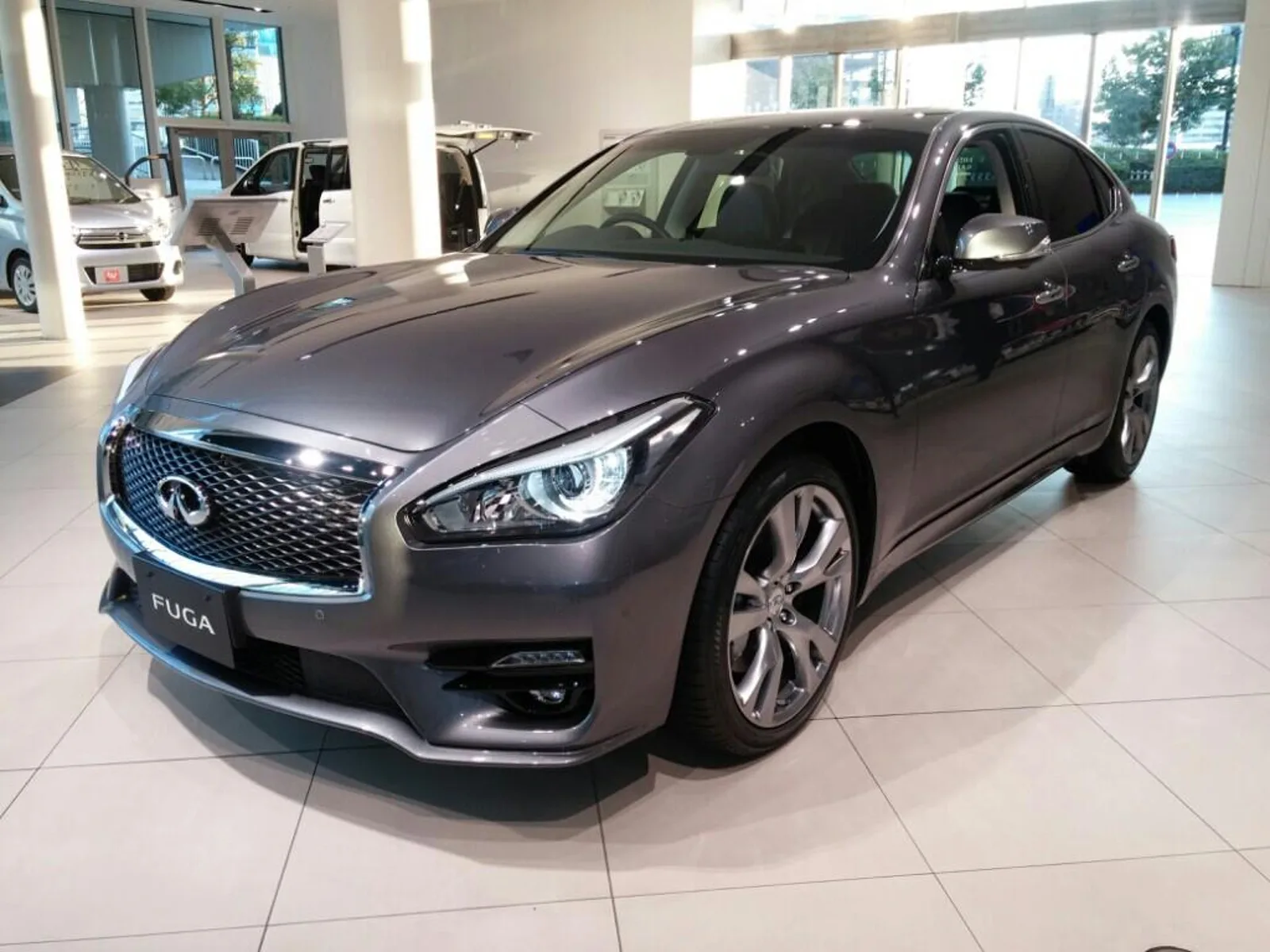
The second-generation Fuga, built at Tochigi from 2009, took over the flagship role, added a torque-converter-less hybrid and spawned Mitsubishi and Infiniti versions.
The Nissan Fuga Y51 was the second-generation Fuga, built at Tochigi from November 2009 as Nissan's flagship. It offered 2.5-litre and 3.7-litre V6 engines and, from November 2010, a hybrid with a 3.5-litre engine. It also formed the basis of the Cima and the Infiniti M.
Nissan's Y51 Fuga was called the flagship in its advertising and catalogues from the start, even though the Cima and President were still on sale when it launched. Its hybrid was Nissan's first rear-wheel-drive hybrid, and the same car wore Infiniti badges overseas.
Where did the Y51 Fuga come from?
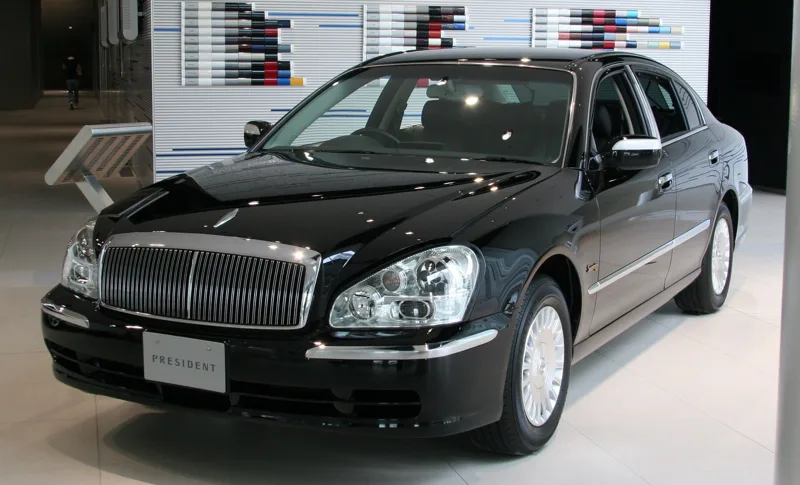
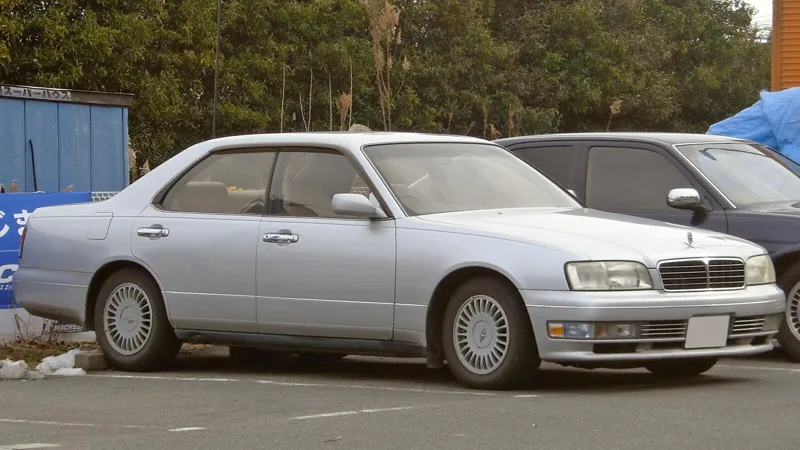
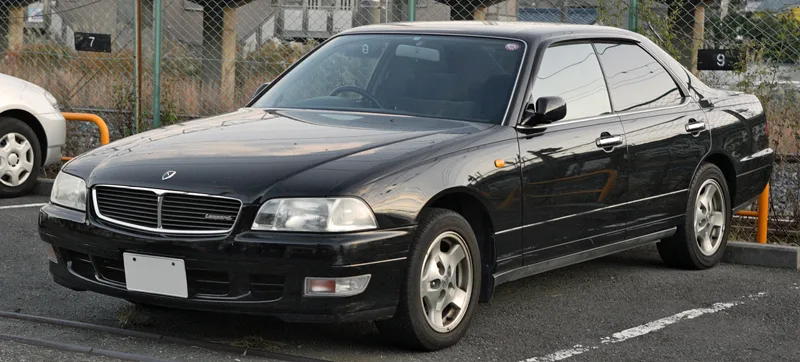
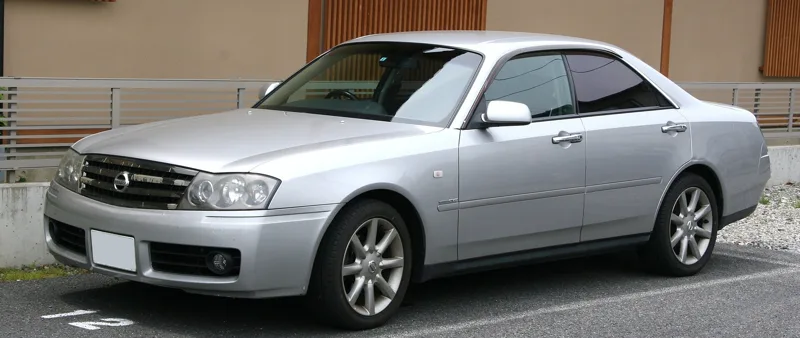
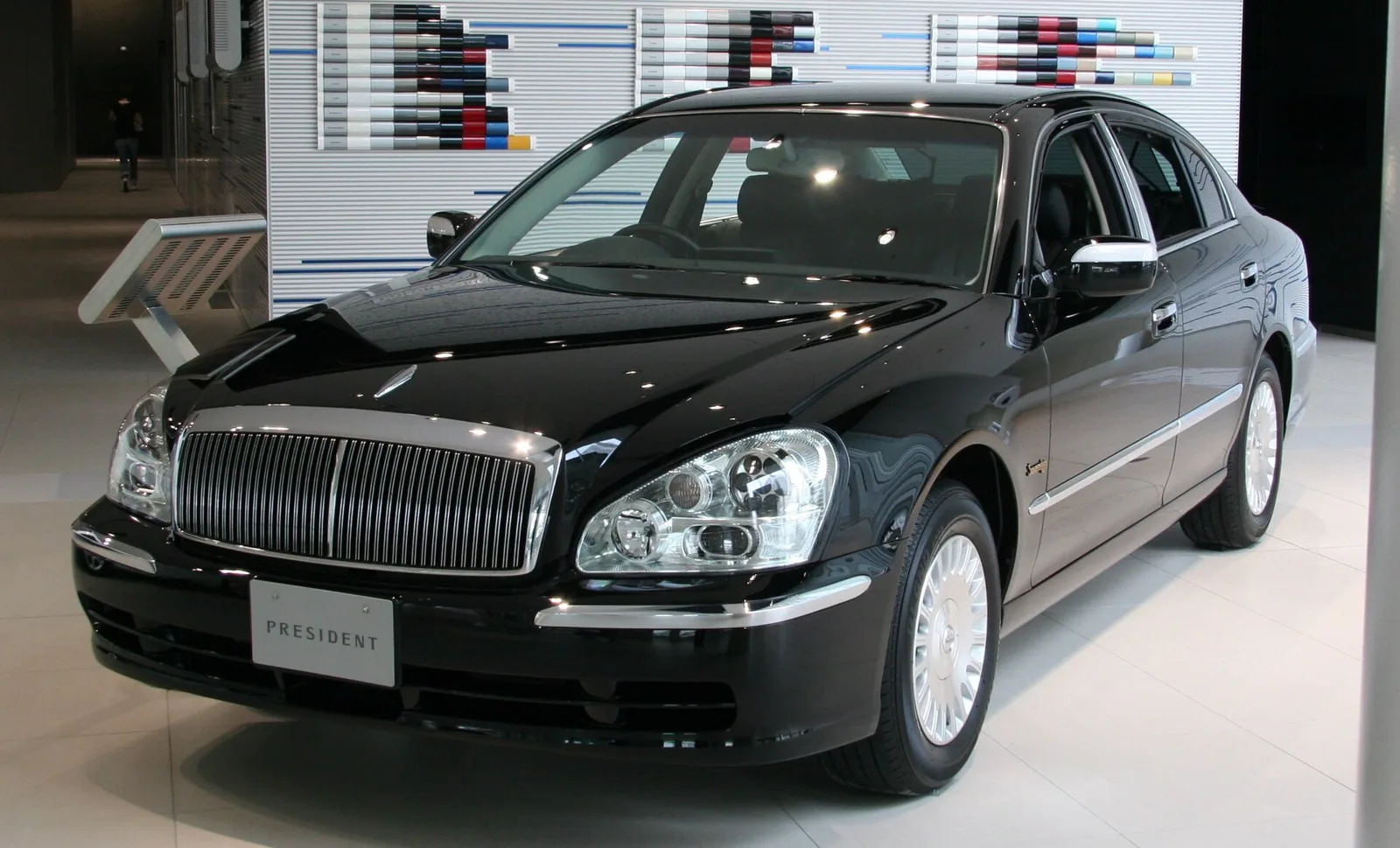
The Y51 replaced the Y50 Fuga, which had been introduced in 2004 when the Cedric and Gloria were discontinued. The full model change arrived in November 2009, and the Y51 was developed as Nissan's flagship because the next Cima and President had been frozen.
The Cima's discontinuation had already been decided in 2008. Both the Cima and the President stayed on sale beside the Fuga for a while, but the Fuga became the official flagship of the Japanese market once both ended in August 2010.
When the Cima's end was announced in May 2010, many customers wrote to Nissan to lament it. Sales staff pressed for a return, and in May 2012 the fifth-generation Y51 Cima went on sale as a hybrid-only car with a longer wheelbase, about a year and a half after the F50 Cima had ended.
A flagship that took on a torque-converter-less hybrid, and a Cima that came back after its end.
How did the Fuga's engines change?
The 2.5-litre VQ25HR carried over, with more maximum output and less maximum torque than before. The 3.5-litre VQ35HR of the earlier car gave way to a 3.7-litre VQ37VHR with 200 cc more capacity, and both output and torque rose. Fuel economy also improved thanks to VVEL on the larger engine.
Active Noise Control was new to the car. Speakers generate a control sound in opposite phase to the booming engine noise, which made it possible to widen the engine's lock-up range at low revs. The version in the Cima is tuned more for the rear seats.
Every car gained a drive mode selector with four settings: STANDARD, SPORT, ECO and SNOW. Each one changes the powertrain, VDC and 4WAS settings to suit normal driving, sporty driving, economy or snow.
A fully electronically controlled seven-speed automatic from JATCO replaced the five-speed unit on all cars. It has a manual mode and is sold as the JR710E and JR711E types.
How does the Fuga Hybrid work?
The Fuga Hybrid uses a parallel layout: an engine, a dry single-plate clutch, one motor, a planetary gear transmission and a wet multi-plate clutch, in that order. The motor produces 50 kW (68 PS; 67 hp), and it can drive the car on electric power alone, which makes it a full hybrid.
The 1.3 kWh lithium-ion battery is made by Automotive Energy Supply, a joint venture between Nissan and NEC. Nissan expects it to last 10 years or 240,000 km under the worst conditions. The battery sits behind the rear seats, so the boot is smaller than on the standard car, and the boot-through mechanism is not fitted.
The engine is the VQ35HR, converted to the Atkinson cycle, the same unit used late in the previous Fuga. It was chosen over the VQ37VHR because its maximum torque arrives at 5,000 rpm.
The gearbox is a seven-speed automatic based on the petrol-car unit, but without a torque converter. The motor and clutch sit inside the converter housing, and advanced motor control softens the shifts. Dropping the converter improves fuel economy by 10%.
The HM34 motor is made at Nissan's Yokohama plant, and the inverter is built at the Zama works, where the battery is also produced. The core hybrid parts are made in Kanagawa Prefecture, as with the Leaf for the Japanese market.
The power steering is an electro-hydraulic system in which the motor works only while steering, which Nissan says was a world first. It combines the efficiency of electric steering with the feel of hydraulic steering, and it saves 2% on fuel.
The December 2019 update brought every petrol and hybrid car to the 2018 emissions standard at the 50% reduction level, rated four stars. The hybrid reached 12.8 km/L under WLTC, meeting the 2020 fuel economy standard plus 20%.
In September 2011 Guinness World Records recognised the North American M35 Hybrid as the fastest full hybrid over 0 to 400 m.
The Cima uses the same hybrid system as the Fuga Hybrid, which is also used by the Infiniti M35h. In July 2013 the Fuga Hybrid was refined, and the motor's maximum torque rose by 20 N m (15 lb ft). That extended the electric drive range and lifted JC08 fuel economy by 1.4 km/L, while performance also improved.
Nissan Fuga Y51 specifications
| Item | Detail |
|---|---|
| Generation | Y51, second-generation Fuga in Japan |
| Platform | E platform, with a rear floor based on the V36 Skyline saloon |
| Wheelbase | 2,900 mm (114.2 in) |
| Petrol engines | 2.5-litre V6 VQ25HR; 3.7-litre V6 VQ37VHR |
| Hybrid engine | 3.5-litre VQ35HR, Atkinson cycle, 7-speed JR712E transmission |
| Hybrid motor | 50 kW (68 PS; 67 hp), HM34 |
| Battery | 1.3 kWh lithium-ion, 10 years or 240,000 km expected life |
| Hybrid fuel use | 12.8 km/L after the December 2019 update |
| Cima wheelbase | 150 mm longer than the Fuga |
| Cima rear knee room | 825 mm |
| Drag coefficient | 0.26, zero lift at front and rear |
How was the body and chassis developed?
The Y51 uses the E platform shared with the first-generation Fuga, but its rear floor was newly designed on the basis of the V36 Skyline saloon. Overall body rigidity matched the well-regarded predecessor, and local stiffness around the front and rear suspension rose by 55% and 25%.
The boot lid became steel, because the complex surface needed for aerodynamics could not be made in aluminium. The doors and bonnet stayed in aluminium alloy, and the structural tidying kept the body weight gain under control.
Kayaba's double-piston shock absorbers, which damp very small vibrations, went onto the sports-tuned and comfort suspensions and the standard hybrid suspension. Other cars kept the dual-flow-path units developed with Hitachi. In February 2015 the ripple control inside the shock absorbers was changed to cut small up-and-down shocks on rough roads.
The Fuga was designed with handling considered up to 250 km/h (155 mph). The Cima prioritised ride comfort and quietness at speeds realistic in Japan, with more noise countermeasures, sealed holes and a reinforced floor tunnel, along with Dunlop low-noise tyres.
Four-wheel active steering, taken from the V36 Skyline saloon, replaced the rear active steer that had been fitted to the earlier Type S.
What did the exterior look like?
The exterior drew on the Infiniti Essence concept of 2009 and moved the headlamps away from the bonnet, a method already used on the V36 Skyline saloon and coupe. The body was made lower and wider than the previous model, and the A-pillar was set back by 50 mm for a long-nose look.
Aerodynamics improved sharply. The previous Fuga had a Cd of 0.28 with front zero lift, while the Y51 achieved 0.26 with zero lift at both ends, a class-leading figure shared with the HGY51 Cima.
The February 2015 facelift brought a wave mesh grille, LED headlamps with LED positioning lamps, and LED rear combination lamps that share the headlamp signature. The 18-inch wheels were redesigned and the bumpers changed as well.
The Nissan CI emblem gave way to an Infiniti badge borrowed from the V37 Skyline. In December 2019 the Nissan emblem returned, about four years and ten months after the change.
The Cima has a wheelbase 150 mm longer than the Fuga's, which was the most the Tochigi plant could build, and its overall length is 175 mm more, while width and height stay the same as the Fuga's. Its front grille uses thick surrounding mouldings.
The Y51-type Proudia and Dignity follow the exterior of their base cars, the Fuga and the Cima, apart from their logos. Both received vertical bars in the grille where the Nissan versions have horizontal ones, and the Infiniti M Long wheels match those of the Cima.
Inside, the Cima's rear knee room is 825 mm, which improves on the previous Cima. That figure is also 55 mm longer than the long-wheelbase version of the F40-type Lexus LS.
The interior was reworked as a whole. Every switch was redesigned and some were moved, including the analogue clock, which the previous Fuga had shared with the V36 and J50 Skyline series and the export Infiniti FX.
Which trims and options did buyers get?
The 2.5-litre 250GT series and the 3.7-litre 370GT series formed the core range, and the 370VIP was added as the top grade. The hybrid came in base, VIP and A Package forms, and in June 2012 the 250GT Type P was renamed the 250VIP.
The Type S added a dedicated front bumper, smoked chrome inside the headlamps, 20-inch aluminium wheels on Bridgestone POTENZA RE050A 245/40 tyres, a sports-tuned suspension, 4WAS and four-wheel opposed-piston brakes with aluminium calipers from Akebono. Other grades ran 18-inch wheels on Dunlop SP SPORT MAXX TT 245/50 tyres.
The A Package was a budget version that left out electric tilt and telescopic steering and the front passenger's power ottoman. It kept HDD navigation and a leather-wrapped steering wheel.
In a June 2012 update the boot gained an auto-closer, and the front passenger received a seat control switch, which the A Package did without. The Fuga's 18-inch wheels also switched to the same chrome colour coat used on the hybrid.
The VIP grades added rear power seats, air-conditioned front seats with rear heated seats, and comfort suspension. The 370VIP and Hybrid VIP also received extra safety equipment as standard.
In February 2015 the four-way driver assistance package, including forward collision warning, emergency braking, blind spot monitoring and rear collision prevention, became standard on all grades except the A Package. A December 2015 update dropped the A Package models and made emergency braking standard on every car.
The Cool Exclusive special edition paired stone-white leather seats with a dedicated console lid, high-contrast door trim, a midnight black grille and a BOSE surround sound system.
The December 2019 update upgraded emergency braking to detect stationary pedestrians, and the forward collision warning to cover the car two ahead. Pedal misapplication assist, high-beam assist and intelligent cruise control became standard on all cars.
How did the Infiniti M and Q70 sell overseas?
Infiniti sold the Y51 as the M37 and M56 in North America from 18 March 2010, with the M35 Hybrid following in spring 2011. In Europe the M37 arrived in July 2010, followed by the M30d diesel in October and the M35h hybrid in March 2011.
The M56 used a 5.6-litre V8, and North America also received the M37S, M56S, M37x and M56x. European versions came as GT grades or as S grades, the latter equivalent to the Japanese Type S. The M35h was offered only in GT trim.
China received the M35hL, a stretched version announced at the Beijing show in April 2012, where L stands for long. A long-wheelbase M25L with a 2.5-litre engine was also offered there.
From the 2014 model year the cars were gradually renamed the Q70.
What happened with the Mitsubishi versions?
On 26 July 2012 the Fuga was supplied to Mitsubishi Motors as the Proudia, and the Cima as the Dignity. Mitsubishi had been without a luxury saloon since the Diamante ended in 2005, and both models were discontinued in 2016.