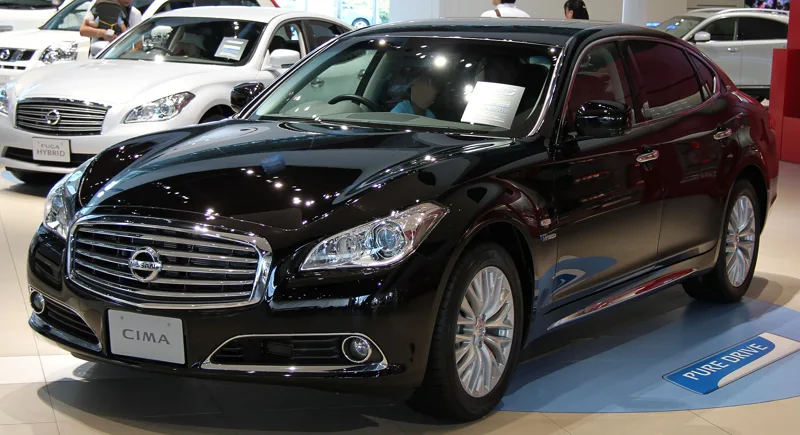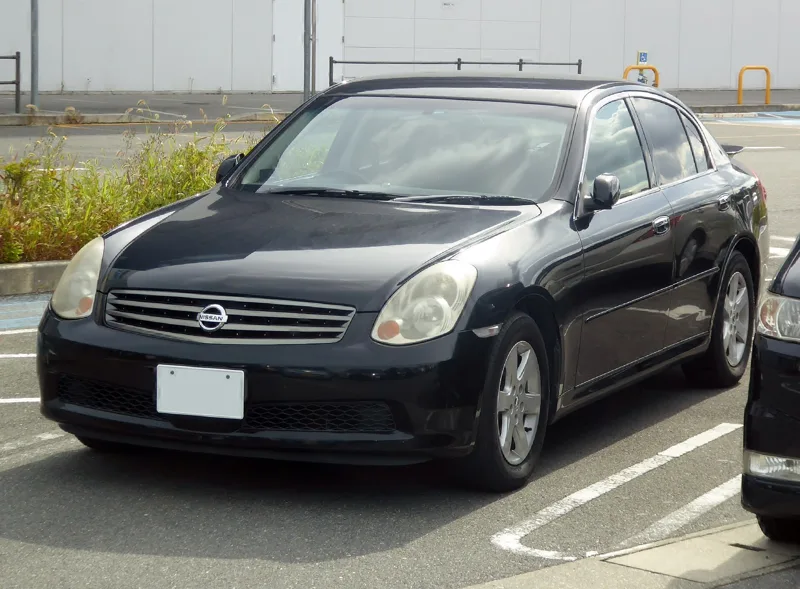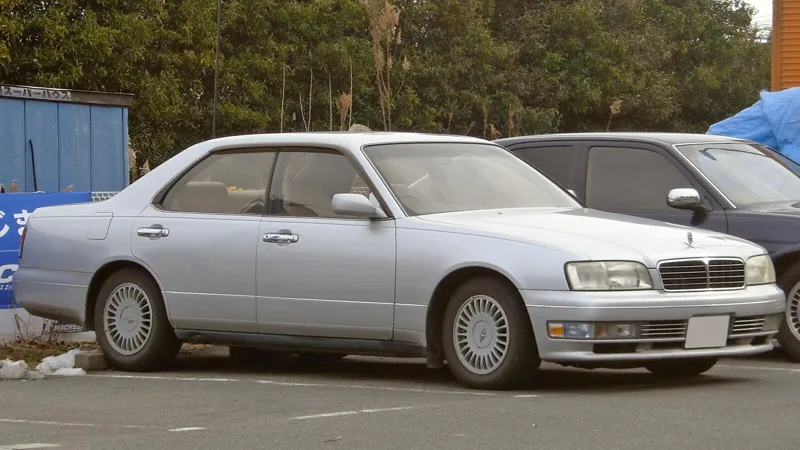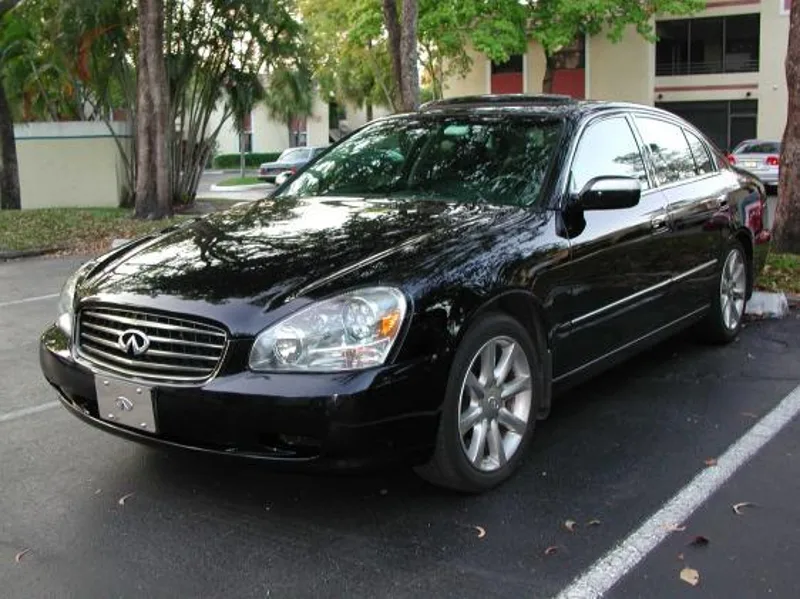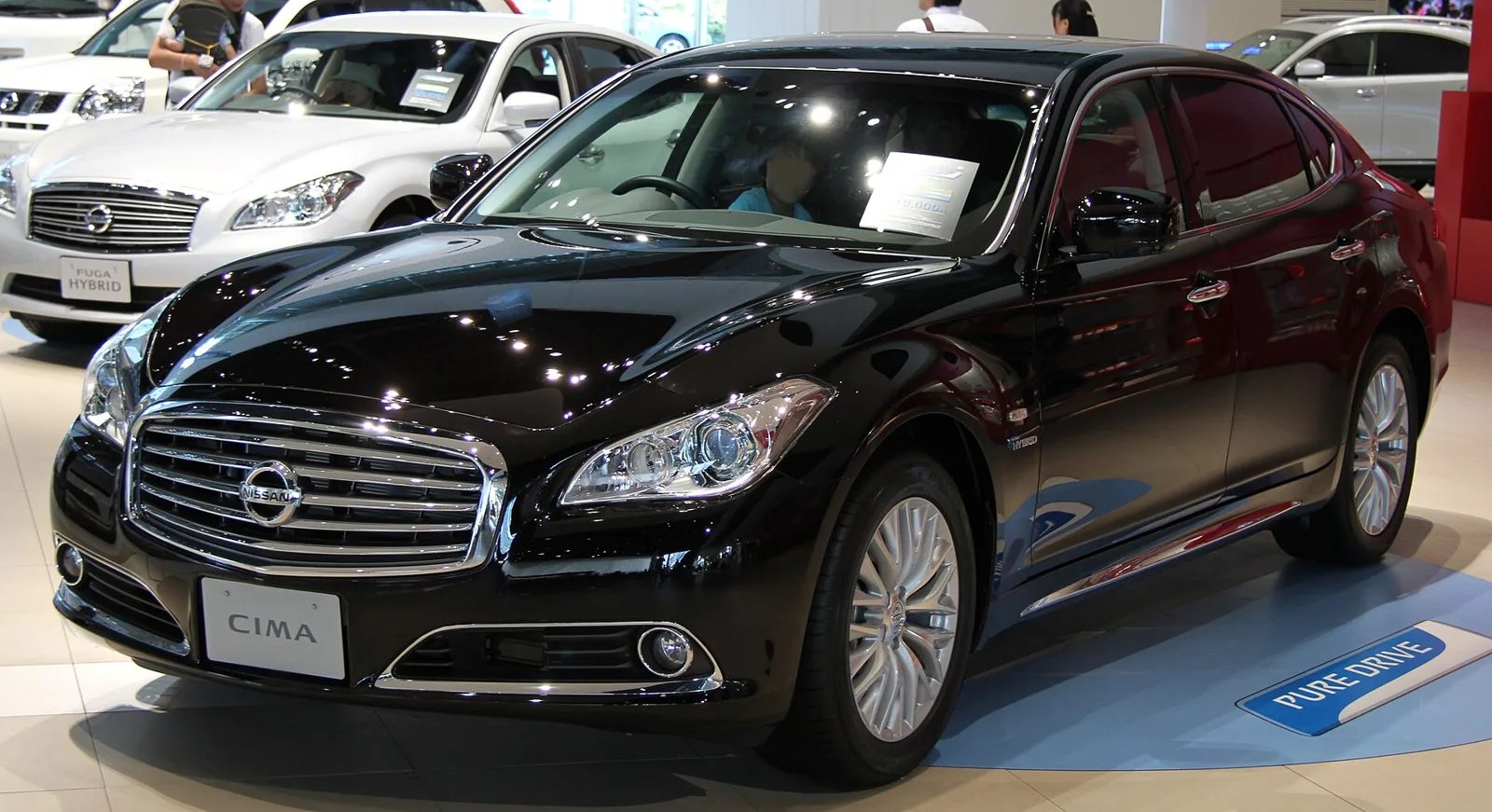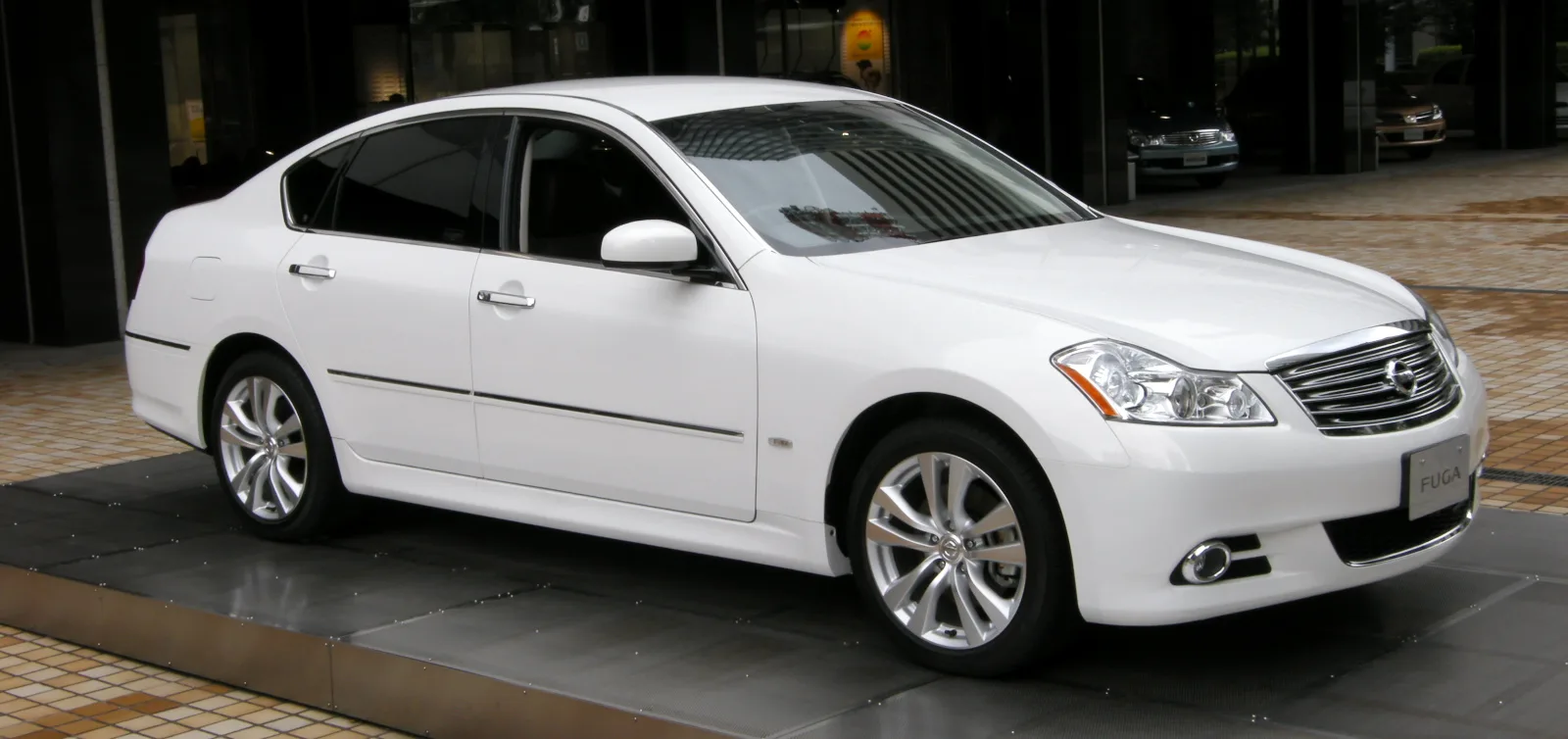
Nissan's 2004 E-segment saloon, sold in Japan until 2009, with a Fengya name in China and an Infiniti M series badge in other markets.
The Y50 Fuga is an E-segment saloon that Nissan Motor sold in Japan from 2004 to 2009 as the successor to the Cedric and Gloria. It came with V6 engines of 2.5 and 3.5 litres, and a V8 4.5-litre 450GT from August 2005. Production ended in October 2009.
For five years the Y50 Fuga stood in for two of Nissan's big saloons, the Cedric and the Gloria, which it succeeded in 2004. Its story runs from a Tokyo show prototype to a Nissan-badged version in China, a Mitsuoka stretch limousine and a full model change in 2009.
Where did the Y50 Fuga come from?
The Y50 Fuga replaced the Cedric and Gloria when it went on sale in Japan on 14 October 2004. It was built at the Tochigi plant and classed as an E-segment passenger car, sold in Japan until 2009.
Before the launch the Cedric had been handled by Blue Stage dealers and the Gloria by Red Stage dealers. The Fuga was the exception: it was sold through both channels ahead of the planned joint sale of every model across both.
The idea was first shown as a prototype named Fuuga at the 37th Tokyo Motor Show in October 2003. It used the FM package of the V35 Skyline, and the production car's design was modelled on it. The concept's wheelbase, however, was 50 mm longer, and its ceiling trim was styled after shoji screens.
The Fuga took the place of the Cedric and Gloria in 2004, on a chassis about twice as rigid as theirs.
How was the Fuga sold outside Japan?
Outside Japan the Fuga was sold as an M series car wherever Infiniti, Nissan's luxury brand, was present, including North America, Russia, the Middle East and South Korea. China was the exception. In June 2005 a Nissan-badged Fuga called Fengya went on sale there, equivalent to the Japanese-spec 350XV and 350XV VIP, and it kept four tailpipes like the 450GT.
After Infiniti entered the Chinese market in January 2007, the car was sold under the Infiniti badge as the M35 from January 2008, timed with the facelift. In North America the Infiniti M34 and M45 went on sale in March 2005, after an M45 concept had been presented in New York in April 2004.
Mitsuoka Motor had built its Gallue II on the Cedric and Gloria until 2004. In July 2005 it switched to the Gallue III, based on the Fuga.
The 2004 launch and the Murano show
The Japanese-spec Fuga was announced in September 2004 at the launch event for the Murano. It appeared alongside the Tiida, Tiida Latio, Lafesta and Note, five vehicles in all, and it reached showrooms in October.
The M45 concept shown in New York in April 2004 differed from the production car in some parts, such as the front bumper, but it had been presented in a form close to the car that followed.
Which engines did the Fuga use?
At launch the Fuga had a V6 2.5-litre (153 cu in) VQ25DE and a V6 3.5-litre (214 cu in) VQ35DE. The 3.5-litre matches the specification of the engine in the early Z33 Fairlady Z, but it was tuned for response and high-revs, so its low-speed torque is lower.
In August 2005 a V8 arrived in the 450GT series: a 4.5-litre (275 cu in) VK45DE, the same type as the North American Infiniti M45. Because Japan's vehicle noise rules differ from those of the United States, the Japanese engine sounds quieter, and its power was tuned for response, giving 333 PS (245 kW; 328 hp) against 340 PS (250 kW; 335 hp) for the North American car.
The same V8 went into the Cima, which was limited to 280 PS (206 kW; 276 hp). In the Fuga the intake system and oil pan were specially arranged.
What were the specifications at a glance?
| Item | Detail |
|---|---|
| Class | E-segment saloon, Y50 generation |
| Engines at launch | V6 2.5-litre (153 cu in) VQ25DE; V6 3.5-litre (214 cu in) VQ35DE |
| V8 from August 2005 | 4.5-litre (275 cu in) VK45DE, 450GT |
| 450GT output in Japan | 333 PS (245 kW; 328 hp) |
| North American M45 output | 340 PS (250 kW; 335 hp) |
| Transmission | JR507E five-speed automatic with manual mode |
| Drag coefficient | 0.28 (Type S 0.30) |
| Weight saving, aluminium panels | 38 kg against steel |
| Production ended | October 2009 |
| New cars registered to the month before sales ended | 70,729 |
What changed in the December 2007 facelift?
In December 2007 the 2.5-litre and 3.5-litre engines were replaced by the VQ25HR and VQ35HR units from the V36 Skyline saloon. Maximum output rose significantly, while maximum torque dipped slightly. The 4.5-litre V8 received minor changes to its camshaft control system.
The exterior was reworked too. The front bumper and grille, rear bumper, boot lid and tail lamps all changed, and the XV series was dropped. The sporty grade became the Type S, and the XV VIP's equivalent became the Type P.
How did the chassis and suspension work?
The Fuga used an improved version of the FR-L platform, which also underlies the V35 Skyline and the Z33 Fairlady Z. More than 60% of its parts were newly developed, and the chassis was substantially strengthened, with rigidity about twice that of the Cedric and Gloria. Aluminium bonnet, boot lid and door panels saved 38 kg against steel.
The front suspension is a newly developed double wishbone and the rear a multi-link. Every suspension arm and subframe is aluminium alloy. On the Skyline, which shares the FM platform, the front lower arm is a double pivot split into two parts. The Fuga went for a conventional A-arm instead to raise tyre camber stiffness and sharpen steering response. Fluid-filled bushes damp the steering vibration usually linked to A-arms, and the front subframe takes a grid-type igeta-gata form, which luxury cars rarely use, for better handling stability.
The shock absorbers were developed with an outside maker over about three years. A system called Ripple Control reduces small vibrations, a rebound spring improves stability during lane changes and cornering, and the dampers use a dual flow path. The 450GT's dampers have slightly weaker damping force.
Rear Active Steer, Nissan's four-wheel steering, was fitted to the early Sport Package and the late Type S to improve turn-in response. It is the same system as HICAS, and it was renamed to something easier to understand for export models.
What did the Fuga look like?
The front carried a double-arch grille, a design also used by Infiniti and some Nissan models, and the tail lamps had the L shape of the V35 Skyline and Skyline Coupe. The GT grades used LEDs arranged as two round lamps, as on the late V35 and V36 Skyline saloons.
The drag coefficient was 0.28, or 0.30 for the late Type S, with zero lift at the front. With optional aero parts the figure dropped to 0.27, with zero lift at both ends.
The XV and GT series differed in grille and bumper, and the 450GT added the enlarged rear bumper of the North American car. The December 2007 facelift brought further exterior changes, and the Type S received its own design to set it apart from the standard cars.
How roomy was the interior?
The long wheelbase and tall ride height gave the Fuga the largest interior in its class. Its front and rear headroom, rear knee room and rear legroom beat those of the Mercedes-Benz S-Class, the BMW 7 Series and the Toyota Celsior, all of which sit a class higher. The rear seat was the largest of any Nissan saloon, ahead of the Cima and the President.
The dashboard hardly changed between the early and late models. The lights around the meters and navigation display moved from orange in the early car to purple tones in the late one. Early seat trims came in black leather, black mole jacquard with Neosoffeel, ecru leather, ecru double Raschel and Fobe leather.
The finishers came in piano-finish, metal-look, wood-grain and real wood grain. The wood-grain option was dropped with the May 2006 upgrade. In the late model the Fobe leather became brown semi-aniline leather, and every trim and finisher could be chosen on every grade.
Which grades did buyers choose?
Early cars came in two families, XV and GT, but the December 2007 facelift unified the range under GT. Initially the engines were the 2.5-litre and 3.5-litre V6, and a V8 grade was added in August 2005. Sales in the first fortnight split about 3:7, and 3.5-litre cars made up the large majority, and the 350GT remained the best seller in the late model.
The XV line was the successor to the Cedric. It had its own grille and bumper, and 225/55 tyres on 17-inch aluminium wheels. It was offered with the 2.5 and 3.5-litre engines only, with no 4.5-litre option, and the metal-look and Fobe interiors were not available. The range included the 250XV, 350XV, the VIP versions and the four-wheel-drive 350XV FOUR. The VIP added reclining rear seats and a rear armrest with audio, air conditioning and seat-control switches, and the top 350XV VIP carried a dedicated emblem on its rear pillar.
The GT line carried on the Gloria Gran Turismo lineage, with a grille and bumper of its own and combination tail lamps with LEDs. The GT SPORTS PACKAGE came with 19-inch chrome-coated alloy wheels, while only the 450GT had 18-inch wheels of its own. There were no 2.5-litre cars in the GT line. The 4.5-litre cars came with a passenger power ottoman and front air-conditioned seats as standard, and their exhaust had dual tailpipe finishers, making four outlets.
From December 2007 the late model was all GT. The XV VIP was matched by the GT Type P, which also came on 4.5-litre cars, and the sporty grade became the GT Type S. A 250GT Type S joined the range in June 2008. The navigation system moved from DVD to a hard disk drive and became standard on all cars, and the intelligent cruise control became full-speed with a navigation-linked function.
Were there special editions?
Three limited editions appeared. Stylish Black Limited was launched in November 2005, with orders taken until the end of March 2006, on the 250GT, 350GT, 350GT FOUR and 350GT Sports Package. It brought the black interior and piano-finish trim of the 4.5-litre cars, 18-inch alloy road wheels, a passenger power ottoman and privacy glass. The sports package version kept its 19-inch wheels.
Stylish Silver Leather arrived in May 2006 across the GT grades, with grey leather seats and piano-finish trim. Stylish Black Limited II followed in November 2006, on all GT grades, with pearl suede and leather seats. Orders for it ran until the end of September 2007.
A specialist tuner, Hoshino Impul, offered IMPUL 650SE and 650S custom versions with styling and performance parts. Its 5.1-litre version of the VK45DE produced 380 PS at 5,600 rpm and 53 kgf-m at 2,850 rpm.
Mitsuoka Motor stretched its Gallue, based on the Y50, by 290 mm in wheelbase for the Gallue Limousine S50, which went on sale in October 2008. At the same time the Mitsuoka Limousine S50 was released with the Fuga's own exterior design. Neither had a 4.5-litre option, and the Mitsuoka Limousine S50 came in three grades, 250LX, 350LX and 350LX 4WD.
How did sales go, and when did the Fuga end?
The Y50 was built until October 2009, and only stock was sold after that. Its successor, the Y51, arrived in a full model change on 19 November 2009. New-car registrations up to the month before sales ended stood at 70,729.
In the first two weeks after launch the 3.5-litre cars dominated sales, and the 350GT was the best-selling grade in the late model. On the same day as the Y51 launch, a certified used car system began for all Y50 model years.
Chronology of the Fuga
- October 2003: Fuuga prototype displayed at the Tokyo show
- April 2004: M45 concept unveiled in New York
- 2 September 2004: production version unveiled
- 14 October 2004: sales begin in Japan
- March 2005: Infiniti M34 and M45 go on sale in North America
- 27 June 2005: Fengya released in China
- 28 July 2005: Mitsuoka launches the Gallue III
- 17 August 2005: 450GT, 450GT Sports Package and 250XV VIP join the range
- 30 November 2005: Stylish Black Limited edition
- January 2006: IMPUL 650SE unveiled at the Tokyo Auto Salon
- 25 May 2006: specification upgrade, plus Stylish Silver Leather
- 16 November 2006: Stylish Black Limited II edition
- 18 August 2007: North American facelift unveiled
- October 2007: facelift shown at the Tokyo Motor Show
- 20 December 2007: facelift goes on sale
- January 2008: Fuga sales end in China as the M35 launches
- 4 June 2008: 250GT Type S added
- 1 October 2008: safety kit added to the 250GT series and 350GT FOUR
- 23 October 2008: Mitsuoka Limousine S50 launched
- October 2009: production ends, stock sales only
- 19 November 2009: Y51 full model change and certified used car scheme
- 11 November 2010: Mitsuoka's new Gallue, based on the J32 Teana, replaces the Gallue III
What awards did the Fuga win?
The Fuga took the Sports Nippon King of Car award in 2004 and the RJC Car of the Year award in 2005. In 2005 it also won a Good Design Award in the product design category, and the Auto Color Award 2005 is also listed.
The Auto Color Award 2005 listings include a Fashion Color Award for the grayish bronze exterior with Fobe and wood-grain trim, or with silky ecru and piano-finish trim, an interior category entry for the Fobe silky ecru pairing, and a colour planning category.