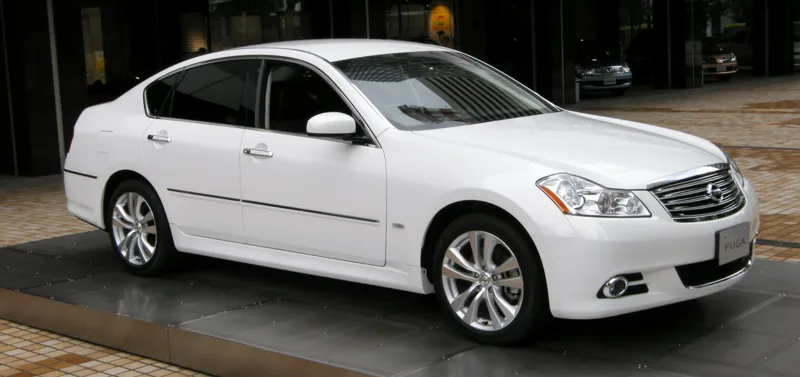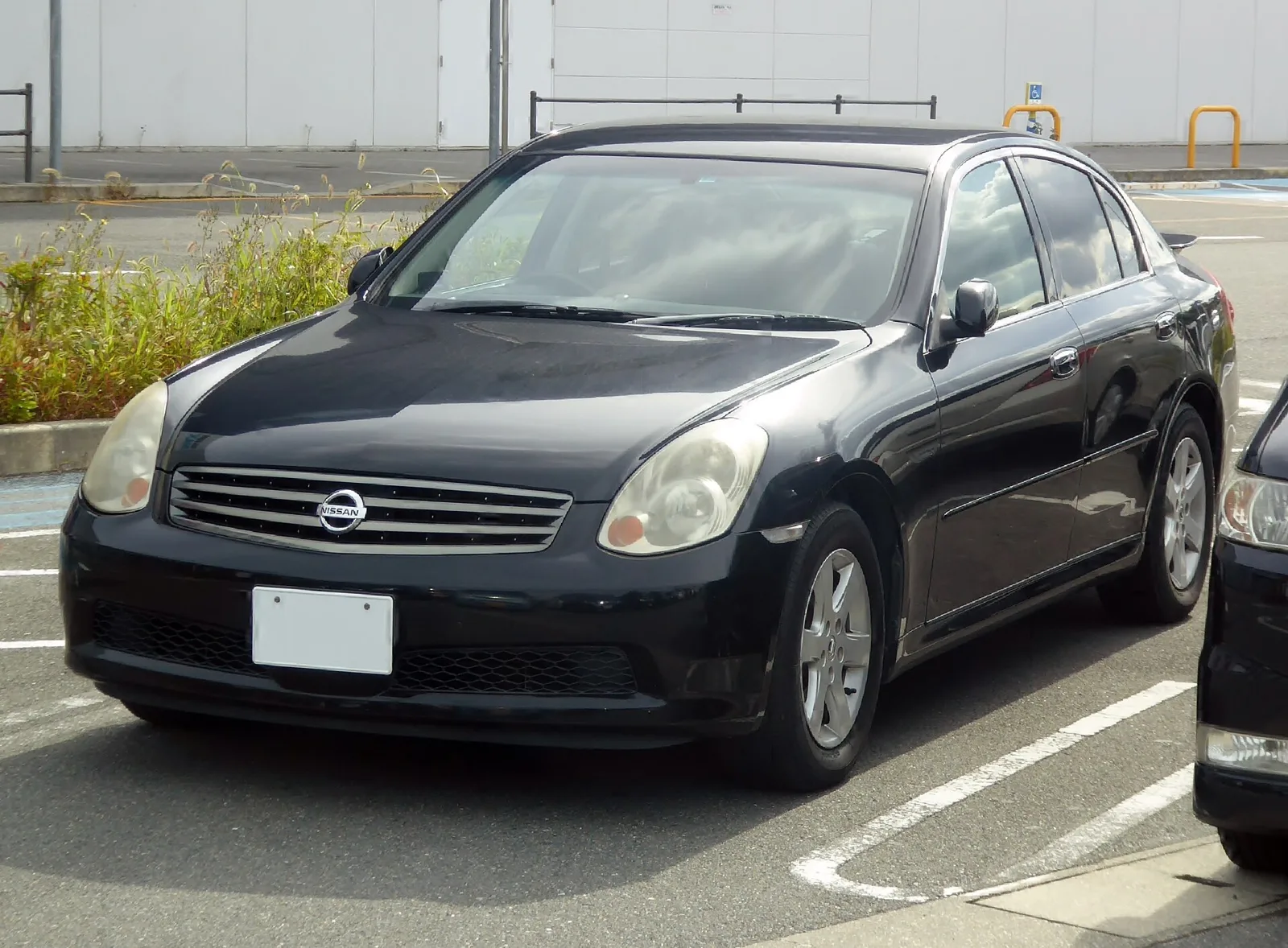
The eleventh-generation Skyline, sold in Japan from 2001 to 2006, with V6 engines, a front mid-ship layout and a major change of direction.
Nissan's V35 Skyline, the eleventh generation, ran in Japan from June 2001 to November 2006 with V6 engines and a front mid-ship layout. Export markets knew it as the Infiniti G35, and it earned high praise in North America.
The Nissan Skyline Sedan V35 was the eleventh generation of the Skyline line, sold in Japan from June 2001 to November 2006. It replaced the R34 with a new V6 engine, a new front mid-ship layout and a styling direction that many Skyline fans did not welcome. In North America, where it was sold as an Infiniti, it was a different story.
Why was the V35 called the third Skyline?
The V35 was the eleventh-generation Skyline, introduced in June 2001. Its model code switched from R to V to signal the VQ engine, and the front badge became Nissan's brand logo. For that reason, Skylines from the V35 onward are also called the third Skyline.
Japanese users and critics were not impressed. Many said it was not a Skyline at all, mainly because the design was heavily criticised and the change of concept was hard to accept. In North America, where the car sold under the Infiniti name, it won the 2003 Motor Trend Car of the Year.
This generation was also the first to be exported in earnest beyond Japan. Abroad the car was sold as the Infiniti G35. From the V35 onward, the sedan and coupe have been sold as Infiniti's G Series, while later crossovers took the EX Series name.
A Skyline that Japanese fans called no Skyline at all, and that North America crowned with a major car-of-the-year prize.
How did the V35 come to be developed?
The V35 grew out of the XVL concept, which was shown at the 33rd Tokyo Motor Show in October 1999. Development began in January 1998 as a completely new luxury sedan for the Infiniti brand, with the aim of revolutionising Nissan's rear-drive packaging. The successor to the R34 had been frozen, but the XVL was well received, and its concept overlapped so much with the Skyline's core that it was chosen as the next model.
Before the V35, the Skyline was so bound by convention that even a major platform change was hard to make. When the R33 was the current car, a big platform change had been planned for its successor. Kozo Watanabe, who led the development of the R34, found the proposal of Kazutoshi Mizuno, head of vehicle planning, attractive, and after driving prototypes he wanted the V35 package to appear already at the R34 stage.
The practical obstacles were real. ATTESA E-TS could only be paired with the VH engine developed for the Cima, which lengthened the programme. The VQ engine was built on a single line at the Iwaki plant, which was already running at full capacity at 20,000 units a month, and a second line was too costly. The R34 therefore kept the R33 concept, and only the V35 finally adopted the new package.
Which engines did the V35 use?
At launch the V35 offered two direct-injection V6s: a 2.5 L (152.6 cu in) VQ25DD and a 3.0 L (183.1 cu in) VQ30DD. Both were shared with the Y34 Cedric and Gloria, but they had been heavily revised, with the cylinder block redeveloped to refine the engine note.
The 3 L cars and the four-wheel-drive models used a five-speed automatic with manual mode from JATCO, developed for the F50 Cima. For cost reasons the 2.5 L front-wheel-drive cars used a four-speed JATCO JR404E, the same unit fitted to the earlier R34 and to the Y34 Cedric and Gloria.
In February 2002 the 350GT-8 arrived with a tuned 3.5 L (213.6 cu in) VQ35DE, an engine developed for the Elgrand and Pathfinder. The Xtroid CVT from JATCO, first seen in the Y34 Cedric and Gloria, was applied here for the second time, with eight speeds that can be shifted with paddle shifters. The CVT was a trial and was not carried over to the V36. The 350GT series also paired the 3.5 L with an Aichi Machine Industry six-speed manual, shared with the Fairlady Z and its coupe.
The VQ30DD was dropped in the November 2004 facelift, leaving 2.5 L and 3.5 L engines. The 3.5 L cars gained a five-speed automatic with Synchro Rev Control.
What was special about the V35's speed limiter?
Like other Japanese cars of its class, the V35 carried a self-imposed 180 km/h (112 mph) speed limiter. Most limiters cut the fuel at that speed and let the car slow down. The V35's limiter instead lets the car cruise at 180 km/h (112 mph).
How was the V35's body and chassis built?
The V35 was the first to use the front mid-ship package, developed from 1997 and later adopted for Nissan's front-engined rear-drive cars. It is also the basis of Nissan's FR-L platform. With the engine mounted longitudinally at the front mid-ship position, the weight split became 52:48 front to rear, an ideal figure for a front-engined car and a clear gain on the 54:46 of the R34.
That layout pushed the transmission into the cabin's centre tunnel and enlarged the bulge of that tunnel. The designers removed that drawback by giving the cabin a feeling of enclosure, as befits a sports sedan. Aluminium went into the bonnet and the bumper reinforcement, and resin into the radiator core support, to save weight.
The four-wheel multi-link suspension carried over, but its design was new and based on the Y34 Cedric and Gloria. Aluminium alloy helped make it one of the lightest unsprung weights in the world at launch. The ripple-control dampers were developed for the V35, and the R34 GT-R M-Spec had tested them earlier. The 350GT-8 received a Euro-tuned suspension that was newly developed for it.
The brakes were ventilated discs, but better weight distribution moved the front-to-rear brake force split to 63:37, further toward the rear wheels than the 70:30 of the previous car.
Why did the V35 look so different from earlier Skylines?
The styling was changed to shake off the Skyline's image as a car for enthusiasts. Its lines moved from straight to curved, and resin undercovers under the engine and boot improved aero performance. The drag coefficient fell from 0.33 on the R34 to 0.27, and lift dropped from about 0.13 to 0.01 or less, which gave zero front lift.
An optional rear spoiler and a dedicated undercover took the Cd to 0.26 and achieved zero rear lift as well. The aero gain also owed something to Nissan's exit from Le Mans, which freed the wind tunnel for road-car work for the first time.
The round twin tail lamps of the earlier Skylines gave way to L-shaped LED units. The November 2004 facelift rearranged the LEDs into round units, restoring the round twin layout. That arrangement was later used on the V36 sedan, the CV36 coupe and the first-generation Fuga.
The longer wheelbase enlarged the cabin to match the Cima, Nissan's F-segment luxury car. The boot gained more than 50 L on the previous car, reaching 475 L (VDA method), matching the Cefiro.
Which grades did the V35 come in?
At launch the 2.5 L cars were offered as the 250GT and 250GTe, and the 3 L cars only as the 300GT. The 250GTe was a budget grade without power seats and some audio equipment. A four-wheel-drive 250GT FOUR, with the ATTESA E-TS system, followed in September 2001.
The 350GT-8 arrived in February 2002 with Rays 17-inch alloys, Dunlop tyres, sports brake pads and high-rigidity rotors. VDC came as standard, and it had the first eight-speed manual mode in Japan, operated by paddle shifters.
The January 2003 partial change renamed the P Collection as Premium and dropped the S Collection, which left black synthetic leather seats on the 350GT-8 alone. In November 2004 the 3 L grades and the budget 250GTm were discontinued, along with the base 350GT.
What special editions did Nissan make?
Special editions included 70th-II, NAVI Edition, Limited Leather and Stylish Silver Leather. The first marked Nissan's 70th anniversary, the second added navigation, and the last two focused on interior trim.
- 70th-II (October 2003): second 70th anniversary edition, on the 250GTm, 250GTm FOUR, 250GT Premium and 250GT FOUR Premium, with an interior environment package including Plasmacluster air conditioning
- NAVI Edition (April 2004): DVD navigation system added to the 250GTm and 250GTm FOUR
- Limited Leather (April 2005): brown leather seats, wood-grain finishers and privacy glass as standard
- Stylish Silver Leather (June 2006): grey leather interior, also offered on the coupe, Stagea, Murano and Fuga
How did police forces use the V35?
Several police forces used the V35 in different roles. The Saitama Prefectural Police introduced the 350GT-8 for its expressway traffic unit, and the national budget paid for 350GT escort cars at police headquarters across Japan. The Ibaraki Prefectural Police used one for training.
Some prefectures also took 250GT and 300GT cars as traffic enforcement vehicles, including reverse-flashing light types, and 250GT cars were used as investigation vehicles by mobile investigation units.
Was there a GT-R version of the V35?
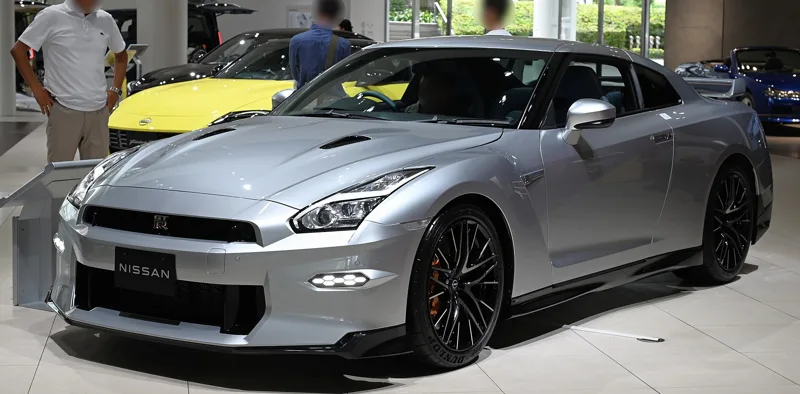
No. The V35 had no GT-R. Production of the R34 Skyline GT-R ended in August 2002, and the Nissan GT-R did not go on sale until December 2007, after the V36 Skyline had already appeared. That left a gap of about five years.
When did production and sales end?
Production of the sedan ended in October 2006, and sales stopped on 20 November 2006, when the 12th-generation V36 replaced it. Cumulative domestic registrations up to the month before production ended reached 86,190 units.
Key dates for the V35 sedan
- The XVL was unveiled in October 1999, at the 33rd Tokyo Motor Show.
- Sales started on 18 June 2001.
- The 250GT FOUR was added on 26 September 2001.
- The 250GTm followed on 31 January 2002.
- The 350GT-8 came on 19 February 2002.
- A partial improvement on 27 January 2003 brought more equipment and suspension and brake changes.
- The 350GT and 350GT Premium were added on 3 June 2003.
- The November 2004 facelift changed the exterior, the interior colours and the ATTESA E-TS system.
- The Stylish Silver Leather special edition went on sale on 1 June 2006.
Skyline Sedan V35 specifications
| Specification | Detail |
|---|---|
| Generation | Eleventh-generation Skyline sedan, 2001 to 2006 |
| Launch | June 2001 |
| Engines | 2.5 L (152.6 cu in) VQ25DD; 3.0 L (183.1 cu in) VQ30DD; 3.5 L (213.6 cu in) VQ35DE |
| Transmissions | JATCO five-speed automatic; JR404E four-speed automatic; JR006E Xtroid CVT on 350GT-8; MRA70 six-speed manual |
| Layout | Front mid-ship package |
| Weight split | 52:48 front to rear |
| Brake force split | 63:37 front to rear |
| Speed limiter | 180 km/h (112 mph), self-imposed |
| Drag coefficient | 0.27; 0.26 with optional spoiler and undercover |
| Lift | 0.01 or less at the front |
| Boot | 475 L (VDA method) |
| Wheels | 16-inch on 2.5 L cars; 17-inch on 3 L and 350GT-8 |
| Production end | October 2006 |