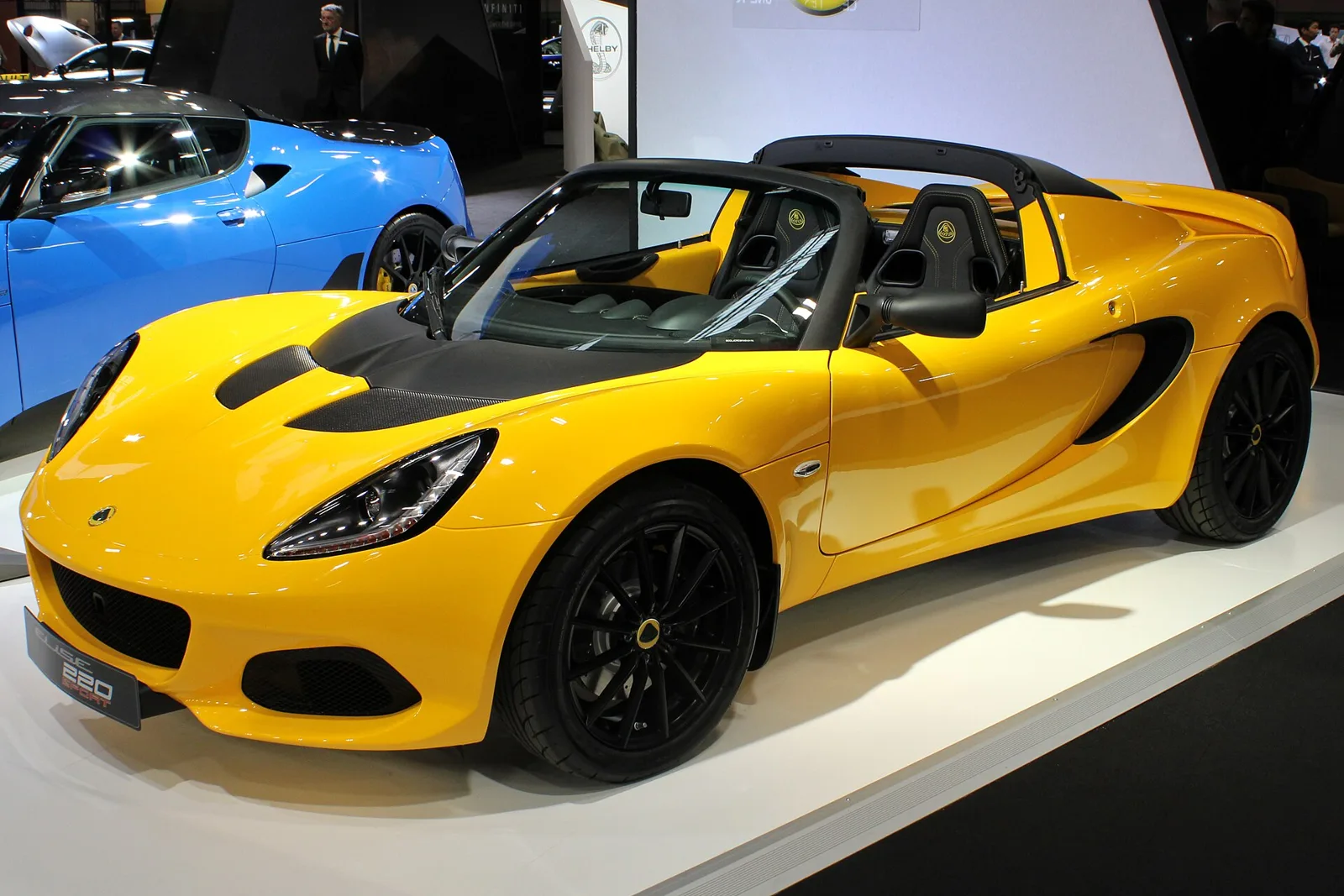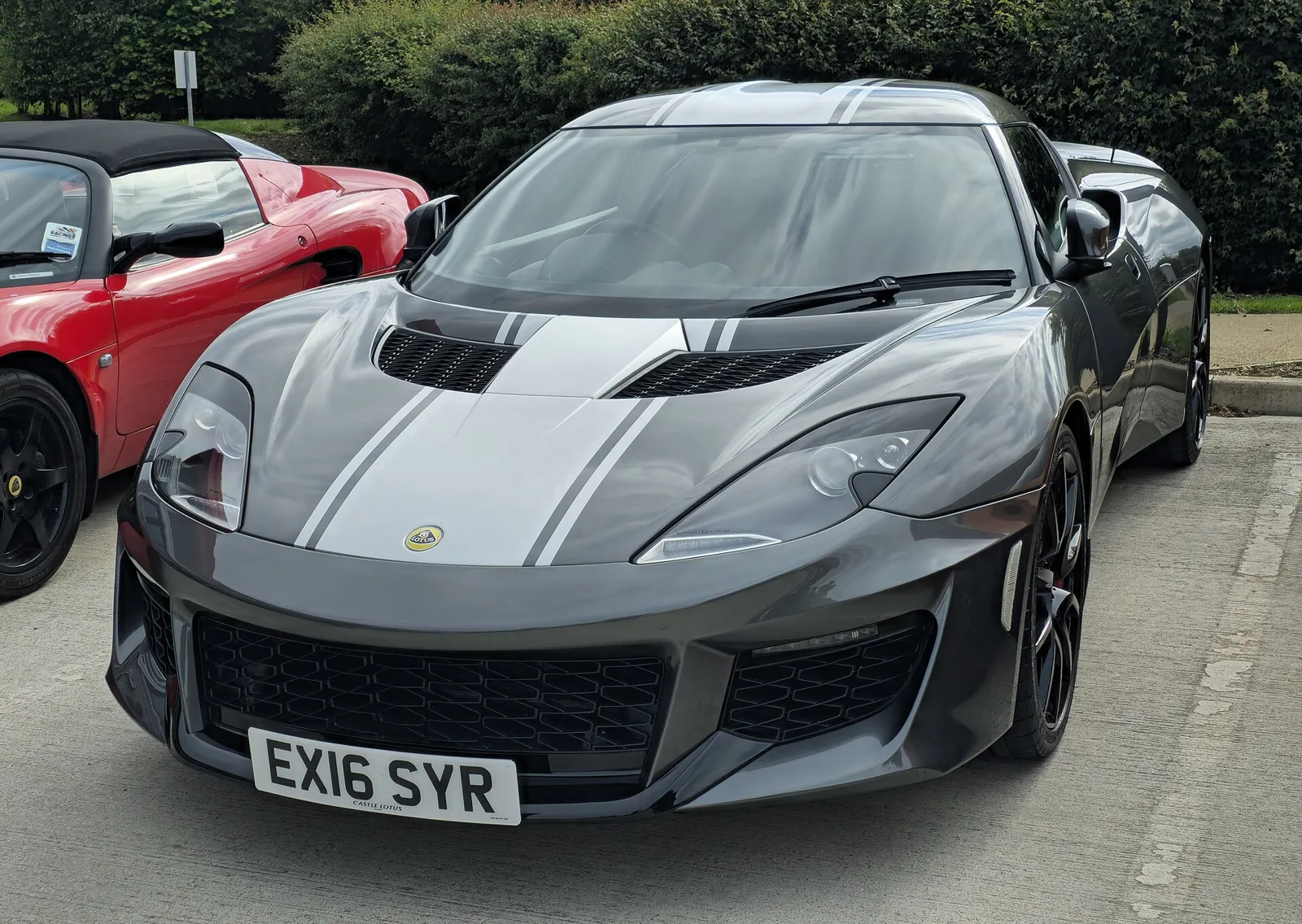
A mid-engined British sports car on Lotus's first all-new platform since the Elise, with a Toyota V6, a long run of performance variants and a GT300 racing career in Japan.
The Lotus Evora was a mid-engined British 2+2 sports car built from 2008 to 2021 with a Toyota-sourced V6. It moved through the Evora S, 400, Sport 410 and GT430 variants before the Emira replaced it in 2022. Outputs ranged from the 345 hp Evora S to the 430 hp GT430.
The Lotus Evora was a mid-engined sports car from the British maker Lotus, launched on 22 July 2008 and built until the 2021 model year. It was the company's first all-new platform since the Elise, and it was the first Lotus with a 2+2 seating layout. Most cars used a supercharged or naturally aspirated Toyota-sourced 3.5-litre V6.
This guide covers the origins of the car and its platform, the name and layout, the engine and gearbox, the Evora S, 400, Sport 410 and GT430 variants, the GT410 Sport and GT Sport, the special editions, the racing history, the reviews and the specification figures.
Where did the Lotus Evora come from?
The Evora was developed under the project name Project Eagle and launched at the British International Motor Show on 22 July 2008. It was the first all-new vehicle platform from Lotus Cars since the Elise arrived in 1995, and the Exige and the 2006 Europa S were both derived from that earlier car.
The Evora was planned as the first of three vehicles on the same platform. Lotus set a sales target of 2,000 cars per year, with prices between 45,000 pounds and just over 50,000 pounds, and planned US sales from the beginning of 2010.
A mid-engined 2+2 on Lotus's first all-new platform since the Elise, from the 345 hp S to the 430 hp GT430.
Why was the Evora a new kind of Lotus?
The Evora was the first product of a five-year plan started in 2006 to take Lotus beyond track-focused cars and into the mainstream. It was larger than recent Elise models and their derivatives, and it aimed at buyers who wanted a practical road car as well as a sharp one.
The unladen weight was 1,383 kg (3,049 lb) for the manual, and the automatic weighed 1,442 kg (3,179 lb). Lotus intended the car to compete in several market sectors, including the sector that the Porsche 911 occupied.
What does the Evora name mean and how is it laid out?
The name keeps Lotus's tradition of model names that begin with an E. It was derived from the words evolution, vogue and aura. Eagle and Ethos were considered but rejected, because they would have been difficult for Lotus to claim as trademarks.
The Evora was the only Lotus with a 2+2 configuration at launch, and it shared that layout with the BMW i8 as the only 2+2 mid-engined coupes on sale. Lotus said a two-seater option, called Plus Zero, could also be offered. The interior was enlarged to fit taller passengers, including people up to 6 ft 5 in (195.6 cm) tall.
The boot behind the engine could take a set of golf clubs, a fact that Lotus design head Russell Carr said was not intentional.
What engine and gearbox did the Evora use?
The Evora carried a mid-mounted, transverse 3.5-litre 24-valve 2GR-FE V6 sourced from Toyota. The Evora S used the same engine with a supercharger. Both versions could be ordered with a six-speed manual or a six-speed automatic with Intelligent Precision Shift, which was made by Aisin.
Lotus built the car on a lightweight aluminium tub with an aluminium front crash structure and a steel rear sub-frame that carried the drivetrain. The chassis used 6000 Series alloy extrusions, bonded with an epoxy adhesive and riveted together to raise torsional rigidity. The suspension was forged aluminium with double wishbones, Bilstein gas dampers and Eibach coil springs, and the steering was hydraulically assisted.
The drag coefficient was rated at Cd=0.337.
How did the Evora S change the car?
Lotus unveiled the Evora S in 2010. The S in the name stood for supercharged, but its supercharger was not intercooled. The car kept the standard design but was more powerful: a new Harrop supercharger lifted output to 345 hp (257 kW; 350 PS), with 295 lb-ft (400 Nm) of torque.
The exhaust became a single-tube system, and the dampers and steering were recalibrated for the new characteristics. The S could reach 60 mph (97 km/h) in 4.6 seconds, and its top speed was 172 mph (277 km/h). Lotus stopped building the S in 2014, and the Romanian police had one in their fleet from 2012.
What did the Evora 400 change?
The Evora 400 replaced both the standard Evora and the S in 2015 after its Geneva debut. The 400 name referred to its 400 hp (298 kW; 406 PS) output, which came from an intercooled Edelbrock supercharger. Torque rose to 302 lb-ft (409 Nm).
The 400 had an all-new body kit that added 23 kg (51 lb) of downforce, a driver-activated exhaust setting and narrower sills for easier entry. The dashboard and centre console were redesigned, and forged wheels became an option. The rear wing was changed to a split design, and the car weighed 1,395 kg (3,075 lb).
The 400 reached 60 mph (97 km/h) in 4.1 seconds, which was 0.5 seconds quicker than the S, and it topped out at 186 mph (299 km/h).
How much faster was the Evora Sport 410?
The Evora Sport 410, a slightly enhanced 400 with 10 hp more, appeared at the 2016 Geneva Motor Show, for a total of 410 hp (306 kW; 416 PS) and 310 lb-ft (420 Nm) of torque. Carbon fibre covered the roof, tailgate and front access panel, and the rear seats were replaced with one-piece carbon bucket seats.
A lithium-ion battery replaced the lead-acid unit, and the car weighed 1,325 kg (2,921 lb) overall. The 0-60 mph time fell to 3.9 seconds and the top speed reached 190 mph (306 km/h). With the IPS automatic the top speed fell to 174 mph (280 km/h).
Why was the GT430 the most powerful Evora?
In 2017 Lotus unveiled the Evora GT430, which it called the fastest street-legal car the company had ever produced. Only about 60 units were planned, and the car was the first of a new performance range within the Evora family. Its 3.5-litre Toyota-derived V6 produced 430 hp (321 kW; 436 PS), with a titanium exhaust.
Torque was 325 lb-ft (441 Nm) for manual cars and 332 lb-ft (450 Nm) for automatics, which had launch control and quicker gear changes. The GT430 was the lightest Evora, at 1,258 kg (2,773 lb) for the manual and 1,310 kg (2,888 lb) for the automatic, because of the extra weight of the automatic gearbox and its cooling.
Top speed was 190 mph (306 km/h) for the manual and 174 mph (280 km/h) for the automatic. The automatic reached 60 mph in 3.6 seconds, against 3.7 seconds for the manual. The GT430 also generated 250 kg of downforce at 190 mph.
The GT430 received a larger carbon-fibre rear wing, larger air intakes, forged aluminium wheels and polycarbonate lights. The interior was stripped down, the rear seats were removed, and the car had carbon-fibre trim and racing seats. Air conditioning stayed as standard, and each car carried a plaque with its production number.
What were the GT430 Sport and GT410 Sport?
Later in 2017 Lotus unveiled the GT430 Sport, which had a more aerodynamic body and no rear wing. Removing the wing reduced drag, and the top speed rose to 196 mph (315 km/h) for the manual, while the automatic stayed at 174 mph (280 km/h).
To mark the company's 70th anniversary, Lotus introduced the GT410 Sport. It took the GT430's basic shape with new composite front and rear panels and larger front air ducts, and it kept some of the 430's downforce pieces, while adding deeper splitters and carbon ducts behind the rear wheels. It produced 410 hp (306 kW) and 310 lb-ft (420 Nm), and it was 28 kg (62 lb) lighter than the 410 at 1,297 kg (2,859 lb).
The GT410 Sport reached 60 mph in 3.9 seconds with the manual and four seconds with the six-speed automatic. Downforce rose by 211 pounds, and it was offered as a two-seater or a 2+2.
The Evora GT arrived in June 2019 for the 2020 model year, and it was sold only in North America. Output was 416 hp (310 kW; 422 PS), and torque read 317 lb-ft (430 Nm) for the manual and 332 lb-ft (450 Nm) for the automatic. Lotus estimated 3.8 seconds to 60 mph regardless of gearbox, and the manual's top speed was 188 mph (303 km/h).
Which special editions did Lotus build?
The Evora 414E was a 2012 prototype hybrid, built as a demonstration project for the UK Government's Technology Strategy Board. It emitted 55 g/km of CO2, had an electric-only range of 30 miles, and used a 1.2-litre three-cylinder petrol engine as a generator, for a total range of 300 miles. The 414E formed the basis for the Infiniti Emerg-e concept.
Two Evora S cars with special equipment went to the Carabinieri, the Italian gendarmerie, in July 2011, and Lotus also offered to maintain them and train their drivers.
The Evora GTE road car was built so that its racing sibling could compete under GT3 and LM GTE rules. Only 25 units were built. It used the race engine to produce 438 hp (327 kW; 444 PS), and it weighed 1,277 kg (2,815 lb), which made it the most powerful Lotus road car at the time.
How did the Evora perform in racing?
Lotus showed the Evora Enduro GT concept at the 2011 Geneva Motor Show as a follow-up to its Type 124 and GT4 race cars. The team aimed to enter it in the LM GTE category by mid-2011, with a Toyota-supplied 444 hp (331 kW; 450 PS) V8.
Two Evoras ran at the 2011 24 Hours of Le Mans for Jetalliance Racing. Despite overheating in practice and qualifying, car No. 65 finished 22nd overall after 295 laps, while car No. 64 retired after 126 laps. Both cars used highly tuned naturally aspirated versions of the factory V6, rather than the planned V8.
In 2012 Jetalliance could not secure a European deal, so Alex Job Racing ran an LM GTE in the American Le Mans Series. The result was poor, and the team later switched to a Ferrari 458 Italia GT2 as its main race car.
In GT4 racing, Ollie Hancock won the Nurburgring round of the 2010 GT4 European Cup. Johnny Mowlem, Stefano D'Aste and Gianni Giudici took a podium at the Dubai 24 Hour race in 2011 as one team. D'Aste became the first Italian since Mario Andretti to win at Circuit Park Zandvoort in an official Lotus car, and he finished third in the GT4 European Series. Richard Adams, David Green and Martin Byford took the 2012 Britcar MSA British Endurance title driving an Evora GT4.
From 2015 to 2021 the Cars Tokai team ran an Evora in the GT300 class of Super GT in Japan, backed by Lotus Cars Japan. Engineered by Mooncraft, the Evora GT300 MC was a silhouette car built to the series' Mother Chassis rules, on a Dome chassis with a Nissan VK45DE naturally aspirated V8. It won for the first time at Fuji Speedway in 2020 and for the second and last time at Twin Ring Motegi in 2021.
How did critics review the Evora?
Early praise came from the British press: Autocar named it Britain's Best Driver's Car for 2009, and Evo gave it Car of the Year 2009. Those awards gave the Evora a strong start in the UK.
Jeremy Clarkson reviewed it on Top Gear and was positive overall. He was happy with the performance, handling and comfort, and he was impressed by the ride even after driving it into a field. He criticised the rear seats for their small legroom, the tinny interior and the satellite navigation.
Road and Track placed the Evora second in its 2017 Performance Car of the Year contest, describing it as the finest over-the-road enthusiast vehicle available at any price.
How did the Evora end?
The Evora GT was discontinued after the 2021 model year, and Lotus replaced the car with the all-new Emira in Spring 2022. In total 6,117 Evora cars were produced over the car's life.
What are the Lotus Evora specifications?
| Specification | Detail |
|---|---|
| Launch | 22 July 2008, British International Motor Show |
| Engine | 3.5 L 24-valve 2GR-FE V6, mid-mounted, Toyota-sourced |
| Transmission | Six-speed manual or six-speed automatic (Aisin) |
| Weight (manual) | 1,383 kg (3,049 lb) |
| Evora S | 345 hp (257 kW; 350 PS), 295 lb-ft (400 Nm); 0-60 mph in 4.6 seconds; 172 mph (277 km/h) |
| Evora 400 | 400 hp (298 kW; 406 PS), 302 lb-ft (409 Nm); 0-60 mph in 4.1 seconds; 186 mph (299 km/h) |
| Sport 410 | 410 hp (306 kW; 416 PS), 310 lb-ft (420 Nm); 1,325 kg (2,921 lb); 190 mph (306 km/h) |
| GT430 | 430 hp (321 kW; 436 PS); 1,258 kg (2,773 lb) manual; 190 mph (306 km/h) manual |
| GT410 Sport | 410 hp (306 kW); 1,297 kg (2,859 lb); 0-60 mph in 3.9 seconds manual |
| Evora GT | 416 hp (310 kW; 422 PS), 317 lb-ft (430 Nm) manual; 188 mph (303 km/h) manual |
| GTE road car | 438 hp (327 kW; 444 PS); 1,277 kg (2,815 lb); 25 built |
| Drag coefficient | Cd=0.337 |
| Total production | 6,117 Evora |