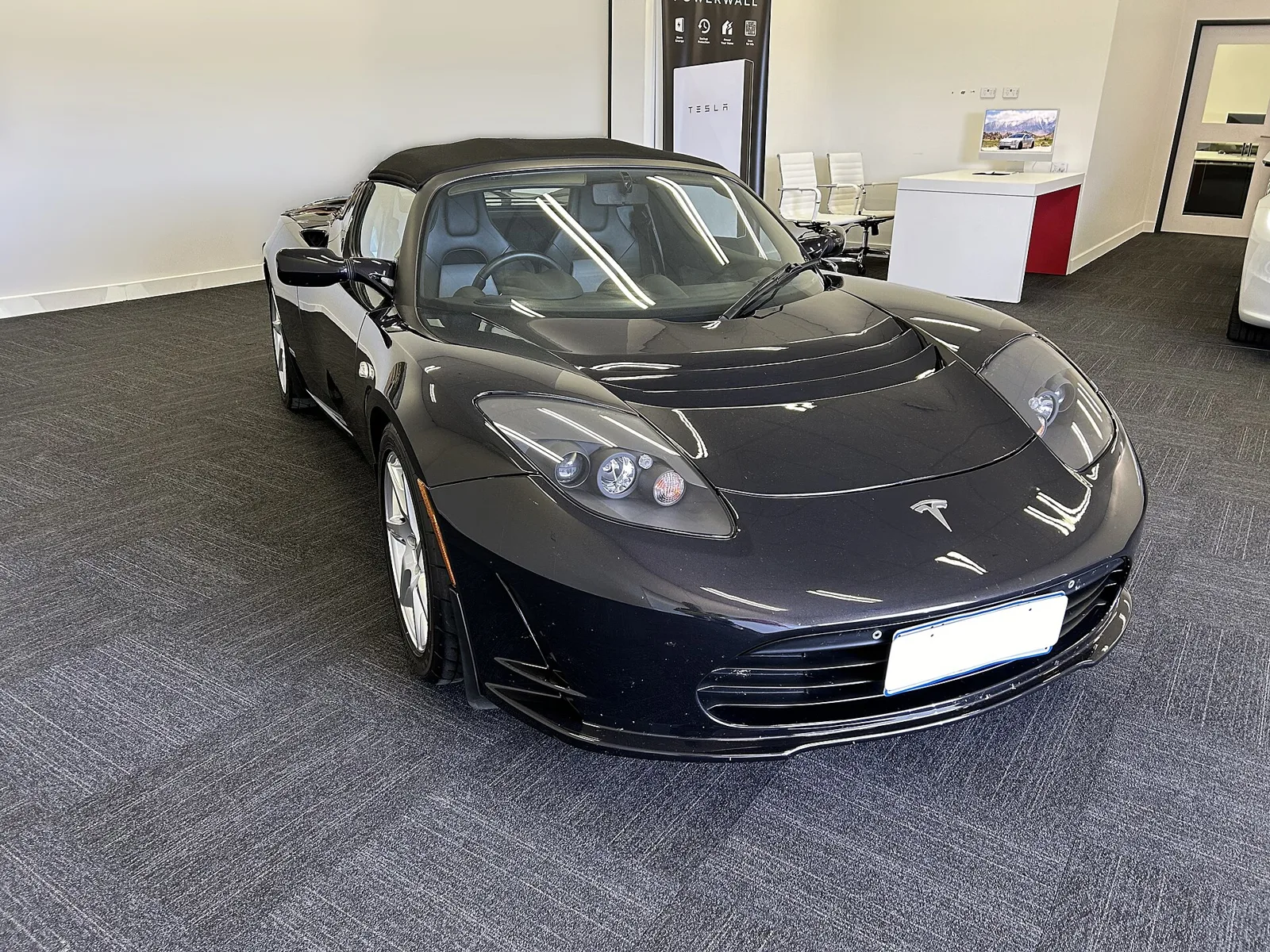
A 2008 electric two-seater built on a Lotus Elise chassis, with a lithium-ion pack, a 244 mile range and a place in space history.
Tesla's Roadster was a Lotus Elise-based electric two-seater built from 2008 to 2012. It sold about 2,450 cars in over 30 countries and had an EPA range of 244 miles (393 km). Its lithium-ion pack and 3.7 second Sport sprint made it a landmark for electric performance cars.
The Tesla Roadster was a battery electric sports car built on the Lotus Elise chassis and produced from 2008 to 2012. It holds an early place in automotive history as the first road-legal, series-built electric car powered by lithium-ion cells, and it showed that an electric car could be quick, desirable and road legal.
This profile covers how the car came about, how it was engineered, its performance and battery, the production run, the later versions, the reviews and the Top Gear dispute, and the car's unusual afterlife. Metric figures come first, with imperial values in brackets.
Where did the Tesla Roadster come from?
Tesla Motors was founded in Delaware on 1 July 2003 by Martin Eberhard and Marc Tarpenning, who wanted to turn an electric sports car into a commercial product. Elon Musk joined as an investor in 2004 and became chairman that April, placing the sports car at the centre of the company's plan.
Eberhard had gained battery experience at NuvoMedia, the maker of the Rocket eBook. After he sold the company, no sports car on the market suited him, so he set out to build an electric one. He test drove the tzero from AC Propulsion, and when that company declined to produce it, he and Tarpenning set up their own venture.
Musk invested US$7.5 million and oversaw the product design from the beginning. He argued that the sports car could fund the development of mainstream vehicles, which became a long-term strategy for the company.
The prototypes were revealed to the public on 19 July 2006 in Santa Monica, at an invitation-only event in Barker Hangar. Time later gave the car its transportation invention award for 2006.
A Lotus Elise-based electric sports car that proved the idea and carried Tesla through its early years.
How was the Roadster engineered?
The Roadster was built on a Lotus Elise chassis under a 2005 agreement with the British maker, which advised on design and development and produced partly assembled cars. Tesla then designed its own powertrain, motor and power electronics, and the body panels were made from resin transfer moulded carbon fibre.
The team first converted a tzero development mule from lead-acid batteries to lithium-ion cells, which increased range and improved acceleration. Tesla later designed its own power electronics and motor, because it was dissatisfied with how the borrowed motor and transmission worked in the chassis.
About 6% of the parts overlapped with the Elise, and the Roadster had a wheelbase two inches longer. In 2018 Musk said that using the Elise as a base had been a poor strategy, because the car was incompatible with the intended technology and only about 7% of the Elise remained.
Development moved through ten engineering prototypes, EP1 to EP10, in late 2006 and early 2007. At least 26 validation prototypes followed from March 2007, and they were endurance and crash tested before series production began.
How quick was the Roadster?
The standard Roadster reached 97 km/h (60 mph) in 3.9 seconds, while the Sport version managed 3.7 seconds. Its top speed was electronically limited to 125 mph (201 km/h), and the EPA range was rated at 244 miles (393 km) on a single charge.
Motor Trend independently confirmed the Sport's 3.7-second sprint in December 2009. It recorded a quarter mile of 12.6 seconds at 165.1 km/h (102.6 mph), and the car weighed 2,877 lb (1,305 kg) with a drag coefficient of 0.35 to 0.36.
The motor produced 248 hp (185 kW), and 200 lb ft (270 N m) of torque was available from 0 to 6,000 rpm. That made the car feel strong from a standstill, and the Sport's hand-wound stator raised output to 288 hp (215 kW).
How did the battery pack work?
The energy storage system weighed 992 pounds (450 kg) and contained 6,831 lithium-ion cells in the 18650 format. The pack held 53 kWh, and a full charge on the 240-volt, 70-amp High Power Wall Connector took about 3.5 hours.
The cells were arranged into 11 sheets connected in series, with 9 bricks in each sheet and 69 cells in parallel in each brick. The layout was designed to stop a single cell failure from spreading, and coolant circulated through the pack even when the car was switched off.
Tesla expected the pack to last seven years or 100,000 miles, and it offered pre-purchase battery replacements at about a third of the pack's price. A July 2013 study found that Roadster batteries still held 80% to 85% capacity after 100,000 miles.
Did the Roadster have fast charging?
No. The Roadster was never fitted with DC fast charging and was not retrofitted when Tesla's Supercharger network arrived. It charged on AC through a proprietary connector, a hard-wired 240-volt wall unit or portable adapters.
The 240-volt setup gave about 56 miles (90 km) of range per hour of charging in the best case. A 120-volt household socket added only about 5 miles (8.0 km) per hour, which kept it a slow option for most owners.
How did the production run unfold?
Production began in March 2008, and Tesla had delivered 500 cars by June 2009. The company reached 1,000 cars in January 2010, and it kept building until January 2012, when the supply of Lotus gliders ran out.
The early months were slow. A transmission problem forced Tesla to ship the first cars with the gearbox locked in second gear, and by 30 September 2008 only 30 cars had reached customers. The company said a newer transmission would fix the problem.
Tesla made its first profit in July 2009, when it shipped 109 vehicles. The company said the Roadster had brought corporate profitability for that month, earning US$1 million on revenue of US$20 million.
Right-hand-drive production for the UK and Ireland began in January 2010. Between February 2008 and December 2012 Tesla sold about 2,450 Roadsters, with the United States the leading market at about 1,800 cars.
What were the Roadster's later versions?
Tesla introduced the Roadster Sport in July 2009, followed by the 2.5 update in July 2010. The Sport had adjustable dampers and a hand-wound motor, while the 2.5 brought a new front fascia, directional forged wheels and better power control in hot climates.
Fifteen Final Edition Roadsters closed the production cycle, with five allocated to each of the three sales regions. They had atomic red paint and dark silver stripes, but no performance changes.
Tesla also offered the Roadster 3.0 upgrade from September 2015 to late 2016, with a new battery pack from LG Chem and a new aero kit. The upgrade cost US$29,000. In November 2023 Tesla open-sourced some design and engineering documents, along with diagnostic software.
Did the Roadster win races or records?
Yes. The Roadster set a world distance record for a production electric car of 501 km (311 mi) in outback Australia in October 2009, and in March 2010 it won the Monte Carlo Alternative Energy Rally, the first electric vehicle to do so.
Simon Hackett and Emilis Prelgauskas drove the record run from Alice Springs to Marla in South Australia. The car still had about 3.0 miles (4.8 km) of range left when the drive finished.
A Roadster also completed a 241-mile (388 km) rally with 36 miles (58 km) of charge left. Awards included BusinessWeek's Best Product Design of 2007, Forbes' Best Cars 2006 and a Popular Mechanics Breakthrough Award in 2006.
How did reviewers rate the Roadster?
Reviewers were largely impressed by the acceleration. The Wall Street Journal enjoyed its torque and speed, while Motor Trend called an early prototype undeniably efficient and said it would humble many a Ferrari or Porsche at a traffic light.
Car and Driver was less generous. Its technical editor, Aaron Robinson, pointed to design anomalies, awkward ergonomics and a steep price rise for buyers who had already paid deposits. He also said he never reached the 240-mile range because the seating was too uncomfortable.
Road and Track confirmed a sprint of around 4.0 seconds and a range of about 200 miles in its independent test. Dan Neil of the Los Angeles Times called the production car superb, and Nordic magazines praised its torque while noting a short battery life.
In 2009 some reservation holders were told that their options had been unlocked and that prices had risen. Tesla then made several options more expensive, and the standard car became US$6,700 dearer than before.
What was the Top Gear dispute?
In 2008 Top Gear reviewed two production Roadsters and praised their speed, but the segment also showed a car being pushed off a track after running out of charge. Tesla disputed the account, saying its cars had never dropped below 20% charge and had never suffered brake failure.
Tesla sued the BBC in March 2011 over libel and malicious falsehood. The High Court in London rejected the claim in October 2011, and the Court of Appeal later upheld that ruling, with Tesla ordered to cover the BBC's legal costs of 100,000 pounds.
The episode remains one of the best-known disputes between an electric car maker and a motoring programme. It shows how strongly the Roadster divided opinion while it was on sale.
What are the Tesla Roadster specifications?
The table lists the core figures for the standard Roadster and the Sport model. Where a figure is specific to one version, the table says so, so that the standard car is not overstated.
| Specification | Standard | Sport |
|---|---|---|
| Motor output | 248 hp (185 kW) | 288 hp (215 kW) |
| 0-97 km/h (0-60 mph) | 3.9 seconds | 3.7 seconds |
| Top speed | 125 mph (201 km/h), electronically limited | Not separately given |
| EPA range | 244 miles (393 km) | Not separately given |
| Weight | 2,877 lb (1,305 kg) | Not separately given |
| Battery | 992 lb (450 kg) pack, 53 kWh | Same pack |
| Charging | About 3.5 hours at 240 V, 70 A | Same connector |
The motor's torque of 200 lb ft (270 N m) was the same across the range, so the difference lay in the Sport's hand-wound stator and adjustable dampers.
Did the Roadster leave a legacy?
The Roadster showed that a small electric sports car could be built, sold and driven on public roads, and Musk used it to fund the development of later models. Its most unusual afterlife came in February 2018, when Musk's personal car was launched into space.
Musk's personal car, serial number 686, rode as dummy payload on the maiden flight of the Falcon Heavy. The car was placed in a heliocentric orbit beyond the path of Mars, making it the first production car launched into space.
Frequently asked questions
Was the Roadster still sold in the United States after 2011?
No. Tesla stopped taking US orders in August 2011, and the last cars could not be sold there once the exemption for two-stage airbags expired for cars built after 2011.
Could an older Roadster be upgraded?
Yes. The Roadster 3.0 upgrade raised battery capacity by 50% to 70 kWh with a new LG Chem pack, and it added tyres with lower rolling resistance and a drag-reducing kit.
Did a Roadster ever go into orbit?
Yes. A Falcon Heavy test flight carried one car into a heliocentric orbit in February 2018, and it travelled beyond the orbit of Mars around the Sun.
How much did a Roadster cost in the UK?
The UK right-hand-drive car started at 86,950 pounds, and the maker said it cost about 1.5 pence per mile to run.
Was there a right-hand-drive version?
Yes. Right-hand-drive production began in January 2010, and fewer than 50 cars were hand built in Britain for the UK market.