A roomier compact with MacPherson struts, a record-setting Japanese award run, a hybrid that reached North America as a 2003 model and a hot hatch Si.
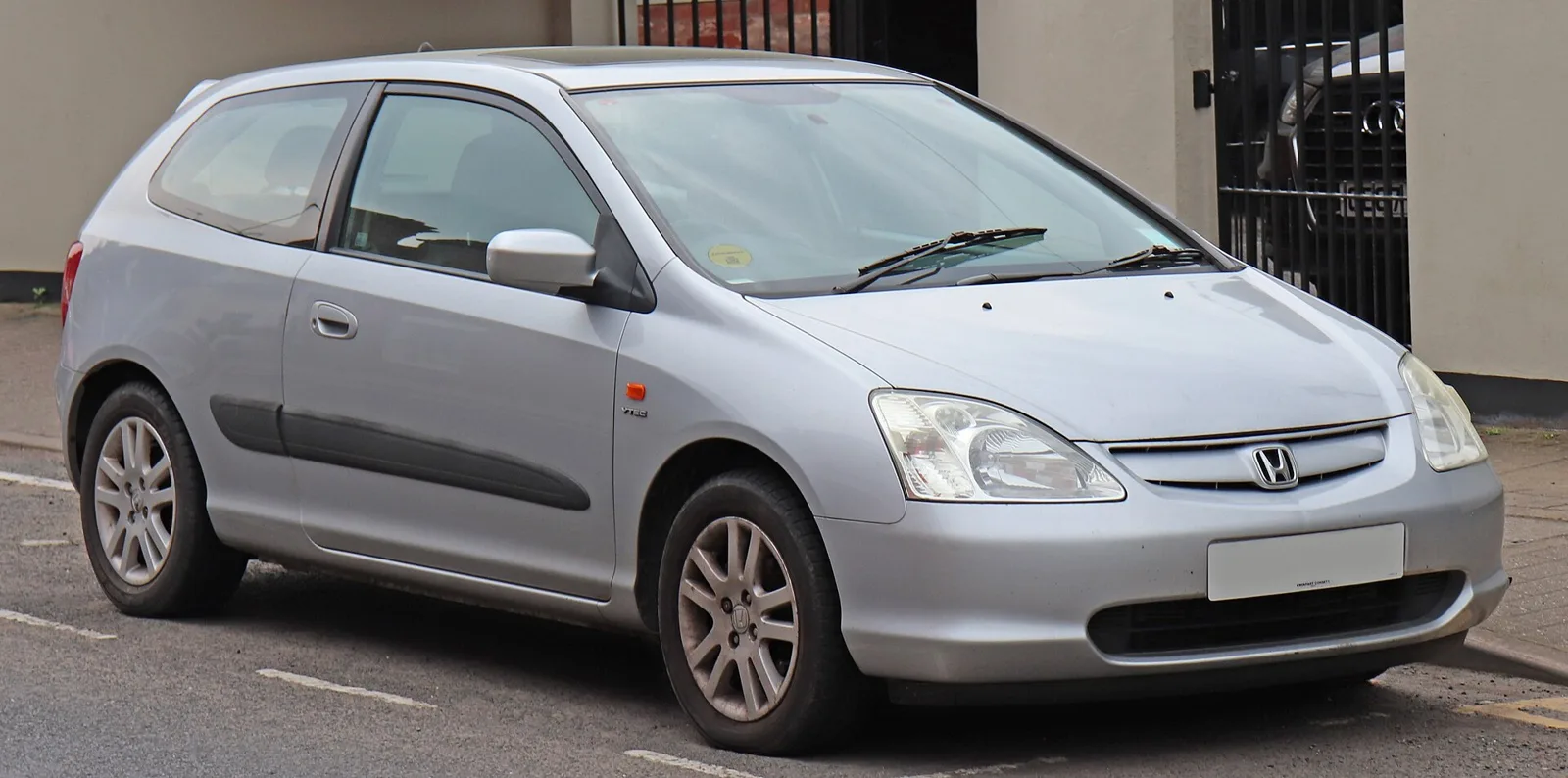
The Honda Civic seventh generation was built from 2000 to 2005 and debuted as a 2001 model with more interior space. It introduced MacPherson struts, a Civic Hybrid with a 1.3-litre engine rated 93 hp (69 kW) combined and a K20A3 Si rated 160 bhp (120 kW).
The seventh-generation Honda Civic was built from 2000 to 2005 and moved the nameplate into the compact class with much more room inside. It introduced MacPherson struts and a flat rear floor, and it produced a hybrid that reached North America as a 2003 model.
What made the seventh-generation Civic different?
The seventh-generation Civic debuted in September 2000 as a 2001 model. Its exterior stayed close to the outgoing car, but the cabin grew significantly, and a flat rear floor gave rear seat passengers more comfort than before.
Honda dropped the double wishbone front suspension it had used from the fourth to the sixth generations and fitted MacPherson struts instead. On the Si, the new front suspension allowed a tighter turning radius than the wishbone setup it replaced.
This was also the last generation to offer 4WD variants, which set it apart from the cars that followed.
A roomier compact with MacPherson struts and a hybrid that taught the market how far fuel economy could go.
Why did the seventh-generation Civic win awards?
The car won the Car of the Year Japan Award for a record fourth time at its introduction in 2000. It then took the Japan Automotive Researchers' and Journalists' Conference Car of the Year award in 2001, a year after its debut.
The engineering of the hybrid was recognised separately. Its engine won the International Engine of the Year title in the 1 litre to 1.4 litre category from 2002 through 2004, and it took the Best Fuel Economy category in 2003 and 2004.
In 2003 the American Council for an Energy Efficient Economy placed the hybrid among the top ten Greenest Vehicles, tied for third with the Toyota Prius.
How did the Civic Hybrid work?
The Civic Hybrid paired a 1.3-litre i-DSI engine with an assist motor rated 10 kW (13 hp), for combined output of 93 hp (69 kW) at 5,700 rpm. A 144 V nickel-metal hydride battery was charged by regenerative braking, and an idle-stop system shut the engine off at traffic lights.
The engine was a lean-burn design with twin spark plugs. It ran at a lean 22:1 ratio more than 60 percent of the time on a flat road, and during deceleration its VTEC cylinder cut-off closed the valves on three cylinders to let the motor recover more energy.
Torque figures show how the assist worked. The manual car made 116 lb ft (157 N m) at 1,500 rpm, while the CVT made 105 lb ft (142 N m) at 3,000 rpm. The electric motor added its own torque and worked as a starter as well as a generator.
The battery was 144 V nickel-metal hydride with a 6.0 Ah capacity, housed in an Intelligent Power Unit that weighed 63 lb (29 kg). Packaging the system behind the rear seat, in the trunk, freed up space in the cabin.
How fuel-efficient was the Civic Hybrid?
The Civic Hybrid was rated 46 mpg-US (5.1 L/100 km; 55 mpg-imp) in the city and 51 mpg-US (4.6 L/100 km; 61 mpg-imp) on the highway with the manual gearbox. Honda estimated it was 40 percent more fuel-efficient than the non-hybrid Civic.
Drag was reduced by a new front air dam, a rear spoiler and revised underbody panels. The drag coefficient fell from 0.30 to 0.28, and fuel efficiency improved by 6 percent from the aerodynamic work alone.
Honda claimed the car was the most fuel-efficient five-passenger gasoline production car in the world at its launch in Japan. At that time it was also the most economical five-passenger sedan sold in North America.
Car and Driver recorded 0-60 mph in 10.9 seconds.
Which engines did the seventh-generation Civic use?
The engine line-up depended on the market and trim, from the D17A1 in most DX and LX models to the K20A3 in the US Si. North American cars used a 115 hp (86 kW) engine, except the EX, which kept 127 hp (95 kW).
The US EX used the D17A2 engine, while the HX had the D17A6. Most non-Si North American engines were stroked to 1.7 litres. In Japan the RS model used the D17A, and the 5-door hatchback that Europe received used the D15B.
The Philippines and Middle East versions used a three-stage VTEC mechanism. The Pakistan VTi carried a D16W9 rated 130 hp (97 kW) at 6600 rpm, while the Pakistan EXi used a non-VTEC D15Y3 rated 115 to 117 HP (86 to 87 KW) at 6200 RPM.
Europe offered a D16V1 rated 110 hp and a D14Z6 rated 88 hp, along with Honda's first diesel offering. That diesel was a 1.7-litre Isuzu 4EE2 producing 100 PS (74 kW), and the European Type R used a K20A2.
The North American DX, LX and VP engines were the last Hondas without VTEC, apart from the 1996-2004 Acura 3.5RL, which was the other exception in the range.
What was the Civic Si like?
The seventh-generation Si returned to a hatchback body and used the K20A3 engine from the Acura RSX base model. Its rating was 160 bhp (120 kW) at 6,500 rpm, its redline was 6,800 rpm, and torque rose 20 percent over the predecessor, although the car weighed 2,744 lb (1,245 kg).
Performance was relatively underwhelming against its rivals. The switch to MacPherson struts made handling less responsive, and the weight gain of near-150 lb (68 kg) over the '99-'00 Si meant it accelerated more slowly than that lighter car.
The chassis was stiffer. Torsional rigidity rose 95 percent and bending rigidity rose 22 percent, which added weight but gave the body a firmer structure to work from.
Measured times were 7.6 seconds to 60 mph and 15.9 seconds through the quarter mile, putting it level with the Ford SVT Focus and Hyundai Tiburon GT V6. The Si lacked a limited-slip differential, and it had to be shifted into third gear to get from zero to 60 mph.
What was the 2003 Civic Si Concept?
Honda unveiled the 2003 Civic Si Concept at the 2002 SEMA show to show off the aftermarket potential of the Si. It used a GReddy T518Z turbocharger, a prototype GReddy front-mounted intercooler kit and a four-piston Brembo brake system.
The exterior had a rally-inspired body kit with a carbon fibre grille, a high-mounted two-stage rear wing and smoked taillights. Inside, Mugen carbon fibre and Kevlar race seats covered in red suede sat beside a six-point harness.
The concept showed how far the Si could be pushed, although it remained a show car rather than a production model.
How did the Civic differ between markets?
The seventh-generation Civic varied widely by market. Japan had a VTEC-E 1.5-litre with a CVT until September 2003, Thailand built sedans in Ayutthaya, and Malaysia sold limited runs of 60 and 150 units.
In Europe the 5-door K20A3 hatchback was sold as the Civic Type-S, with a 2.0 badge in the front grille. The Type-S was the rarest trim of the generation, and a sporting hatchback Si was unveiled for that market only in August 2005.
The Philippines launched the car in 2001 as a sedan only, with 1.5 LXI, 1.6 VTi and 1.6 VTi-S trims. Honda updated it in 2003 and again in 2004, when the 2.0 i-VTEC arrived as an automatic with a five-speed transmission.
What trims did the Civic offer in North America?
North American coupes came in VP, DX, HX, LX, EX, Si and RAJ trims, while sedans came as DX, VP, LX, EX, GX and MX Hybrid. The EX sedan included a sunroof, and a 2002 limited edition marked a Canadian milestone.
In 2003 Honda added a 30th Anniversary Edition to all models. In 2004 the DX trim was replaced by a Special Edition model, and the Si was the only hatchback trim sold in the United States and Canada.
The Si was built in Swindon, England, and exported to Canada and the United States.
How well did the Civic sell in the United States?
In 2004 the Civic was the seventh best selling vehicle overall in the United States and the third best selling passenger car. Those results came from a range that spanned coupe, sedan and hatchback styles.
The 2003 Greenest Vehicles ranking and the fuel economy awards gave the hybrid a strong profile in the market.
Consumer Reports gave the 2003 Civic EX sedan a Recommended rating, and the Civic HX took the best vehicle in class award in 2001.
What changed in the 2003 and 2004 facelifts?
The 2004 model year brought a facelift with new headlights, bumper and grille, plus side skirts and body-coloured bonnet and boot trim. A small centre console replaced the driver's armrest, and the rear seats gained adjustable headrests.
The 2004 and 2005 Si received dual headlight designs and standard side skirts, along with an option for a factory performance upgrade. The suspension moved from a 4-lug to a 5-lug bolt pattern and gained a larger rear sway bar.
Si wheels moved from 15-inch to 16-inch (205/55-16), and the interior received more silver accents in place of the chrome.
What are the Honda Civic seventh generation specifications?
| Specification | Detail |
|---|---|
| Production | 2000 to 2005; debut September 2000 as a 2001 model |
| Si engine | K20A3, 160 bhp (120 kW) at 6,500 rpm |
| Si redline | 6,800 rpm |
| Si weight | 2,744 lb (1,245 kg) |
| Hybrid engine | 1.3-litre i-DSI, 85 hp (63 kW) at 5,700 rpm |
| Hybrid combined | 93 hp (69 kW) at 5,700 rpm |
| Hybrid battery | 144 V nickel-metal hydride, 6.0 Ah |
| Hybrid fuel use | 46 mpg-US city, 51 mpg-US highway (manual) |
| Hybrid acceleration | 0-60 mph in 10.9 seconds (Car and Driver) |
| European diesel | 1.7-litre Isuzu 4EE2, 100 PS (74 kW) |
| European engines | D16V1 at 110 hp; D14Z6 at 88 hp |