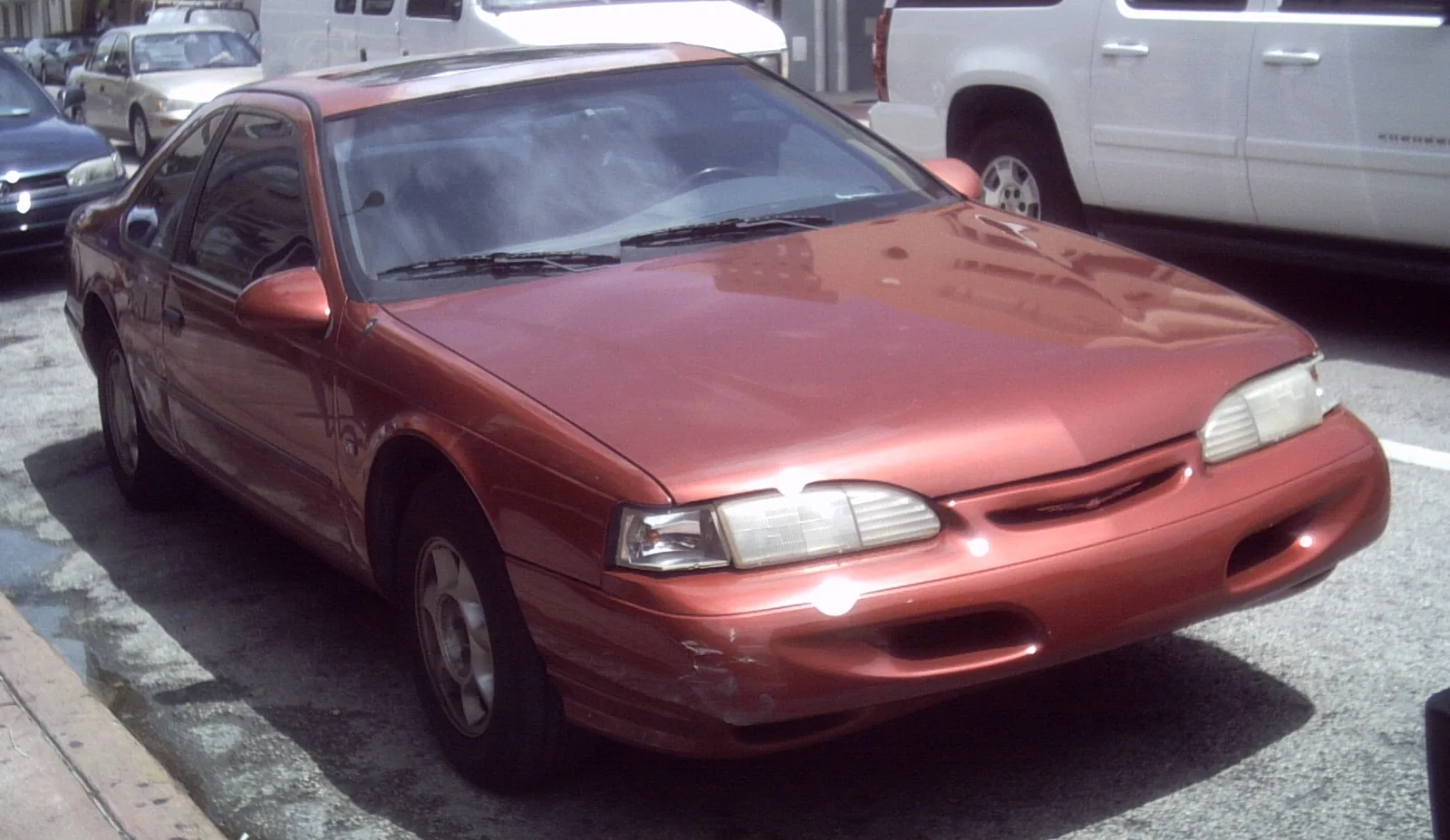
A rear-drive personal luxury coupe with independent suspension, a supercharged Super Coupe and the 4.6-litre V8 that closed out the MN12 era.
The tenth-generation Thunderbird was a rear-drive Ford personal luxury coupe built on the MN12 platform from 1989 to 1997. It used a 140 horsepower V6 at launch, a supercharged Super Coupe and, from 1991 until 1997, a V8 option. Production ended in 1997.
The tenth-generation Ford Thunderbird was a two-door luxury coupe for five people, with its engine at the front and power sent to the rear wheels. It arrived at the end of 1988 as a 1989 model and stayed in the range until 1997.
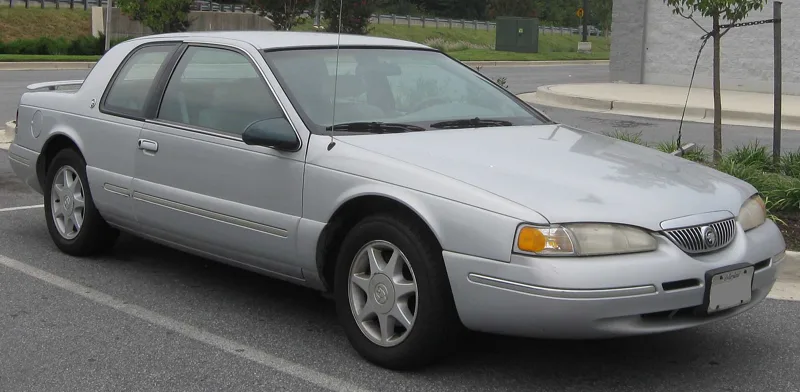
Ford built the car on its MN12 platform together with the Mercury Cougar, and the Lincoln Mark VIII shared the same foundations. The new body was more aerodynamic and a little shorter overall, yet its wheelbase grew by nine inches compared with the 1988 car.
How was the MN12 Thunderbird suspended?
Every corner had independent suspension. The front used short and long arms with a spring strut, and the rear used a multi-link layout that gave strong handling and a comfortable ride. Apart from the Corvette, the Thunderbird, Lincoln Mark VIII and Cougar were the only rear-drive domestic cars from North America with that arrangement.
The layout set the car apart from its class rivals, but it also added cost and weight. The programme team later had to answer for both, and the criticism that followed shaped the car's reputation inside Ford.
Management called the new Thunderbird a failure, yet its Super Coupe won Motor Trend Car of the Year for 1989.
What engines did the 1989 Thunderbird offer?
Engine choices shrank to two for 1989, after Ford dropped the V8. The standard unit was the 3.8-liter Essex OHV V6. Its peak power was 140 horsepower, or 104 kW, reached at 3,800 rpm, and torque peaked at 215 lb-ft (292 N-m) at 2,400 rpm.
Many found the V6 a little short of power for a car that weighed more than 3,500 pounds (1,600 kg) with the base equipment, and the weight of options made matters worse. Every V6 car used Ford's AOD four-speed automatic from 1989 to 1993, whatever the trim.
The V6 also carried the best fuel-economy figures in the range, better than those of the higher-performance engines.
How economical was the base V6?
The EPA rated the 1989 car with the standard V6 at 19 mpg-US (12 L/100 km) in town, and at 8.7 L/100 km (27 mpg-US) on the highway. Those figures were later lowered by the EPA, as happened with most cars built before 2008, to reflect more realistic testing.
A low drag coefficient helped the car's figures. The 19-gallon fuel tank, later reduced to 18 gallons, gave the base car a useful range between fill-ups.
Ford put the blue oval on the trunklid alone, which made this generation unusual, since the Thunderbird normally carried no Ford badge on the exterior at all.
What made the Super Coupe special?
The Super Coupe was the performance Thunderbird, with a supercharged and intercooled 3.8-liter V6 rated at 210 horsepower (157 kW). Buyers could pick a Mazda-derived five-speed manual or the AOD automatic, and Motor Trend named the Super Coupe its Car of the Year for 1989.
The supercharger delivered 12 psi of boost at a maximum of 5,600 rpm. Torque reached 315 lb-ft (427 N-m) at 2,600 rpm, and the early engines ran an 8.2:1 compression ratio.
Super Coupes came with extra equipment. Their alloy wheels measured 16 x 7.0 inches and carried performance tyres, where standard cars had 15 x 6.0-inch steel wheels, plus a Traction-Lok limited-slip differential, anti-lock brakes, four-wheel discs, speed-sensitive steering and fog lights. Tokico supplied the adjustable shocks.
How did the Thunderbird's development go wrong?
Ford's top management did not regard the new Thunderbird as a success. In January 1989 the company's president, Harold Poling, criticised the MN12 programme staff for missing weight and cost targets by 250 lb (113 kg) and US$900 a car.
The staff had expected praise for the cars' engineering, so the criticism came as a shock. Tony Kuchta, the MN12 manager, was more upset that the criticism landed on his team rather than on him, since many of the overruns followed from the features that set the car apart.
Kuchta had fallen out of favour with management after the launch, and he retired early from Ford in May 1989.
When did the V8 return?
The V8 came back in 1991 as a 5.0-liter unit, sold alongside a sports suspension. Peak output was 200 horsepower (149 kW) at 4,000 rpm, and torque reached 275 lb-ft (373 N-m) by 3,000 rpm. Set against the 1988 car, it made 45 hp (34 kW) more and 10 lb-ft (14 N-m) more torque.
The V8 was paired only with the AOD automatic, and it stayed in the range until 1993. A MotorWeek road test of a V8 car recorded 0 to 60 mph in 9.2 seconds, about two seconds quicker than the V6 but two seconds slower than a Super Coupe.
What styling changes came in 1992 and 1993?
The 1992 model year brought the first restyling, with a reshaped decklid and LED tail lamps that were new to production cars, a first for any production car's taillights. In that year only, Ford also sold a V8 Sport version, and for 1993 every Thunderbird wore the Super Coupe front end.
The V8 Sport brought Super Coupe front styling and fog lamps, plus lower accent stripes and a suspension upgrade with better handling.
What did the 1994 refresh change?
The refresh was extensive, touching the powertrain, the exterior and the cabin in one go. It brought extra safety equipment and a full interior redesign, which included dual front airbags and a new steering wheel and dashboard layout for the driver.
Outside, the front fascia gained larger air intakes, new headlamps and a slightly more curved hood, and the Thunderbird badge moved to the upper air intake. The interior swapped motorised seatbelts for conventional belts, and LX seats gained a choice of fabric or leather.
The most important change was the switch to the 4.6-liter Modular SOHC V8, a replacement for the 5.0 small block. Its peak was 205 horsepower (153 kW), reached at 4,500 rpm, and its torque peak was 265 lb-ft (359 N-m) at 3,200 rpm. A revised engine computer came with it, and an electronically controlled 4R70W automatic took over wherever the AOD had been used.
Car and Driver recorded 0 to 60 mph in 8.1 seconds for the V8, with a quarter mile covered in 16.3 seconds and a finishing speed of 87 mph (140 km/h).
How quick was the 1994 and 1995 Super Coupe?
The 1994 Super Coupe kept the supercharged V6 but raised output to 230 horsepower (172 kW) at 4,400 rpm, and torque at 2,500 rpm reached 330 lb-ft (447 N-m). A larger supercharger inlet, bigger injectors and an 8.5:1 compression ratio made the gain possible.
Motor Trend ran a comparison in its March 1996 edition, pitting a 1995 Super Coupe against two front-drive rivals: the Chevrolet Monte Carlo Z34 and the Buick Regal Gran Sport. The Super Coupe was the quickest of the three, reaching 0 to 60 mph in 7.0 seconds and finishing the quarter mile in 15.2 seconds, with an exit speed of 141.8 km/h (88.1 mph).
The reviewer called the Super Coupe the clear winner, a sophisticated answer to the four-seat coupe that carried a higher price. Slowing sales still led Ford to end the Super Coupe after the 1995 model year.
What changed in 1996 and 1997?
For 1996 the Thunderbird was sold only as an LX, and fewer options were offered as the model wound down. It gained a honeycomb mesh grille, clear headlamp lenses, body-coloured door handles and new lower cladding, along with a Sport option for V8 cars.
The Sport package included a performance suspension, 16-inch aluminum wheels and a rear decklid spoiler. The spoiler held a reverse light that had previously sat inside the cabin.
1997 was the final year. Horsepower was unchanged, but a revised manifold lifted V8 torque to 280 lb-ft (380 N-m), while many interior options were removed and the dashboard was simplified to match the Taurus.
Which special editions did Ford build?
Ford made several special editions across the run, from a 1990 35th Anniversary model to 1997 cars linked to NASCAR drivers. Some were tied to racing figures, and others to anniversaries. Most differed in badges, interior trim or paint, and several were built in small numbers.
The 35th Anniversary Edition was a black Super Coupe with blue and silver stripes, two-tone wheels and anniversary fender badges. Ford made 3,371 examples, all for 1990 only.
The 1993 Davey Allison Limited Edition honoured the NASCAR driver who died in a plane crash in July 1993. It was offered in white or black, with red pinstripes, embroidered floormats and a plaque bearing his signature, and 1500 cars were made.
The 1995 40th Anniversary package cost US$795 and added accent stripes, floormats, front fender badges and a key chain. Its production total is not known.
The 1996 SVE prototypes were a late attempt at a high-performance Thunderbird. Ford's Special Vehicle Engineering division built four, with a supercharged 4.6 L DOHC V8, a Tremec T-45 five-speed manual and 17-inch Cobra R wheels. Three were destroyed, and the surviving car is in private hands.
The 1997 Mark Martin Edition was one of six Roush Racing builds celebrating the NASCAR driver's success in a Valvoline-sponsored Thunderbird. Ford was not officially involved, and each car had Moonlight Blue paint and grey leather seats.
The 1997 Limited Edition marked the last year of the MN12 car. It resembled the 40th Anniversary model, with grey side trim, embroidered floormats and Limited Edition badges.
What were the MN12 Thunderbird's main specifications?
| Specification | Detail |
|---|---|
| Model years | 1989 to 1997 |
| Platform | Ford MN12, shared with the Mercury Cougar |
| Base engine, 1989 to 1997 | 3.8 L Essex OHV V6, 140 hp (104 kW) at 3,800 rpm |
| V8, 1991 to 1993 | 5.0L V8, 200 hp (149 kW), peaking at 4,000 rpm |
| V8, 1994 to 1997 | 4.6 L Modular SOHC V8, 205 hp (153 kW), peaking at 4,500 rpm |
| Super Coupe, 1989 to 1995 | Supercharged 3.8 L V6, 210 hp (157 kW), rising to 230 hp (172 kW) for 1994 and 1995 |
| Transmissions | AOD 4-speed automatic; 4R70W from 1994; Super Coupe manual option |
| Fuel tank | 19 gallons, later 18 gallons |
| Final example | Built September 4, 1997, at Lorain, Ohio |
How did production of the MN12 Thunderbird end?
The last MN12 Thunderbird was completed on September 4, 1997, at the Lorain, Ohio assembly plant. As it rolled down the line, a sign reading That's All Folks was hung on its decklid, and its whereabouts today are unknown. It was a light-hearted touch to end the run.
Ford ended the Thunderbird and Cougar line with that model year, which closed the MN12 era. It was the last Thunderbird built on that platform.