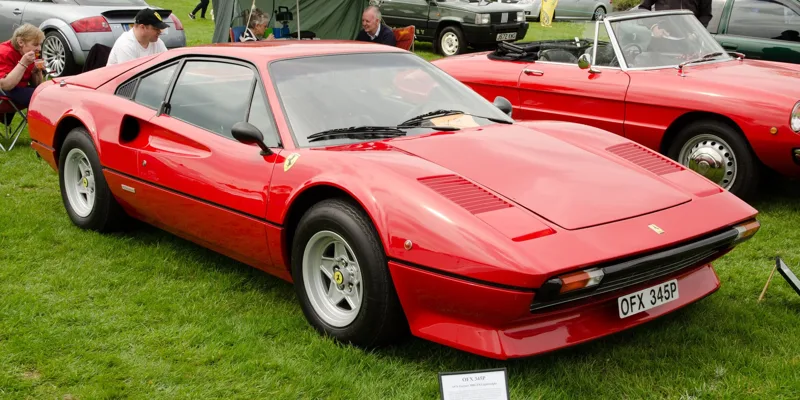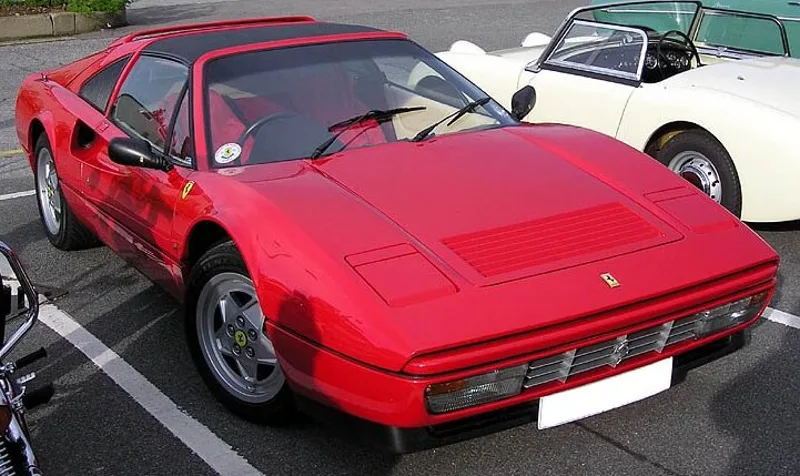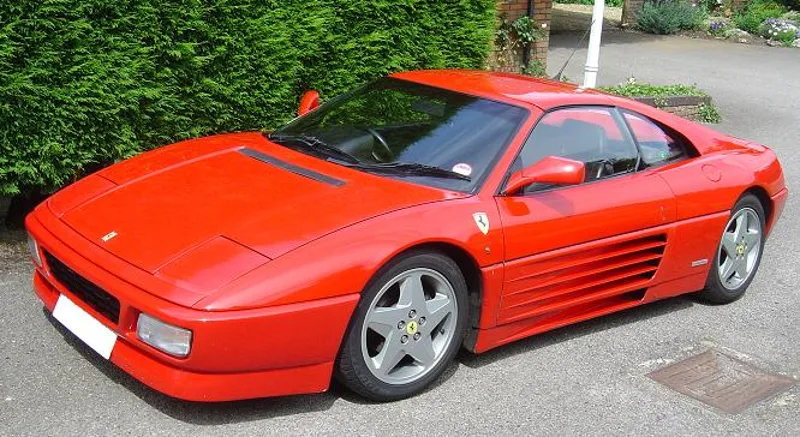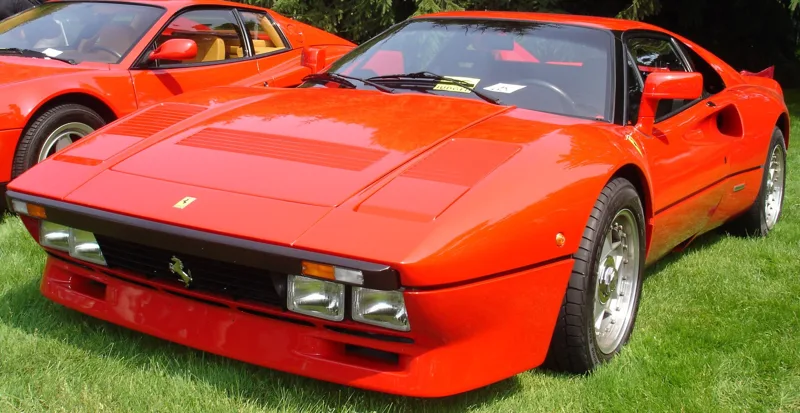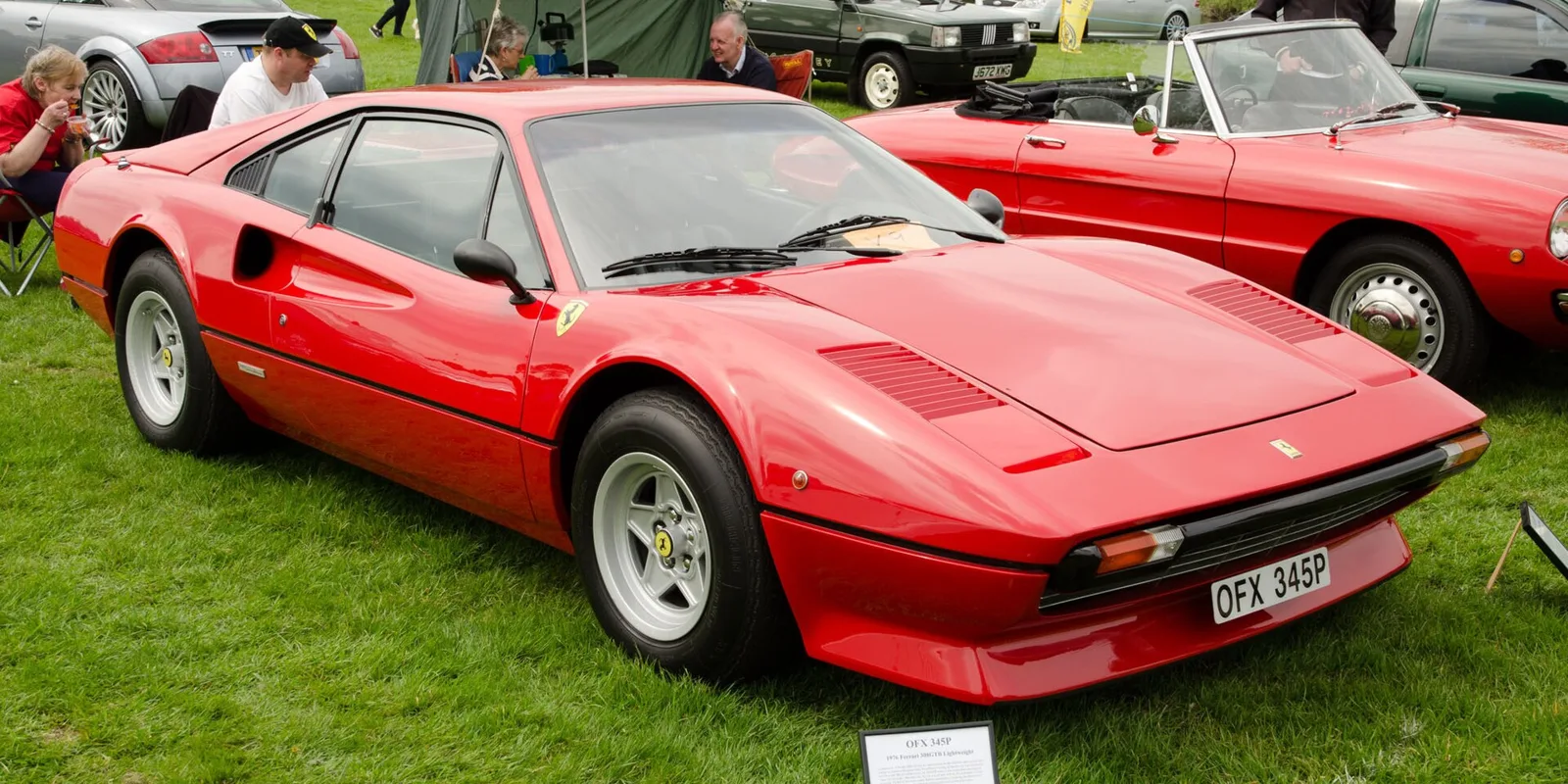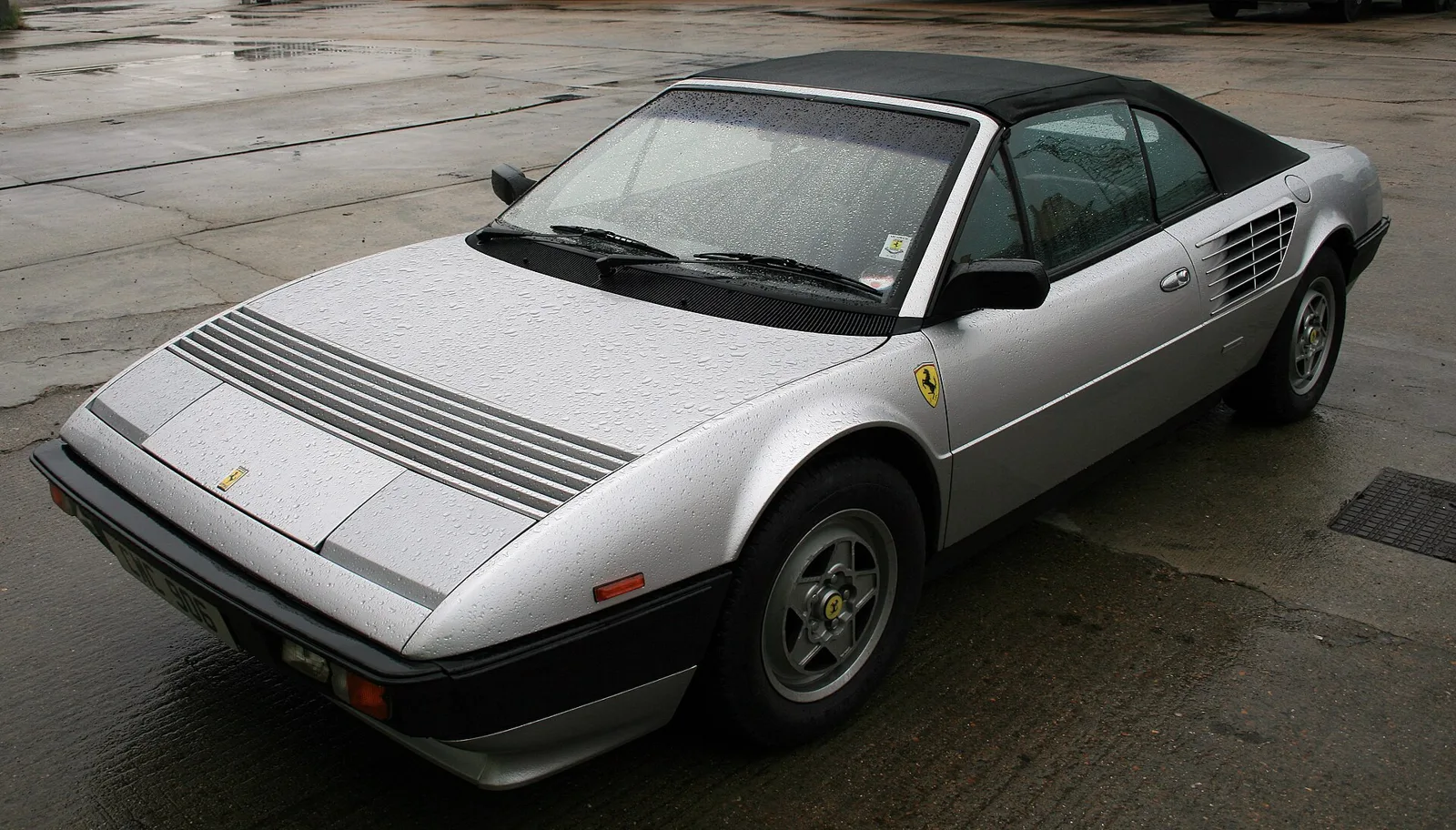
A Pininfarina-styled grand tourer from 1980 to 1993, built as Ferrari's more luxurious V8, with a fourth model that rewrote its layout and a last 2+2 mid-engined Ferrari.
The Ferrari Mondial was a mid-engined V8 2+2 grand tourer built from 1980 to 1993, styled by Pininfarina and bodied by Scaglietti. It came as a coupe or cabriolet, moved from two to four valves per cylinder, and ended as the t with a transverse gearbox and 300 hp.
The Ferrari Mondial, type F108, was a mid-engined V8 grand tourer that Ferrari built from 1980 to 1993. Pininfarina styled it and Carrozzeria Scaglietti built its bodies, and it was offered as a 2+2 coupe or cabriolet.
What was the Ferrari Mondial?
The Mondial was intended as the more luxurious option beside the 308 GTSi and 308 GTBi. It offered 2+2 seating, a taller roof, extra wheelbase length and an electronic system that monitored warning lights, and it replaced the 308 and 208 GT4 coupe. It remains the last rear mid-engined V8 2+2 Ferrari.
The name is Italian for global. Ferrari first used the word in the 1950s, when Formula 1 titles were won, and revived it in the 1970s for its constructors' crowns. For the 1980s car the name also reflected its compliance with global safety and emission standards.
A 2+2 that Ferrari built to be the grand tourer of its V8 line, which ended as a mid-engined layout that the marque kept for decades.
Who designed the Mondial?
The original Mondial 8 was drawn by Pierangelo Andreani, a young designer who had just joined Pininfarina. Later versions were redesigned by Leonardo Fioravanti, who had worked closely with Ferrari since 1951. The predecessor 308 GT4 had been styled by Bertone, so the Mondial marked a change of design house.
Pininfarina's design was built by Carrozzeria Scaglietti. The Mondial was sold alongside Ferrari's two-seat 308 GTB and GTS, 328 and 348, and it shared its major mechanical systems with the two-seater line.
How was the Mondial's body and chassis built?
The body skin was attached to its own space-frame chassis of tubular and oval steel sections. Most panels were steel, but the front lid and rear engine cover were aluminium on the Mondial 8 and QV models. Aluminium was used only on those two panels.
Full-width aluminium louvres across the front lid and engine cover let air flow through the front radiators and the engine bay. Side louvres just ahead of the rear wheels fed air to the engine on one side and to an external oil cooler on the other.
The chassis included detachable sub-frames for the major mechanical assemblies. The rear one carried the engine, transmission and rear suspension as a single unit, which made engine work simpler than on earlier Ferrari V8s.
The front lid opened forwards on gas struts and covered a compartment holding the spare tyre, radiator, cooling fans, battery and fuse panel. The rear boot was insulated and trimmed, and it sat behind the engine bay. The headlamps were electrically raised, with twin round lamps on the Mondial 8, QV and 3.2, and a single rectangular unit each side on the t.
What engine did the Mondial use?
The Mondial V8 descended from the 2.9-litre engine that Ferrari had introduced in the 308 GT4. It was a light alloy 90-degree V8 that used shrink-fit liners, a five-bearing flat-plane crankshaft, and belt-driven quad cams working straight on the valves.
Capacity grew across the range. The Mondial 8 and QV used 2.9 litres, the 3.2 used 3.2 litres, and the t reached 3.4 litres. Most engines had a wet-sump lubrication system, but the t switched to dry sump.
The Mondial 8 had two valves per cylinder, while the QV and every later engine had four. A cast alloy intake housing sat over the engine vee on every model, with manifold tubes feeding each cylinder. Marelli electronic ignition was fitted to all cars except the t.
How did the Mondial's manual gearbox work?
A five-speed, all-indirect manual was the only transmission offered on the Mondial 8, QV and 3.2 cars. It used a dog-leg selector pattern in place of the usual H gate, with first gear set far to the left and back, behind reverse. Racing gearboxes have used that layout because it speeds up shifts between the upper gears.
On those cars the clutch was hydraulic, while the two-seaters used cable operation. The gearbox selection ran through a rod that passed through the central tunnel and the engine sump.
The t was different. Its transaxle was derived from the Ferrari 312T Formula 1 car, and the engine and gearbox were rotated so that the crankshaft and input shafts ran lengthways in the car. The clutch was hydraulic and the gear selection cable-operated.
In 1991 an auto-clutch option developed by the French supplier Valeo became available on the t. It kept the mechanical manual gearbox but replaced the clutch pedal with an electro-mechanical actuator, which engaged or disengaged the clutch when the driver moved the lever.
How did the Mondial handle and brake?
The Mondial was based on the two-seater designs but was slightly larger, with noticeably wider front and rear tracks. Each end had independent suspension with unequal-length wishbones, coil-over dampers and anti-roll bars. The wider track was the main visible difference from the two-seaters.
The t added a driver-adjustable selector for its electronically controlled dampers, which offered three ride-stiffness settings. Its steering gained hydraulic power assistance, which the earlier cars had not had.
Braking used four ventilated disc brakes with split-circuit vacuum assistance. The wheels were five-spoke alloys with a clear-lacquered finish. Anti-lock brakes were offered as an option in 1987 and became standard in 1988. The early cars ran on Michelin TRX tyres that could only be fitted to TRX rims, which limited the choice of tyres.
Later 3.2 and t models moved to conventional wheel designs, which allowed a much wider choice of tyres.
What was the Mondial's interior like?
The Mondial's seats and interior were trimmed in Connolly hide, apart from black vinyl on the dashboard top and the upper door linings. The usual colours were the reds Rosso Corsa and Rosso Dino, blue Azzurro and black Nero, paired with beige, tan or black leather.
Every seat, including the rear pair, was strongly bucket-shaped, with inertia-reel belts. A central tunnel for the chassis ran through both footwells, and a large centre console carried the gear selector and a warning-light panel. Electric windows and air conditioning were standard.
The steering wheel had three spokes and adjusted for reach and rake. Behind it sat a pod-style binnacle with six gauges covering speed, revs, fuel, water temperature, oil pressure and oil temperature, along with a set of warning lights.
Why was the Mondial 8 criticised?
The Mondial 8 went on sale at the 1980 Geneva Auto Salon as the first Ferrari to break from the company's simple three-digit model names. Some reviewers found it mild for a Ferrari, and the press criticised its performance. That was a tough position for a car meant to be the more luxurious model.
The car was larger, heavier and less aerodynamic than its two-seater cousins. Tougher emission rules cut power further, and US safety requirements led to large black bumpers that many felt spoiled the styling. It also cost more than the two-seater 308 GTBi.
The engine used Bosch K-Jetronic mechanical fuel injection, shared with the 308 GTBi and GTSi, and mounted transversely. The chassis was based on the 308 GT4 but had a wheelbase 100 mm (3.9 in) longer at 2,650 mm (104.3 in), and it kept unequal-length double wishbones with Koni dampers at all four corners.
What did the Quattrovalvole change?
Ferrari responded in 1982 with the Quattrovalvole, or QV, which fitted a four-valve cylinder head. The head's chamber design was said to borrow from early 1980s Formula 1 engines, and it used the same engine as the 308 GTB and GTS QV of the same period.
The QV produced 240 hp (177 kW). Its looks were largely unchanged, although it had red engine heads and Quattrovalvole script at the rear. Between 1982 and 1985 Ferrari built 1,145 QV coupes.
Was there a Mondial cabriolet?
A convertible joined the range for 1983, and it kept the coupe's styling and buttress roofline. It set a pattern that every later Mondial followed. The rear seats had to sit closer together to make room for the folding roof, but the car was otherwise unchanged.
The cabriolet helped lift the Mondial's popularity, especially in the United States. It was the only four-seat, mid-rear-engined convertible ever made in regular production. Only 629 were built between 1983 and 1985, which makes it the rarest version of the Mondial.
What changed with the Mondial 3.2?
The Mondial 3.2 arrived in 1985, with the engine bored and stroked to 3.2 litres (3,185 cc) and output rising to 270 hp (199 kW). It was first shown at the Frankfurt Motor Show that September, and it shared its engineering with the 328.
The car was restyled, with body-coloured bumpers, integrated indicators and driving lamps, new alloy wheels and a more rounded instrument binnacle. From 1987 the later cars also had ABS brakes. The fuel system stayed a mechanical Bosch K-Jetronic with an oxygen sensor for trimming the mixture.
The 1988 model year was the last to keep the simpler 308 and 328 drivetrain, which let owners and workshops replace the timing belt and clutch with the engine and gearbox still in the car.
What made the Mondial t different?
The Mondial t arrived in 1989 as the most substantial change in the car's life. Road and Track described it as the spearhead of a new generation of Ferrari V8s, and its styling was visibly different, with smaller rectangular air intakes, redesigned door handles, body-coloured bumpers and fuller wings that covered wider tracks.
The t name refers to the car's engine and transmission layout. The engine was turned to run lengthways, while the gearbox stayed transverse, forming the letter t. The name also paid homage to the 312T that Niki Lauda drove, the first Ferrari with a transverse gearbox.
The layout allowed a longer engine to sit lower in the chassis, which improved handling. It became the standard for Ferrari's mid-engined V8s from the 348 onwards, and it borrowed from the company's Formula 1 cars of the 1980s.
The t's engine was enlarged to 3.4 litres (3,405 cc) and produced 300 hp (221 kW). It used two Bosch Motronic DME engine management computers, one for each bank of cylinders, and it had a dry-sump lubrication system.
The t also brought several Ferrari firsts. It was the first Mondial with power-assisted steering, it had three-position electronic suspension and it was equipped with ABS as standard.
How did the t's maintenance differ from the earlier cars?
The engine and transmission sat on a removable subframe that had to be lowered from the car for timing belt work, which made that job costly without a lift. The clutch sat at the rear end of the drivetrain, so clutch work was simpler and cheaper for an owner.
In 1991 the optional Valeo auto-clutch changed the feel of the car again, using a conventional H-pattern gate with an electronically operated clutch. The t was generally regarded as the best Mondial for performance and refinement, but its maintenance costs were higher than the earlier models.
What was the Mondial PPG Indy pace car?
One Mondial t was built exclusively for PPG Industries to lead the field at PPG Indy Car World Series races. It was designed under Ercole Spada at the I.DE.A Institute, with a budget of about $1 million. It was built for the series rather than for customers.
The pace car made its debut at the 1989 Champion Spark Plugs 300 at Laguna Seca. It was built exclusively for PPG, so it was never a production model. It was a single car, built for that one role.
How many Mondials were built?
The Mondial was a commercial hit for Ferrari in its day, with over 6,000 examples built during its thirteen-year run. The total across all four variants was 6,149 cars, and production ceased in 1993. The figure includes the Mondial 8, QV, 3.2 and t together.
The variants were the Mondial 8, the QV, the 3.2 and the t. All except the Mondial 8 were offered as both coupe and cabriolet.
How is the Mondial regarded today?
For many Ferrari enthusiasts the Mondial was a disappointment, and some have listed it among the worst Ferraris ever made, citing its styling, performance and weight. Some buyers now see it as a future classic, partly because it costs far less than other classic Ferraris.
The Mondial t is generally regarded as the best car in the range, and its layout influenced the mid-engined V8s that followed it.
What came after the Mondial?
The Mondial's chassis underpinned a generation of two-seater Ferraris up to the 360. The 2+2 Mondial itself ended production in 1993, four and a half years after the t arrived. No mid-engined 2+2 has followed it from Ferrari since. The t's layout, however, lived on in later mid-engined V8s.
Ferrari returned to the four-seat format with the front-engined 456 in 1992, and later four-seaters such as the GTC4Lusso, Portofino and Roma have all been front-engined. The Mondial t therefore remains the most recent four-seat, mid-engined Ferrari.
What are the Ferrari Mondial specifications?
| Specification | Detail |
|---|---|
| Type | F108, mid-engined V8 2+2 grand tourer |
| Production | 1980 to 1993; 6,149 vehicles in total |
| Mondial 8 engine | 2.9 L V8, two valves per cylinder, Bosch K-Jetronic injection |
| Quattrovalvole (QV) output | 240 hp (177 kW), four valves per cylinder |
| Mondial 3.2 output | 3.2 L (3,185 cc), 270 hp (199 kW) |
| Mondial t output | 3.4 L (3,405 cc), 300 hp (221 kW) |
| Mondial t engine management | Bosch Motronic DME, one computer per bank |
| Transmission | Five-speed manual; Valeo auto-clutch option on the t from 1991 |
| Mondial 8 wheelbase | 2,650 mm (104.3 in) |
| Suspension | Independent, unequal-length wishbones, coil-over dampers |
| Brakes | Four-wheel ventilated discs; ABS optional from 1987, standard from 1988 |
| Interior trim | Connolly hide; six-gauge pod-style binnacle |
| Cabriolet production | 629 units, 1983 to 1985 |
| QV coupe production | 1,145 units, 1982 to 1985 |