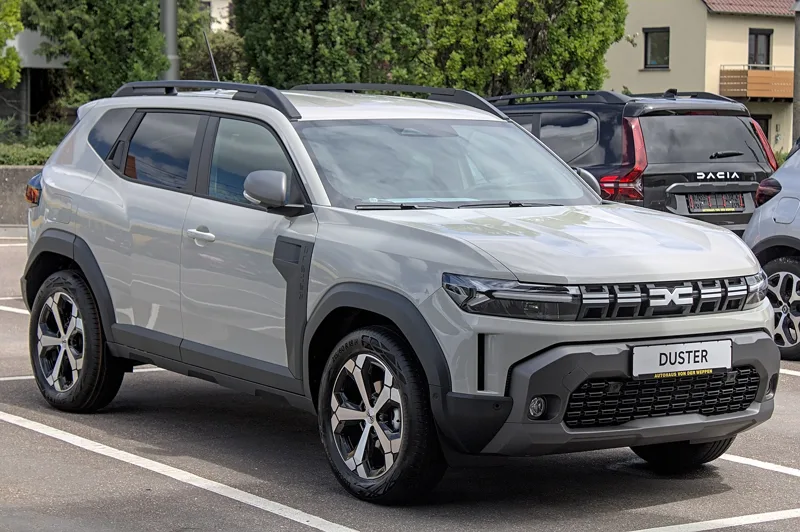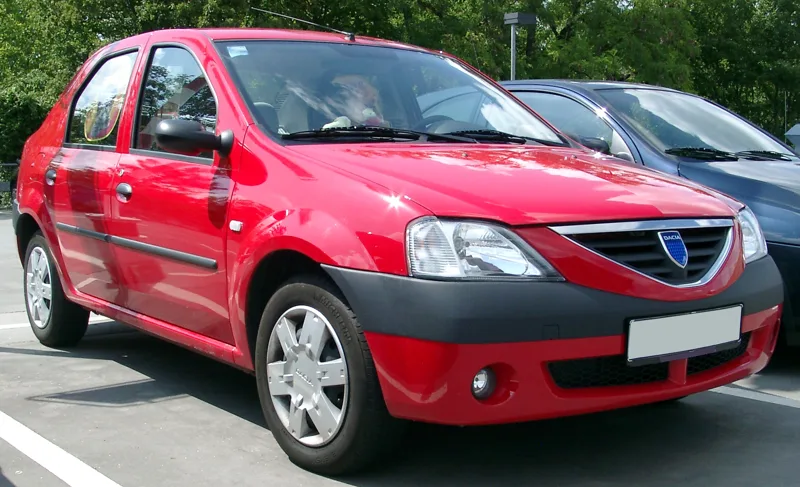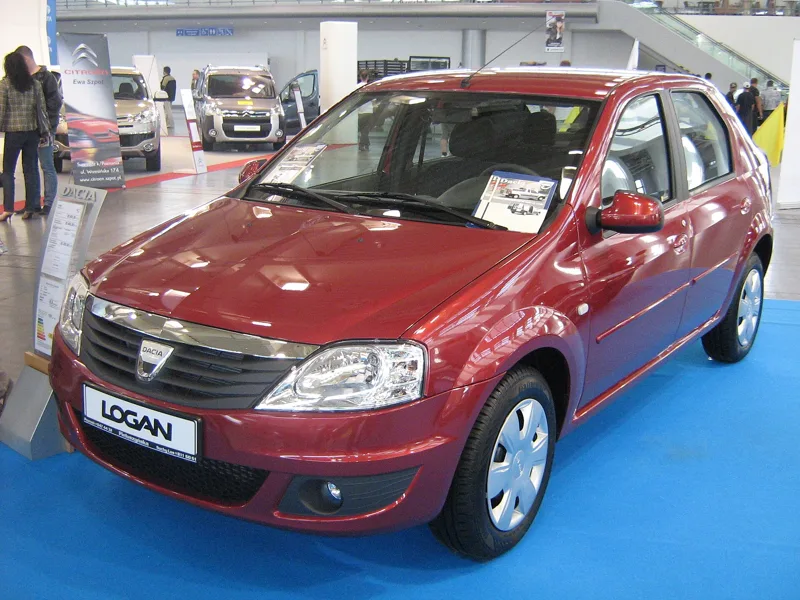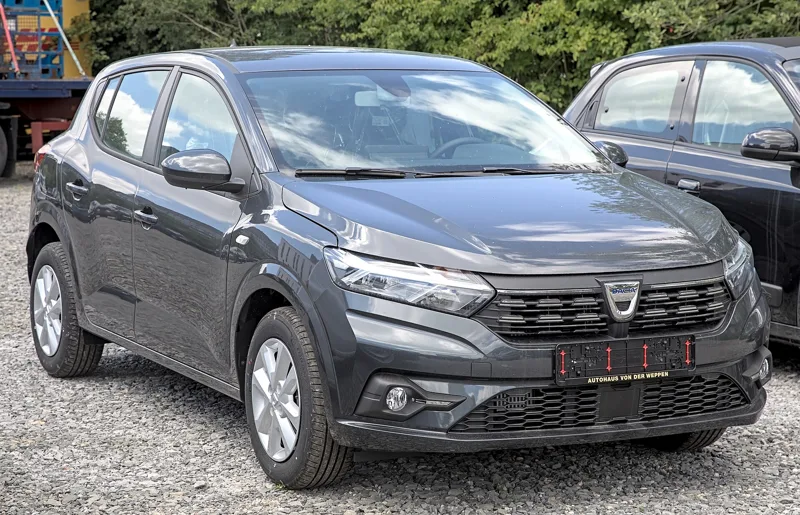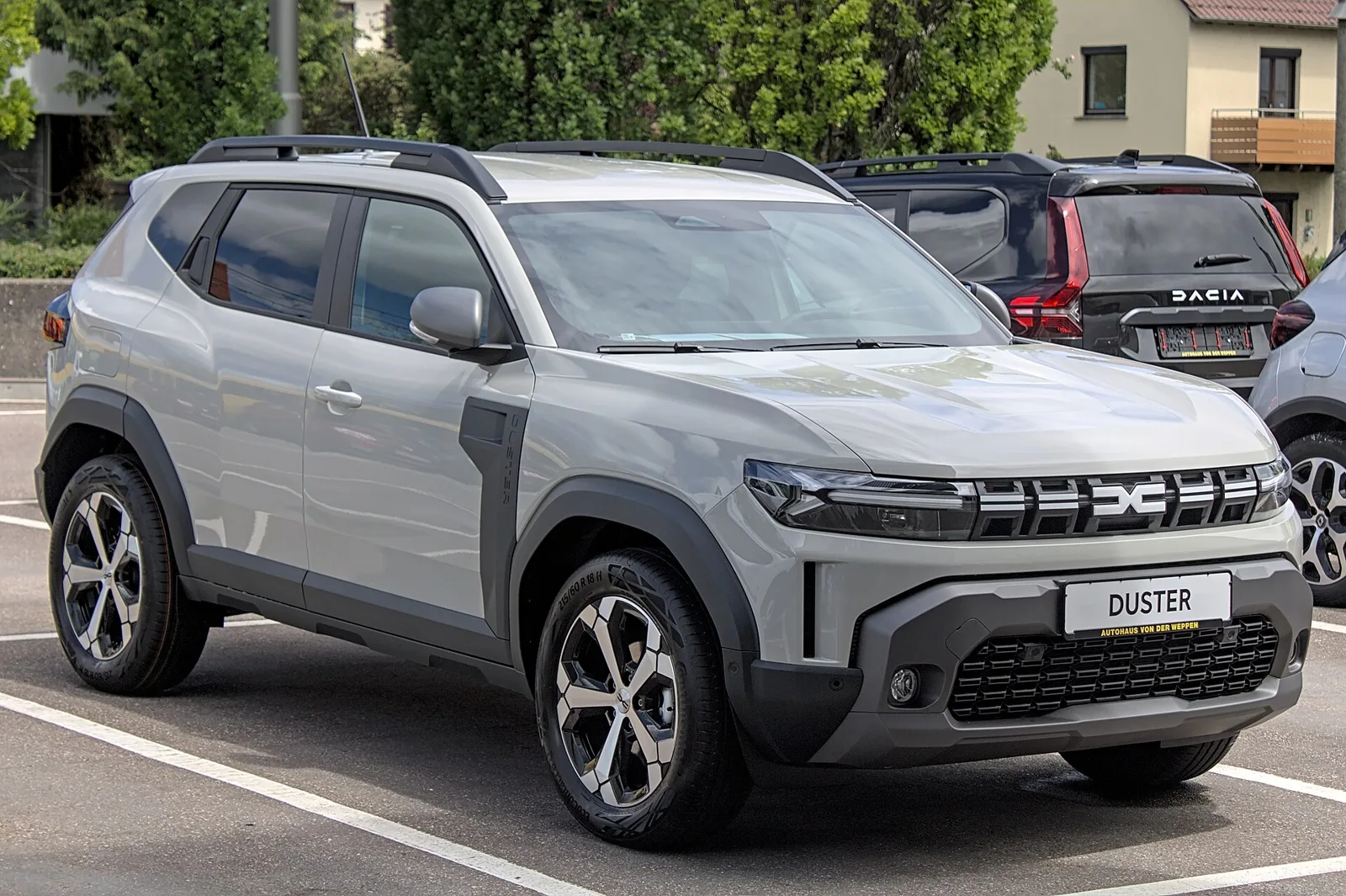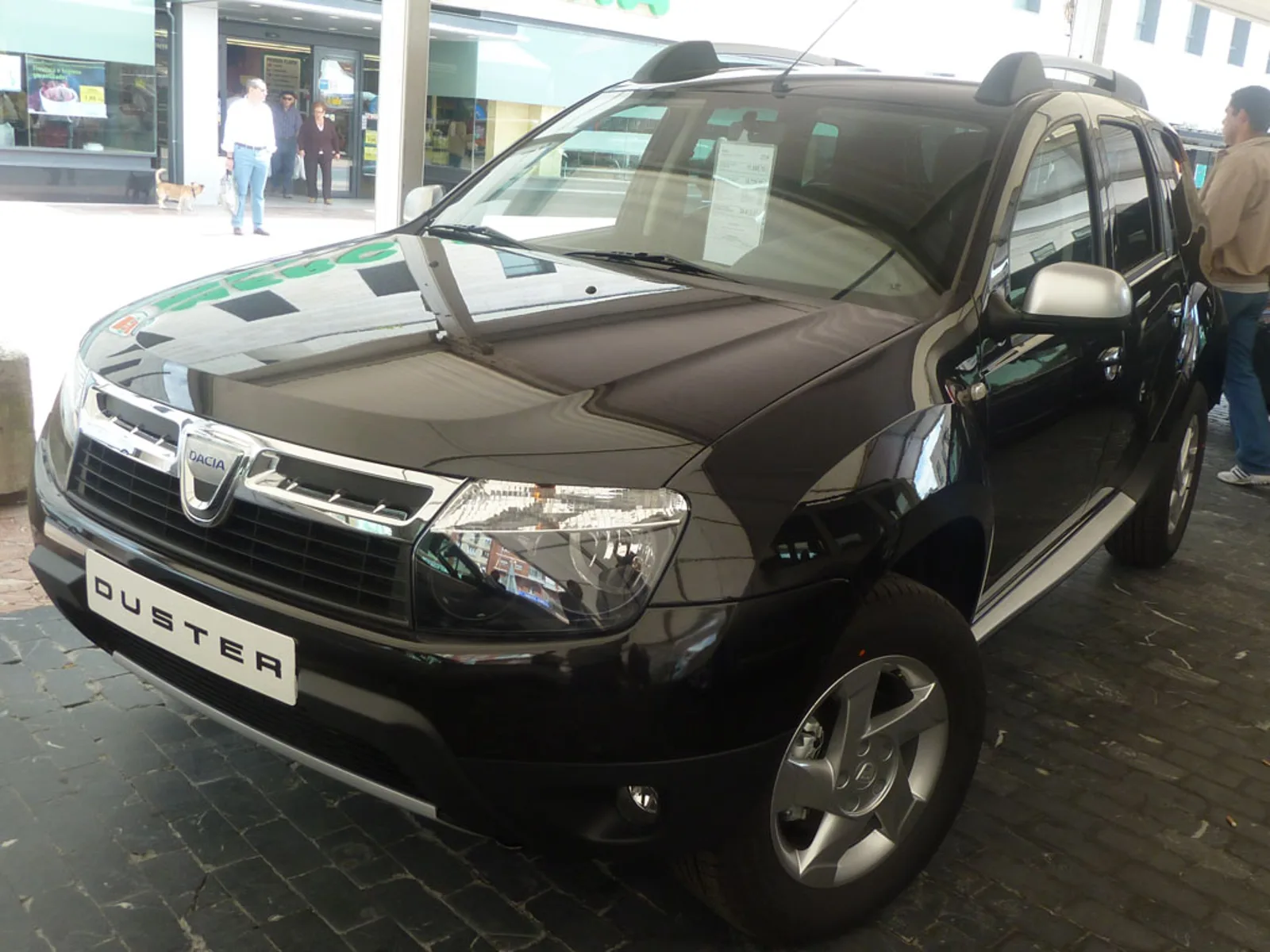
A boxy shape drawn from the Renault 4, a simple engine line-up and a 4x4 option, sold as a Dacia in Europe and a Renault elsewhere.
The Dacia Duster I was a Renault Group SUV built on Renault 4 styling, launched in 2010 with 1.6 petrol and 1.5 diesel engines. It offered an optional 4x4 system and entered the Dakar, and 395,350 were built in 2014, when it was the Renault brand's best-selling vehicle.
The Dacia Duster is an SUV from the Renault Group, sold under the Dacia badge in Europe and the Renault badge elsewhere. The first model used a boxy shape inspired by the Renault 4, a small range of petrol and diesel engines and an optional 4x4 system. The Dacia version was discontinued in 2017, and in 2014 it was the best-selling Renault brand vehicle.
Where did the first Duster come from?
The Duster came out of the Renault Group, and its first models appeared in Europe from March 2007. The first design sketch had very little in common with the car that went on sale. Orders opened on 16 March 2010, and the official presentation followed on 8 April 2010 in the French dealer network.
Pre-production pictures, most likely shot inside the company's own engineering premises, circulated online in late February 2009 through enthusiast forums. A Dacia Duster Concept, shown at the Geneva International Motor Show in 2009, had previewed the design.
A cubic SUV drawn from the Renault 4, sold in Europe as a Dacia and elsewhere as a Renault.
How did the Renault 4 shape the design?
Mongolian designer Erde Tungaa based the Duster's philosophy on the simple, robust and practical Renault 4. Its cubic body, characteristic side glazing and small vertical rear lights recall the Renault of the 1960s. The car was first meant to carry the Renault badge even in Europe, but it was eventually made a Dacia.
The early plan was an openly acknowledged revival of the Renault 4L, with round headlamps that recalled its ancestor. Tungaa later also worked on the second-generation Duster.
Which engines did the Duster use?
At launch the Duster came with a 1.6 L 16V petrol engine rated at 105 PS (77 kW; 104 hp) and a 1.5 dCi diesel. Most sales in France were diesel, so the 1.5 DCI 85 and the 110 PS version formed the core of the range from the start.
The petrol engine first emitted more than 175 grams of CO2 per kilometre, which brought a 750 euro environmental malus. In July 2010 it was adapted to accept E85 superethanol. That change left torque and power alone, but it let the petrol version escape the malus and gave it a fresh reason to compete with the diesel DCI 85, which had been very close in price.
The DCI 85 gave way on 6 July 2010 to the DCI 90, which meets the Euro 5 standard. Delivery times stretched beyond six months, so the DCI 90 became the only one offered, and the 85 PS car survived only for vehicles registered before 1 January 2011.
In 2015 the 1.6 16v 105 K4M of Renault origin failed the new Euro 6 standards. Its replacement, the 1.6 16v 115 H4M (85 kW; 113 hp), came from Nissan, gained 10 PS and used a timing chain. The H4M had already powered the Nissan Note, the Nissan Juke and other Renault-Nissan Alliance models.
A 2.0 16V 135 PS (99 kW; 133 hp) version never reached Europe because of the emissions rules. It was sold in Russia under the Renault badge and could be ordered as a 4x4.
Dacia Duster I key specifications
| Item | Detail |
|---|---|
| Launch petrol | 1.6 L 16V, 105 PS (77 kW; 104 hp), E85 compatible from July 2010 |
| Launch diesel | 1.5 DCI 85 and 1.5 L DCI 110 (81 kW; 108 hp), the latter with six-speed gearbox |
| DCI 90 diesel | From 6 July 2010, Euro 5 compliant |
| 1.6 16v 115 H4M petrol | 85 kW; 113 hp, Nissan origin, from 2015 |
| Russian 2.0 petrol | 2.0 16V 135 PS (99 kW; 133 hp) |
| 4x4 extra weight | About 120 kg (265 lb) over the 4x2 |
| Ground clearance | 21 cm on the 4x4, against 20.5 cm on the 4x2 |
| Braking from 130 km/h | 70 m (2WD), 75 m (4x4) |
How did the 4x4 system work?
The 4x4 used a semi-permanent all-wheel-drive layout from the Nissan X-Trail II, controlled by a three-position selector. In AUTO the rear axle engaged when a driven wheel slipped, while LOCK locked the central differential up to 80 km/h for full all-wheel drive.
Its rear axle was a multi-link design from Nissan's parts bank, used on the X-Trail and Murano. The 4x2 kept a conventional trailing arm from the Logan MCV, which tied it to the Renault Modus. The 4x4 gearbox also offered a creeping first gear for very slow progress over obstacles without touching the clutch.
Because the Duster had no front or rear differential lock, ESP was strongly recommended for 4x4 use. ESP braked a spinning wheel, which sent torque to the wheel still gripping. Switching ESP off changed how the ABS worked and let the wheels lock slightly, which helped them bite into snow or mud.
The 4x4 cost 2,000 euros more at equivalent equipment and was around 120 kg (265 lb) heavier. Its boot also shrank by 30 dm3 because the spare wheel moved from under the car into the boot. On the DCI 110, fuel consumption rose by 0.6 l/100 km on average, and by up to 0.9 l/100 km in town.
Which trim levels were offered?
The Duster range had four trim levels: Duster, Ambiance, Laureate and Prestige. The base Duster was stripped out for utility buyers and sold for under 12,000 euros in 1.6 16V form, with no options beyond roof bars and a spare wheel.
Ambiance added front side airbags, longitudinal roof bars, central locking with remote control and electric front windows. The Laureate brought manual air conditioning, electric heated mirrors, a trip computer and fog lights, and offered alloy wheels or a grey look pack as options.
The Prestige was not limited to the most powerful engines, since the DCi 85 and 90 diesels could be fitted. It stood out for its interior, which used leather on the seats and a leather-wrapped steering wheel, with Tep covering the edges and upper backrest.
Special editions followed. The first ESF edition was reserved for instructors of the French ski school, and the Grand Public version from April 2012 was based on an Ambiance dCi 90 4x2 without air conditioning or radio. The Delsey edition offered 3,500 units with the Prestige 4x4 look and a fabric interior, and the Aventure of March 2013 came in black or white with Duster stickers, with 1,000 units reportedly planned for France.
How did the Duster change during its run?
Renault facelifted the Duster at the Frankfurt Motor Show in September 2013, and a sporty show car based on it, the Duster Extreme, appeared at the Sao Paulo show. Earlier, in March 2012, the original radio gained Bluetooth as standard, and the dCi 110 versions were re-homologated to escape the environmental malus.
The re-homologated 2WD version fell to 130 grams of CO2, and the 4x4 to 140 grams, once its mirrors were swapped for the more aerodynamic units from the Dacia Sandero Stepway.
How well did the Duster sell?
Production reached 395,350 cars in 2014, of which 234,883 were Renaults and 160,467 were Dacias. That year the Duster was the best-selling Renault brand vehicle, and it sold more under the Renault badge than under Dacia.
Outside Europe the car was called the Renault Duster in markets where the Dacia brand did not exist, mainly Brazil, Argentina, Colombia and Mexico. It was built in Pitesti in Romania, Moscow, Curitiba, Envigado and at the Renault-Nissan Alliance plant in Chennai, India.
Nissan introduced the Terrano in India in 2013, and it was built there from July 2014 as a rebadged, higher-end Duster with new front and rear styling and a more upmarket dashboard. The Renault Duster had been sold in India since July 2012 and won 18 awards there.
Colombian production ended in 2021, and Chennai stopped assembling the Duster at the end of that year. The Indian Terrano had stopped in 2020, so the Terrano still on sale was the Russian-market one, alongside the Renault Duster Oroch pick-up.
Renault Duster Oroch and the Terrano
Renault's Duster pick-up came in single or double cab versions and was unveiled in Buenos Aires in June 2015. Named after the Oroch concept shown at the Sao Paulo motor show in October 2014, it was aimed mainly at South America and was not sold in Europe.
The Oroch was exported to New Caledonia and French Polynesia from 2021. April 2022 brought a facelift: the infotainment was new, ESP and traction control were added as safety kit, and the range was revised. A 1.3 TCe Flex engine rated at 170 PS (125 kW; 168 hp) joined the 1.6 Sce unit, which makes 120 PS (88 kW; 118 hp).
Did the Duster compete in motorsport?
It did, with a few notable outings. The Duster took part in the Andros Trophy from 2009, driven by four-time Formula One world champion Alain Prost. A 2011 project entered the Pikes Peak hill climb with driver Jean-Philippe Dayraut, and in 2014 Renault Argentina took two Dusters to the Dakar.
The Argentine mechanical company Oreste Berta prepared the Dakar cars, and each carried a 3.5 L V6 rated at 330 PS (243 kW; 325 hp). The pair of Emiliano Sparato and Francisco Jose Garcia ended 14th, a result above what the brand had aimed for.
Did the army use the Duster?
Renault studied an army-spec 4x4 Duster to replace the Peugeot P4. It had a limited-slip front differential in place of the standard unit, protective plates under the engine, gearbox and rear axle, off-road tyres, and suspension raised by about 30 cm.
The State purchasing agency UGAP did not choose it. It preferred militarised Ford Everest vehicles built by Renault Trucks Defense. Romania's army did adopt the Duster.
How did critics judge the Duster?
Reviewers praised the Duster's price, suspension comfort, adequate engines, habitability and off-road ability. It was also named the best car of the year 2011 by the Autobest jury, which had members from 15 countries. Ten of the 15 jury members picked it after scoring 13 criteria, with the Renault Fluence placed third.
The online magazine Turbo tested the car on 14 April 2010 and found the prices hard to beat, the looks pleasant and the comfort careful. It also liked the boot volume and all-terrain ability, but it found fault with the cabin finish, with barely any modularity and with weak engines.
The main complaint was soundproofing, led by the petrol engine, which was noisy at high revs. The DCI 110 was quieter than the 90 PS unit thanks to its six-speed gearbox. Braking drew criticism too: 70 m from 130 km/h, or 75 m on the 4x4, put the Duster towards the back of the field, while the Renault Koleos stopped in 77 m.
What replaced the first Duster?
The second generation was shown at the Frankfurt Motor Show in September 2017, after seven years on sale for the first car. The Duster II went on sale in January 2018, and the original was discontinued in 2017 to make way for it.
Outside Western Europe, the Renault and Nissan versions carried on after the Dacia model was discontinued.