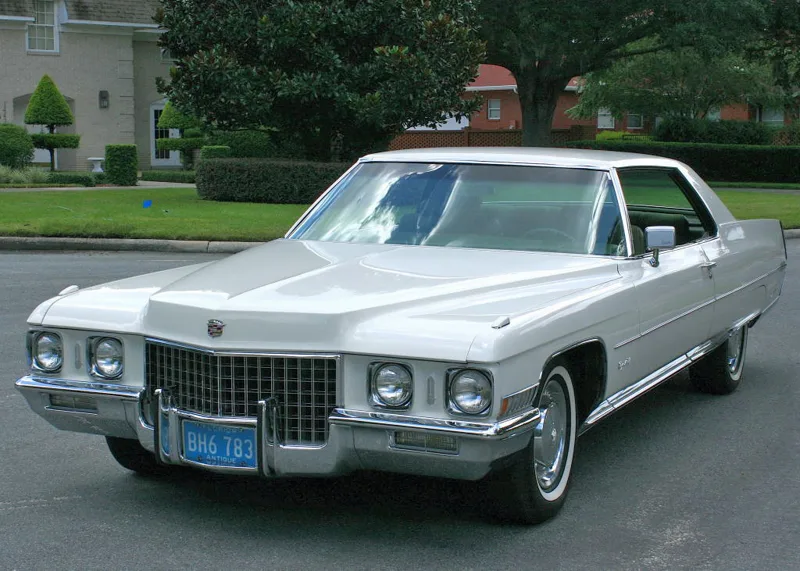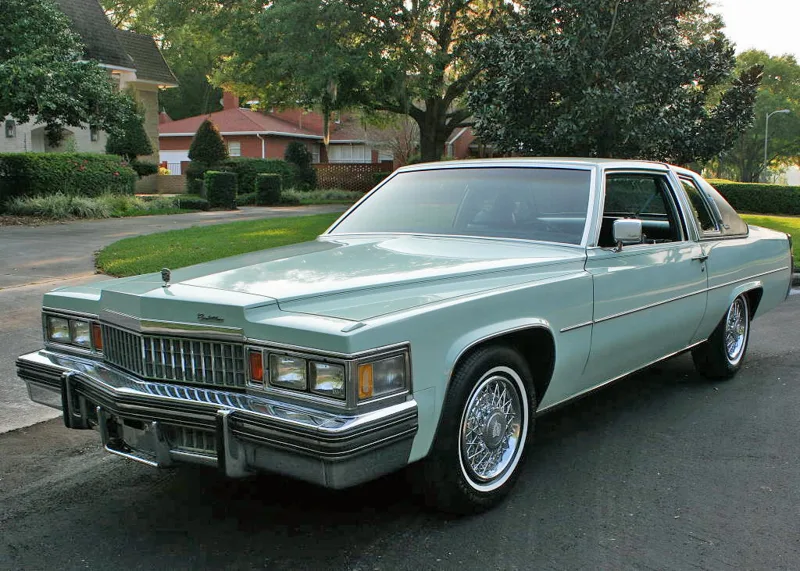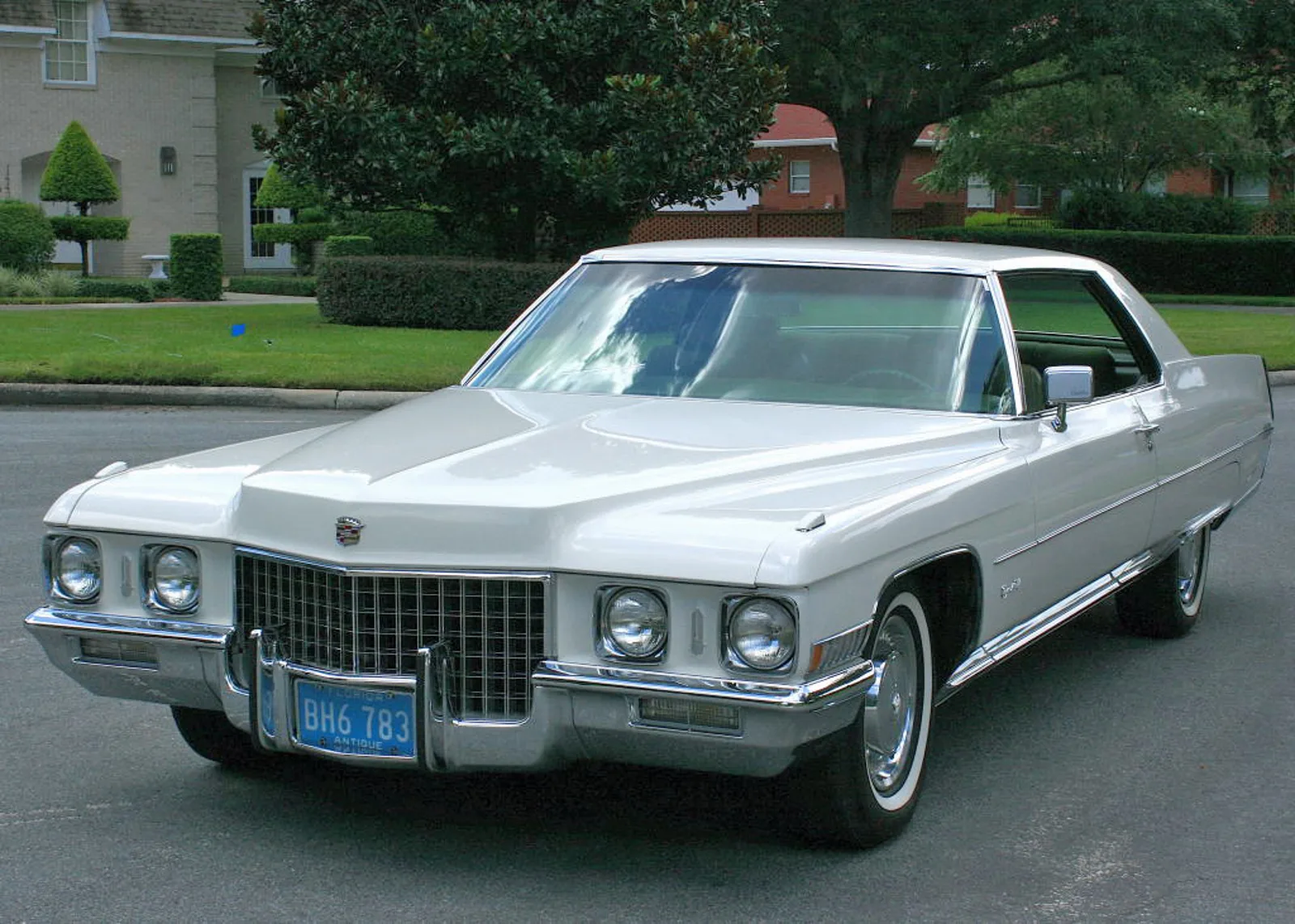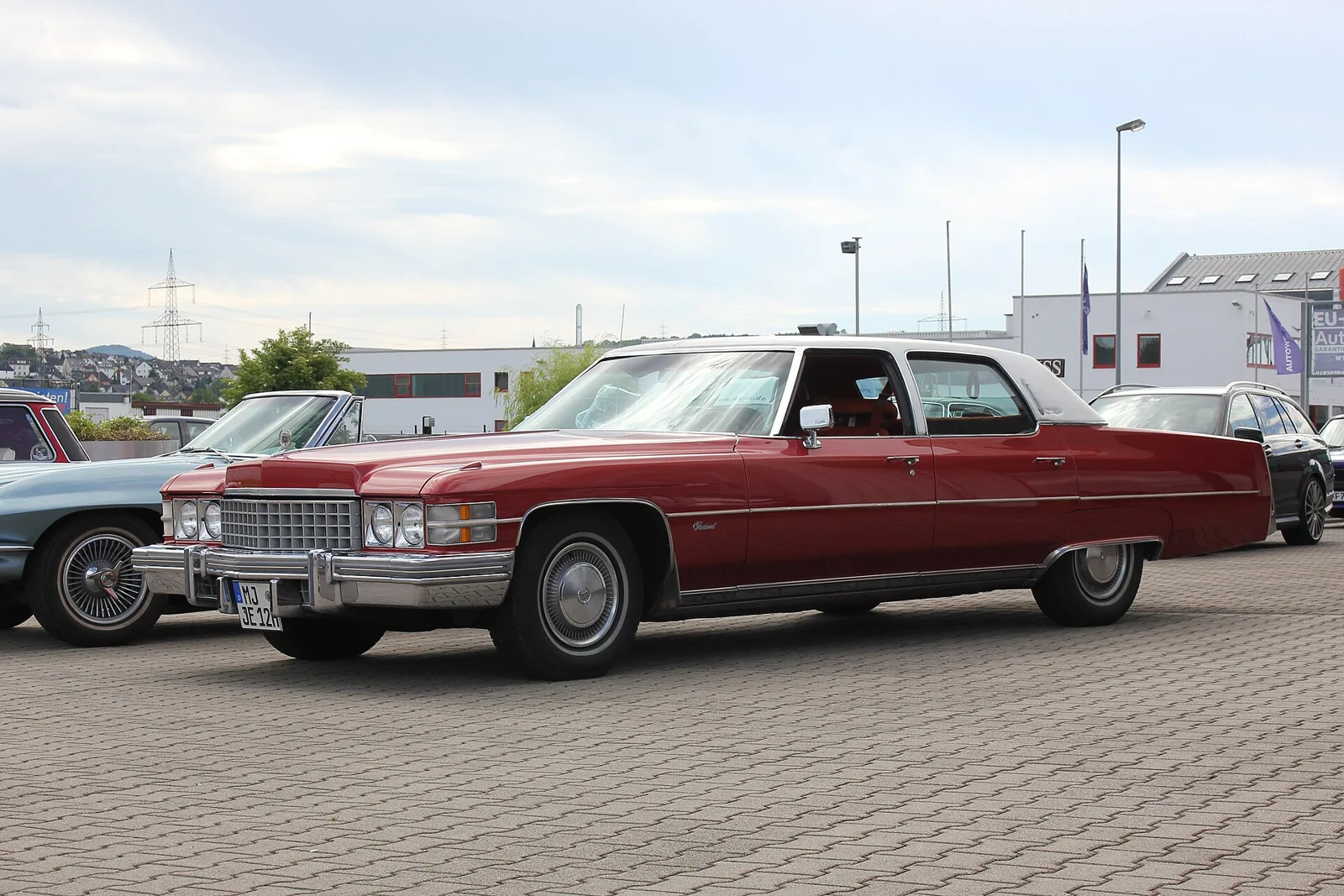
A four-door luxury car sold as the Fleetwood Brougham, built on General Motors' C platform with V8 power and a Talisman trim that cost almost US$2,000 more.
The Cadillac Sixty Special was a four-door luxury car built from 1971 to 1976, sold as the Fleetwood Brougham. It shared its platform and most of its body with the DeVille, and its V8 engines were cut in output as emissions rules tightened.
The Cadillac Sixty Special of the 1971 to 1976 model years was a four-door luxury car from the Cadillac brand of General Motors, sold under the name Sixty Special Fleetwood Brougham. It was the better-equipped and slightly longer sister of the DeVille, sharing its technology and largely its body. For a period it was the longest car of American series production, and it is usually counted as the tenth and last generation of the Sixty Special family.
Where did the Sixty Special sit in Cadillac's range?
Since 1959 Cadillac had built its models on unified designs, spread across different model lines through equipment and pricing. The Sixty Special was the top standard model, above the DeVille and above the entry-level Series 62, which the Calais replaced in 1965.
Until 1970 the Sixty Special came as two sub-models: a Sedan as the base and a Fleetwood Brougham at the top. The tenth generation dropped to one trim line under the Fleetwood Brougham name, and further equipment packages followed from 1974.
The 1971 Sixty Special arrived with new versions of Cadillac's full-size models, and it was again the priciest Cadillac line among the standard models.
The car stayed in the range until 1976, alongside the Calais and DeVille. Its rivals were the Lincoln Continental and the Imperial LeBaron. The Sixty Special name, which dated back to 1938, was dropped when Cadillac launched a more compact full-size series for 1977, and the Fleetwood Brougham took over the old model's role.
A tenth and final generation, 122,255 cars built, and V8 output lowered as the emissions rules tightened.
How was the Sixty Special engineered?
The car used the C platform of General Motors, which is closely related to the slightly shorter B platform, and a box frame with the basic features of the previous generation. Newly designed front and rear suspension made the cars softer, and the frame was 76 mm (3 in) longer than that of the Calais and DeVille.
Its styling almost completely matched the Calais and DeVille. The Sixty Special was sold only as a four-door notchback hardtop, though, and it had a fixed B-pillar running from the floor to the roof, which its four-door sister models did not have. Its longer wheelbase lengthened only the rear footwell.
Early cars, from 1971 and 1972, used door pressings identical to those of the saloon siblings, so only the stretched wheelbase needed a panel in body colour set between the front and rear doors. Longer front doors from 1973 made that panel redundant.
What changed on the body after 1972?
Lights and trim details changed almost every year. The 1973 model year brought safety bumpers at the front, and in 1974 the rear was adapted to match. Smooth flat body sides replaced the profiled ones in the same facelift, and the tail lamps moved to a horizontal position above the rear bumpers.
That horizontal arrangement ended a design pattern that had marked the brand for more than ten years, the upright tail lamp. The pricier Fleetwood Eldorado coupes and convertibles adopted the same horizontal layout at the same time. The front was also reworked in 1974, with the indicators and side lamps placed directly beside the headlamps. From 1975 rectangular twin headlamps were fitted.
Engines and power ratings
| Item | Figure |
|---|---|
| Model years | 1971 to 1976 |
| Platform | General Motors C platform |
| Body | Four-door notchback hardtop |
| Frame | 76 mm (3 in) longer than Calais and DeVille |
| Engine, 1971 | 7,729 cc (472 cu in) V8 |
| Power, 1971 | 345 SAE-PS gross (254 kW; 340 hp) |
| Power, 1972 | 223 SAE-PS net (164 kW; 220 hp) |
| Power, 1974 | 208 SAE-PS net (153 kW; 205 hp) |
| Engine from 1975 | 8,194 cc (500 cu in) V8 |
| Power, 1975 carburettor | 190 SAE-PS (140 kW; 187 hp) |
| Power, 1976 injection | 215 SAE-PS (158 kW; 212 hp) |
Only large-capacity V8 petrol engines were offered, and in this form no other GM brand used them. Competing models faced the same tightening rules each year, and Cadillac answered them largely by reducing how much power the engines gave.
Output figures therefore fell from 345 SAE-PS gross in 1971 to 208 SAE-PS in 1974, the later figures being net ratings.
The 7,729 cc V8 had already been standard on the predecessor, and it carried the car through the switch to net ratings for 1972. From 1975 the 8,194 cc engine became standard, the largest engine fitted as standard in a passenger car of the postwar period up to that point.
The carburettor version of the larger engine produced 190 SAE-PS, and the injected version of 1976 went beyond it. Bendix fuel injection, optional from 1976, lifted the output to 215 SAE-PS.
What did the 1974 trim packages offer?
From 1974 Cadillac offered two optional packages for the Sixty Special, and they were available in slightly modified form in 1975 and 1976. They mainly changed the interior and made the car plush, which critics called a bloated luxury imitation.
The d'Elegance package, also offered on the DeVille though not on the Calais, brought specially designed seat covers in an even softer leather or a velour. The velour was called Medici on the Sixty Special and Mardi Gras on the DeVille. The front bench moved in a 40/60 split, changing to 50/50 from 1975, and the driver's seat was electrically adjustable as standard. Door panels in a special trim material, pockets on the backs of the front seats, extra-thick carpets and mats, and body-side stripes matched to the paint completed the package.
The d'Elegance was not offered on the Calais, while the Talisman was offered only on the Sixty Special.
The Talisman package, introduced in 1974, was the most exclusive option and was available only on the Sixty Special. Buyers received two front seats split by a centre console, upholstery in special fabrics or leather, a vinyl roof with a textured finish and wire-spoke wheels. Its surcharge in 1974 was almost US$2,000 with fabric seats and US$2,400 with leather, a sum equal to the price of a brand-new AMC Gremlin.
Only 1,200 to 1,900 cars with Talisman trim were built each year. The d'Elegance and Talisman packages were both optional, and the Talisman was the more exclusive of the two.
How much did a Sixty Special cost?
In the 1970s the Sixty Special saloons were the most expensive American four-doors apart from Cadillac's Series 75. Their base prices sat between US$1,300 and US$1,700 above the largely identical DeVille sedan, and Lincoln's Continental cost a few hundred dollars less.
The price ladder placed the Sixty Special at the premium end of Cadillac's standard range, above the DeVille.
Fitted with Talisman trim, the Sixty Special came close to the cost of Cadillac's top saloon, the Series 75 range's flagship. An imported Mercedes-Benz 280 came close to the price of a Fleetwood Brougham Talisman in the United States in 1975.
How many Sixty Specials were built?
Set against the DeVille, which outsold the Sixty Special by a wide margin, the Sixty Special was a niche car within Cadillac's line. Cadillac built 122,255 Sixty Specials from 1971 to 1976, a small figure beside the 1,074,829 coupes and saloons of the DeVille series built in the same years. The Sixty Special was made at Detroit Assembly in Detroit, Michigan, and at Linden Assembly in Linden, New Jersey, like its sister models.
How did critics judge the 1970s Sixty Special?
Critics thought the trim packages were a bloated luxury imitation, meant to distract buyers from the fact that much of the car hid very simple engineering under its sheet metal. That view placed the Sixty Special among the typical cars of the Malaise Era.
The model stood at the top of Cadillac's standard range for six model years, and its tenth generation was its last.