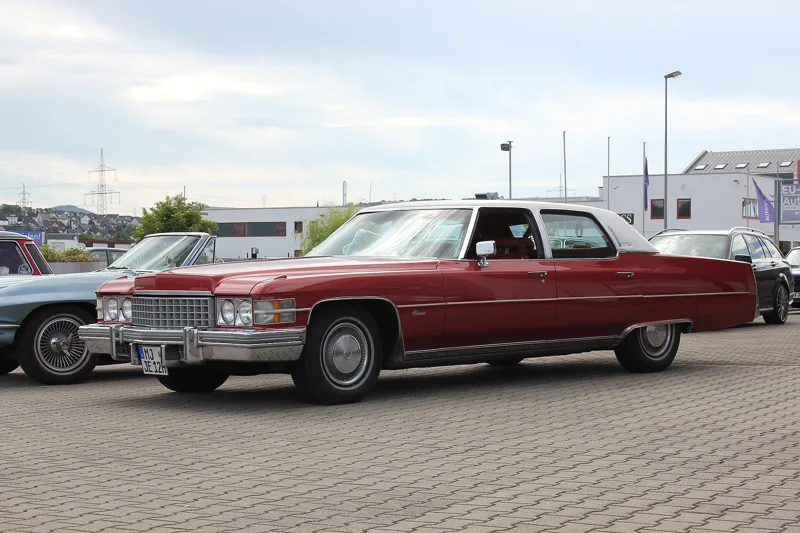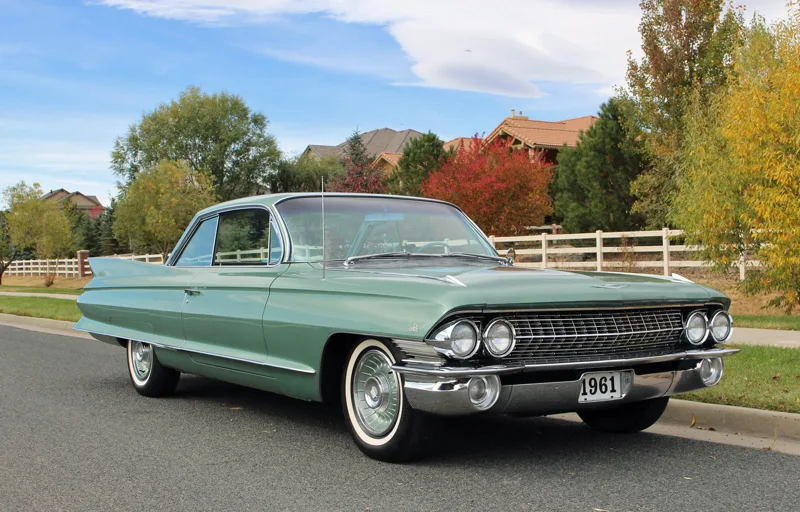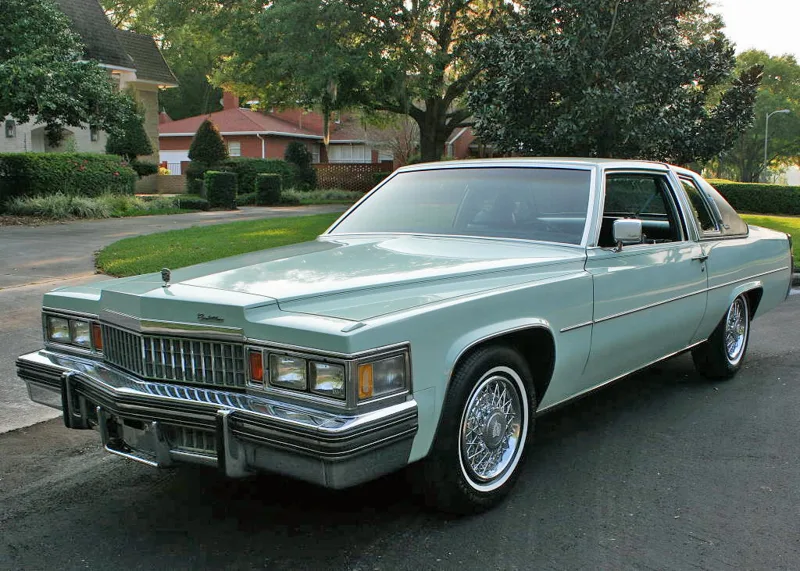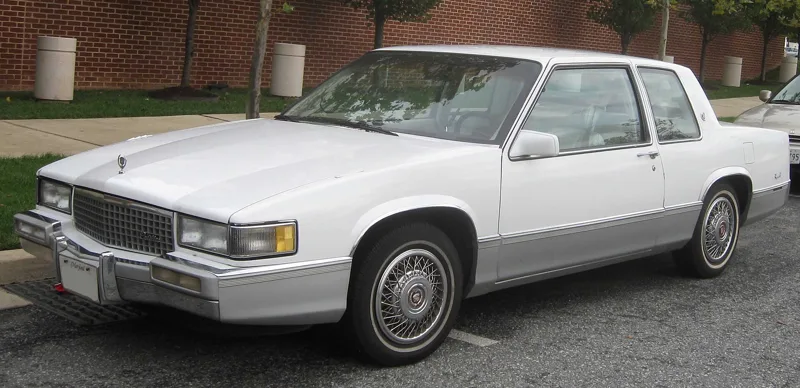
A large V8 saloon and coupe with a pillared body, a 7.7-litre engine that became 8.2 litres, and 1,074,829 cars built between 1971 and 1976.
Among Cadillac's eight generations of the DeVille, the 1971 to 1976 car was the fourth. It used 7.7-litre and 8.2-litre V8 engines, sat above the Calais in the range, and is regarded as a typical Malaise Era luxury car today.
The Cadillac DeVille of the 1971 to 1976 model years was the fourth generation of the DeVille line, sold as a two-door coupe and a four-door sedan. Its eight-cylinder engines and long, heavy bodies make it a typical example of the Malaise Era, the period in which Cadillac and its direct competitors cut engine output to meet tightening limits on consumption and emissions.
How did the DeVille name begin?
The DeVille name first appeared in 1949 on a hardtop coupe. For a while the DeVille was simply a higher-trim version of the Series 62, but in 1959 Cadillac made it an independent model, positioned above the Series 62 and below the expensive Series 60 Special. When the Series 62 was replaced by the Calais range, the DeVille remained the middle line among Cadillac's full-size models.
The fourth generation came out in 1971, selling through years of ongoing changes to safety and emissions rules. The first oil price crisis hit in its third production year, and the US government's fleet fuel-economy rules, known as CAFE, came into force in 1975.
The DeVille's rivals were the Lincoln Continental and the Imperial LeBaron, and both trailed far behind the DeVille's production volume. The DeVille was by far the most successful Cadillac range, and its models counted among the largest and heaviest cars in their class.
Eight cylinders, a pillared coupe and more than a million cars: the DeVille of the Malaise Era, built to survive the rules.
What did the 1971 DeVille look like?
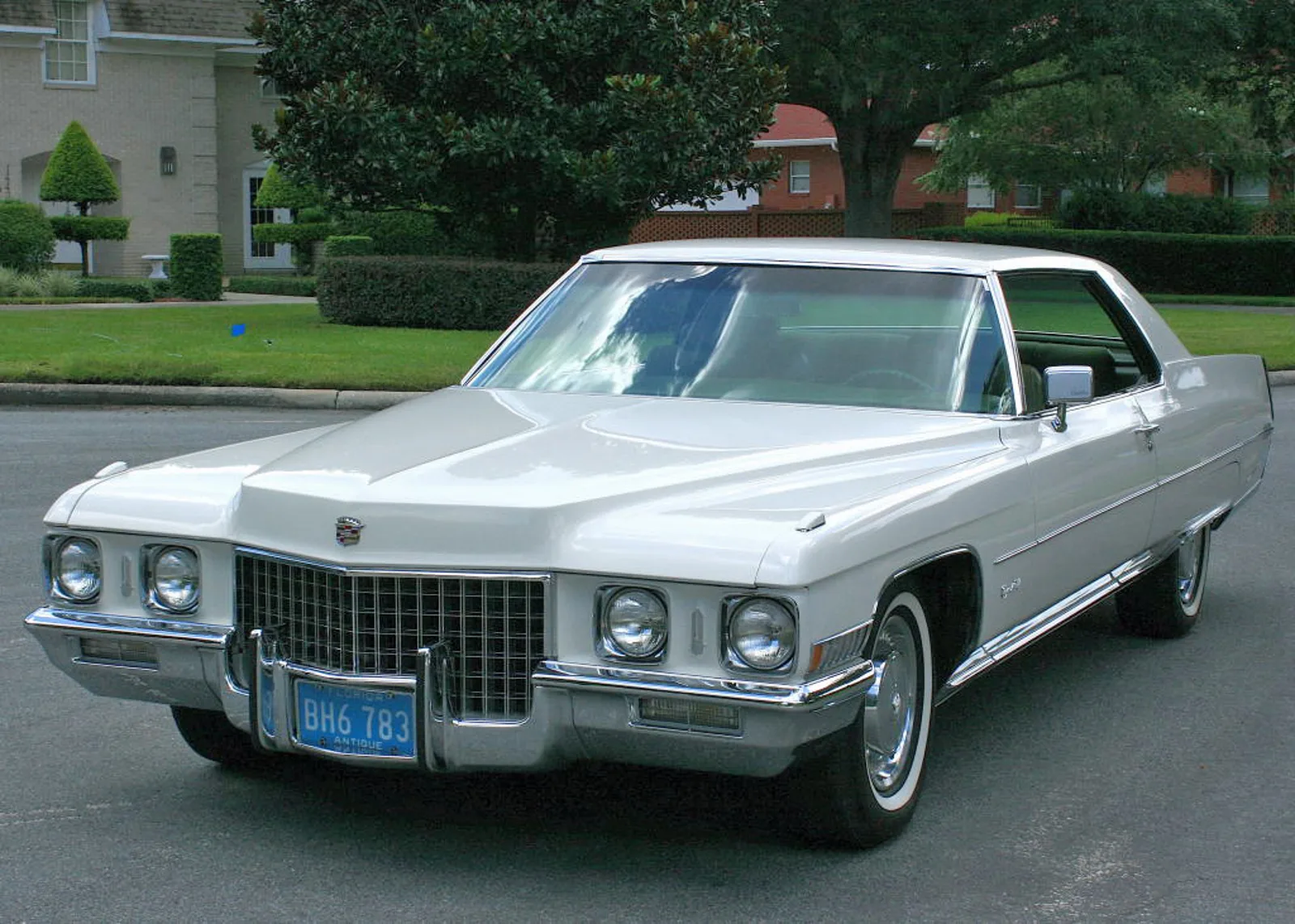
The 1971 car had flanks that taper to a point towards the rear, twin front headlamps in a body-coloured bezel, and a stylised crest between them. The radiator grille was rectangular with a square mesh, called the Egg-Crate grille, and it broke the horizontal line of the front bumpers. Narrow vertical tail lamps sat in chrome surrounds at the end of the rear wings.
The body was reworked for model year 1971, and the DeVille's styling was broadly similar to that of the Calais and the 60 Special. Cadillac made detail changes to the front and rear almost every year, but the basic body structure stayed largely the same from 1971 to 1976.
For 1972 the radiator grille received horizontal struts, and the front indicators moved out of the bumper and into the headlamp unit, sitting between the two headlamps in a body-coloured surround. Technically, Cadillac switched to net ratings that year, although the engine itself was unchanged.
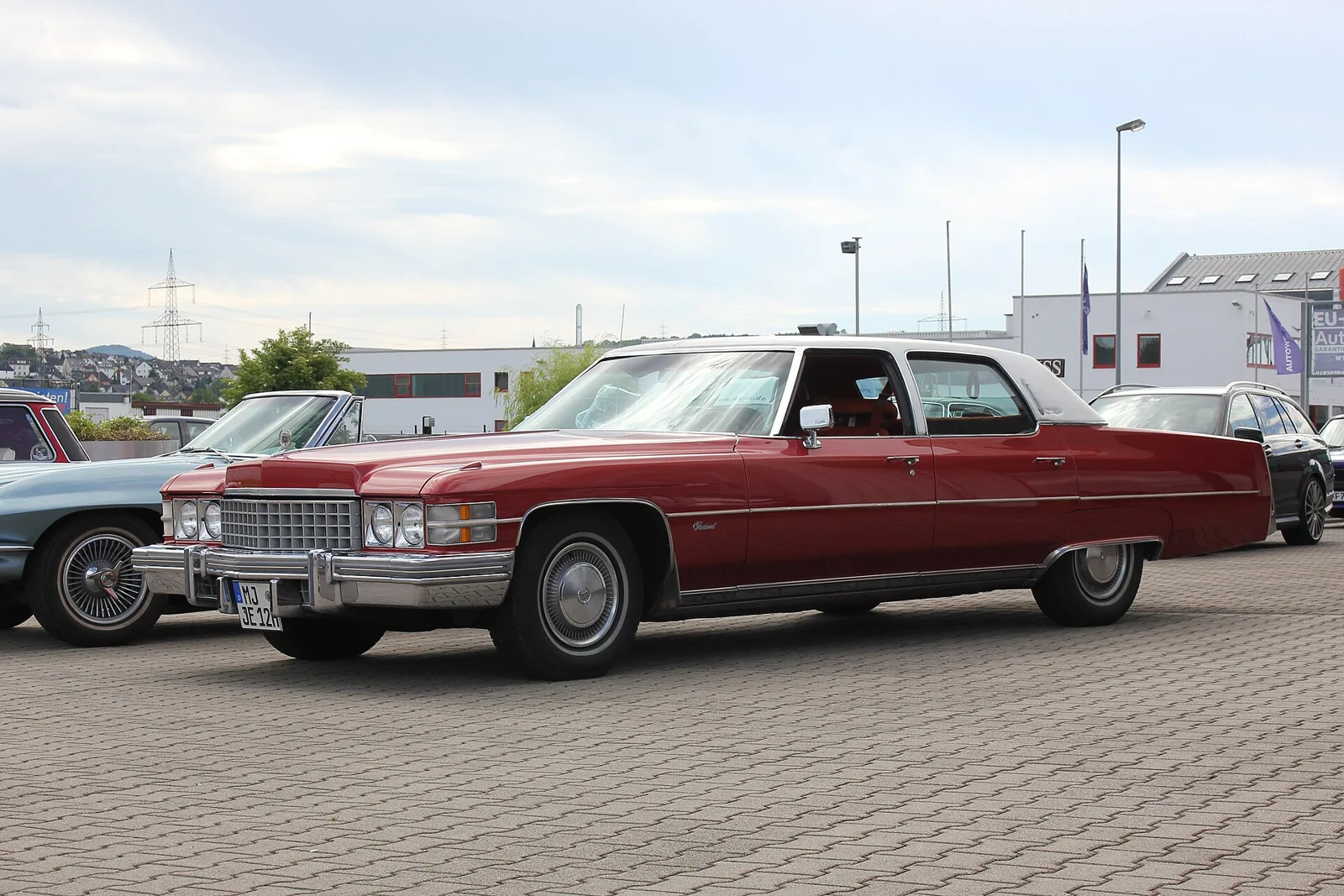
From 1973 front safety bumpers were required on new cars, to prevent body damage at five miles per hour (8 km/h). The DeVille received a horizontal bumper that ran the full width of the car, and its grille became a horizontal rectangle with vertical struts. The headlamps and indicators now sat in a uniform chrome surround on each side.
From 1974 rear safety bumpers were also required, and Cadillac combined the change with a larger facelift. The flanks became smoother, and the tail lamps moved horizontally above the rear bumpers, under the boot lid. Large Cadillacs gained rectangular twin headlamps for 1975, and the sedan, except the Sixty Special, gained a trapezoidal opera window in the C-pillar.
Why was the two-door body different?
Until 1973 the two-door DeVille was a hardtop coupe with no B-pillar and frameless, fully retractable side windows. A statutory requirement for a continuous centre pillar ended that style, and Cadillac met the side-impact requirements for the coupe at the 1974 facelift.
From 1974 the coupe was built as a Pillared Coupe, with the B-pillar running from sill to roof and the rear roof trim starting directly behind the doors. On these cars the rear side window sits within the side roof trim, surrounded by vinyl. The covering could run over the whole roof or, in the manner of a landau, cover only the rear section above the back seats. That second option was called the Cabriolet Treatment and cost extra.
The four-door sedan stayed a hardtop without a centre pillar until 1976. This generation had no convertible, and from then on open Cadillacs were offered only by the Fleetwood Eldorado.
How roomy and how heavy was it?
The DeVille was a full six-seater, with a continuous bench at the front and another at the rear, each seating three. Its wheelbase was 3,302 mm (130.0 in) on every body style. Kerb weights ran from 2,124 kg (4,683 lb) for the 1971 coupe to 2,334 kg (5,146 lb) for the 1975 sedan.
Front shoulder room came to 1,580 mm (62.2 in), and rear shoulder room to 1,640 mm (64.6 in). The cabin was wider than that of any Cadillac built before it. A 40:60 split of the front bench could be ordered for extra cost. On the 60 Special the split was standard, while the cheaper Calais could not have it at all.
The 60 Special was about 100 kg (220 lb) heavier than the DeVille, while the Calais, with the same dimensions, was slightly lighter. Cars were upholstered in cloth as standard, and leather was an option. Wood-imitation foil decorative panels appeared in several places, though the press criticised where they were placed.
From 1974 a redesigned instrument panel was available. The speedometer and several warning lamps sat in monitor-like boxes above the steering column, and advertising called it the Space Age Instrument Panel. Earlier cars had a one-piece plastic panel with widely spread displays.
Which V8 engines did the DeVille use?
Every DeVille of this generation had a large eight-cylinder V engine, and the 1971 to 1974 cars used a 7,729 cc (472 cu in) unit. From 1975 the 8,194 cc (500 cu in) engine was standard, rated at 190 SAE-PS (187 hp) in carburettor form, and a fuel-injected version for 1976 raised the output to 215 SAE-PS (212 hp).
For 1971 Cadillac cut the compression from 10.0:1 to 8.5:1, and output fell from 375 to 345 SAE-PS (gross; 340 hp). Cadillac switched to net ratings in 1972, when the same engine was quoted at 223 SAE-PS (net; 220 hp). The 1974 output was reduced to 208 SAE-PS (net; 205 hp).
The 8,194 cc engine was close to square in its proportions, with a 109 mm bore and a 109.3 mm stroke. Cadillac had first fitted it in 1970 to the front-drive Fleetwood Eldorado. It was the biggest engine in any postwar series-production car, yet its 23 PS per litre was among the weakest in its decade. A three-speed automatic was standard in every model year.
How did the DeVille sell?
The first model year sold a little over 66,000 coupes and 69,300 sedans, which was nearly four times as many as Lincoln sold with the Continental. The previous DeVille had sold more than 180,000 cars, so the new model's sales fell back from that level. The 1973 model year was the best of the generation, with more than 215,000 coupes and sedans sold.
Production was split between Detroit Assembly in Detroit, Michigan, and Linden Assembly in Linden, New Jersey.
The 1972 model year produced 195,000 coupes and sedans, and the 1974 model year saw sales fall by about 20 percent to about 172,000, as the oil crisis hit. Cadillac was less affected than Lincoln, where sales of the Continental fell by almost 40 percent in the same period.
In 1975 Cadillac introduced the Seville, a medium-sized luxury saloon 50 cm (19.7 in) shorter and nearly 450 kg (992 lb) lighter than the DeVille, with a base price almost 40 percent higher. It did not dent the DeVille's sales, because it competed with European imports such as the Mercedes-Benz S-Class and BMW 2500 and 2800 models.
Production of the DeVille reached 173,500 cars in 1975, against 55,000 Lincoln Continentals and 8,800 Imperial LeBarons. The 1976 model year, the last of the generation, produced about 180,000 more. Total output for 1971 to 1976 was 1,074,829 coupes and sedans of the DeVille range.
What was the d'Elegance package?
The d'Elegance package was introduced for model year 1974 on the DeVille and the 60 Special, and it was available on both body styles. Its extras included Mardi Gras velour seat covers in black and white, amber, terracotta or dark blue, panelled door sides, pockets on the front seat backs, thicker carpets and a transparent Cadillac crest on the bonnet.
On the coupe the package could be combined with the Cabriolet Roof Treatment for extra cost. Cadillac kept the package in 1975 and 1976, changing only the seat colour combinations each year, and smaller successors from 1977 also had d'Elegance packages.
What did the Mirage pick-up involve?
The Mirage was a DeVille coupe converted into a two-door pick-up by Traditional Coachworks of Chatsworth, California. About 250 coupes were converted in 1975 and 1976, and they were sold as the Cadillac Mirage pick-up. The converted cars were existing DeVille coupes, reworked into a different body style.
The cars keep a B-pillar, which is unusual for a pick-up, with a side window set into it. Some sources say the conversion took place with the approval of General Motors.
What changed for the 1976 model year?
The 1976 car changed very little. Cadillac made almost no stylistic changes, carried the 8.2-litre carburettor engine over from 1975 with its 190 SAE-PS output, and added a fuel-injected version rated at 215 SAE-PS. Production ended in late summer 1976, and the 1976 cars were the last of the generation.
Chrysler had dropped its Imperial LeBaron after model year 1975 and competed with the largely identical but considerably cheaper New Yorker Brougham. At Lincoln the Continental, dating back to 1970, remained in the range. Around 180,000 more DeVilles were built in 1976, more than twice as many as Lincoln and Chrysler produced in this class together.
Specifications at a glance
| Specification | Detail |
|---|---|
| Model years | 1971 to 1976, fourth DeVille generation |
| Engine 1971 to 1974 | 7,729 cc (472 cu in) V8, 345 SAE-PS (gross; 340 hp) in 1971 |
| Engine 1975 to 1976 | 8,194 cc (500 cu in) V8, 190 SAE-PS (187 hp) |
| Fuel-injected 1976 option | 215 SAE-PS (212 hp) |
| Transmission | Three-speed automatic, all model years |
| Wheelbase | 3,302 mm (130.0 in) |
| Length growth to 1976 | 125 mm (4.9 in) |
| Coupe weight, 1971 | 2,124 kg (4,683 lb) |
| Coupe weight, 1975 | 2,290 kg (5,049 lb) |
| Sedan weight, 1975 | 2,334 kg (5,146 lb) |
| Successor, model year 1977 | 250 mm (9.8 in) shorter, 216 mm (8.5 in) shorter wheelbase |
| Production 1971 to 1976 | 1,074,829 coupes and sedans |
Why does the DeVille still matter?
The DeVille of 1971 to 1976 matters because it shows the Malaise Era at full stretch. Its large engines lost power to meet tightening rules, its body lost the pillarless coupe, and it still sold in great numbers.
When the successor arrived for model year 1977 it was the first DeVille to be shorter and lighter than the car it replaced, with the length down 250 mm (9.8 in) and the kerb weight up to 500 kg (1,102 lb) lower than the 1976 car.