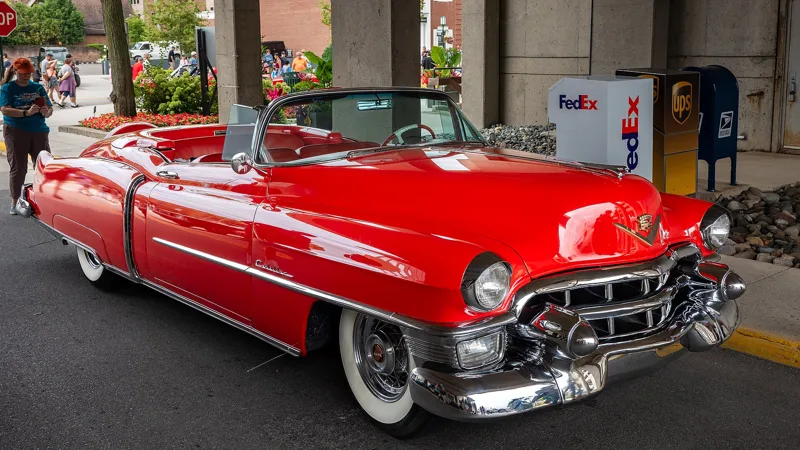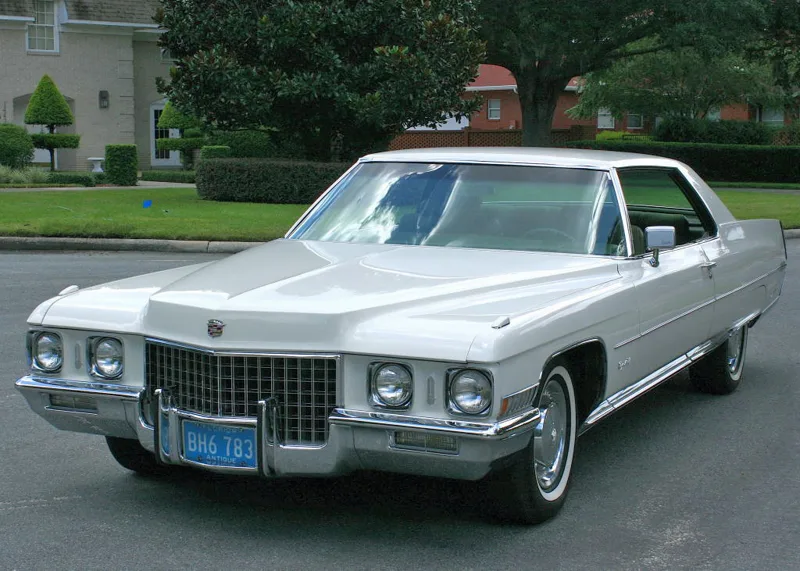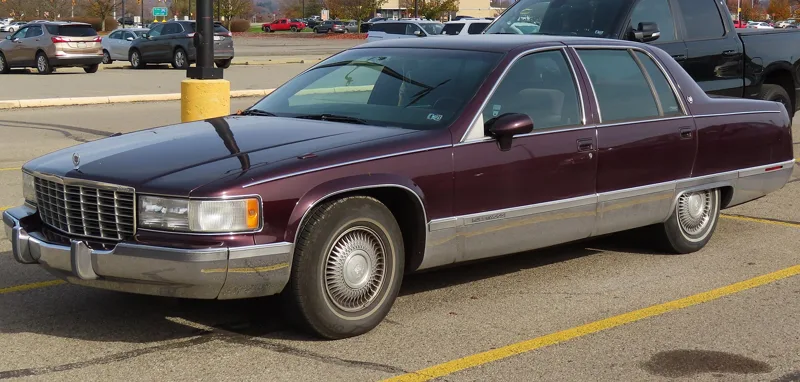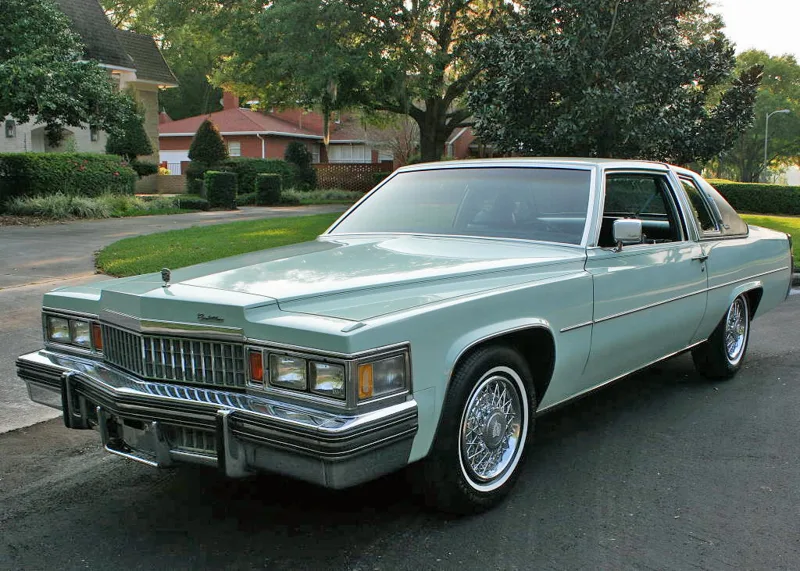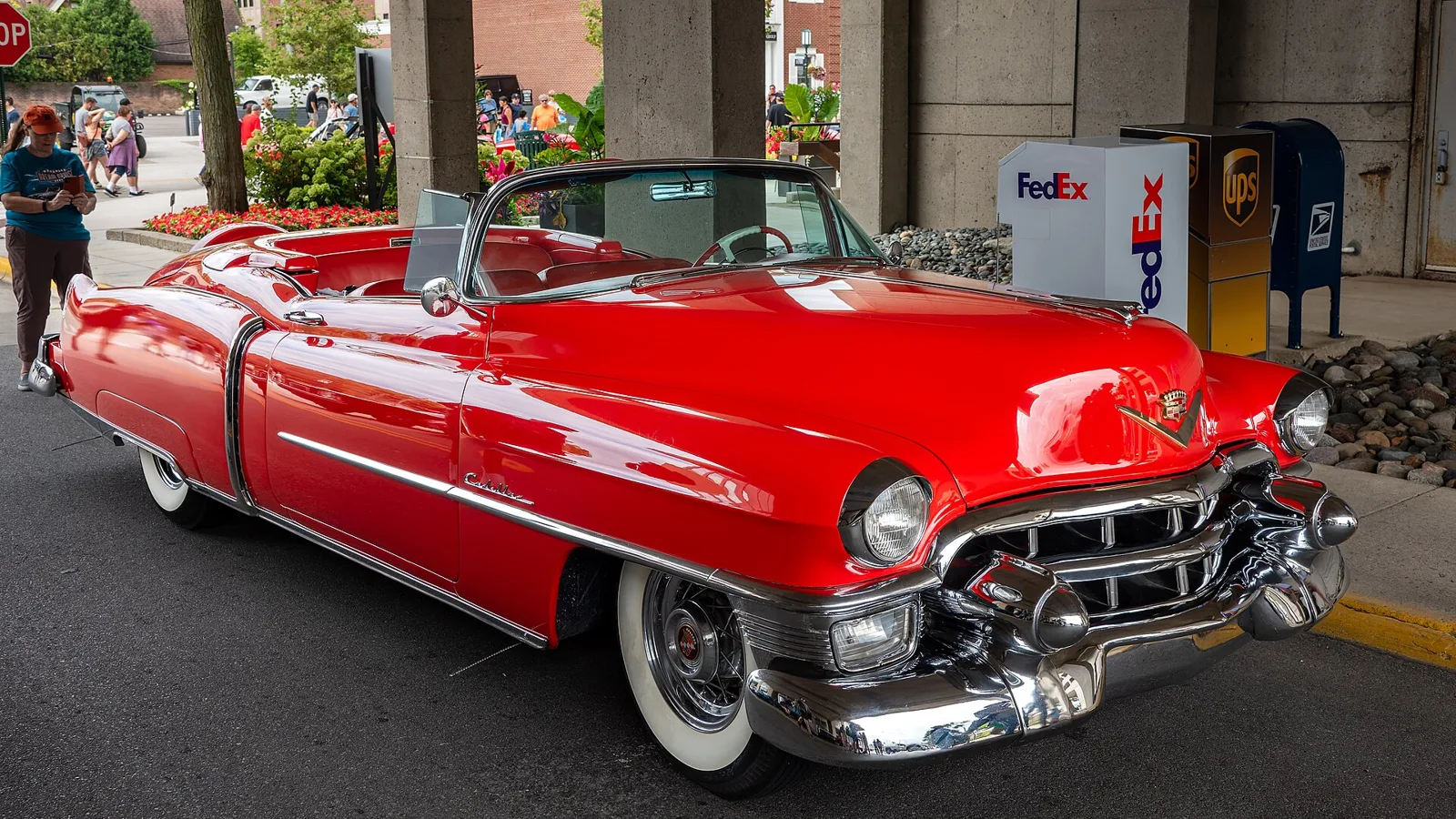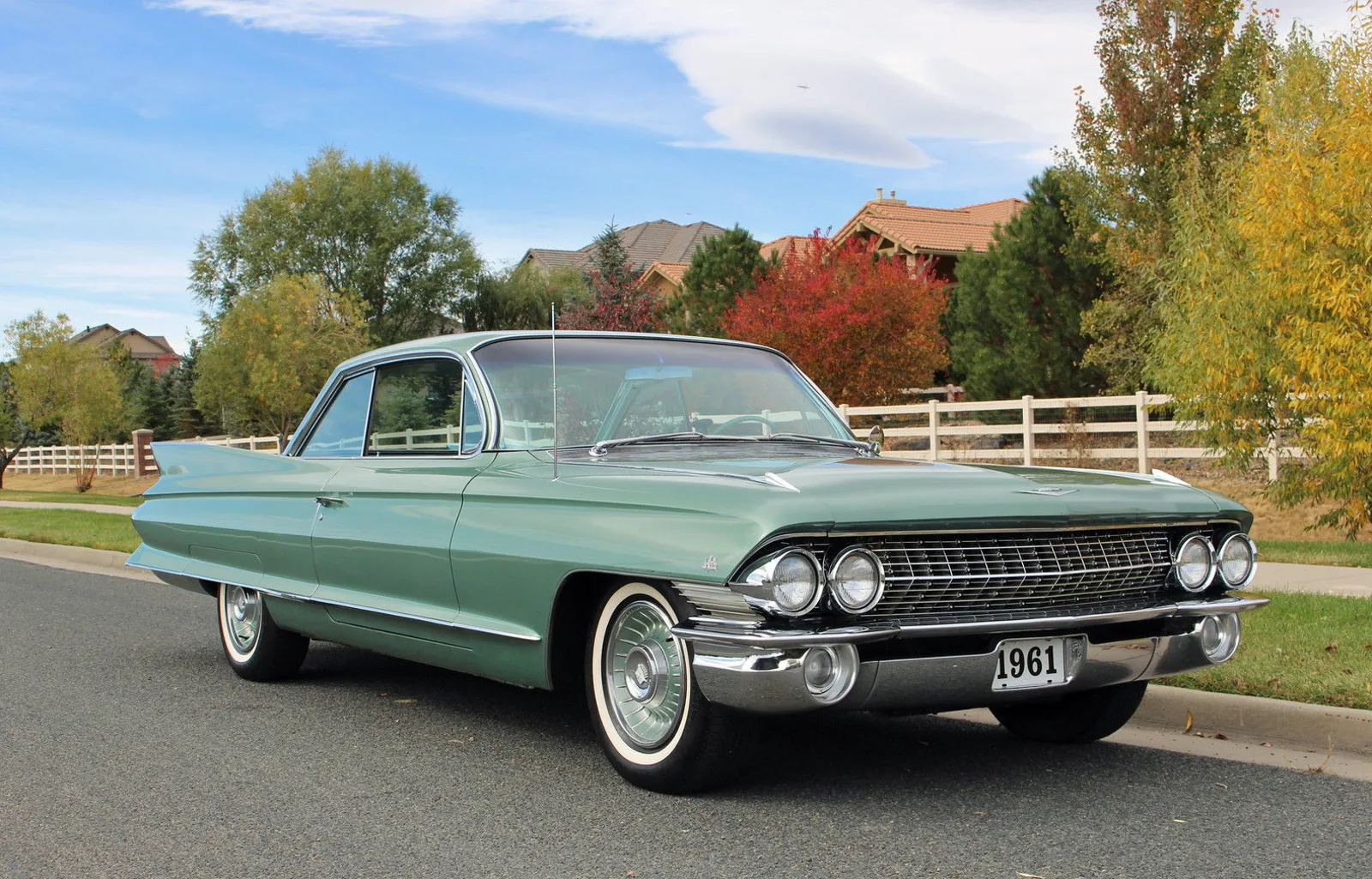
The second DeVille generation ran for four model years, kept its tail fins longer than any rival, and produced a short Town Sedan built to meet the new Lincoln Continental.
Built by Cadillac from 1961 to 1964 under factory code Series 6300, this DeVille was offered as a coupe, sedan and occasional convertible. It was the second DeVille generation, with a 6,391 cc V8 in 1961 and a 7,030 cc V8 by 1964.
The Cadillac DeVille of the 1961 to 1964 model years, factory code Series 6300, was a luxury car sold as a coupe, a four-door sedan and, at times, a convertible. It was the second generation of the DeVille line, and its 6,391 cc V8 of 1961 grew to 7,030 cc by 1964.
Cadillac changed its look slowly, one model year at a time, and kept its tail fins longer than any other American series-production maker. The short Town Sedan was Cadillac's answer to the new Lincoln Continental.
Where did the DeVille come from?
Cadillac had introduced a hardtop coupe called the DeVille in 1949, and it kept similar cars in the range through the following years. The DeVille began as a better-equipped version of the Series 62 and only later stood apart from it.
For the 1959 model year Cadillac separated the DeVille from the Series 62, so it became an independent model. In the range it sat above the Series 62 but below the costly Series 60 Special and Eldorado.
For 1961 Cadillac introduced new versions of all its model series. Unlike earlier years, every series now shared the same technology and the same basic body, so the differences lay in equipment, design and trim details.
Cadillac changed its look slowly, one model year at a time, and kept its tail fins longer than any other American series maker.
Why did the DeVille become its own model?
Cadillac's second independent DeVille generation, introduced in 1961, doubled the cycle that had been two years until then to four. Like every other Cadillac, though, the DeVille received a larger facelift after two years, so each car still had a midlife update.
The second generation became Cadillac's most successful series in the early 1960s. Cadillac sold more DeVilles than Series 62 cars on a regular basis, even though the DeVille cost about US$400 more and came in fewer body styles.
How was the body styled?
The basic body matched the contemporary Series 62 models, and the expensive 60 Special saloon and the Eldorado luxury convertible shared the same structure. The DeVille came as a two-door coupe and as a four-door sedan, which was offered with four or six side windows.
The design was created in the Cadillac Design Studio under Bill Mitchell, with Chuck Jordan as the responsible designer. The aim was a new face for the brand. Cadillac wanted to leave behind the 1950s look that Harley Earl had shaped, which many found pushy and exaggerated, and which had peaked in tail fins of ridiculous proportions and heavy chrome trim.
The brand's new direction was meant to be plain, elegant and less playful, with modern restraint. Cadillac made the change over several years, with annual alterations, while its rival Lincoln made its break in a single step.
The overall theme of this generation followed the exclusive Eldorado Brougham saloons that Pininfarina had designed and built for 1959 and 1960. The roof line was trapezoidal and without curves, and the front panoramic windscreen was dropped.
Why did the tail fins last so long?
Cadillac did not give up its tail fins entirely. It kept the feature across all four model years of the generation, and the fins became lower each year. That left the design increasingly dated, and by 1964 Cadillac was the last American series-production maker still using tail fins.
Lincoln had dropped them completely on the Continental, designed by Elwood Engel and introduced in 1961. Imperial followed for the 1962 model year, after Engel moved to Chrysler. The Cadillac fins disappeared only with the next generation, for the 1965 model year.
What did the 1961 and 1962 cars look like?
The 1961 and 1962 body styling is generally regarded as very successful. The 1961 coupe had a strongly sloping C-pillar, and the Six Window Sedan had a sloping pillar with a small triangular window between it and the rear doors, giving six side windows in total.
The Four Window Sedan of 1961 had a very thin C-pillar that met the rear door glass directly, followed by a large panoramic window. This version was unofficially called the Flat Top. The 1961 and 1962 cars also had double tail fins, with fin-like projections at the lower rear as well as the raised areas above the rear wheel arches. The idea came from the 1959 Cadillac Cyclone show car, and it also appeared to a smaller extent on Pininfarina's Eldorado Broughams.
The 1962 cars kept the design largely unchanged, with lower fins, vertically arranged rear lights, less chrome on the front, and a new roof on the Four Window Sedan. The rear panoramic window was dropped in favour of a broad, sloping C-pillar.
What changed for 1963?
The 1963 model year brought a thorough body revision, mainly at the rear. The skeg fenders disappeared in favour of smooth rear wings, and the tail fins were made smaller. The DeVille also received a newly designed engine, as did every other Cadillac.
The Series 390 engine kept the same displacement and maximum output as the unit used until 1962, but its connecting rods, crankshaft and ancillary layout were heavily changed. It was 25 mm lower, 110 mm narrower and 32 mm shorter than the old engine, and its total weight was 25 kg lower. General Motors' four-speed automatic remained the transmission.
What engines did the DeVille use?
Every car of the generation used an eight-cylinder V petrol engine, fitted with four-barrel carburettors from Rochester. The engines sat longitudinally at the front and drove the rear wheels through a standard automatic gearbox. The engine details changed several times in the individual years.
The 1961 engine displaced 6,391 cc (390 cu in), with a bore and stroke of 101.6 x 98.4 mm. It came from the 331 Series and represented the final development stage of the eight-cylinder design that had reached the market in 1948. Output was 330 SAE PS gross (242 kW). Cars exported to Europe made only 309 SAE PS gross (227 kW), and the gearbox was a four-speed Hydramatic.
What changed in 1964?
A convertible joined the DeVille range for the first time in 1964. The open version of the Series 62 was discontinued at the same time. Cadillac had offered open two-door cars only in the Series 62 and Eldorado lines until 1963.
The Series 390 engine grew to 7,030 cc (429 cu in), with a 105 mm bore and a 102 mm stroke. Output rose to 345 SAE PS gross (253 kW) for the home market and 313 SAE PS gross (230 kW) for export. The engine came with a new three-speed automatic, the GM Turbo Hydramatic THM-400, which was limited to the DeVille and 60 Special. The cheaper Series 62 and the large Series 75 saloon kept the older four-speed automatic.
Why was the Town Sedan built?
The regular DeVille for 1961 was about 76 mm (3.0 in) shorter than its direct predecessor, but at an overall length of 5,677 mm (223.5 in) it was still very large. The new Lincoln Continental, presented the same year, was almost 250 mm (9.8 in) shorter and more manageable than the 1961 DeVille.
To offer an answer to the new, shorter Lincoln, Cadillac built a version of the DeVille Six Window Sedan cut to 5,461 mm (215.0 in) for 1961. It was sold as the Town Sedan. Its buyers were wealthy people living in cities such as New York City and San Francisco, where roads were tighter and parking scarcer than across most of the USA.
The Town Sedan shared its wheelbase, width and height with the regular DeVille, and its roof, doors and glazing were the same. Its boot was 178 mm (7.0 in) shorter, and the shortening at the rear made the body look out of proportion. It was not a commercial success, and only 3,751 were built in 1961, making it the least common DeVille variant.
Where did the short DeVilles end up?
In the 1962 model year Cadillac kept the short DeVille, now called the DeVille Park Avenue. The Town Sedan name passed to an identical sister model in the Series 62, which appeared in the range for the first time in 1962.
Both short Cadillacs were based on the four-door sedan with four side windows. In 1963 the short saloon was offered only in the DeVille range, and for 1964 the DeVille version was discontinued too. Today the DeVille Town Sedan and Park Avenue are sought-after collector's pieces, largely because they are rare.
They are seen as Cadillac's first attempt to enter a more compact market segment, and so they are indirect predecessors of the Seville of 1975.
How did the DeVille sell against its rivals?
In America the DeVille competed with the Lincoln Continental from the Ford group, which was launched in the same year, and with Chrysler's Imperials. Both of those rivals were built in far smaller numbers than the DeVille.
The DeVille regularly outsold the Series 62 despite its higher price.
Cadillac DeVille 1961-1964 at a glance
| Specification | Detail |
|---|---|
| Model years | 1961 to 1964, factory code Series 6300 |
| Body | Two-door coupe, four-door sedan, convertible from 1964 |
| Wheelbase | 3,302 mm (129.5 in), all body versions |
| Overall length, 1961 | 5,677 mm (223.5 in) |
| Engine, 1961 | 6,391 cc (390 cu in) V8, 330 SAE PS gross (242 kW) |
| Engine, 1964 | 7,030 cc (429 cu in) V8, 345 SAE PS gross (253 kW) |
| Transmission | Four-speed Hydramatic to 1963; THM-400 three-speed from 1964 |
| Brakes | Four drum brakes |
| Town Sedan, 1961 | 5,461 mm (215.0 in) long; 3,751 built |