A convertible that cost twice a Series 62 coupe, carried a panoramic windscreen and opened a family that ran to twelve generations.
Cadillac's 1953 Eldorado was a convertible built as a variant of the Series 62 and sold for a single model year. Its V8 produced 213 SAE PS gross, and it cost US$7,750, making it the priciest American production car of its time.
The 1953 Cadillac Eldorado was a luxury convertible that General Motors sold under the Cadillac name for a single model year. It was the most expensive Cadillac built up to that point, and only a little over 500 were made. The car opened a family that eventually ran to twelve generations, and it rode on the same running gear as the Series 62.
Where did the 1953 Eldorado come from?
The Eldorado grew out of a 1952 show car called the El Dorado Golden Anniversary, which Cadillac had shown to mark its 50th anniversary. Cadillac had already turned a show car into the Coupe DeVille in 1949, and the Eldorado repeated that path in the convertible segment.
From 1953 Cadillac therefore offered a basic and a high-priced luxury version in both its coupes and its convertibles. The name itself was first written as two words, El Dorado, and then as one word, Eldorado, for the production car.
The Series 62 was Cadillac's cheapest and most successful range from 1952, sold as a coupe, a convertible and a four-door sedan. The Eldorado sat above the regular Series 62 convertible, just as the Coupe DeVille stood above the plain Series 62 coupe. Since 1949 the Coupe DeVille had been a special model within the Series 62, priced above the plain coupe. Cadillac advertised the Eldorado in 1953 as a Special Sports Convertible, aimed at younger buyers than its usual customers.
Its very high price stood in the way of wide distribution. Even so, the car fulfilled its role as an image vehicle, and it kept the Cadillac brand in the press.
A one-year image car that kept Cadillac in the press and started a family of twelve generations.
Who was the Eldorado built for?
Cadillac's usual customers were not the target market here. The Eldorado was pitched at younger buyers, and its marketing label, Special Sports Convertible, reflected that goal.
Price was the biggest barrier. At US$7,750 it was the most expensive Cadillac built until then. The press attention it generated still kept the marque visible, which was the job it had been given.
How did the Eldorado body differ from the Series 62?
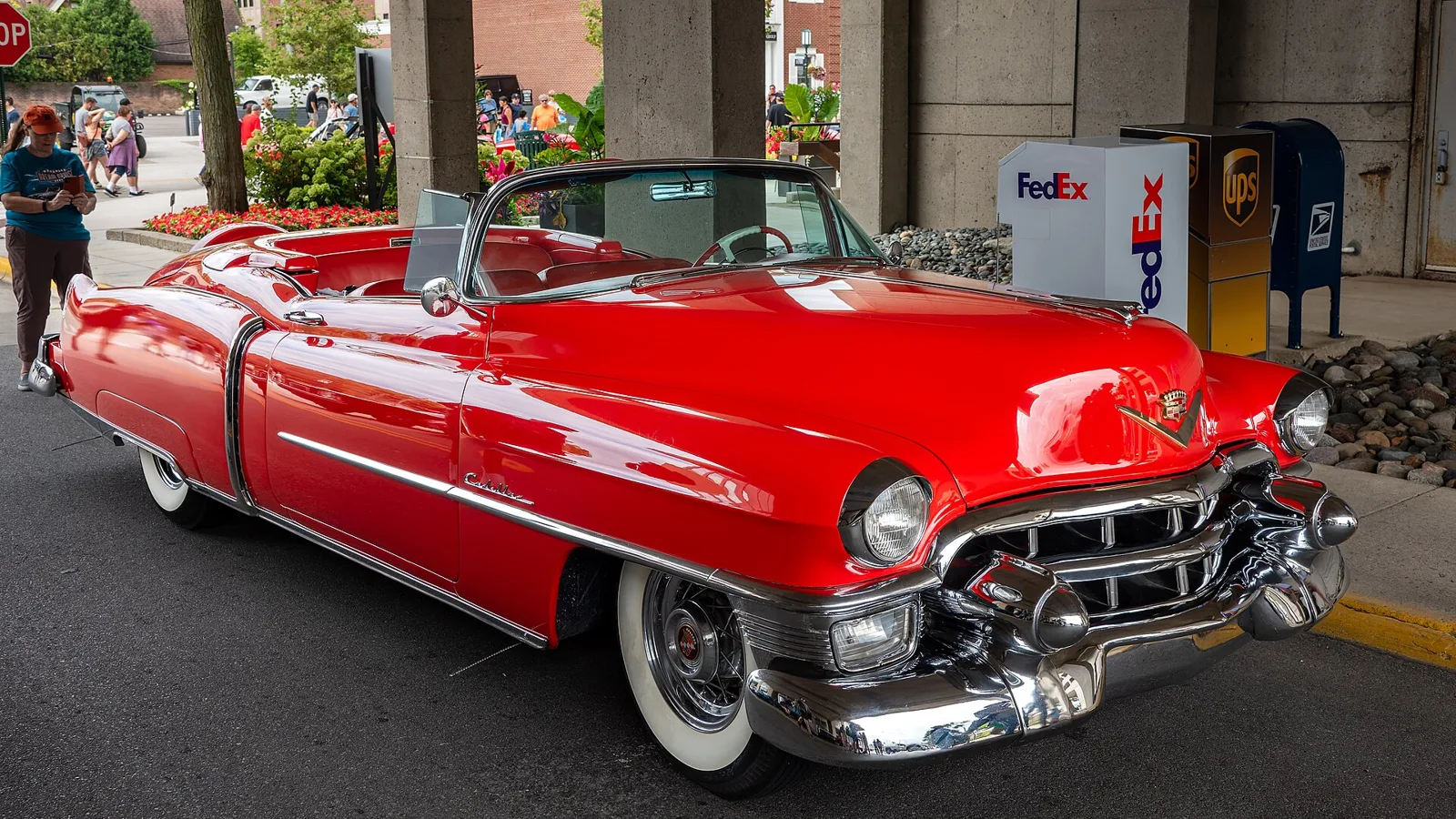
The Eldorado kept the front and rear sections of the Series 62 convertible, but its passenger area was reshaped. The signature feature was a front panoramic windscreen, which Harley Earl had made an explicit requirement. The beltline also dropped toward the rear at the doors, so the car looked lower and more sporting from the side.
Six people could ride in the two-door body. Together with the Oldsmobile Fiesta, the Eldorado was the first production car with a windscreen that reached into the sides. Fitting it meant deep and expensive changes to the structure of the base design.
Cadillac's chief designer Ed Glowacke and his team shaped the body to the specifications of Harley Earl, GM's design chief. Out back, small tail fins from 1948 echoed the wings of a Lockheed P-38. Instead of a fabric cover, the stowed roof disappears under a body-coloured metal panel.
Independent suppliers sold Continental Kits, an external spare wheel on an extended rear bumper, although the factory never offered one. Many Eldorados were later fitted with them.
The panoramic windscreen did not stay exclusive for long. Starting with model year 1954, all Cadillacs up to 1960 received panoramic windscreens of their own.
Chassis and running gear
Beneath the bodywork, the frame, suspension and brakes matched the Series 62 exactly. The Eldorado's distinctiveness therefore came from its body, its trim and its price rather than its running gear.
The front wheels were independently sprung on coil springs, while the rear used a rigid axle with semi-elliptic leaf springs. Servo-assisted drum brakes worked at both ends, and the box-section frame was carried over unchanged from the Series 62.
What engine did the Eldorado have?
The Eldorado used an eight-cylinder V petrol engine mounted longitudinally at the front. Its displacement was 5,425 cc (331 cu in), and a four-speed GM Hydramatic automatic was standard. The basic design dates back to 1949, and the engine is the same one fitted to the regular Series 62.
Key specifications and production
| Specification | Detail |
|---|---|
| Body | Two-door, six-seat convertible with electric fabric top |
| Engine displacement | 5,425 cc (331 cu in) |
| Output | 213 SAE PS gross (165 kW; 210 hp) |
| Maximum torque | 447 Nm (330 lb ft) |
| Transmission | Four-speed GM Hydramatic automatic |
| Price in 1953 | US$7,750 |
| First-generation units | 532 |
Peak output of 213 SAE PS gross made the Eldorado the most powerful engine fitted to a US production car of 1953. Maximum torque reached 447 Nm (330 lb ft).
What did the Eldorado cost and how many were built?
The Eldorado was listed at US$7,750 in 1953, the most expensive production car made in the United States. Buyers paid double the price of a Series 62 coupe, and US$3,500 above the Series 62 convertible. Production reached 532 first-generation cars, most of them assembled by hand.
Of those 532 cars, 514 were sold to customers in the USA. New York took 83 and California 74. Of the 18 exported cars, 17 went to Canada, and only one reached Europe, a customer in Belgium.
The Series 75 sedan was US$2,000 cheaper than the Eldorado. One source puts the number of surviving Eldorados at around 200 in 2024.
Who rode in an Eldorado at the 1953 inauguration?
President Dwight D. Eisenhower stood in an open white Cadillac Eldorado for a four-and-a-half-hour parade through Washington, D.C. after his swearing-in as the 34th President on 20 January 1953. Television stations across the country broadcast the parade, which brought the car wide public attention.
Experts argued for years over which car took part. The first-built car was the early favourite, yet the consensus now points to the second production example. GM lent the car for the occasion, and despite rumours it never went to Eisenhower. After the parade GM recalled it, rebuilt it and in August 1953 sold it to a buyer in New York.
How did Buick and Oldsmobile answer the Eldorado?
Buick and Oldsmobile also showed dream cars built on 1952 Motorama show cars, and both were four-seat convertibles. Buick's Roadmaster Skylark, technically a Series 70 car, lacked the panoramic glass. Oldsmobile's Fiesta, built on the Ninety-Eight, did have a front panoramic windscreen, as the Eldorado did. Its beltline dip was less pronounced than that of the Cadillac or the Buick. Both dream cars were four-seaters, while the production Eldorado seated six.
The Skylark sold 1,690 units at a list price of US$5,000. The Fiesta was sold for US$5,717, and only 458 were built in 1953. Oldsmobile's version survived a single year and Buick's two, while Cadillac kept the Eldorado name going.
How long did the Eldorado name last?
Cadillac kept the Eldorado name running for decades, with eleven further generations from 1954 to 2002. Until 1965 the Eldorados were more or less modified versions of Cadillac's volume models. From 1967 they became front-wheel-drive cars with technical independence and often individual bodies.
At times there was also a coupe version, the Eldorado Seville, and a four-door sedan, the Eldorado Brougham.
Colours, tops and equipment
The Eldorado came in 16 colours. Four were exclusive to the model: Aztec Red, Alpine White, Azure Blue and Artisan Ochre, a yellow. The other 12 were standard colours from the regular Cadillac range. The plastic-covered top was offered in black on 302 cars and in white on 230.
Buyers got power windows and seats as standard, along with a radio that finds stations on its own, power steering, whitewall tyres on wire-spoke wheels, and fog lamps. The top of the instrument carrier was trimmed in real leather.