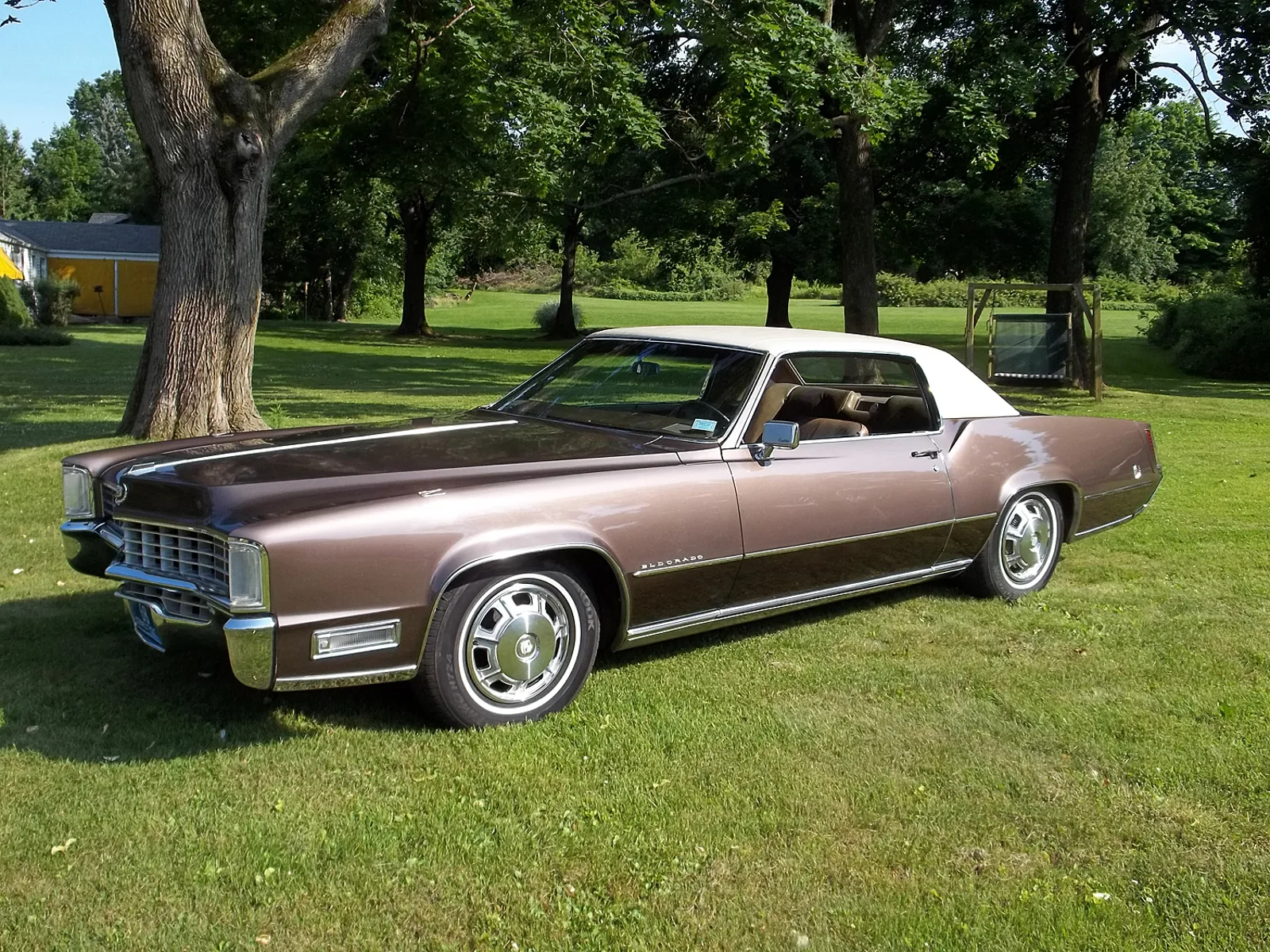
Razor-edge styling, a front-drive layout shared with the Oldsmobile Toronado and V8 engines that grew to 8,194 cc by 1970.
The Cadillac Fleetwood Eldorado of 1967 to 1970 was a personal luxury coupe built by General Motors. It was the first Cadillac with front-wheel drive, and its V8 engines grew from 7,024 cc to 8,194 cc during its run.
The Cadillac Fleetwood Eldorado of 1967 to 1970 was the brand's first front-wheel-drive car, and it arrived as a separate luxury coupe rather than a dressed-up convertible. Its razor-edged body and V8 engines, which grew from 7,024 cc to 8,194 cc (500 cu in) over four model years, gave the model a clear identity.
Where did the Eldorado name come from?
The name came from a 1952 show car, the El Dorado Golden Anniversary, which Cadillac unveiled to mark its 50th anniversary. The Eldorado model line began in 1953 as an open two-door above the Series 62 Convertible, and the name was kept for the 1967 coupe.
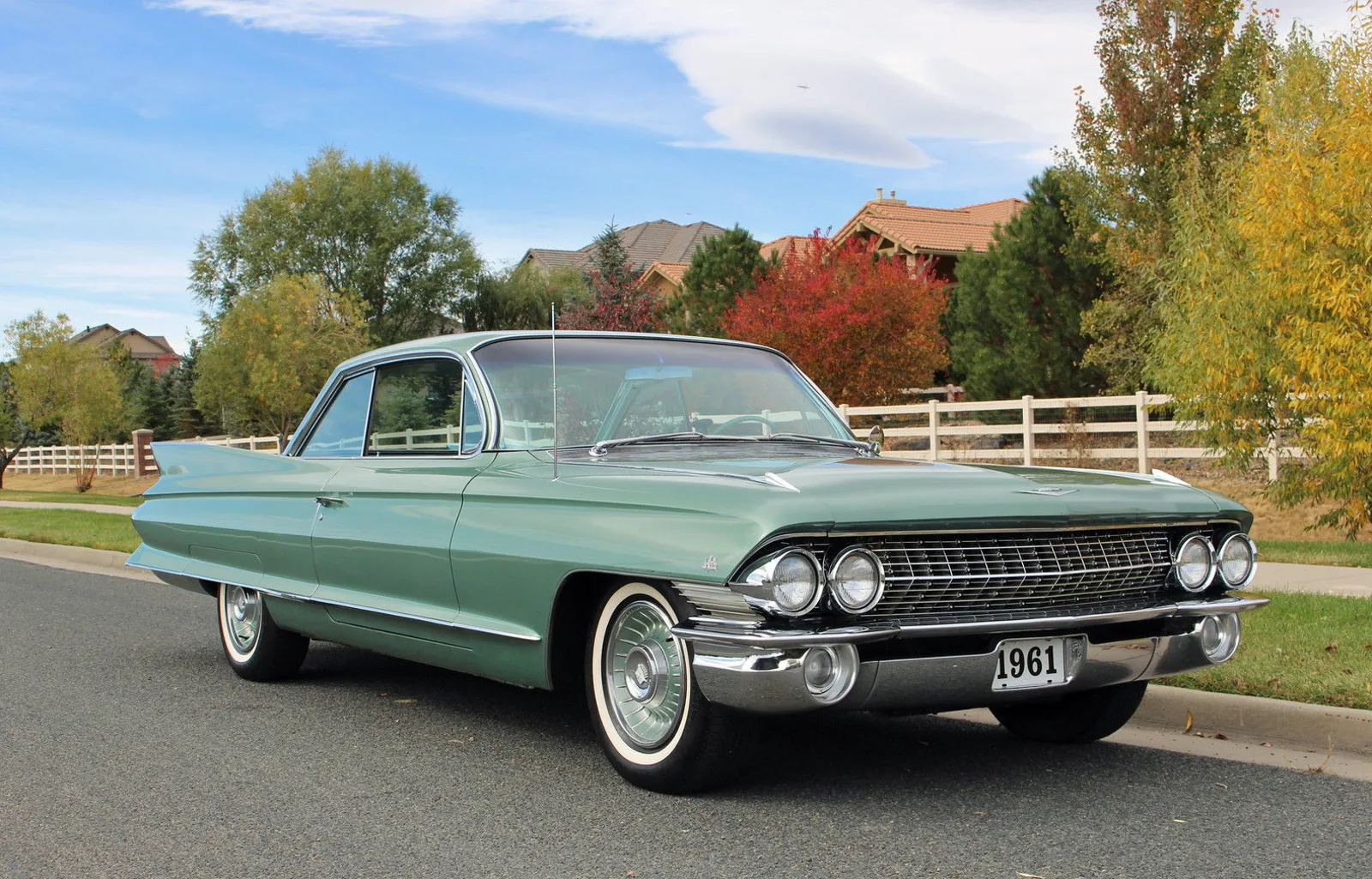
The family lost its pull in the early 1960s. The Eldorado Brougham, a limousine added in 1957 at an extreme price, was dropped at the end of 1960 without a replacement after losing money. The regular Eldorado Convertible had lost its separate identity a year earlier. The Biarritz, and then the Fleetwood Eldorado of 1966, shared their bodies with Cadillac's standard convertibles while offering better equipment.
The new model was first discussed under the LaSalle name, a Cadillac sub-brand used from 1927 to 1940. Reviving it was rejected because that line had sat below Cadillac in the market, and a clash with the upper-class position was feared. Adding Fleetwood to the Eldorado name lifted it further.
A front-drive Cadillac coupe with razor-edged styling and V8 engines that grew to 500 cubic inches.
How did the Eldorado convertible compare with other Cadillacs?
The Eldorado Convertible was priced between 1,500 and 3,500 US$ above the regular Cadillac convertibles, depending on the model year. It sold only in small numbers, yet as a high-quality, attractive model it drew customers to the dealers and so helped raise sales of the standard Cadillacs.
The Eldorado family held the top position at General Motors, and the two-door hardtop Seville, added in 1956, widened the range within it.
Why did Cadillac switch to front-wheel drive?
Cadillac chose front-wheel drive in 1962, after three years of concept work, to underline the independence of the Eldorado. The sister brand Oldsmobile was already developing a front-drive car, which became the Toronado in 1966, and both models ended up with the same underlying technology.
Cadillac's engineers did change details, and observers felt the Eldorado handled better than the Toronado. Like the Toronado, the car had a box-section frame and a wheelbase of 3,048 mm (120.0 in), which was unusually short for a Cadillac. Its front wheels hung on wishbones with torsion bars, while a solid rear axle carried leaf springs. In this class front-wheel drive was a novelty.
Unlike its predecessors, the new Eldorado was developed only as a coupe, and a convertible version was not planned. Later generations of the Eldorado were, like this one, related to the Oldsmobile Toronado.
How did the Eldorado differ from the standard Cadillacs?
From model year 1967 the Eldorado was separated technically and stylistically from Cadillac's standard models and became an independent upper-class coupe. Its front-wheel-drive layout set it apart, and it still shared engines with the rear-drive Cadillacs until 1969. The rear-drive Fleetwood Eldorado had ended with model year 1966.
Its chassis broadly followed the Oldsmobile Toronado rather than the standard cars. For front drive the engine needed a revised oil pan and exhaust connections, and the power went through a gearbox installed beside the engine. Its basic technology was the same as the Toronado's, with the Toronado as the sister model it was built alongside.
Who designed the Eldorado body?
Bill Mitchell, General Motors' design chief, is credited with the body, and it is considered one of his best works. Mitchell himself contributed little to the shape, which was developed mainly by Stan Parker and Charles 'Chuck' Jordan. First drafts from 1960 had already set the long-bonnet proportions.
Early studies imagined a two-seat coupe, its bonnet very long and its cabin pushed far back. A V16 engine was considered for a time but never built. By summer 1964 the XP-825 concept matched the production body in almost every detail.
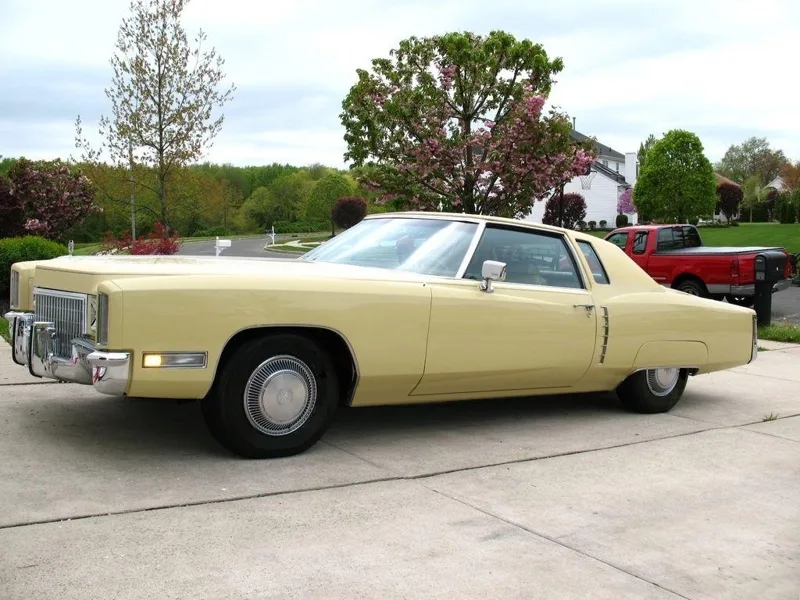
The styling later became known as Razor Edge Design. Lines were clear and straight, with sharp angles, and the doors were very long while the rear side window was narrow. A broad trapezoidal C-pillar sat above a striking kink in the beltline. The headlights hid behind flaps when not in use, and after two years the flaps were dropped in favour of permanently visible double headlights. The outer shape of the headlights continued the pattern of the radiator grille, so the grille seemed to run across the entire front.
Which engines did the Eldorado use?
Every Eldorado used a V8. The first model year had a 7,024 cc (429 cu in) unit producing 340 SAE gross PS (250 kW; 335 hp). The engine grew for 1968 and 1969 to 7,729 cc (472 cu in), and in 1970 a new 8,194 cc (500 cu in) engine was fitted exclusively to the Eldorado.
The 1967 to 1969 cars shared engines with the rear-drive Cadillacs, but the front-drive layout required a revised oil pan, exhaust connections and engine mountings. Power passed through a three-speed automatic called Hydra-Matic, installed beside the engine and linked to it by chains.
The 1970 unit was the largest series-production car engine of the postwar period, rated at 400 SAE gross PS (294 kW; 395 hp).
Only eight-cylinder engines were used across these model years, so the V8 was the one constant in the car's powertrain.
What did the Eldorado cost?
The Eldorado launched at US$6,277 in summer 1966. That was more than any Cadillac Calais or DeVille, but slightly less than the four-door Series 60 saloons. Prices rose to US$6,605 in 1968, US$6,711 in 1969 and US$6,903 in 1970. In Germany a 1967/68 Eldorado cost 39,600 Deutsche Mark (DM).
An Oldsmobile Toronado with comparable drive technology cost about US$1,500 less. In 1967/68 buyers could pay 31,950 DM for a Mercedes-Benz 300 SE coupe, or 5,150 DM for a Volkswagen 1300 Beetle.
How many Eldorados were built?
The Eldorado sold well from the start. Almost 18,000 cars were built in its first model year, 23,333 in 1969 and 28,842 in 1970, when the Eldorado alone received the 8.2-litre eight-cylinder engine. Production began at the Fleetwood plant in Detroit and moved to Euclid, Ohio, for 1969.
What changed for the 1970 model year?
For 1970 the Eldorado received a new 8,194 cc (500 cu in) V8, fitted exclusively to the Eldorado and rated at 400 SAE gross PS (294 kW; 395 hp). The price for that model year was US$6,903, and output rose to 28,842 cars from 23,333 in 1969.
The 8.2-litre engine was the largest the Eldorado carried in these four model years. Through all four years the car kept the same basic layout: front-wheel drive, a Hydra-Matic automatic and an eight-cylinder engine.
How did buyers and critics respond?
Observers judged the Eldorado's handling better than the Toronado's, because Cadillac's engineers changed details. The model was an immediate success, and today the car is regarded as a style icon, with its design counted among Bill Mitchell's finest work. Its rival was the Continental Mark III from Lincoln, which had similar prices but conventional drive technology.
Earlier, the Eldorado Convertible had drawn customers to Cadillac dealers and helped sell standard models, so the name carried a sales role as well as a prestige one.
Specifications
| Specification | Detail |
|---|---|
| Model years | 1967 to 1970 |
| Layout | Front-wheel drive coupe |
| Wheelbase | 3,048 mm (120.0 in) |
| Engine 1967 | 7,024 cc (429 cu in) V8, 340 SAE gross PS (250 kW; 335 hp) |
| Engine 1968 and 1969 | 7,729 cc (472 cu in) V8, 375 SAE gross PS (276 kW; 370 hp) |
| Engine 1970 | 8,194 cc (500 cu in) V8, 400 SAE gross PS (294 kW; 395 hp) |
| Transmission | Three-speed Hydra-Matic automatic, chain-linked to the engine |
| Front brakes | Disc brakes from the start |
| Launch price (1966) | US$6,277 |
| Price (1970) | US$6,903 |
| Output, first model year | Almost 18,000 |
| Output, 1970 | 28,842 |