A front-drive Cadillac with a long bonnet, a big V8 and a 1970s convertible that sold strongly in its final year.
The Cadillac Fleetwood Eldorado of 1971 to 1978 used a front-drive layout that was a novelty in its class. Its 8.2-litre V8 lasted until 1976, a 7.0-litre engine replaced it from 1977, and the car came as both a coupe and a convertible.
Built for the 1971 to 1978 model years, the Eldorado was Cadillac's second front-drive version of the model. At the time it was the biggest front-drive car anywhere. Cadillac gave it a box frame and an all-new body, and the convertible ran for six model years while the coupe stayed in the range for eight.
Where did the Eldorado line come from?
The Eldorado name was a regular Cadillac model from 1953, and it began life as a show car. The El Dorado Golden Anniversary, shown in summer 1952, marked the brand's 50th anniversary. For the first 13 years the Eldorado was a convertible sitting above the Series 62 Convertible, though it still used the base model's rear-wheel-drive technology.
The premium over the Series 62 was steep early on, topping US$3,500 in the first model year. It later settled at US$1,500 to US$2,000. From 1959 the Eldorado took the body of Cadillac's standard convertibles, and the models were called Eldorado Biarritz until 1965 before the Fleetwood Eldorado name appeared in 1966. Annual output through the 1960s regularly stayed in the low four-digit range.
Critics called it massive and clumsy, yet Bill Mitchell counted the 1971 cars among his favourites.
What changed when the Eldorado went front-drive?
In 1967 Cadillac separated the Eldorado from its standard models and made it an independent upper-class coupe. The move to front-wheel drive was a novelty in that class, and the drive system came from the Oldsmobile Toronado. The first front-drive car lasted only four years, and internal reports blamed high production costs on its large, hard-to-press body panels.
The second generation, which arrived in August 1970, kept the drive system as a mere further development, while the body was completely redesigned. Unlike the first generation, it came with a convertible as well as a coupe. With the DeVille Convertible discontinued after 1970, the Eldorado was the lone open model left in Cadillac's lineup.
Who designed the 1971 Eldorado?
Bill Mitchell, General Motors' design chief at the time, is usually credited with the 1971 styling. The detail work was carried out by the Advanced Cadillac Studio under Wayne Kady, who said Mitchell chose options and set the overall concept rather than drawing body details himself.
A long bonnet and a short cabin
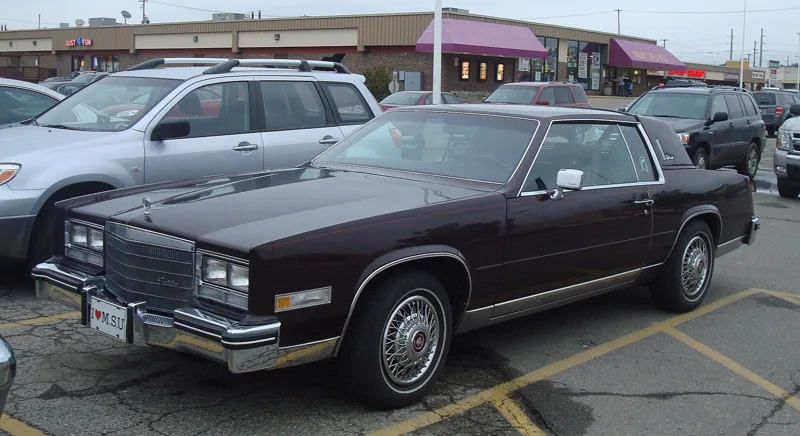
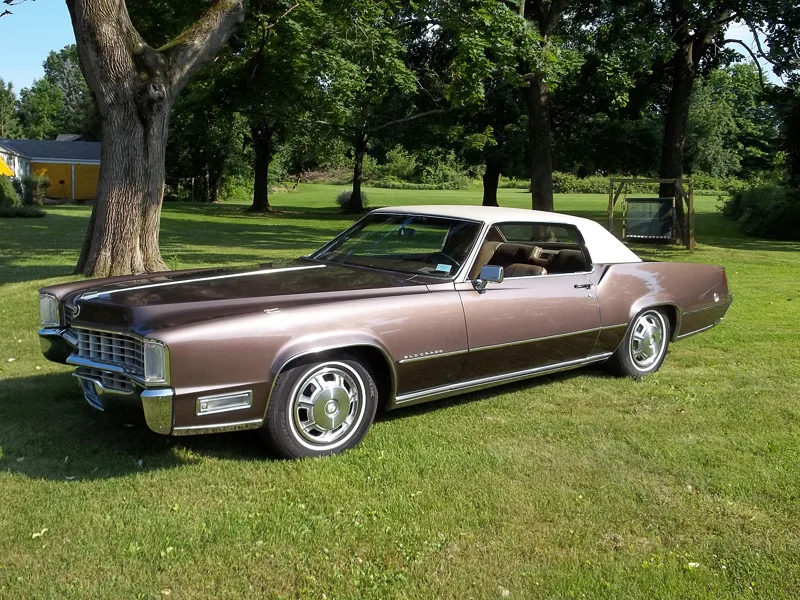
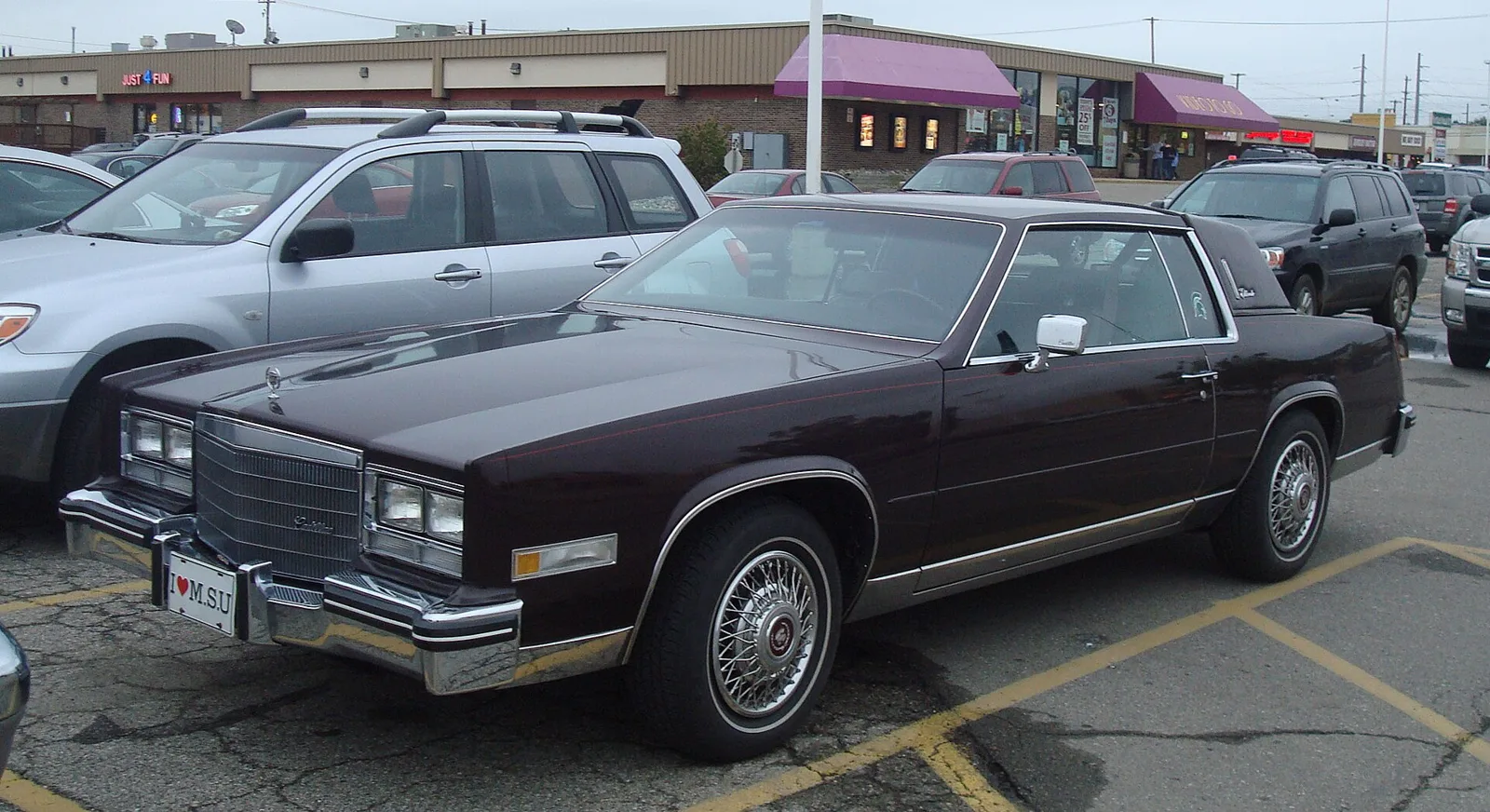
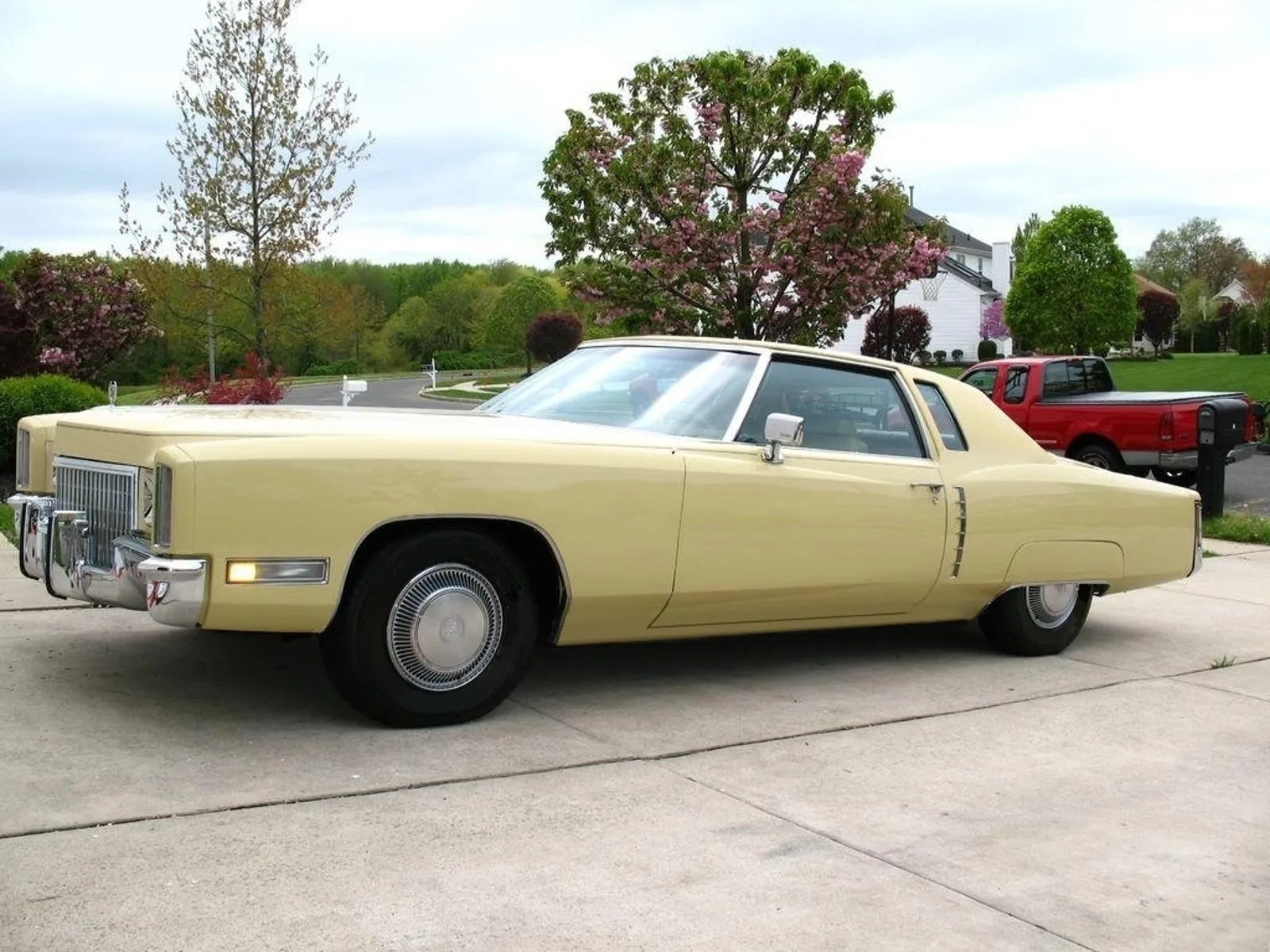
The concept put a long bonnet in front to show off the front-wheel drive, with the passenger cabin and rear section each kept short to suggest sportiness. Work on the body began in 1967, and no panel could be swapped with the predecessor. The result was rounder than the earlier car and borrowed from classic Eldorado styling, including a vertical chrome strip on the rear wings, a feature the 1953 to 1955 convertibles had carried. It was meant to suggest an air intake.
Its sides carried the coke-bottle line, with a pronounced hip swing above the rear wheels. Cadillac changed the rear wings several times over the production run. The vertical chrome strip disappeared in 1973, and by 1975 the hip swing had a more sharply defined outline.
The closed car had a fixed B-pillar, so it was not a true hardtop, although factory literature often used the word. A narrow vertical side window sat behind the B-pillar beside a very wide C-pillar, a feature meant to recall the landau styling of the prewar years. That layout restricted the view out and made the rear of the cabin dim. Cadillac made stylistic changes every model year, though most were small.
Why did the press dislike the design?
The press largely turned against the styling, with writers finding the cars oversized and awkward. Yet the 1971 Eldorados were among Bill Mitchell's favourite vehicles, so opinion was split from the start. The Eldorados of 1971 to 1978 were also heavy cars.
Chassis and frame
Like its predecessor, the second-generation Eldorado sat on a box frame with the body set on top. The new frame ran all the way back to the tail, and the suspension was revised in detail. Coil springs replaced the leaf springs at the back, which had been the previous arrangement.
Wheelbase stretched by 160 mm, reaching 3,208 mm (126.3 in), yet the 1971 car measured just 20 mm more than the car it replaced overall. Cadillac gained no room inside, so the extra length went into the engine compartment.
How heavy was the Eldorado?
At launch the open model tipped the scales at 2,335 kg (5,148 lb), and by the final production year it had climbed to 2,567 kg (5,659 lb). Each coupe was about 60 kg (132 lb) lighter than the convertible. That made the coupes the lighter of the two body styles.
How powerful was the 8.2-litre V8?
The 8.2-litre V8 displaced 8,194 cc (500 cu in) and was almost square, with a bore and stroke of 109 x 109.3 mm. Factory figures slid from 365 gross SAE PS (360 hp) in 1971 to a low of 190 SAE PS (187 hp) by 1975, with the 1972 switch to net figures and emissions work playing a part.
The engine arrived in 1970 with the first front-drive Eldorado, and it was the largest engine fitted as standard to a passenger car in the post-war era. The Eldorado used it exclusively until 1974, while all other Cadillac models had a 7.7-litre eight-cylinder instead. From 1975 the 8.2-litre became the standard engine across the Cadillac range.
The decline is regarded as emblematic of the Malaise Era in US car making. The final ratings worked out to only 23 PS per litre of displacement. For model year 1976 buyers could also choose a version with petrol injection from Bendix, rated at 215 SAE PS (212 hp).
What replaced the 8.2-litre engine?
Production of the 8.2-litre engine ended with the 1976 model year. From 1977 a newly designed 7.0-litre V8 with 425 cu in (7.0 litres) took over across the Cadillac range, including the Eldorado. With a dual-barrel carburettor it was rated at 180 net SAE PS, or 135 kW (181 hp); the other version was rated at 195 net SAE PS, or 146 kW (196 hp).
Which years brought the biggest changes?
The 1975 model year brought the largest visual change, a major facelift with a kinked rear hip swing and no more rear wheel covers. The front now had rectangular twin headlamps and indicators set into the bumpers. Earlier years brought smaller steps, including anti-lock rear brakes in 1972, front safety bumpers in 1973 and rear bumpers in 1974.
The final years were quieter. From 1976 to 1978 the styling changed only slightly, and in 1978 level control became standard, after it had been available for an extra charge.
How long did the Eldorado convertible last?
The convertible ran for six model years, from 1971 to 1976. It was the only open Cadillac once the DeVille Convertible had gone, and after other GM convertibles were dropped in autumn 1974 it became the last open car built in the United States. Sales almost doubled in 1976, when Cadillac said production would end.
The open body folded its fabric roof completely into the bodywork, so the belt line was not broken by a folded hood as on many rival convertibles. Advertising called it the Hideaway Top.
The last American convertible
Advertising for the 1976 car used the slogan The Last American Convertible. Cadillac sold 14,000 Eldorado Convertibles that year, more than in any other production year, and many buyers were collectors and speculators treating them as investments. Production was constrained by roof mechanisms: Cadillac had begun stockpiling components in 1974, but a larger run was beyond what could be sourced.
Aftermarket and T-top conversions
Several independent firms turned Eldorado coupes into open cars for private buyers after the factory version ended. Custom Coach, based in Lima, Ohio, had the most success; it relied on genuine Cadillac parts that it had bought from dealers.
Cadillac also offered a Custom Cabriolet Roof Coupe trim from 1972, finished with a vinyl rear roof panel designed to look like a landau top. In 1978 American Sunroof Corporation fitted 500 cars on factory order with glass sliding roofs marketed as Astroroof or Moonroof. Individual cars also received an electric T-top that year, with a fixed centre bar and two movable roof panels that slid into it. Reports differ on the count, putting it between two and seven examples.
What were the Biarritz and Biarritz Classic?
The Biarritz was a higher-trim closed Eldorado introduced during the 1976 model year. It brought thicker vinyl roof padding, a smaller rear window, extra chrome on the flanks and leather upholstery, at a surcharge of US$1,760 in 1977 and US$1,865 in 1978. The Biarritz Classic, added in the final year, cost US$2,466 more than the base car.
The Classic was finished in beige and dark brown two-tone paint, with the bonnet set apart in colour from the body, and the same colours appeared in the leather. Its equipment matched the regular Biarritz. Cadillac outsourced the interior and paint work to American Sunroof Corporation for capacity reasons. A total of 2,000 were built, and the batch was completed in May and June 1978.
What the critics said
Automobile Quarterly saw no logical case for buying such a car. The magazine put the Eldorado's efficiency close to zero, described its handling as that of a barge, and called it the thirstiest car on sale.
How did the Eldorado compare with rivals in the US?
Its main rivals were the Continental Mark III and Mark IV, personal luxury coupes from Ford sold through the Lincoln brand. Chrysler offered nothing comparable in that niche, and the large Imperial, though sold as a two-door, did not fill it. Ford sold more Mark IVs than Cadillac sold closed and open Eldorados combined.
US magazines usually preferred the older Lincoln Mark III in comparison tests. Technically, the Eldorado was ahead, but the Mark III seemed the more serious car. That view changed with the Mark IV, and later reviews rated the Eldorado's grip on the road more highly.
Through the 1970s Ford's Mark IV, and the Mark V that followed it, were the stronger sellers as a rule, even though the first front-drive Eldorado had each time outsold the Continental Mark III.
What did the car cost in Germany?
General Motors sold the Fleetwood Eldorado through its European branches for a time, and prices moved with currency swings. The coupe's 1971 price in Germany was 52,700 Deutsche Mark (DM), roughly ten times what a VW 1200 Beetle cost in its basic form. By 1977 it cost 41,097 DM, about as much as a Mercedes-Benz 350 SLC.
In 1975 the coupe cost 44,900 DM. A Mercedes-Benz 300 SEL 6.3 cost 45,400 DM in 1971, and the Citroen SM, another front-driver, cost 31,600 DM. The Eldorado stayed cheaper than a Jaguar XJ-S with a V12 engine in 1977.
Specifications at a glance
| Specification | Detail |
|---|---|
| Model years | 1971 to 1978 |
| Body styles | Coupe (1971 to 1978) and convertible (1971 to 1976) |
| Layout | Front-wheel drive, box frame, rear coil springs |
| Engine, 1971 to 1976 | 8,194 cc (500 cu in) V8, 8.2 litres |
| Engine, 1977 onward | 7.0-litre V8, 425 cu in (7.0 litres) |
| Power, 1971 | 365 gross SAE PS (360 hp) |
| Power, 1975 and 1976 | 190 SAE PS (187 hp) |
| Wheelbase, 1971 | 3,208 mm (126.3 in) |
| Convertible weight at launch | 2,335 kg (5,148 lb) |
| Weight, last production year | 2,567 kg (5,659 lb) |
| Biarritz surcharge | US$1,760 (1977); US$1,865 (1978) |
| Coupe price in Germany, 1971 | 52,700 DM |