The second-generation Audi A6, built from 1997 to 2004, grew from a 0.28 drag-coefficient saloon into a range topped by the twin-turbo RS6.
The A6 C5 was the second-generation Audi A6, built from 1997 to 2004, with a drag coefficient of 0.28. Its engines ran from a 1.8 turbo to a 450 PS RS6 V8 by 2002, and the Allroad version continued until July 2005.
The Audi A6 C5 was the second generation of the A6, a car that Audi built from 1997 to 2004 as a saloon, with an Avant estate from 1998. Its aerodynamic body and lighter front suspension marked a clear step forward, and its engine line grew from a 1.8 turbo to the twin-turbo RS6 V8 by 2002.
When did the A6 C5 reach showrooms?
Audi presented the A6 C5 at the Geneva Motor Show in March 1997, where it appeared as a pre-production model. The first definitive cars came off the lines at Neckarsulm, the former NSU plant, in April 1997. The project had begun in 1992, with tougher anti-pollution rules already on the horizon.
A 0.28 drag coefficient and an engine line that ran from a 1.8 turbo to a 450 PS V8 made the C5 a wide-ranging generation.
How did the A6 C5 look when it arrived?
The A6 C5 looked more solid than the car it replaced, although its dimensions had grown only slightly. Careful wind tunnel work gave it a drag coefficient of 0.28, one of the lowest for a saloon of those years. Claus Potthoff and Hartmut Warkuss, two Audi design managers, led the work.
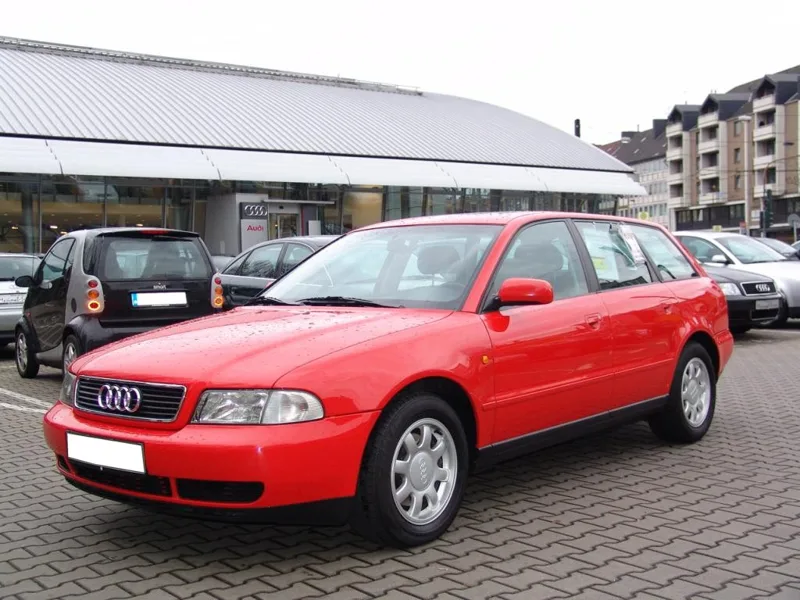
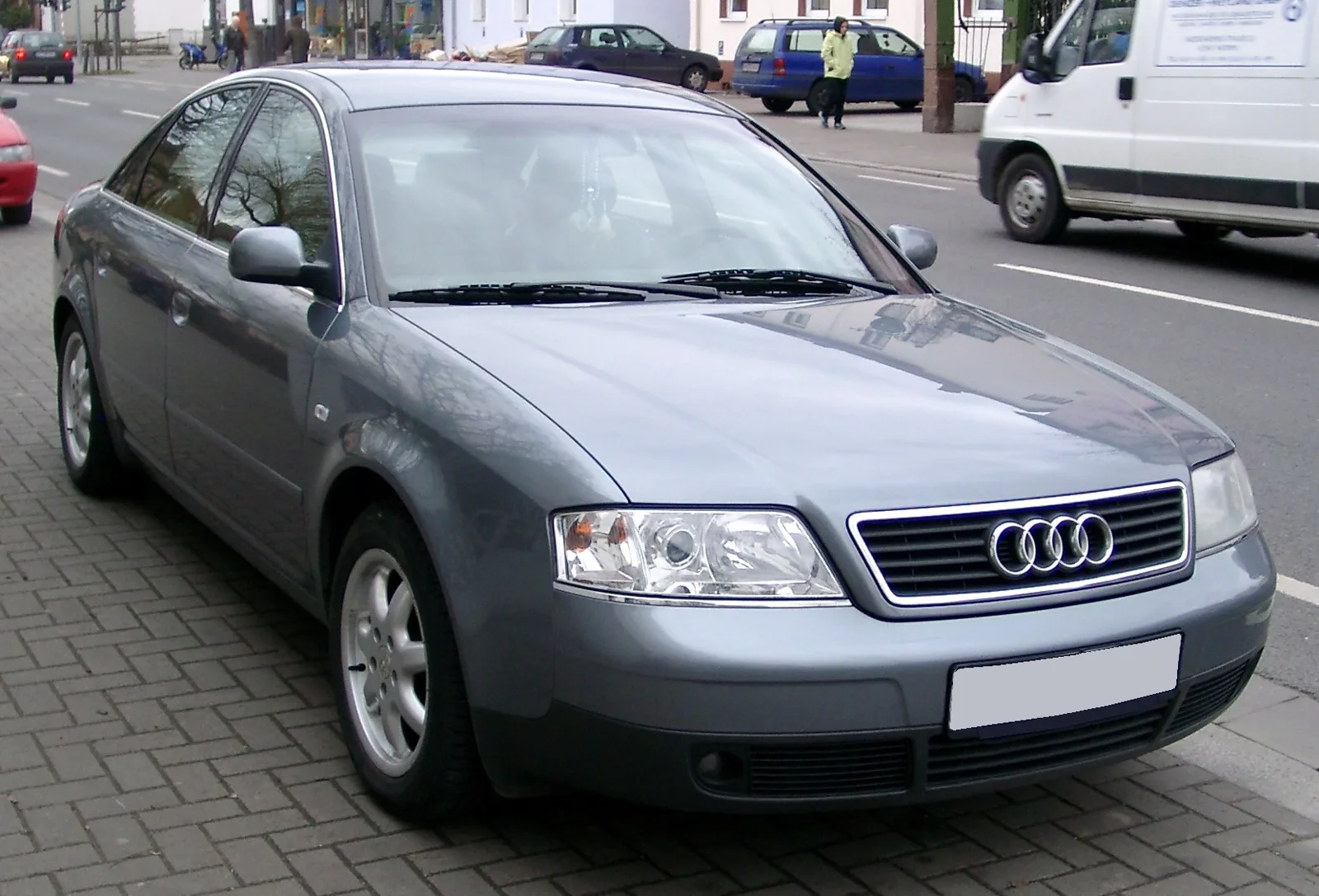
The front kept the four-ring grille, shaped to suit a more aerodynamic profile, and the light clusters were trapezoidal with a more modern cut. In side view the belt line sat higher, and the glazed areas and pillars bore a certain resemblance to the Volkswagen Passat V, which had launched two years earlier. The tail was more rounded and taller, which helped the luggage compartment, and the fog lights were placed unusually above the number plate. At the rear, the upper profile of the boot was not shaped into a spoiler, and the light clusters, no longer horizontal, sat at the ends of the tail without reaching the tailgate.
Inside, the arched roofline did not stop the cabin feeling spacious. Rear passengers gained 62 mm of extra length, front passengers 28 mm of extra height and rear passengers 19 mm more again in height. The dashboard was lighter than before because the centre console was lower and narrower, and the boot offered 551 litres with a connection to the cabin that could take skis.
What was new under the skin of the A6 C5?
The front suspension moved from the MacPherson type of the previous car to a high wishbone with a virtual steering axis, a layout already used on the Audi A4 B5 and A8. The rear used a torsion beam with a Panhard bar on front-wheel-drive cars and a low wishbone layout on quattro versions, and the whole front end weighed 10 kg less.
Aluminium alloy went into the auxiliary subframes that carried the spring and shock units, while the tubular front subframe was steel made with light-alloy techniques. The anti-roll bar was hollow, and the springs sat apart from the gas shock absorbers so that the boot kept its full capacity. Braking used ventilated front discs and solid rear discs, with ABS and EDS acting on a single wheel when needed.
Launch engines of the Audi A6 C5
| Engine | Displacement | Output |
|---|---|---|
| 1.8 T | 1,781 cc (108.7 cu in), turbocharged | 150 PS (110 kW; 148 hp) |
| 2.4 V6 | 2,393 cc (146.0 cu in) | 165 PS (121 kW; 163 hp), 150 PS in some markets |
| 2.8 V6 | 2,771 cc (169.1 cu in) | 193 PS (142 kW; 190 hp) |
| 1.9 TDI | 1,896 cc (115.7 cu in), direct injection | 110 PS (81 kW; 108 hp) |
| 2.5 TDI | 2,461 cc (150.2 cu in), V6 turbodiesel | 150 PS (110 kW; 148 hp) |
The 2.8 V6 came directly from the previous A6 range. Every engine except the 1.9 TDI could be ordered with quattro four-wheel drive. Most had a five-speed manual gearbox as standard, and the most powerful diesel was the exception, with a six-speed manual.
How did the range grow after the 1997 launch?
The line expanded fast after launch. A 2.4 de-tuned to 136 PS (100 kW; 134 hp) appeared in August 1997, mainly for official cars, and a 1.8 turbo with 180 PS (132 kW; 178 hp) arrived in November in some European markets. At the end of 1997 a naturally aspirated 1.8 with 125 PS (92 kW; 123 hp), the same five-valve engine as in the previous A6, joined the range. The Avant estate came in March 1998.
The Avant's boot had its own character. With the parcel shelf in place it offered only 455 litres, almost one hundred litres less than the saloon. Removing the shelf and folding the rear seat gave 1,590 litres. In late 1998, and only in some markets, the 2.4 V6 was reduced from 165 to 163 PS (121 to 120 kW; 163 to 161 hp).
The 1.9 TDI with unit injector arrived in January 1998 with 115 PS (85 kW; 113 hp). It did not replace the existing 1.9 TDI but joined it as an alternative.
In 1999 the range expanded dizzyingly. A 2.7 twin-turbo V6 with 230 PS (169 kW; 227 hp) arrived in February, and in April a 4,172 cc V8 with 300 PS (221 kW; 296 hp) came with quattro only. The S6 followed in September, and in November a 2.5 TDI with 180 PS (132 kW; 178 hp) reached the range.
A couple of months after the Allroad appeared in February 2000, the 2.7 twin-turbo of 250 PS became available on other A6s as an alternative to the 230 PS version. At the end of 2000 the 1.8 turbo of 180 PS left the price list in the markets where it had been offered.
What did the 2001 facelift change?
The June 2001 facelift was discreet but visible in many details. The new grille seemed to extend into the central area of the bumper, the side indicators turned clear, the exhaust tailpipes became visible, and the reversing lights turned white. Inside, a new steering wheel, aluminium trim and new wood inserts marked the change.
The engine changes were far larger. The 1.8 of 125 PS, naturally aspirated, was dropped, and the 1.8 turbo of 150 PS remained. Above it sat a new 2-litre with 130 PS (96 kW; 128 hp). The 2.4 V6 moved up to 170 PS (125 kW; 168 hp), and the 2.8 was replaced by a naturally aspirated 3-litre making 220 PS (162 kW; 217 hp).
On the diesel side the 1.9 TDI with 110 PS left the price list, and its unit-injector sibling rose to 130 PS (96 kW; 128 hp). The 180 PS V6 diesel stayed in the line-up, and its sibling climbed from 150 to 155 PS (114 kW; 153 hp).
Few engine changes came in the final years. The two notable ones arrived in July 2002: the V6 diesel was lifted to 163 PS (120 kW; 161 hp), and the RS6 arrived as the definitive top of the range.
What was the S6 and why did it matter?
The second-generation S6 arrived in September 1999 as a stand-in top model while the far more powerful RS6 was still years away. It used a derivative of the 4.2-litre V8 with 340 PS (250 kW; 335 hp), permanent quattro and a Torsen centre differential, with an electronic top speed of 250 km/h (155 mph). It was sold both as a saloon and as an Avant, as the other four-wheel-drive A6s of the period also were.
The S6 stood out from the other A6s with widened wheel arches, an S6 badge on the grille, chrome mirror shells and 17-inch alloys with a 255 mm tread. The valve gear was revised with more aggressive camshaft profiles and variable valve timing, and the suspension was lowered by 10 mm on stronger subframes. Aluminium was used widely to save weight.
What made the RS6 the top of the range?
The RS6 arrived in July 2002 with a twin-turbo 4.2-litre V8 producing 450 PS (331 kW; 444 hp) and 560 Nm (413 lb ft) from 1,950 rpm. Two KKK turbochargers, each with its own intercooler, fed the engine, which could reach 100 km/h from a standstill in under five seconds. It was the definitive top of the range, arriving three years after the S6 had first appeared.
The engine was made entirely of aluminium alloy, and its cylinder head was revised for better cooling. A throttle body of 82 mm and two metal pre-catalysts ahead of the main catalysts completed the engine changes. Quattro four-wheel drive and a five-speed automatic put the power to the road.
The RS6 also got Dynamic Ride Control, an anti-roll system with hydro-mechanical control, plus ventilated cast-iron discs with aluminium bells. Its 18-inch wheels were standard, with 19-inch wheels optional, and the car was identified by its mesh grille badge and the twin oval exhausts at the rear.
The RS6 Plus, offered only as an Avant in its final months, raised the 4.2-litre V8 to 480 PS (353 kW; 473 hp). Only 999 examples were built, each with a special identification plate, and the car ran alongside the 450 PS version between April and September 2004.
How did the S6 and RS6 compare?
The S6 produced 340 PS (250 kW; 335 hp) from its 4.2-litre V8, while the RS6 reached 450 PS (331 kW; 444 hp) with two turbochargers. Both were quattro cars. The RS6 also had a five-speed automatic gearbox and 560 Nm (413 lb ft) of torque from 1,950 rpm.
The S6 relied on variable valve timing and revised air management, while the RS6 leaned on a pair of KKK units with separate intercoolers, plus an 82 mm throttle body. Dynamic Ride Control was part of the RS6 package.
What was the Allroad quattro?
The Allroad quattro was an A6 Avant with raised suspension and unpainted plastic cladding on the underbody, sills and wheel arches. It launched in February 2000 and was built to handle rough routes without fuss, though the cladding alone did not make it a serious off-roader.
The biggest change was adjustable air springs in place of the coil springs. Ground clearance could be set on four levels between 142 and 208 mm. Sensors on each wheel measured clearance continuously, and at speeds above 120 km/h on asphalt the car sat at its lowest, while lower speeds lifted it by 25 mm.
Manual adjustment for light off-road use raised the body another 25 mm, to 192 mm, and the most demanding routes allowed a further 16 mm. The launch engines for the Allroad were a 2.7 twin-turbo rated at 250 PS (184 kW; 247 hp) and a 2.5 TDI with 180 PS (132 kW; 178 hp). In May 2002 came a 4.2 V8 of 300 PS (221 kW; 296 hp), and in April 2003 a 2.5 TDI of 163 PS (120 kW; 161 hp) arrived.
The Allroad was never officially part of the A6 C5 range, and it did not carry the A6 name at first. Later Allroads took the A6 name to avoid confusion with the A4 Allroad, which debuted in February 2009.
How did production of the A6 C5 end?
The saloon left production in February 2004, and the Avant stayed in the catalogue until September of that year. Allroad output ran on to July 2005, when the A6 of this generation had already been off the price list for close to a year.