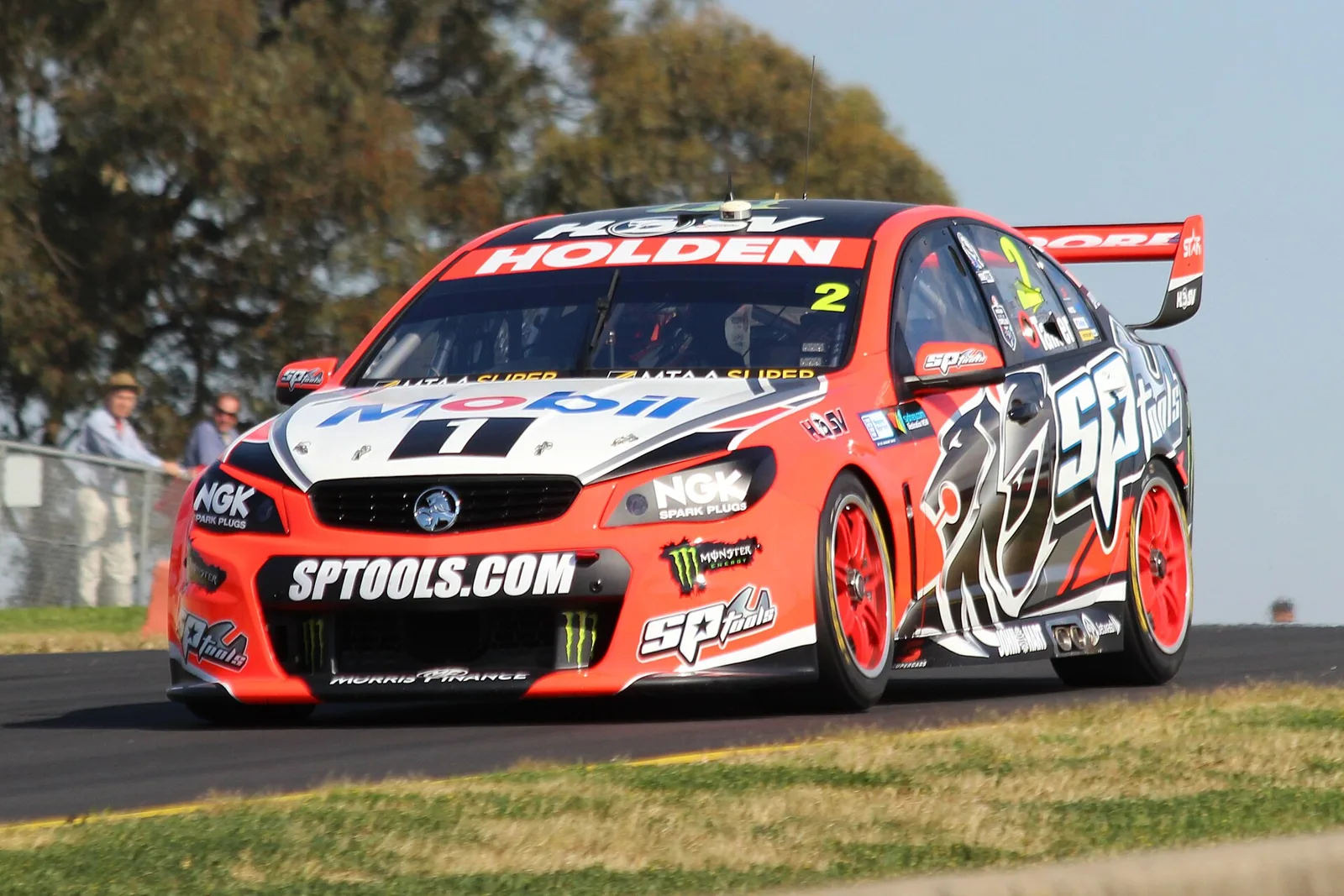
A Melbourne team founded as the Holden Racing Team, through Brock, Lowndes and Skaife titles and a Ford era, to a Toyota Supra future with Chaz Mostert and Ryan Wood.
Clayton-based Supercars operation that began as the Holden Racing Team and has since won seven drivers' titles and five teams' championships. It moved from Holden Commodores to Ford Mustangs in 2023 and to Toyota GR Supras in 2026. It has also won eight Bathurst 1000s.
Based in Clayton, a Melbourne suburb, Walkinshaw TWG Racing began in 1990 under the Holden Racing Team name. The squad ranks among the most decorated in Supercars history, with seven drivers' championships, five teams' championships and eight Bathurst 1000 wins. It has raced Holden Commodores, Ford Mustangs and, from 2026, Toyota GR Supras.
The team's name has changed as its owners and manufacturers have changed. Walkinshaw, Andretti, United Autosports and TWG Motorsports have all held stakes, and each change of partner brought a new livery and a new identity. The constant has been a run of race-winning drivers, from Peter Brock and Craig Lowndes to Mark Skaife and, most recently, Chaz Mostert.
Where did the team come from?
The team traces its roots to a 1987 joint venture between Tom Walkinshaw and Holden, which created Holden Special Vehicles. Tom Walkinshaw Racing was to run Holden's motorsport programme, and TWR designed the VL Commodore SS Group A SV, which won its racing approval in August 1988, once 500 cars had been built.
A 1989 plan for a full TWR season with two cars was dropped when the cars looked likely to struggle against the Ford Sierra RS500s, and Perkins Engineering again ran the Sandown 500, the Bathurst 1000 and the Grand Prix support races. From 1990 the operation came back in house, and Win Percy moved to Melbourne as driver and manager.
Founded as a Holden operation, the team has since raced Commodores, Mustangs and Supras, and still counts itself among the sport's most successful squads.
How did the team win Bathurst in 1990?
Percy drove in almost every round of the 1990 championship, and his best results were sixth in qualifying at Winton and third in a race at Lakeside. He finished eighth overall. At Bathurst the team entered two cars, and Holden and Tom Walkinshaw had objected, but Percy recruited Allan Grice as co-driver of the lead car.
Percy was nursing a shoulder injury, so Grice did most of the driving, and the pair won unexpectedly. Neil Crompton and Brad Jones finished fifth in the second car. The result gave the team a place in the Bathurst record book that it would revisit with a retro livery in 2010.
What were the lean years of 1991 to 1993?
For 1991 the VN Commodore was homologated, and Percy ended the season eighth overall once more. At Bathurst Percy and Grice came second, while the second car of Crompton and Jones dropped out after running out of fuel. It was the closest the team came to a repeat of its 1990 success that decade.
In 1992 Percy returned to England, and Tomas Mezera was hired. A budget shortfall, and the work needed to develop the VP for the new V8 rules, meant the team competed only at Sandown, Lakeside and Eastern Creek. Mezera and Brad Jones took third at the Sandown 500, while Percy and Grice finished fifth at Bathurst.
The 1993 season was dominated by money and politics. Castrol moved its funding to Perkins Engineering, leaving the team short of budget, and former world 500cc champion Wayne Gardner was signed despite having made only one touring car start. Gardner ended up competing in all nine rounds and took a win in the Australian Grand Prix support races, but he was suspended for two weeks before the Sandown 500 after a dispute over sponsors. He later formed his own operation, Wayne Gardner Racing.
How did Brock's arrival change the team in 1994?
In 1994 Peter Brock joined the team. Holden had been wary of him since 1987, but his Mobil and NGK sponsorship was too valuable to pass up. Both sponsors stayed with the team into 2020, and Brock won the Eastern Creek round, the team's first ATCC round win.
In the endurance races Craig Lowndes replaced an absent co-driver for the Sandown 500, finished fifth and set the fastest lap of the four drivers. He stayed for Bathurst, where Brad Jones delivered a strong double stint to bring the car home second. Those results convinced the team to sign Lowndes full-time for 1996.
What made 1996 and 1997 so strong?
The collapse of tobacco sponsorship gave the team a chance to recruit key staff from Gibson Motorsport, and the 1996 season was one of its most dominant. Lowndes won the ATCC, the Sandown 500 and the Bathurst 1000, the last two with Greg Murphy, while Brock finished fourth in the series.
The 1997 season brought mechanical failures with the VS Commodores, but there were one-two finishes at Symmons Plains and Wanneroo. Brock retired from full-time racing before the Eastern Creek round, and Murphy and Brock finished fourth and sixth. Lowndes and Murphy won the Sandown 500 that year, while Mark Skaife took pole at both endurance events but failed to finish either race with Brock.
How did the Skaife era shape the team?
Skaife succeeded Brock in 1998, and Lowndes returned to the team. Lowndes won the ATCC again in 1998 and 1999, with Skaife finishing third in both seasons. At Bathurst in 1998 the pair led much of the race but suffered repeated tyre failures and finished sixth.
Skaife took the 2000 title, and Lowndes was third. Lowndes and Skaife also won the Queensland 500 that year. Lowndes then left for Gibson Motorsport at the end of the season after a dispute over his management contract with Tom Walkinshaw.
The team kept winning. Skaife took the 2001 and 2002 titles, and Bright was third and fourth in those seasons. In 2001 Skaife and Tony Longhurst won Bathurst, and in 2002 Skaife and Jim Richards did the same. The team won the first eight rounds of 2002, a run that remains one of the most dominant starts in the team's history.
What happened when Tom Walkinshaw Racing collapsed?
Tom Walkinshaw Racing collapsed in early 2003, and the administrator put the team up for sale. Holden bought it, but manufacturers could not own teams, so Mark Skaife took it over soon after. The K-Mart team was bought by John and Margaret Kelly, who ran as a customer of the team until the end of 2008.
Todd Kelly settled into the second car for five years. In 2003 Skaife and Kelly won the Sandown 500, and in 2005 they won the Bathurst 1000 together. Kelly also won a round at the Shanghai circuit that year, which gave the team its 50th round win.
Why were 2006 and 2008 so turbulent?
In 2006 Kelly finished sixth in the championship and Skaife sixteenth. Kelly won at Surfers Paradise and Phillip Island, but the team's endurance plan was controversial. Drivers were swapped between sister teams, and Skaife and Garth Tander finished 26th at the Sandown 500 and crashed on lap one at Bathurst after a driveline failure.
The VE Commodore arrived in 2007, when Skaife ended sixth and Kelly seventh, but Skaife needed appendix surgery before the Sandown 500, which forced a reshuffle. In 2008 Garth Tander arrived from the sister team, and Skaife announced on 29 October that the season would be his last full-time drive. In December 2008 he sold his 50% share to Tom Walkinshaw.
How did the 2007 ownership battle play out?
Early in 2007 the governing body pressed Skaife for licence paperwork, with a deadline of 12 March. He produced it, and a commercial settlement left him, not Tom Walkinshaw, in control, although Walkinshaw was reported to hold half of Skaife's company.
What did the team achieve in 2009 and 2010?
In 2009 John and Margaret Kelly set up their own team, Kelly Racing, using Perkins Engineering hardware. Walkinshaw's team expanded to four cars, two under the Holden Racing Team banner and two under Walkinshaw Racing. Paul Dumbrell finished 15th in the championship and David Reynolds 22nd, while Will Davison stepped into Skaife's seat.
The 2009 Bathurst 1000 went to Tander and Davison, and the Holden Racing Team won the teams' championship. In 2010 Fabian Coulthard and Andrew Thompson replaced Dumbrell and Reynolds, and the team finished seventh in the teams' standings. At Bathurst that year the cars ran a retro livery to mark the team's 1990 victory.
How did the team fare in 2011 and 2012?
James Courtney joined in 2011 after Davison left for Ford Performance Racing. The season opened with a Courtney win in Abu Dhabi, and at Bathurst Tander and Nick Percat won the race. Tander finished fifth in the championship, with Courtney tenth. Meanwhile the Walkinshaw Racing entry was cut to one car for Fabian Coulthard, under a new number.
The team scored no wins in 2012. Tander finished seventh and Courtney tenth, and Russell Ingall arrived with Supercheap Auto backing to replace Coulthard. The second car's number changed again.
What did the Commodore years of 2013 to 2016 bring?
The VF Commodore debuted in 2013. At the Townsville 400 Tander and a team-mate filled the top two places, ending a 20-month drought. Tander also won at Phillip Island that year, and Courtney won at Winton. Russell Ingall stayed on with Supercheap Auto backing.
In 2016 Supercheap Auto moved to Prodrive Racing Australia, and the team downsized to two cars. Tander and Warren Luff won the Sandown 500 that year, the team's last major endurance success for some time.
Why did the team switch from Holden to Mustangs?
Holden's factory backing passed to Triple Eight Race Engineering in 2017, and the team raced on as Mobil 1 HSV Racing, fielding two VF Commodores. Scott Pye replaced Tander. In January 2018 the team was rebranded Walkinshaw Andretti United, with Andretti Autosport and United Autosports taking 37.5% and 25% stakes.
In 2019 James Courtney announced on 27 August that he would leave after nine years. Mega Fuels, the new main sponsor, went into receivership on 3 September, and Mobil 1 stepped in as primary sponsor at Pukekohe. In 2023 the team switched to Ford machinery with full factory support, joining the Ford-backed squads of the day.
How did the Mostert era take shape?
Bryce Fullwood and Chaz Mostert signed for 2020. Mostert's podium came early, at the Adelaide 500, and with Warren Luff he claimed third at that year's Bathurst 1000. In 2021 Mostert took pole at Sandown and won at Symmons Plains and Hidden Valley.
In 2024 Ryan Wood replaced Nick Percat in the second car, and Mostert won the team's first Mustang race in Perth before adding two more wins in Sydney. In 2025 Mostert won the Supercars Championship with four wins, and Wood took his first win in Perth.
What is the team's Toyota future?
For 2026 the team switches to Toyota GR Supras, with Mostert and Wood staying on. Both signed multi-year extensions on 10 April. The name Walkinshaw TWG Racing followed once United Autosports had sold its stake, while Andretti Autosport had come under TWG Motorsports in 2023.
Did the team race outside Supercars?
Yes. Since 2016 the team has run a Porsche 911 GT3 R in the Australian GT Championship with factory support, first driven by John Martin and later by Liam Talbot. When Talbot left for the Carrera Cup in 2019, the GT operation closed.
What were the team's key milestones?
| Year | Milestone |
|---|---|
| 1990 | Bathurst 1000 victory with Win Percy and Allan Grice |
| 1994 | Peter Brock wins at Eastern Creek, the team's first ATCC round win |
| 1996 | Craig Lowndes wins the ATCC, the Sandown 500 and the Bathurst 1000 |
| 2000 | Mark Skaife wins the championship; Lowndes and Skaife win the Queensland 500 |
| 2002 | Skaife wins again; the team wins the first eight rounds |
| 2005 | Skaife and Todd Kelly win the Bathurst 1000; team's 50th round win |
| 2009 | Tander and Will Davison win the Bathurst 1000 |
| 2013 | Townsville 400 one-two ends a 20-month drought |
| 2018 | Scott Pye wins at the Melbourne 400 |
| 2023 | Switch to Ford Mustangs with factory support |
| 2025 | Chaz Mostert wins the Supercars Championship |
| 2026 | Switch to Toyota GR Supras |