A radical design built to challenge Ferrari, undone by cooling trouble and a fragile gearbox, and remembered mainly for the car that followed it.
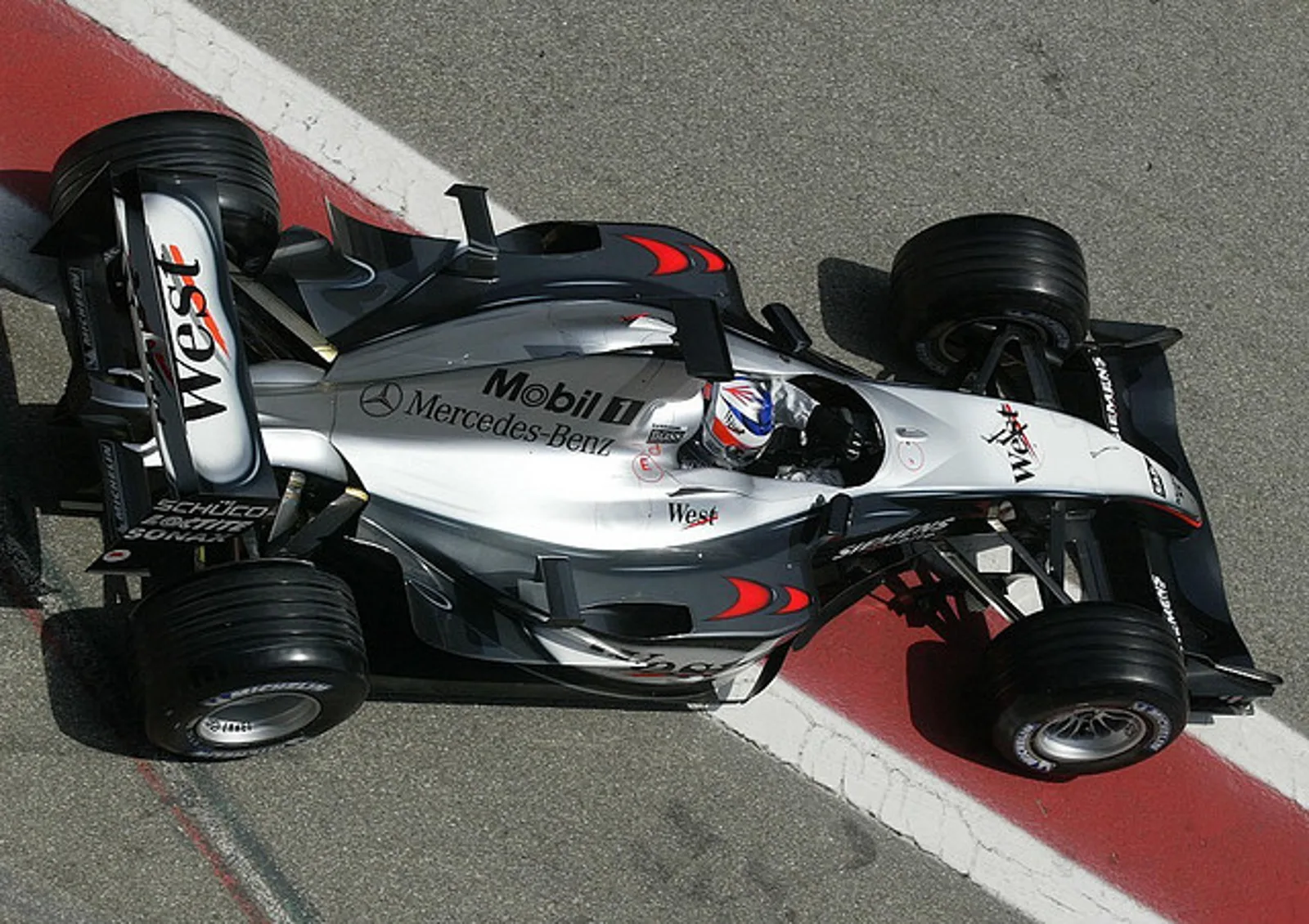
The McLaren MP4-18 was a 2003 Formula One car, the work of Adrian Newey, Mike Coughlan and Neil Oatley. It used twin-keel suspension, a blown diffuser and very narrow sidepods, but engine cooling and gearbox fragility stopped it from ever racing. Its design fed directly into the MP4-19 for 2004.
Built for the 2003 season, the McLaren MP4-18 was meant to close the gap to Ferrari after a disappointing 2002 campaign. Cooling and gearbox problems surfaced at its first tests, and the project was dropped before the car ever started a race. Its basic ideas survived, because the MP4-19 that raced in 2004 was built on its foundations.
Why was McLaren's 2002 season a setback?
McLaren finished the 2002 season with 65 points, 37 fewer than in 2001, and slipped to third in the constructors' standings. The MP4-17 was regularly slower than the Ferrari F2002 and suffered reliability problems, with both cars finishing only four races. That shortfall convinced the team that a much more ambitious car was needed for 2003.
Ron Dennis argued that the regulations should stay as they were, because reopening them would make close racing harder rather than easier. He was confident the team could close the gap to Ferrari through its own engineering. McLaren's answer was the MP4-18, but the team chose to delay its debut.
A radical 2003 design, shelved after cooling and gearbox failures, that never started a race.
Rules, testing and the interim car
After the 2002 season, the FIA's Formula One Commission gathered in London to set the rules for the coming year. Most changes concerned how race weekends were run, and three teams agreed to limit private testing to 10 car-days. Those teams received extra Friday running with a spare car and a test driver. McLaren did not take that route, so it kept the full 10 car-days of private testing and used them to the maximum.
McLaren also postponed the MP4-18. A shadow team working under Neil Oatley developed the interim car, an evolution of the 2002 machine, called the MP4-17D. At the Melbourne season opener, David Coulthard claimed the final victory of his career in that car. Afterwards Dennis described the car as a useful step that could compete with the new Ferrari, and said the team would push hard on it.
Dennis was pleased with the Melbourne result and said that results of that kind would be welcome while the new car was prepared. The MP4-17D was only a stopgap, though, and the longer-term hopes rested on the MP4-18 arriving in a competitive state. The 2003 season was built around a wait, with a stopgap car on track and an ambitious project held in reserve.
What was new about the MP4-18 design?
The MP4-18 combined twin-keel suspension with a blown diffuser, a longer, narrower nose that dropped down, narrower sidepods and very tight rear packaging. The twin-keel layout was paired with a waved wing that pulled the front of the car down. Many of these ideas returned years later, the blown diffuser among them, on Red Bull cars.
The twin-keel concept was still new to Formula One, having first appeared in 2001 through Sauber designer Sergio Rinland. McLaren brought in the experienced twin-keel specialist Mike Coughlan after the Arrows team was liquidated, which tied the car closely to his expertise. The front wing became the first structure to disturb the oncoming air, which reduced the aerodynamic role of the nosecone. Ferrari stayed with its high, protruding nosecone instead.
The waved wing worked in a similar way to a diffuser, creating an area of low pressure beneath it that drew the nose and front end toward the ground. It was a first for Formula One, and Williams, with its FW25 that year, and McLaren developed the idea independently of one another.
The sidepods curved sharply down at the rear, and the narrow sidepod and tight rear packaging were drawn from the Ferrari F2002. To achieve such narrow sidepods, McLaren gave up side crash structure, which most likely led to failing the FIA-mandated side crash tests.
In his memoir How to Build a Car, Adrian Newey traced the MP4-18 problems to the shape of the chassis. The front of the sidepod overloaded a vortex shed by a delta wing sitting directly in front of it, which made that vortex unstable and liable to burst. Trimming the wing would have helped but cost downforce, so Newey called for a chassis redesign, a job that would have been close to impossible mid-season.
Engine and gearbox: the other weak points
In the early 2000s Ron Dennis preferred pace to reliability, but the points changes for 2003 put more emphasis on finishing races. Mercedes-Benz had been struggling since the FIA moved to outlaw beryllium in engines from 2001. That decision was announced on 6 October 1999 for health and safety reasons, and it hit Mercedes harder than anyone, because beryllium had let its engine run a longer stroke and still rev as high as Ferrari's.
Mercedes-Benz produced the P spec engine for the MP4-18, which grew out of the FO series. Estimates for its output ranged from 870 to 888 bhp. It sat very low in the chassis to lower the centre of gravity, and mechanics found that taking it out could damage the car.
The gearbox was new too, built from titanium with a casing bonded to carbon fibre. It weighed less than the MP4-17D gearbox, but it was so fragile that the team was not sure it would work after being removed and refitted.
The engine problem was older than the MP4-18. Ross Brawn, Ferrari's technical director, said in 1999 that Mercedes reached the same revs with its longer stroke and that he could not work out how. Adrian Newey also said that McLaren's power in 2001 was no greater than it had been in 1998, and that the team needed to improve on that.
How did the MP4-18 perform in testing?
The MP4-18 made its test debut at the Circuit Paul Ricard, where overheating appeared straight away. Two holes punched in each sidepod did not fix the problem. Later problems included a floor failure at Jerez, a crash at Barcelona and gearbox overheating on a 330 km (205 mi) run in Austria.
Former McLaren mechanic Marc Priestley said the car returned from each test with cooling trouble so severe that fire extinguishers stayed in the pit box. At Jerez Alexander Wurz suffered a big shunt caused by floor delamination, and the cause was never established. In June at Barcelona Kimi Raikkonen crashed at the last corner, hurting his knee and totalling the chassis.
At the 2003 San Marino Grand Prix, Dennis was asked when the MP4-18 would debut. His answer was cryptic: no sooner than the Canadian race and no later than Silverstone. It left the paddock guessing about the real timetable.
Ferrari's F2003-GA debuted at the next race in Barcelona, and Coulthard said McLaren had to get its new car out as soon as possible if it wanted to keep challenging for the title. In June Norbert Haug, who held a vice-president post at Mercedes-Benz at the time, said he had never seen a more impressive car. Those comments came before the cooling and gearbox problems had fully played out.
The gearbox internal temperature reached 120 degrees C (248 degrees F) during Wurz's running, and the heat caused delamination. By August Dennis said the team was leaning toward continuing with the MP4-17D, and the MP4-18 was not mentioned again that season.
What happened to the MP4-18 after 2003?
The MP4-18 never raced. Newey himself said the MP4-19 was, in many ways, identical to the MP4-18. Its design was used as the foundation for the MP4-19, which competed in 2004 with a narrow nosecone and slim sidepods. Reliability stayed poor until the MP4-19B upgrade arrived at the French Grand Prix, and that car delivered the team's sole victory of 2004, at the Belgian Grand Prix.
Newey had wanted a new chassis for the MP4-18 but was outvoted, and the team's 2004 start was disastrous as a result. He eventually prevailed with the MP4-19B chassis. Newey felt the vote had effectively removed his authority as technical director, and the episode deepened a rift with Ron Dennis. Later it emerged that after an earlier dispute involving Newey and Jaguar, Dennis had reshaped McLaren's management structure so that the departure of a key figure could not devastate the team again. Newey announced in November 2005 that he would join Red Bull Racing for the 2006 season.
Legacy and the surviving chassis
| Item | Detail |
|---|---|
| Season | 2003 Formula One World Championship |
| Designers | Adrian Newey, Mike Coughlan and Neil Oatley |
| Suspension | Twin-keel, carried over from the MP4-17 |
| Aerodynamics | Blown diffuser, waved wing, narrow sidepods |
| Engine | Mercedes-Benz P spec, estimated 870 to 888 bhp |
| Gearbox | Titanium, casing bonded to carbon fibre |
| First test | Circuit Paul Ricard |
| Race starts | None |
| Successor | MP4-19, raced in 2004 |
| Surviving chassis | MP4-18A-03, McLaren Technology Centre |
Motorsport writer Edd Straw argued in 2023 that the design had been pitched beyond what the era could support. He added that the long focus on perfecting the MP4-18, at the expense of the MP4-17D, was one of the factors that cost Kimi Raikkonen the 2003 Drivers' Championship.
The third chassis built, MP4-18A-03, was displayed for years at Donington Park with a broader nose resembling the later MP4-20. Its livery read Alex in place of West, a nod to the ban on tobacco advertising and to test driver Alexander Wurz. It now sits at the McLaren Technology Centre in a private room, where the television presenter Jodie Kidd was shown it during a visit in 2021.
Newey thought the problems were fixable had the vote gone his way on whether to keep the MP4-18 design or develop it further. He was intent on evolving it, and the chassis decision became a source of friction inside the team.
The MP4-18 sits in an unusual place in McLaren's history. It was a car that never raced, yet it shaped the decisions behind the 2004 season, and its design thinking reached the track in a different form. Few cars in the period show so clearly how far a team was willing to push in a single step.