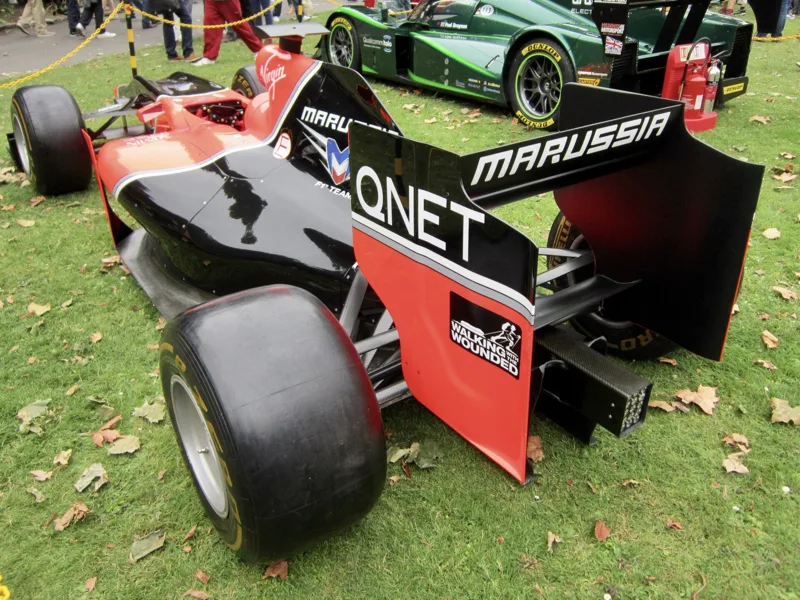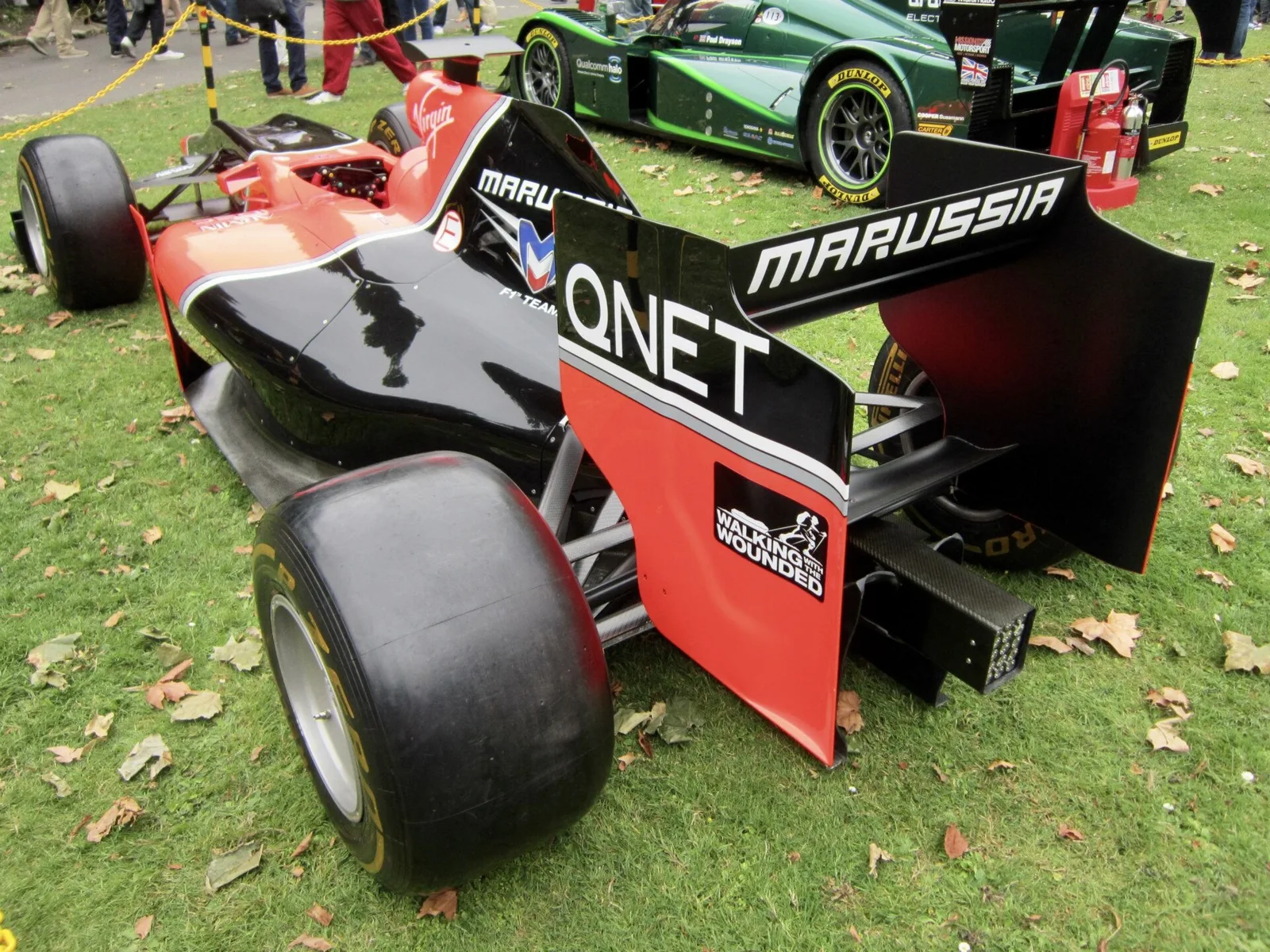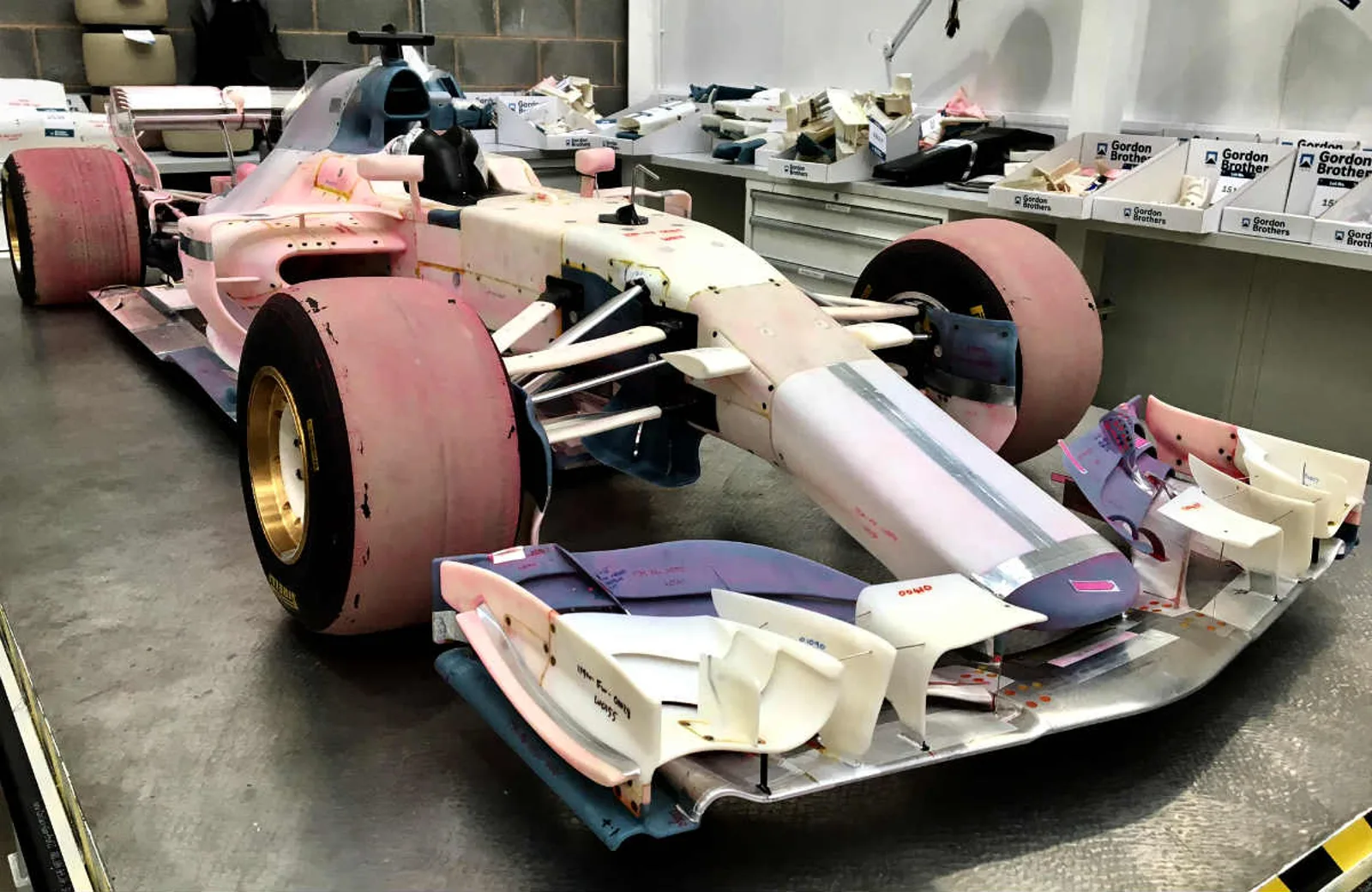
A 2017 design drawn up while Manor's owners searched for a buyer, and a chassis that never reached a grid.
The Manor MRT07 was a Formula One car designed for Manor Racing's 2017 season. The team, formerly Marussia, went into administration in January 2017 before the car was finished, and only two chassis were built. The MRT07 never raced, and its wind tunnel model was offered at auction later that year.
Manor Racing planned to field the MRT07 in the 2017 Formula One World Championship, but the team's finances collapsed before the car could be finished. Some references call it the MRT06, and the design work is the most visible trace of a project that never reached the track.
The story runs from the collapse of Marussia in 2014 to a closing sale in 2017. Along the way the team changed owners, sponsors and drivers, and each change left the car further from the grid.
Where did Manor Racing come from?
Manor was the successor to the Marussia F1 Team, which had been on the grid since 2012. Marussia went into administration in late 2014, and its assets were sold to settle debts estimated at 81.4 million euros. Stephen Fitzpatrick then bought the team in early 2015.
The receivership began on 7 November 2014, when no buyer had come forward. The team's 200 creditors included Ferrari, its engine supplier, and McLaren, which had helped with the design of its cars. Gene Haas took back the Banbury factory at a December 2014 sale, together with a model of the MNR1.
In early February 2015 the administrator, FRP Advisory, paid 450,000 euros in entry fees to the FIA, and on 19 February it ended the receivership. The team reappeared at Dinnington as Manor F1 Team, and the 2014 Marussia MR03 was adapted to the new rules.
Fitzpatrick, founder of Ovo Energy, put more than 40 million euros of personal money into the team. He spread the debts with creditors, agreed a technical partnership with McLaren and secured a supply of Ferrari engines. Justin King, a former Sainsbury's boss, joined him, while Graeme Lowdon and John Booth kept their positions.
A 2017 design for a grid Manor never reached, drawn up while its owners were still searching for a buyer.
How did Manor perform before the MRT07?
Manor's 2015 car was the MR03B, with a Ferrari V6, and it missed the Melbourne start because of technical problems. In 2016 the team ran the MRT05 with a Mercedes-Benz V6, and it finished eleventh in the Constructors' Championship. Results were modest, but the team came close to tenth place.
In 2015 Will Stevens and Roberto Merhi raced at the back of the grid, well over seven seconds off the leaders. Merhi's best result came with twelfth at the British Grand Prix, and the team signed sponsors including Airbnb and Shazam.
In 2016 Pascal Wehrlein and Rio Haryanto drove the MRT05, and Esteban Ocon replaced Haryanto mid-season. Wehrlein qualified twelfth at the Austrian Grand Prix and then scored a tenth-place point. That point briefly lifted the team to provisional tenth in the standings, ahead of Sauber.
The season ended on a costly note. At the Brazilian Grand Prix, Felipe Nasr's ninth place for Sauber put the Swiss team back in tenth, which put 12 million euros of Formula One Management revenue at risk. Manor finished eleventh overall, and in Abu Dhabi neither Wehrlein nor Ocon scored a point.
Who wanted to buy the team?
Several groups looked at Manor in late 2016 and early 2017. They included Tavo Hellmund, an American businessman, a team led by Ricardo Gelael under the Jagonya Ayam name, and a consortium linked to Graeme Lowdon. None of the offers closed in time for the 2017 season.
On 25 November 2016, Fitzpatrick said he had spent six months talking to several potential investors. In December Tavo Hellmund, who had been behind the return of Grand Prix racing to the United States and Mexico, came forward with plans that would reportedly draw on backing from the State of Texas. Bernie Ecclestone doubted that Hellmund had the money to take over.
Hellmund's first offer was 25 million euros a year, which Fitzpatrick turned down because he valued tenth place at 30 million euros. For the second bid, Hellmund planned a partnership with Honda or Mercedes-Benz and a budget of 140 million euros a year. The plan relied on 28 million from commercial deals, 21 million from a paying driver and between 14 and 37 million from Formula One Management.
Jagonya Ayam was the Indonesian subsidiary of KFC, and its backer Ricardo Gelael had a son, Sean Gelael, who raced in GP2 for the same team. Ron Dennis was also approached by Dave Ryan to lead a bid with Chinese investors, but none of these plans reached a signed deal.
What led to the closure in January 2017?
Manor lost its tenth-place position at the Brazilian Grand Prix in late 2016, and with it the prize money that would have covered part of the 2017 budget. Stephen Fitzpatrick placed Just Racing Services Ltd, the company that ran the team, into compulsory administration on 6 January 2017. The team was closed on 27 January 2017.
Fitzpatrick had hoped to finish 2016 in at least tenth place, and losing that position at Brazil put the 2017 budget in doubt. He said he did not want to start a season the team might not finish, and he admitted that the loss had cast doubt on whether it could complete 2017.
The wider Formula One money system made the stakes high. Only teams finishing in the top ten of the standings shared in the television rights money, so a team that slipped from tenth stood to lose a large share of its income in one race weekend. That structure left little room for error at the back of the grid.
The closure was confirmed on 27 January 2017, when FRP Advisory dismissed 150 of the team's 212 employees. The rest were kept on for a short time in case a buyer appeared at the last minute.
What did the MRT07 look like?
Tim Milne, Nikolas Tombazis, Luca Furbatto and John McQuilliam drew up the MRT07 as an evolution of the MRT05. It was built to the 2017 regulations, which increased downforce by 25%, and the plan was to pair it with the F1 M08 EQ Power+ V6 from Mercedes-AMG. Only two chassis were built before the project stopped.
The MRT07 sat at the end of a family line. The MRT05 had evolved from the MNR1, a single-seater that Marussia designed for the 2015 season before its collapse. Work on the MRT07 started in spring 2016, with the last wind tunnel runs held in December 2016, only weeks before the team closed.
The car had a carbon-fibre monocoque, a minimum mass of 728 kilograms and seven kilograms of ballast that could be moved between the front and the rear. The team designed its front and rear suspension in-house, after previously farming that work out to Williams Grand Prix Engineering. The front relied on a pair of torsion bars plus a shock absorber to limit body roll.
The aerodynamics drew on many ideas. Six different noses were designed, and the favoured one used the minimum length allowed, reinforcing the Venturi effect under the nose. The front spoiler had three upper fins with upturned tips, and the rear had a shark fin that fed air to the rear wing. Four side louvers on the rear wing were angled at 25 degrees.
The rear spoiler was lower and more steeply angled than the MRT05's, as the technical regulations required, and it had slots to draw air inwards. Twin pylons gave it extra stability. The DRS actuator was made smaller than the MRT05's so that it would not disturb the airflow.
Cooling was unusual. A liquid-air cooler sat between the fuel tank and the V6, in the style Mercedes had used on its W05. The pontoon intakes were angled 15 degrees towards the rear, because the Mercedes engine needed less cooling air.
Key figures for the MRT07
| Item | Detail |
|---|---|
| Designers | John McQuilliam, Luca Furbatto, Nikolas Tombazis, Tim Milne |
| Development | Started in spring 2016; final wind tunnel tests in December 2016 |
| Engine | Mercedes-AMG F1 M08 EQ Power+ V6, 1,600 cm3, up to 15,000 rpm |
| Minimum mass | 728 kilograms, with seven kilograms of ballast movable front to rear |
| Ballast range | Seven kilograms movable, reaching 330 and 391 kilograms |
| Downforce | 25% more than the 2016 rules allowed |
| Chassis built | Two |
| Team closed | 27 January 2017 |
What happened to the car after the closure?
On 27 January 2017, the day the team ceased operations, aerodynamicist Joao Correia posted a photograph of a wind tunnel model at 60% of full size, along with a picture showing two chassis. Ricardo Gelael withdrew his offer in February, and on 1 March the FIA's final entry list left Manor out.
Luca Furbatto later said Fitzpatrick had halted parts production at the end of November 2016, which removed any chance of running the MRT07 from the first race in Australia. He said 90% of its parts were ready, and the plan had been to run an adapted MRT05 for the early rounds instead.
Furbatto believed the car could have fought in the middle of the grid and scored points, although he thought it would still have been about three seconds a lap slower than the best cars. The press suggested it would have outperformed the Sauber C36, which ran a 2016 Ferrari Tipo 061 V6.
The FIA returned $522,322 in entry fees to help the company clear its debts. In mid-May 2017 Gordon Brothers auctioned the assets over four days, offering about 4,000 items, including four Marussia MR03B chassis, MRT05 chassis and a scaled wind tunnel model of the MRT07. The sale aimed to cover more than 3.5 million euros owed to fifty creditors, against an estimated value of 2.9 million euros.
Why does the MRT07 still matter?
The MRT07 is a record of how much design work goes into a Formula One car before a season begins. Its suspension, aerodynamic and cooling choices drew on ideas from teams including Mercedes, Haas, Renault and Williams. Without the money to finish it, those ideas never reached a track.
The car also shows how thin the margin was for teams at the back of the grid. A single lost position, worth 12 million euros in TV revenue, was enough to bring down a team that had already been rescued once.