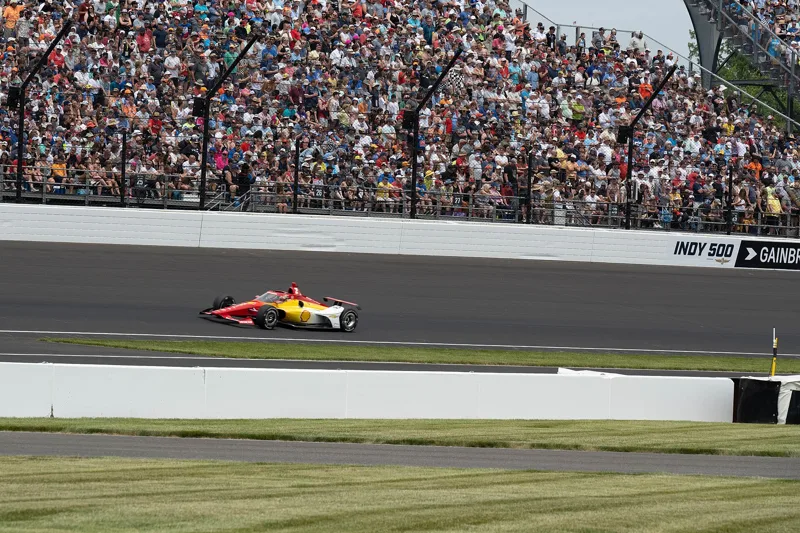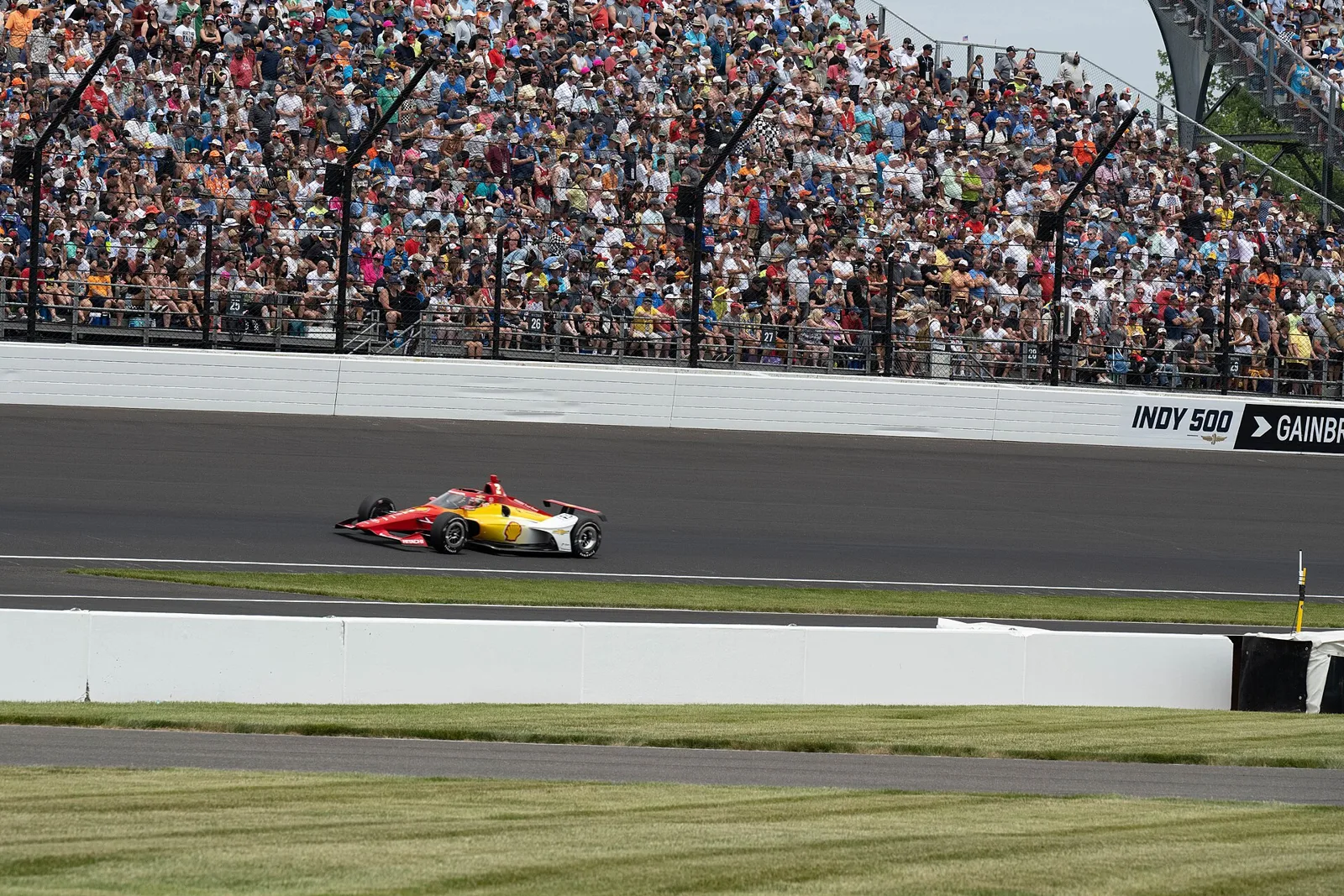
Scott Dixon's pole ended with a fuel problem and Takuma Sato's late stop, leaving Castroneves to win a race that set a new average-speed record in front of a capped crowd.
Helio Castroneves won the 2021 Indianapolis 500 for Meyer Shank Racing, adding a fourth win to his record. The race set a record average of 190.690 mph and a record 30 cars at the finish, all run in front of a crowd capped at 135,000.
Helio Castroneves won the 105th Indianapolis 500 on 30 May 2021, his fourth victory in the race. He led for the last time on lap 199, and the race set a new record for average speed in the event's history.
What was the 2021 Indianapolis 500?
The 2021 race was the 105th running of the Indianapolis 500, a 500-mile event over 200 laps at Indianapolis Motor Speedway and the sixth round of the IndyCar Series season. It came back to the Memorial Day weekend after the previous year's race had been moved to August.
The race itself was scheduled for Sunday 30 May, the 54th time it had fallen on that date. Between 1911 and 1970 the race used 30 May whatever the weekday, and since 1974 it has run on the Sunday of Memorial Day weekend.
Gainbridge's name sat on the race for a third season of its four-year agreement, which began in 2019.
A capped crowd, a record average speed and a fourth win for a driver who climbed the fence to celebrate.
How did the pandemic shape the 2021 crowd?
Organisers announced on 21 April that attendance would be capped at 135,000, roughly 40 per cent of the venue's capacity. The 2020 race had been postponed from late May to 23 August, and it was then run without any spectators at all.
The 2020 GMR Grand Prix had also been moved, to 4 July, and it too ran without fans. An Intercontinental GT Challenge weekend in October 2020, which included IndyCar road course races, allowed up to 10,000 spectators, and they were kept to certain sections of the grandstands.
Other traditions were lost as well. The Pit Stop Challenge did not run for a second year, the Carb Day concert and the Snake Pit concerts were cancelled, and Allen Bestwick joined the public address team. Bob Jenkins, the long-time voice of the race, had cut back his work while fighting brain cancer, and he died on 9 August 2021.
What did the 2021 season look like before Indianapolis?
Five drivers won the first five races, including three first-time winners. Alex Palou, in only his second season, opened the season at Birmingham with his first IndyCar victory, and Colton Herta won at St. Petersburg a week later. The early winners were spread widely across the field.
A doubleheader at Texas went to Scott Dixon and Pato O'Ward, and Rinus VeeKay took the GMR Grand Prix on 15 May. Dixon was the series points leader going into Indianapolis, and Team Penske had gone without a win before the 500 for the first time since 2013.
What rules changed for 2021?
The temperature rule moved from 50-50 to 45-45, so both ambient and track surface temperatures needed to reach 45 F (7 C) before cars could leave the pits. Last Chance qualifying was stretched to 75 minutes, allowing several attempts, where only one had been allowed in 2019.
Tyre allocations were also set out. Each entry had 34 sets of Firestone tyres, with three extra for Rookie Orientation and two extra for refresher tests. Between 2015 and 2019 the total had been 36.
The planned 2020 change to Last Chance qualifying was never used, because only 33 cars were entered that year and the session was cancelled.
How big was the 2021 field?
The entry list appeared on 12 May and showed 35 cars, nine of them former race winners and three of them rookies. Bumping returned with 35 entries, for the first time since 2019, so the slowest cars in qualifying faced the real risk of missing the field.
One expected 36th car, for Cody Ware, was withdrawn shortly before publication for lack of sponsorship. Every car ran the Dallara DW12 with the Universal Aero Kit 18 and Firestone tyres, and nine former winners made it the largest group since ten took part in 1992.
What testing took place before the race?
The offseason session at the end of October 2020 was disrupted by rain, but Takuma Sato and Josef Newgarden tried new aero configurations. On the Friday, Ryan Hunter-Reay, Ed Carpenter, Pato O'Ward and Scott Dixon joined them for a six-car session focused on aero in traffic, and Scott McLaughlin completed the mandatory Rookie Orientation.
A special oval test on 26 March 2021 used push-to-pass to mimic the KERS that a 2023 hybrid package would bring. Four cars, two Chevrolets and two Hondas, ran choreographed laps, with horsepower gains in the range of 50-60 and speed rises of 5-7 mph.
What went wrong at the April open test?
Rinus VeeKay crashed hard at turn one, breaking a finger, just twelve minutes into the first day of the full-field open test on 8 and 9 April. Rain ended the veterans' running early on the first day, and VeeKay sat out the second because his car was being repaired.
On the first day Conor Daly was fastest at 222.714 mph (358.423 km/h), while Colton Herta's best without a tow was 219.846 mph (353.808 km/h). Josef Newgarden led the second day at 226.819 mph (365.030 km/h), and Graham Rahal's best no-tow was 221.949 mph (357.192 km/h).
Rookie orientation and refresher tests followed on the first day, with Sebastien Bourdais fastest at 224.427 mph (361.180 km/h) in the roughly one-hour session. The running was halted only once, for a track inspection.
How did practice week begin in May?
Opening day, 18 May, began with veteran practice, and Graham Rahal set the opening session's best at 223.449 mph (359.606 km/h). Light rain interrupted the veterans three times and pushed the rookie tests back. Max Chilton had a minor problem when a helmet ventilation hose came loose and wrapped around his rear wing.
Will Power set the day's fastest time at 226.470 mph (364.468 km/h), and Ed Carpenter's quickest effort without a tow was 219.162 mph (352.707 km/h). Around 4:45 p.m., Sebastien Bourdais's machine went up in flames behind the right sidepod after what looked like an engine failure.
Wednesday 19 May was mostly cloudy. Scott Dixon set the day's pace at 226.829 mph (365.046 km/h), and Alexander Rossi topped the no-tow ranking at 221.114 mph (355.848 km/h). Thursday was hotter, and speeds dropped in the heat of the day, with Tony Kanaan fastest at 225.341 mph (362.651 km/h) and Jack Harvey best without a tow at 222.090 mph (357.419 km/h).
Practice speeds at a glance
| Session | Date | Fastest driver | Speed |
|---|---|---|---|
| Open test, day 1 | 8 April 2021 | Conor Daly | 222.714 mph (358.423 km/h) |
| Open test, day 2 | 9 April 2021 | Josef Newgarden | 226.819 mph (365.030 km/h) |
| Opening day, full field | 18 May 2021 | Will Power | 226.470 mph (364.468 km/h) |
| Wednesday | 19 May 2021 | Scott Dixon | 226.829 mph (365.046 km/h) |
| Thursday | 20 May 2021 | Tony Kanaan | 225.341 mph (362.651 km/h) |
| Fast Friday | 21 May 2021 | Scott Dixon | 233.302 mph (375.463 km/h) |
Which engines dominated Fast Friday?
Honda-powered cars took 12 of the top 15 places on Fast Friday, 21 May, when engine boost was raised for qualifying. Dixon was fastest at 233.302 mph (375.463 km/h), and Alexander Rossi's best no-tow lap was 231.597 mph (372.719 km/h).
The day's main incident had come the day before, on 20 May, when Santino Ferrucci lost control and hit the turn-two wall at 4:14 p.m. He was checked at hospital for a possible leg injury, but he still finished the day as the third-fastest driver.
Why did Dixon lose the race?
Dixon started from pole but ran out of fuel during the first round of pit stops after a caution. The pit lane closed with him stranded on track, and he had to make an emergency stop. The crew could not restart the engine, and he fell a lap down.
Takuma Sato, the defending champion, had led as late as lap 193 but was out of sequence with the leaders. He pitted for fuel with seven laps to go and finished 14th.
How did Castroneves win the race?
Castroneves took the lead for the last time on lap 199, after a long duel with Alex Palou over the final 80 laps. His fourth win tied him with A. J. Foyt, Al Unser Sr. and Rick Mears as four-time winners at Indianapolis.
The race averaged 190.690 mph (306.886 km/h), the fastest average in the event's history, and 30 cars were running at the finish, another record.
After the race he celebrated by climbing the catch fence, his trademark move, which had earned him the Spider-Man nickname early in his career. It was also the first IndyCar Series victory for Meyer Shank Racing.