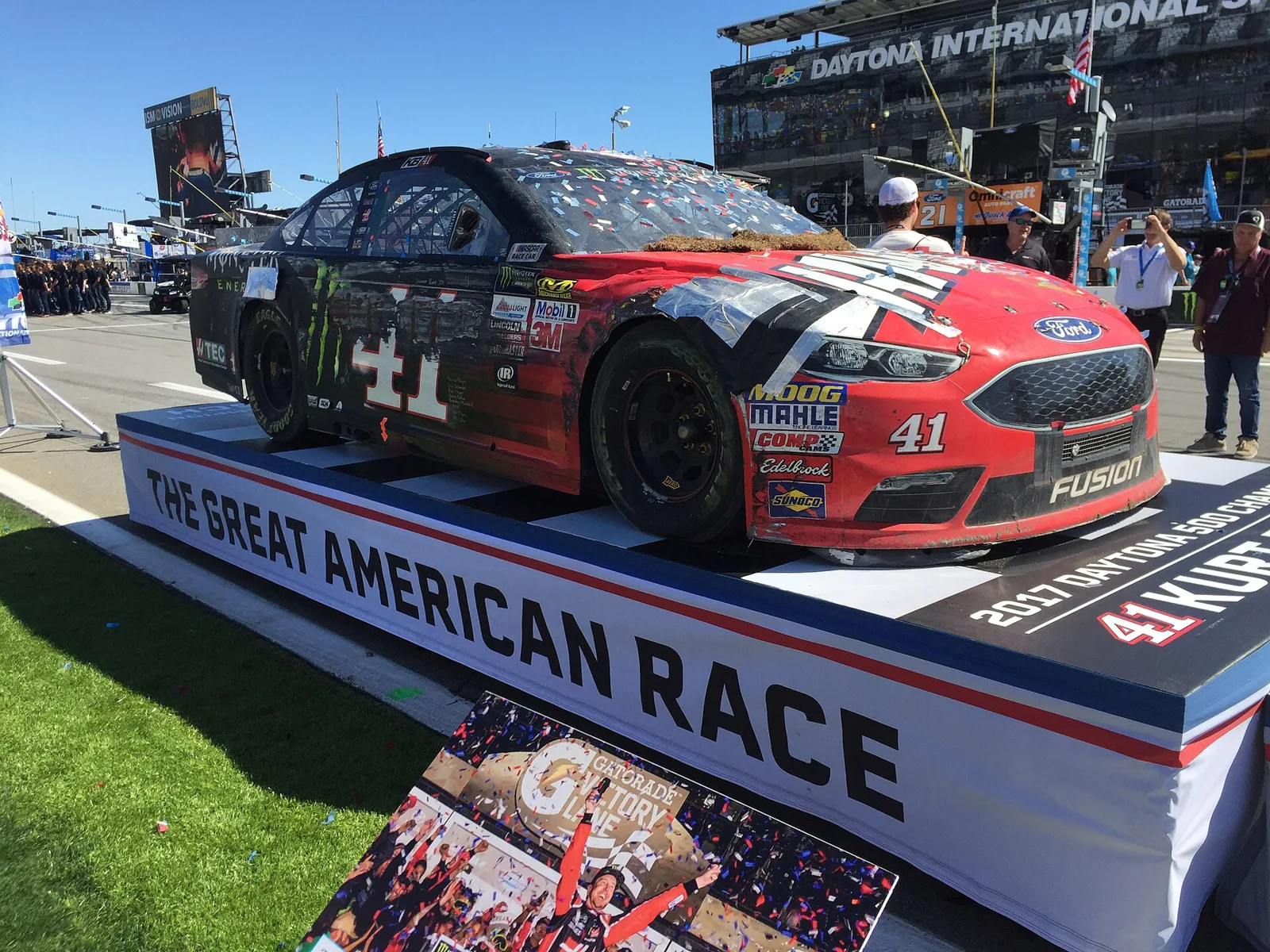
Kurt Busch took his first Daytona 500 as Chase Elliott and Kyle Larson ran dry in the closing laps, in the first race of the Monster Energy era.
Kurt Busch won the 2017 Daytona 500 for Stewart-Haas Racing, opening the Monster Energy era of the Cup series. Ryan Blaney and A. J. Allmendinger completed the podium, and Busch passed the last of the stranded leaders on the final lap.
The 2017 Daytona 500 was decided as much by fuel as by speed. Kurt Busch took the 59th running on 26 February 2017, after Chase Elliott and Kyle Larson ran out of fuel in the final laps. It was the first race of the 2017 Monster Energy NASCAR Cup Series season, and the first with Monster Energy as title sponsor in place of Sprint.
The race also tested a new season format. Three stages, with points for stage winners, were introduced for 2017, and new rules limited how teams could repair damaged cars on pit road. The event therefore became a test of strategy and discipline as much as outright speed.
What was the 2017 Daytona 500?
The 2017 Daytona 500 was the 59th running of the event, held on 26 February 2017. Kurt Busch of Stewart-Haas Racing won the 200-lap race on the 4.0 km (2.5-mile) asphalt superspeedway. Ryan Blaney finished second, and A. J. Allmendinger finished third, while two of the leaders, Elliott and Larson, were caught out on fuel near the finish.
The win was Busch's first Daytona 500, and it was also his first career win on a restrictor plate track.
The first race of the Monster Energy era ended with three leaders out of fuel and a Stewart-Haas driver taking his first Daytona 500 win.
What rules changed for the 2017 season?
NASCAR's three main national series all moved to a new racing format and points system that year. Under the new format, each race was split into three stages, with a competition caution at the end of the first and second stages. Bonus championship points were awarded to the top 10 drivers at those points, and the stage leader received points that carried over into the playoffs.
For the 500, the first and second stages each covered 60 laps, with the remaining 80 laps forming the final stage. The leader at the end of each stage, including the eventual overall winner, received points that could be carried into the season-ending playoffs, which had been renamed from the Chase for the Championship.
Repairs were also tightly restricted. Pit road repairs were confined to five-minute periods and a crew of six, beginning once the car passed the commitment line. Repairs were limited to sheet metal and re-attaching or reinforcing body panels, and body panels could not be replaced. A car that could not be fixed on pit road, or that needed more than six crew members, was removed from the race and could not return.
Other changes applied to the 2017 Daytona 500 specifically. Teams had one fewer set of tyres available for the race, and they had to start the race on the same tyres they used in qualifying. The restrictor plate openings were also reduced from 23 mm (57/64 inch) to 22 mm (7/8 inch), and the new safety features mandated at Daytona and Talladega included structural additions to the cars.
How was the grid set?
Qualifying for the Daytona 500 was different from any other race weekend. The starting lineup, apart from the two fastest drivers in the final round, was not set on qualifying day. Instead, the lineup was set for the two Duel races the following Thursday, which decided most of the field.
At Daytona and Talladega, qualifying consisted of two rounds, with cars sent out one at a time to make a single timed lap. The fastest 12 advanced to the final round, where the pole was decided. Chase Elliott won the pole with a time of 46.663 seconds and a speed of 192.872 mph (310.397 km/h). He credited the Hendrick Motorsports team for its work through the off-season and for its record on plate tracks.
The Can-Am Duels set the lineup for positions 3 to 38. Positions 39 and 40 went to the two fastest open teams, which had not locked into the Duels. Both practice sessions scheduled after qualifying were cancelled because of rain.
What happened in the Can-Am Duels?
The Can-Am Duels were two races of 60 laps, or 150 miles (240 km), that acted as heat races for the Daytona 500. The first race set the lineup for cars that had qualified in odd-numbered positions, and the second for those in even-numbered positions. Both races produced incidents that affected the field.
In Duel 1, Elliott held off late charges to win. After the restart with eight laps left, Harvick and Keselowski, both driving Fords, lined up on the high side to chase him, and that group faded before the five-lap mark. Jamie McMurray also challenged, but Elliott held on to take the win.
A two-car wreck with 12 laps to go set up the finish of that race. Corey LaJoie rear-ended Reed Sorenson, who checked up and turned into Paul Menard before sliding into the inside wall. Sorenson missed the race as a result, and he said afterwards that it had been a big deal for a small team.
In Duel 2, Dale Earnhardt Jr. dominated, leading 53 of the 60 laps. He lost the lead on the final lap to Denny Hamlin, who had received a push from Austin Dillon and faked Earnhardt out on the backstretch before going into Turn 3. Hamlin credited Dillon's push and the crew chief, Mike Wheeler, for the result.
Also in Duel 2, Ryan Blaney and Jimmie Johnson made contact on the backstretch with 18 laps remaining. Five laps later, Johnson blew a right-side tyre and hit the wall in Turn 3, which set up the final nine laps.
Who was fastest in practice?
Joey Logano was fastest in the first practice session at 46.604 seconds, which was 193.116 mph (310.790 km/h). David Ragan led the second session at 46.178 seconds and 194.898 mph (313.658 km/h). Kyle Busch was fastest in the third session at 45.624 seconds, a speed of 197.265 mph (317.467 km/h).
Ricky Stenhouse Jr. was fastest in the final practice session at 45.351 seconds, which equated to 198.452 mph (319.378 km/h). Those numbers were a useful guide, but the race would show how quickly the front of the field would change.
How did the race unfold?
Elliott led the field to the green flag at 2:40 pm, and he jumped ahead of teammate Earnhardt Jr. on the first lap. Earnhardt was boxed in between the two lanes with no help from a draft, a spot known as the sucker hole, and he was soon back through the pack.
Jamie McMurray took the lead on lap 8 by running the low lane. Joey Logano made an unscheduled stop for a loose wheel on lap 14, and a group of Toyotas pitted together on lap 17. Daniel Suarez was given a pass-through penalty for speeding, and Matt Kenseth came down pit road a second time for a loose wheel caused by flat-spotting his tyres on his first stop.
Kevin Harvick took the lead from McMurray on lap 18, and Elliott regained it on lap 23. Harvick took it back on lap 26. A caution on lap 31 came after Corey LaJoie mistimed his pit entry and hit the outside wall in the tri-oval. Kurt Busch restarted from the tail of the field for speeding on pit road.
On the restart, Kyle Busch led the outside line past Harvick to take the lead on lap 43, and Truex followed on the top line. Ryan Blaney later dove under to lead on lap 49. David Ragan hit the frontstretch wall the following lap, but the race stayed under green. The first stage ended under caution on lap 61, and Kyle Busch led at the conclusion of the stage.
What happened in the second stage?
The race restarted on lap 68 and was calmer for most of the second stage. The outside line was the strongest, and the inside line faded by lap 78. Jimmie Johnson took the lead as many Fords came down pit road on lap 90, and Earnhardt took the lead for the first time on lap 97.
On lap 105, Kyle Busch's car suffered a tyre blowout in turn three and spun into the wall, collecting Jones, Kenseth and Ty Dillon in a six-car pile-up. Earnhardt was clipped by Busch and slammed the wall. He later said he had lifted to avoid the incident, but the damage was too great to fix. Kenseth finished 40th, his third career last-place finish.
That wreck brought out a red flag of 17 minutes, which was the third caution of the race. Elliott Sadler led when the race resumed, but he surrendered the lead to Harvick on pit road. Harvick led to the end of the second stage, when all but the first eight cars pitted under caution.
How did the final stage play out?
The race restarted on lap 125, and Kyle Larson briefly took the position before Elliott powered by on the outside line on lap 126. Kasey Kahne then edged his teammate at the line to lead for the first time on lap 127. The same lap, McMurray shoved Johnson down the backstretch, and the resulting pile-up took 14 cars and brought out the fifth caution.
With 65 laps to go, Ryan Blaney signalled that he was pitting, but Elliott Sadler swerved up the track to avoid him and clipped both Trevor Bayne and Stenhouse, which sent them into the inside wall. The sixth caution came out, and Kahne took the lead before it was flown. The race restarted with 59 laps to go, and McMurray was hooked into the outside wall by Brendan Gaughan. Suarez then collided with Ryan Newman, and the accordion effect caused an 11-car wreck.
After that caution, the race was almost decided by fuel. Logano took the lead with 51 laps to go, and Cole Whitt, who had opted not to pit, assumed the lead before the restart. Aric Almirola went around Whitt on the outside and grabbed the top spot with 45 to go, but he faded and gave the lead to Larson.
Logano took the lead again with 37 to go, and Elliott took it over with 27 to go before clearing Logano for the race lead on the backstretch. With 20 laps to go the bottom line disappeared, and the top 12 cars formed a breakaway draft against the wall. Elliott's tank went dry with four laps left, and Martin Truex Jr. inherited the lead in turn four. Truex then also ran short with two to go.
With one lap to go, Larson took command of the race but he also ran out of gas exiting turn two. Busch passed him in the same corner and won the 59th Daytona 500.
Who finished where?
Busch crossed first, with Blaney and Allmendinger behind him on the podium. Blaney's car had run dry on the final lap, and Michael Waltrip took eighth as the top Toyota in his last career start.
| Specification | Detail |
|---|---|
| Race date | 26 February 2017 |
| Running | 59th Daytona 500 |
| Winner | Kurt Busch, Stewart-Haas Racing |
| Second | Ryan Blaney, out of fuel on the final lap |
| Third | A. J. Allmendinger |
| Race length | 200 laps |
| Lead changes | 37 among 18 drivers |
| Cautions | 8 for 40 laps |
| Red flags | 1 for 17 minutes |
| Race time | 3 hours, 29 minutes and 31 seconds |
| Average speed | 230.437 km/h (143.187 mph) |
What did the drivers say after the race?
Busch said the race was unpredictable and that he had kept trying to go back to old patterns that had not worked for him. His mirror fell off with 30 laps to go, and he treated that as a sign to throw caution to the wind. He said the drivers had put on a show for a full fuel run without taking each other out.
Tony Stewart, the team owner, had failed to win the Daytona 500 in 17 attempts as a driver. He joked that he could have retired 17 years earlier if he had known how to win it, and he called the win a long-awaited moment for the team.
Who broadcast the race?
Fox has carried the Daytona 500 since 2001, except for 2002, 2004 and 2006. Mike Joy called the race from the booth alongside Jeff Gordon, a three-time Daytona 500 champion, and Darrell Waltrip, a 1989 race winner. Pit road was covered by Jamie Little, Chris Neville, Vince Welch and Matt Yocum.
On radio, Motor Racing Network has covered the race since 1970, and it was simulcast on Sirius XM NASCAR Radio. Joe Moore led the MRN booth alongside Jeff Striegle and Rusty Wallace, and Winston Kelley led the pit reporting team.