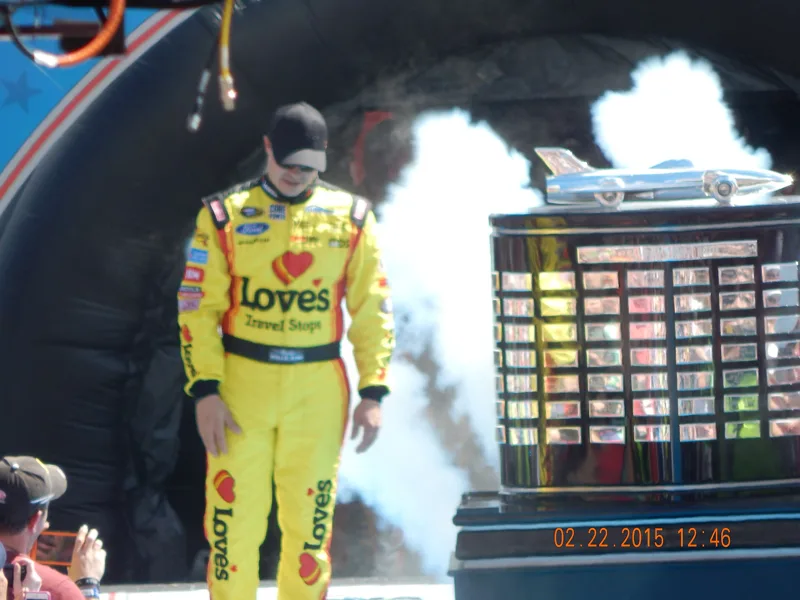
The race came back to Labor Day weekend after years away, ran 367 laps, produced 18 cautions and was settled by a late restart.
The 2015 Bojangles' Southern 500 was a NASCAR race at Darlington Raceway on Labor Day weekend, won by Carl Edwards after 367 laps. It produced 24 lead changes and 18 caution periods, and the race had been moved back to Labor Day after years away from the date.
The sixty-sixth edition of the Bojangles' Southern 500 took place at Darlington Raceway in South Carolina on September 6, 2015. Carl Edwards won it, collecting his twenty-fifth career victory after 367 laps around the egg-shaped track. Brad Keselowski finished second, and Denny Hamlin, Joey Logano and Kevin Harvick completed the top five.
What was the 2015 Bojangles' Southern 500?
The race returned to its traditional Labor Day weekend date and ran 367 laps, making it the sixty-sixth edition of the event. Keselowski led 196 laps from the front row, but Edwards won after a late restart. The field produced 24 lead changes among 11 different drivers.
Darlington is a 1.366-mile oval shaped like an egg, located in South Carolina. Kevin Harvick began the weekend with a 43-point advantage over Joey Logano, while Dale Earnhardt Jr. sat 89 points back, Keselowski 115 back and Jimmie Johnson 116 back.
It was the first time Darlington had staged the race on Labor Day weekend since 2003, which made the date a central part of the story before the green flag.
A race back on Labor Day weekend that ran 367 laps and was settled by a late restart and a record 18 cautions.
Why did the race return to Labor Day weekend?
The event ran on Labor Day weekend from 1950 to 2003. In 2004 it was moved to the second-to-last race of the season, and other tracks took the Labor Day date until NASCAR announced Darlington's return in August 2014.
Auto Club Speedway took the Labor Day slot that the 2004 move created. Fontana kept the date for several years, and Atlanta Motor Speedway held it until the change announced in August 2014.
Reactions were broadly positive. Pete Pistone, writing for the Motor Racing Network, said Darlington fitted the Labor Day weekend like a glove, while Jordan Bianchi of SB Nation argued that some traditions should never be tampered with. Mike Hembree of USA Today called the original move a serious mistake, and Bob Pockrass said NASCAR should never have touched the date at all.
Ricky Craven felt that a spring date was simply the wrong time of year for this race. Ryan McGhee said a return to Labor Day meant admitting an error, which NASCAR does not like to do. John Oreovicz argued that NASCAR had been listening to its fans more closely.
What changed at Darlington for this race?
Darlington had added 4,600 ft of SAFER barrier to its walls since April 2014, which made it the second track after Bristol to line the whole outside wall with the barrier. Teams also ran the low-downforce package used earlier that season at Kentucky.
The low-downforce package had debuted at Kentucky, and it was used here as well. It meant a 3 in spoiler instead of a 6 in one, a 25 in radiator pan rather than a 38 in pan, and a quarter-inch leading-edge splitter.
Goodyear supplied a softer compound, and the left-side and right-side tires were built and shaped differently to give more grip. NASCAR also reworked the restart zone so the restarts would be easier to see, which targeted complaints about jumped restarts.
How did the throwback schemes and entry list shape the weekend?
Some 32 of the 46 teams took part in a throwback program. Track president Chip Wile, who had come up with the throwback idea, had expected only a handful of teams to join in. He later described the response as bigger than anyone had imagined, and said the sport needed to celebrate its history.
The entry list came out on Sunday, August 28, and it named 46 drivers. Every car except the No. 25 Hendrick entry had raced at Bristol the previous week.
Driver changes were part of the entry. Jeb Burton and J. J. Yeley exchanged cars at BK Racing, Travis Kvapil was in a No. 30 Chevrolet run by The Motorsports Group, and Premium Motorsports ran T. J. Bell in its No. 98 Ford.
How did practice and qualifying go?
Greg Biffle set the pace in the first practice session at 27.909 seconds, while Brad Keselowski was fastest in the final session at 27.960 seconds. Keselowski then won the pole at 27.492 seconds. His speed was 178.874 mph, or 287.870 km/h.
The opening practice was the first session in which a car used the digital dashboard that every car must use from 2016. Kyle Busch had to switch to a backup car when he crashed his primary car an hour into the final session.
Qualifying used three runs to determine the pole, and each run cost the tires grip. Keselowski called Darlington one of the unique tracks in NASCAR and said the pole meant a great deal to him personally. Kurt Busch described his first run as almost too fast, and Harvick said the car felt better in race trim.
How did the first half of the race unfold?
Keselowski led the field to the green at 7:24 p.m., and the first caution came on lap 7. Lap 61 brought debris and a two-tire stop for Kasey Kahne. By the halfway mark the lead had changed hands several times.
Brett Moffitt hit the wall exiting Turn Two, and Cole Whitt and Chase Elliott were caught up behind him. Racing resumed on lap 14, and Matt Kenseth hit the wall in Turn Two, which cost him an unscheduled stop three laps later.
Ryan Newman lost grip in Turn Three, saved the car, then spun in Turn Four on lap 44. Debris on the frontstretch followed on lap 61, and Kahne's two-tire stop put him in front. Edwards, who had stayed out, took the front, and Kahne passed him for the lead on lap 66.
Hamlin, on fresh tires, went by Kahne three laps after that. Michael Annett spun in Turn Two on lap 108, and Keselowski got around the outside of Hamlin on lap 119 to regain the front.
Mike Bliss cut a right-front tire and hit the wall on lap 122, bringing out the fifth caution. Kyle Busch stayed out and assumed the lead. Yeley and Annett made contact on lap 125, and Johnson drifted into Logano's path on lap 134 and spun exiting Turn Four.
Harvick briefly led on lap 139 before handing the lead back to Keselowski the following lap. On lap 165 Bayne made hard contact with Danica Patrick, and his tires went flat as he tried to reach pit road.
Patrick then lost the car in Turn Four on lap 189, slamming the wall and bringing out the ninth caution as debris littered the backstretch.
What happened in the second half?
The second half brought a steady run of cautions as tires and cars failed. Kyle Busch and Greg Biffle made contact on lap 208, and Hamlin regained the lead on lap 223. Ragan hit the wall on lap 265 and again on lap 279.
The race restarted on lap 195, and the tenth caution followed on lap 198 after a crash at the inside wall in Turn Four. Each stoppage gave the teams another chance to reshuffle the field.
The eleventh caution came on lap 208 after the Kyle Busch and Biffle incident. Hamlin then retook the lead on lap 223, and Elliott blew a right-front tire on lap 229 to bring out the twelfth caution. Hamlin and Harvick traded the lead on pit road during that stop, and Harvick left in front.
Bayne cut a tire on lap 246 to bring out the thirteenth caution. Ragan slid into the wall on lap 265, and Kyle Busch took the lead by staying out. He botched the restart on lap 270, and Logano retook the lead.
Ragan hit the wall again on lap 279 to bring out the fifteenth caution. The sixteenth came on lap 300 for debris in Turn One, and Keselowski got the better of Harvick on pit road and was back in front.
How did the final stretch decide the race?
The seventeenth caution came with 60 laps left, after Truex tapped Kurt Busch. Harvick then began to pressure Keselowski, and a bobble on exit let the leader hold on. Those closing laps decided the win and showed how little margin separated the leaders.
With 50 laps to go Harvick began to pressure Keselowski. He had the momentum to pass but bobbled on the exit with 45 laps to go, and Keselowski kept the lead.
Edwards pushed Keselowski hard on the run to the line, and with 22 laps left he came out ahead for a moment. Keselowski retook the lead the following lap, and the battle stayed close until the end.
The eighteenth caution came late, with 13 laps left, after Jeb Burton collided with Johnson. It set a new mark for cautions in this event, and Edwards got the better of Keselowski on pit road to move back in front.
Edwards drove away to win with eight laps to go.
How did the drivers react after the race?
Edwards said this was the kind of racing he loved and hoped the team could produce it again in the Chase. Keselowski said his team needed one more level to win races and the championship, having come up just one spot short.
Harvick ended fifth, and Kyle Busch secured a Chase place by finishing seventh. Truex took ninth and blamed a loss of handling late in the race.
Jeff Gluck of USA Today called it a grueling marathon of four and a half hours, while John Oreovicz said the low-drag package had delivered almost everything drivers asked for. Larry McReynolds said the race was long but still good racing, and Nate Ryan argued that NASCAR should have used the package for the Chase.
What did the result mean for the standings?
Edwards climbed to 12th in the drivers' standings, 235 points behind Harvick. His win also left Toyota trailing Chevrolet by 63 points in the manufacturers' title, even though Toyota had the winning car. Edwards said he hoped the style of racing could carry into the Chase.
Kyle Busch had finished 43rd in the June race at Michigan, which made his Darlington result a sharp turnaround. The seventh-place finish secured his Chase place.
Race statistics at a glance
| Measure | Result |
|---|---|
| Date | September 6, 2015 |
| Venue | Darlington Raceway, Darlington, South Carolina |
| Scheduled laps | 367 |
| Winner | Carl Edwards, Joe Gibbs Racing |
| Pole | Brad Keselowski, 27.492 seconds |
| Race-high laps | 196 led by Keselowski |
| Lead changes | 24 among 11 different drivers |
| Cautions | 18 for 89 laps |
| Race time | 4 hours, 28 minutes, 35 seconds |
| Average speed | 111.993 mph (180.235 km/h) |
| Winnings | $285,225 |
| Leader bonus rollover | $220,000 |