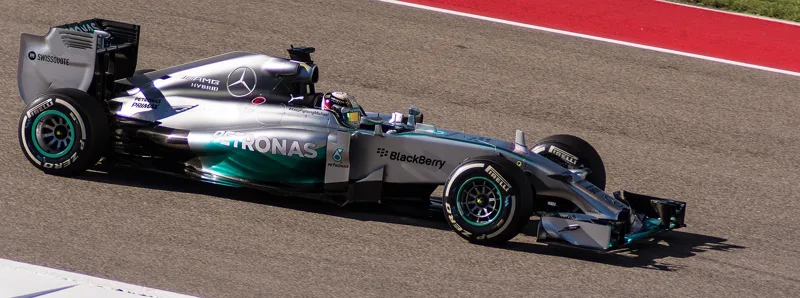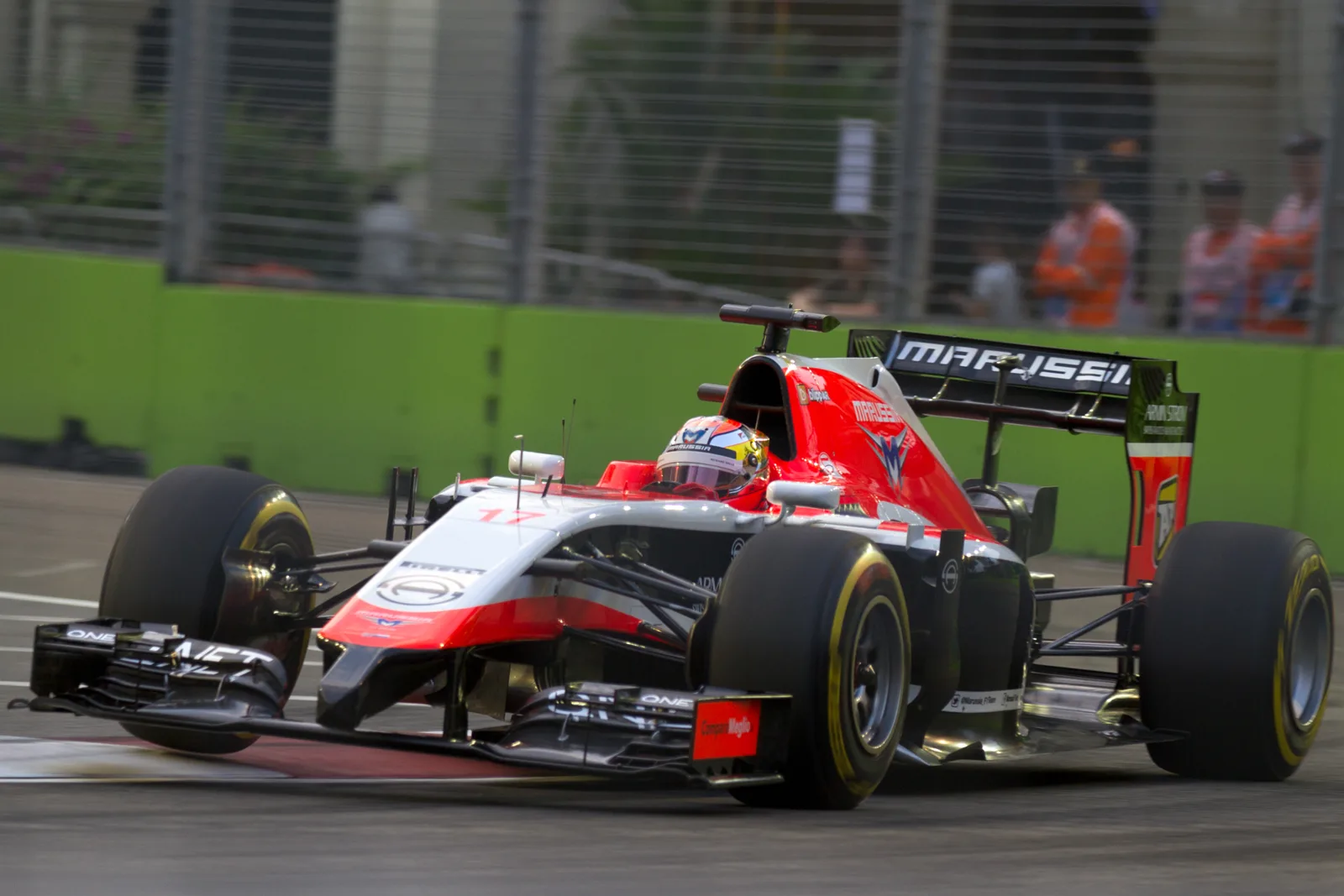
A steering wheel fault cost Rosberg his place on the grid, and Hamilton converted his Marina Bay pole into the lead of the drivers table.
Lewis Hamilton won the 2014 Singapore Grand Prix from pole, taking the drivers lead back from Nico Rosberg. A steering wheel fault left Rosberg starting in the pit lane, and he retired after 14 laps, while Sebastian Vettel finished second and Daniel Ricciardo third.
Mercedes began the 2014 Singapore Grand Prix with a fault on its second car, and it ended with Lewis Hamilton winning from pole. Nico Rosberg started from the pit lane after a steering wheel control problem that a wheel change and a computer reset could not cure, and he retired after 14 laps.
Singapore was round 14 of 19, and the title picture had been tight going in. Rosberg led the drivers table, but Hamilton's win turned the points gap back in his direction. The Marina Bay street circuit is a demanding venue, with 23 turns over 5.065 km (3.147 mi).
Who won the 2014 Singapore Grand Prix?
Hamilton won the 60-lap race for Mercedes, with Vettel second and Ricciardo third. It was Hamilton's seventh victory of 2014 and his 29th in Formula One, and it came from the pole he took in qualifying, a result that moved him back to the top of the table.
The race started at 20:00 Singapore Standard Time in dry, clear conditions, with air at 28 to 30 degrees C and the track between 33 and 37 degrees C. Every driver began on super-soft tyres. Kobayashi's car developed an oil pressure problem on the formation lap and pulled off the circuit, so he never took the start.
Hamilton led into the first corner. Alonso tried to pass both Red Bulls on the outside, arrived at turn one too quickly, locked his front-left tyre and ran onto the run-off area, dropping to third. The stewards looked at his start but took no further action. By the end of the first lap Vettel was second, Alonso third, Ricciardo fourth and Raikkonen fifth.
A steering wheel fault put Rosberg in the pit lane, and Hamilton used the pole he had earned to take the lead of the drivers table.
The title fight going into Singapore
Rosberg led the drivers table with 238 points, 22 ahead of Hamilton in second. Ricciardo was third, a further 50 points back, with Bottas fourth on 122 and Alonso fifth. Mercedes led the constructors with 454 points, Red Bull were second on 272, and Williams (172), Ferrari (162) and McLaren (110) followed.
Hamilton had won at Monza the round before, and six races remained. He said he could not afford to lose any more ground to Rosberg, and he was pleased with how his form had improved since Monza. Ricciardo took a different view. He said a couple of wins and a couple of bad races for the leaders would make the championship possible again, and that he would take it one race at a time.
Rosberg said he was enjoying his racing more than ever, because his car gave him a real chance of taking pole and winning. That confidence was tested by a fault that had nothing to do with his driving.
What rules and team talk shaped the weekend?
The FIA tightened the rules on pit-to-car messages in the weeks before the race, and in race week it banned coded messages by radio or pit board. Teams then pressed for changes, and the governing body eased its position on car performance and safety messages only days before the race.
The coaching ban was the most contentious part. Under the sporting regulations a driver must drive the car alone and unaided, and the FIA used that wording to stop teams giving drivers comparisons with rivals, such as how their sector times stacked up against another competitor's.
Charlie Whiting, the race director, had introduced the restriction in the run-up to the event. Team principals raised concerns about how far the ban went three days before the race, and the FIA then revised what teams could say by radio, including messages about car performance and safety.
The restrictions also reached beyond Singapore. From the following round in Japan, teams would be barred from sending drivers information about tyres and brake wear. Caterham confirmed that Kamui Kobayashi would race after persistent speculation about his future.
What happened in practice?
Alonso was fastest in the first practice session at 1:49.056, and Hamilton was second, one-tenth behind. Hamilton then set the fastest time of the second session at 1:47.490 on super-soft tyres, despite brake vibrations, before Alonso took the final practice with a best of 1:47.299.
The first session passed fairly smoothly, although Vergne's battery had to be changed and his session ended early with an energy recovery failure. Raikkonen's session also finished early after a brake fire. Vettel stopped at the pit lane exit with a sudden drop in oil pressure, and he avoided a ten-place grid penalty by using an older engine.
The second session was disrupted when Maldonado overdrove through turn ten, lost the rear and hit the right-hand exit barriers. Lotus built him a new E22 chassis overnight for the rest of the weekend. The stoppage made for a busy Friday in the garages.
In the final practice, under cloudy skies, Alonso posted 1:47.299, the quickest time of the weekend so far, with Ricciardo 0.051 seconds back. Rosberg lost time after a slow first sector and a run over the turn 11 kerbs, and the session showed the field closing up on the front.
Who took pole and how did qualifying play out?
Hamilton took his sixth pole of 2014 with a 1:45.681 lap in the final session, his 37th of his career, despite locking his tyres into turn one. Rosberg joined him on the front row and described the session as the hardest of his career.
Qualifying ran in three parts, with 18, 15 and 12 minutes for each stage and the 107 per cent rule applying in the first part. Cars that reached the final part could only use the tyres they had set their best time on in the second session, so the tyre choice was locked in before the decisive lap.
Hamilton lost two-tenths of a second when he locked his tyres into turn one and missed the apex, but his final lap was quick enough to take pole. Ricciardo was third, and Vettel fourth after feeling that he had overdriven and that pole might have been his. Alonso made a minor set-up change that gave him confidence and started fifth.
Massa was sixth, and his engine shut down while he was preparing a second timed lap in the final session. Raikkonen, who had been quickest in the first session, was seventh, and Bottas started eighth after an error at turn one. Magnussen was ninth and Kvyat tenth, the latter on the only super-soft tyre he had available.
Button was the fastest driver outside the final session. He locked a front tyre at the turn 13 hairpin on his last timed lap and lost time. Vergne had front-grip problems, locked his tyres and was twelfth. Force India's Hulkenberg and Perez qualified thirteenth and fifteenth, with Gutierrez's Sauber in between.
Grosjean was slowed by a turbocharger wastegate problem and eliminated in the second session, and he radioed his frustration to Lotus. Maldonado had the same turbo issue and started eighteenth. Chilton was held up on his first attempt by mapping trouble, and Ericsson started twenty-second after a late electrical fix.
How did the race unfold from the lights to lap 27?
Hamilton led into the first corner after a clean getaway from pole, while Rosberg had been released from the pit lane because of his steering wheel fault. At the end of the first lap Hamilton led Vettel, Alonso, Ricciardo and Raikkonen. Button gained four places in the opening lap, and Rosberg dropped to twenty-second.
Magnussen passed Massa for sixth outside track limits at turn five, then slid at turn seven while holding off Button and dropped to ninth. The stewards investigated him for track limits and took no further action. Vergne encouraged his team-mate Kvyat to let him through, but Kvyat insisted he could pass Magnussen himself, and Vergne overtook Kvyat for tenth on lap eight.
Rosberg left the pit lane on lap two but could not immediately get past Chilton's Marussia. He passed Chilton on lap five, and by lap six he was more than 40 seconds behind Hamilton. DRS was enabled on lap three as the field spread out, and the McLarens of Magnussen and Button avoided a collision on lap four before the two Williams cars passed them.
Massa pitted at the end of lap 10 and Raikkonen followed on lap 11. Hamilton led by about five seconds at that point, despite car balance problems over a single lap. Rosberg was then told he could not go past 6,500 rpm in first gear because of a faulty pit lane limiter. He slowed into the pit lane on lap 14 and stalled the car while the tyres and steering wheel were changed, and after almost two minutes it was pushed into the garage to retire.
Hamilton made his stop from the lead on lap 14 and retained it, narrowly ahead of Button. Massa overtook Perez for sixth on lap 15, and Vergne picked up a five-second stop-and-go penalty for exceeding track limits on the following lap. Gutierrez retired in the garage on lap 19 with an electrical fault, and Chilton made an unscheduled stop after a puncture.
On lap 23 Raikkonen drew closer to Massa, and Williams responded by bringing Massa in for soft tyres to set up an overtake. Massa rejoined ninth behind Bottas. Hamilton pulled away from Vettel, who was then caught by Alonso. Ferrari brought Alonso in on the 24th lap for super-soft tyres, and Vettel pitted on lap 25 for soft tyres and emerged third behind Alonso.
Massa overtook Hulkenberg on the main straight for eighth on the same lap. Hamilton stopped for super-soft tyres on the following lap, handing the lead to Ricciardo, whose team used the time gap to remove debris from his front wing. Ricciardo pitted on lap 27 and returned the lead to Hamilton.
How did the race finish?
Hamilton passed Vettel on lap 54 to win, after Vettel had led for one lap. There were four lead changes among three different drivers during the race. The win was Hamilton's seventh of 2014, and it came after Rosberg's car failure ended his race early.
Rosberg's retirement was the moment that shaped the result. He had gone into the weekend as the drivers leader, and a fault that began before the start left him with no points at all. Hamilton's advantage in the table came from a race where his car worked and his team-mate's did not.
Race facts at a glance
| Item | Detail |
|---|---|
| Date | 21 September 2014 |
| Venue | Marina Bay Street Circuit, Marina Bay, Singapore |
| Track length | 5.065 km (3.147 mi), 23 turns |
| Race distance | 60 laps |
| Pole | Lewis Hamilton, 1:45.681 |
| Winner | Lewis Hamilton, Mercedes |
| Podium | Sebastian Vettel (second), Daniel Ricciardo (third) |
| Round | 14th of 19 |
What did the result mean for the title race?
Hamilton regained the drivers lead on 241 points, three ahead of Rosberg, who retired after 14 laps. Ricciardo stayed third, and Mercedes extended its constructors lead over Red Bull to 182 points with five races left in the season.
The margin was small on paper, but it came in a race where one team-mate's car failed before the lights went out. With five races left, the question for Mercedes was no longer whether it had the pace, but whether its drivers could keep the points gap from swinging back.