A new circuit on the Winter Olympics site hosted Russia's Grand Prix, and Hamilton led from pole to the flag.
Lewis Hamilton won the 2014 Russian Grand Prix at the new Sochi Autodrom on 12 October 2014, leading every lap from pole. Nico Rosberg finished second, Valtteri Bottas took third with the fastest lap, and the result secured Mercedes the constructors title.
Russia's first Formula One race in a century was held at Sochi, on a brand-new circuit built on the site of the Winter Olympics, and Lewis Hamilton led every lap to win. The race was the sixteenth of the 2014 season and the first time the Russian event had counted towards the world championship since the series began in 1950.
The weekend also carried the weight of Jules Bianchi's crash in Japan the week before. The paddock marked it with a lone Marussia, a livery tribute on the cockpit and a one-minute silence before the start. The race itself turned on tyre choice and on a Rosberg flat spot that cost him more than a few places.
Who won the 2014 Russian Grand Prix?
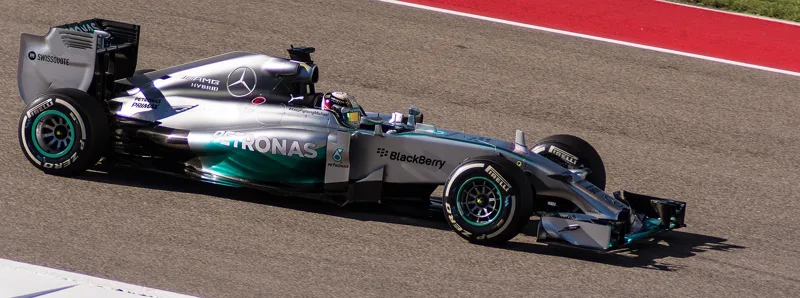
Hamilton won from pole, leading every lap, and finished 13 seconds clear of his team-mate Nico Rosberg. Valtteri Bottas took third and set the fastest lap, and the result gave Mercedes its ninth one-two finish of the season, with Mercedes-powered cars taking the top five places.
Rosberg made the most eventful start. He tried to out-brake Hamilton into turn two, locked both front wheels, ran wide and flat-spotted his tyres. He pitted on the first lap for the harder prime compound, and the team planned to run the rest of the race on that one set.
A new circuit on the Winter Olympics site, a lone Marussia, and a Mercedes win from pole with every lap led.
Why did the Sochi race matter?
Sochi was the first Russian round of the world championship in a century, and it was the first time the event had counted towards the title since the championship began in 1950. The venue had been prepared for the 2014 Winter Olympics, which gave the race a place in the country's recent sporting history.
The International Olympic Committee had voiced concern that construction would disrupt its preparations, and it was given the power to postpone the race until the 2015 season if the two events clashed. The Winter Olympics went ahead without interruption, and the IOC never used that power. Charlie Whiting gave the circuit the FIA's final approval the week before the Belgian Grand Prix.
What was the political backdrop?
The race came after Malaysia Airlines Flight 17 was shot down over eastern Ukraine in July 2014, and the tension that followed reached Formula One. British Conservative politicians called for the sport to abandon the race as a sanction, and parliamentarians in Britain and Germany raised similar questions about Russia's hosting of the 2018 World Cup.
Christian Horner and Toto Wolff both refused to pass judgement, and they said that the FIA was responsible for monitoring the situation. Bernie Ecclestone said he had no doubts that the race would go ahead. Russian deputy prime minister Dmitry Kozak said that sanctions would not affect the Grand Prix, and Vladimir Putin attended and presented the winner's trophy.
The GP2 and GP3 feeder series also made their debut at the circuit, as the penultimate rounds of their 2014 championships. Their practice and qualifying sessions helped the track evolve, which mattered for the main event.
How did Marussia and the grid change the race?
Jules Bianchi suffered serious head injuries at Suzuka and was ruled out of Sochi. Marussia entered only Max Chilton for the race, and the grid had twenty-one cars. The team placed Bianchi's car in his side of the garage and used a #JB17 livery on Chilton's car, while drivers wore a helmet sticker and held a minute's silence before the start.
Pastor Maldonado carried a five-place penalty into the race. He had been given a ten-place penalty at Suzuka for exceeding his quota of engine components, but as he had started seventeenth there he could not take the full penalty without going past the back of the grid. The remainder carried over to Sochi.
How did free practice and qualifying unfold?
Rosberg was quickest in the first free practice session, seven hundredths of a second ahead of Hamilton, and Sergey Sirotkin made his Formula One debut for Sauber. Bottas had a limited session after tyre blankets failed and damaged his tyres. Hamilton led the second session by eight-tenths of a second over Magnussen, and the third by three-tenths of a second over Rosberg.
Pirelli supplied the medium compound as the prime and the soft as the option, because the new surface placed high lateral loads on the tyres, especially through turn four. That corner is estimated at 200 km/h (120 mph) and is the longest corner on the 2014 calendar. Two DRS zones were used, one at the entry to turn one and one along the back straight through turns 12 and 13.
After the first day officials added speed bumps in the turn two and three run-off to discourage drivers from running wide to carry speed into turn four. They also cut the pit lane speed from 80 km/h (50 mph) to 60 km/h (37 mph), because of concerns over the narrow pit entry and its tight corners.
Because Marussia ran only one car, qualifying was changed so that five drivers rather than six were eliminated at the end of the first part. Hamilton topped the first part, going under 1:39.000 for the first time all weekend. Massa was a surprise elimination after a fuel flow problem that cost him power on the speed trap.
Vettel missed the third part by one-tenth of a second, and Ferrari endured its most difficult qualifying session since the British Grand Prix. Hamilton was on provisional pole after the first timed laps. Bottas then looked set to take a first pole, having been faster through the first two sectors, until an error in the final corner cost him the chance. Kvyat's fifth place was a career best in his home race.
Qualifying's first part eliminated Marcus Ericsson in seventeenth place, once again ahead of his Caterham team-mate Kamui Kobayashi, who was nineteenth. Pastor Maldonado, struggling with another engine fault, managed twentieth, enough to beat the sole Marussia of Max Chilton.
In the second part, Esteban Gutierrez outqualified Adrian Sutil to give Sauber fourteenth and fifteenth on the grid, and Romain Grosjean was the last driver eliminated. Sebastian Vettel missed out on a place in the final part by a tenth of a second, after a weekend of struggling with his car.
After qualifying Magnussen and Hulkenberg took five-place penalties for gearbox changes, which dropped them to eleventh and seventeenth. Maldonado and Chilton also took five-place penalties for gearbox changes. After the first timed laps the circuit stopped getting quicker, so the grid was set on a surface that had reached its limit.
Roberto Merhi also drove in the first free practice session, in place of Kobayashi, in his third appearance of the season for Caterham.
How did the race play out from the start?
Hamilton built a forty-second lead before the only round of pit stops, which gave him enough margin to stop without losing the lead, even with the lowered limit in the pit lane. Bottas kept pace with him early on but could not close the gap across the race. Hamilton was never seriously challenged, and he won by 13 seconds.
Rosberg's recovery was the story behind the front. He used other drivers' pit strategies and his car's straight-line speed to work his way through the field. Massa tried to copy the same strategy with a stop on the first lap, but he was less successful and slipped to eleventh behind a slower midfield.
Bottas finished third, his fifth podium of the season, after being passed by Rosberg on track. He set a series of laps among the fastest of the race, including the fastest lap and the official lap record, but he could not catch Rosberg in the closing laps even on fresher tyres.
Button and Magnussen took fourth and fifth, giving Mercedes-powered cars the top five places. McLaren had tried to position Button ahead of Rosberg after his pit stop, but it could not stop the overtake. Alonso finished sixth, the first driver not in a Mercedes-powered car, after spending most of the race fending off Ricciardo.
Vettel secured four points with eighth place after a weekend of struggling with an underpowered car. Raikkonen and Perez completed the top ten, while Massa finished eleventh ahead of Hulkenberg. Vergne and Kvyat were forced to race conservatively on fuel, and they finished thirteenth and fourteenth.
Questions were also raised about the revival of the European Grand Prix in Azerbaijan, given that country's record on human rights. Those questions did not change the schedule, and the race went ahead as planned.
The lowered speed limit and the lengthy pit lane made every stop expensive, which is why Hamilton's forty-second lead mattered. It gave him a buffer to pit without losing the lead, even under those conditions.
As drivers struggled to keep heat in their tyres, the gap between the Mercedes pair went up and down, but both stayed well clear of the rest of the field. Magnussen spent the early phase of the race in a strategy battle with Alonso, Ricciardo and Vettel, and he ultimately won it.
Sochi also had a warm-up of sorts. A Russian Touring Car Championship round had been held at the circuit in September 2014, as preparation for the Grand Prix.
Race facts at a glance
| Item | Detail |
|---|---|
| Date | 12 October 2014 |
| Venue | Sochi Autodrom, Russia |
| Race distance | fifty-three laps |
| Cars on the grid | Twenty-one |
| Pole and winner | Lewis Hamilton, Mercedes |
| Podium | Hamilton, Rosberg, Bottas |
| Fastest lap | Valtteri Bottas, a new official lap record |
| Round | Sixteenth of the season |
What did the result mean for the championship?
Mercedes secured the constructors title with three races remaining, and Hamilton extended his drivers lead over Rosberg to 17 points. Bottas's podium moved him past Alonso and Vettel in the drivers standings.
Marussia went into administration before the next race in the United States, so Sochi was its last race of the season. The team had done what it could to honour Bianchi at the track, and the paddock remembered the weekend for that as much as for the Mercedes result.