A 20-year-old Wood Brothers driver won the season opener on a record 16 cautions, 74 lead changes and a 0.118-second margin.
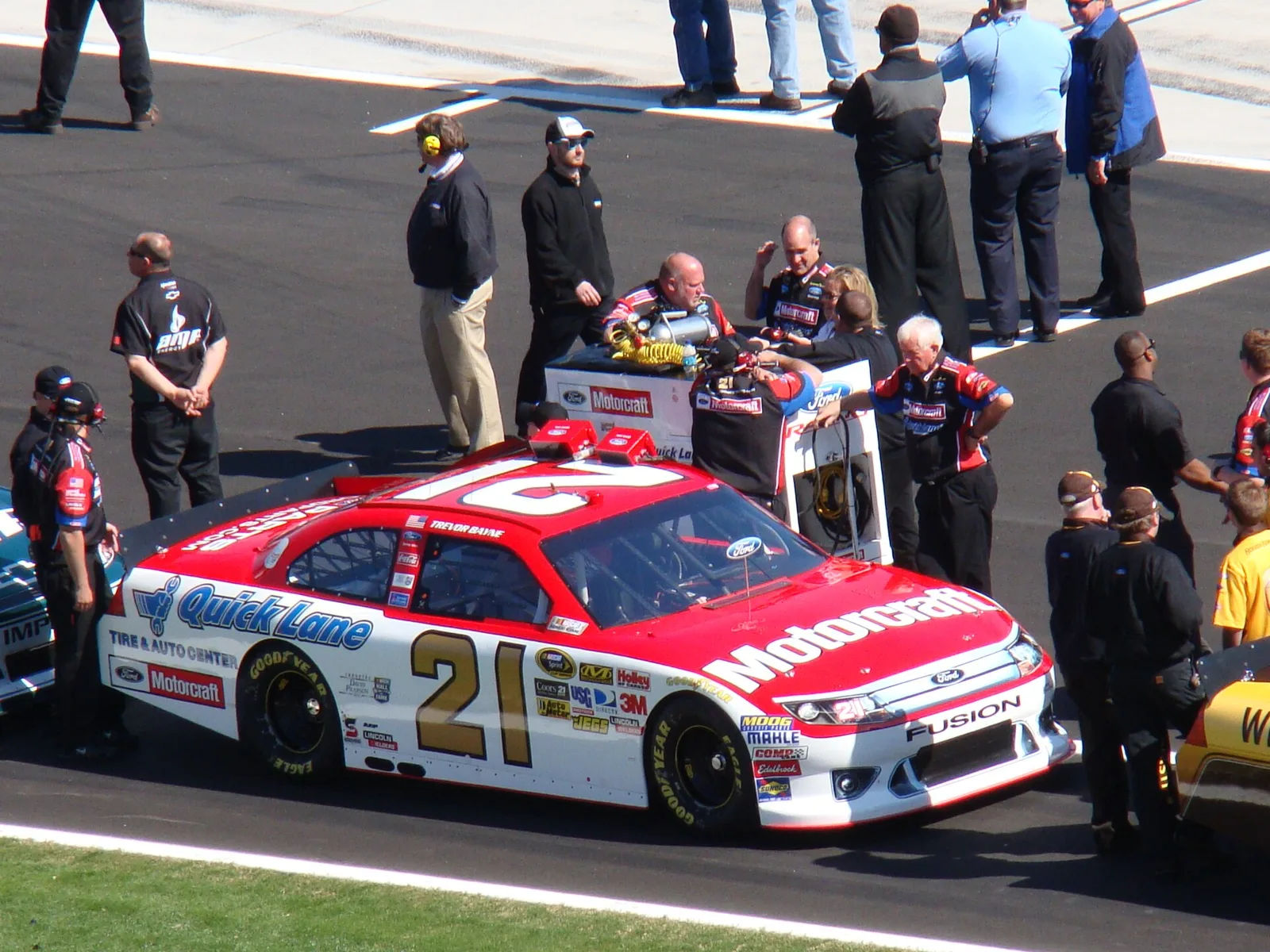
The 2011 Daytona 500 was the 53rd running of the race and the opening round of the 2011 NASCAR Sprint Cup season. Trevor Bayne of Wood Brothers Racing won at 20 years old, after a race with 16 caution periods and 74 lead changes among 22 different drivers.
Trevor Bayne won the 2011 Daytona 500 for Wood Brothers Racing at 20 years and one day old, the youngest winner in the race's history. The event was the 53rd running of the Daytona 500 and the opening race of NASCAR's 2011 Sprint Cup campaign, held at Daytona International Speedway on 20 February 2011. It was a race of 16 caution periods and 74 lead changes, and Bayne finished 0.118 seconds clear at the end.
Who won the 2011 Daytona 500?
Trevor Bayne won the race, and Carl Edwards finished second. David Gilliland was third, Bobby Labonte fourth and Kurt Busch fifth, with Juan Pablo Montoya, Regan Smith, Kyle Busch, Paul Menard and Mark Martin completing the top ten. Bayne was in only his second Sprint Cup start, and the win was the fifth Daytona 500 for Wood Brothers Racing.
The win was also Wood Brothers' first since the 2001 season. Bayne was only the second driver to triumph at his first try, after Lee Petty took the inaugural 1959 event. He equalled Jamie McMurray's mark for the quickest victory early in a Cup career, a mark that Shane van Gisbergen later beat at the 2023 Grant Park 220.
He was contesting the Nationwide Series title at the same time, so the Sprint Cup standings gave him nothing for the victory. His age also made history: at 20 years and one day he displaced Jeff Gordon, who had held the youngest-winner record at 25.
A record 16 cautions and 74 lead changes kept the 2011 Daytona 500 open until the final lap.
What made the Daytona layout demanding?
Daytona International Speedway is a four-turn superspeedway, 2.5 miles (4.0 km) in length. The turns carry 31 degrees of banking, and the home straight, where the flag falls, has 18 degrees. McMurray had won the previous year's event and was the reigning champion of the race.
Steep banking and a long, fast layout let cars run close together at very high speed. Packs formed, and the drafting that followed produced the lead changes that defined the afternoon. Restrictor plates limited engine output, which kept the speeds high while cutting the power available.
How did testing and rule changes shape the race?
NASCAR ran test sessions from 20 to 22 January 2011 on newer pavement at the track. It reduced the restrictor plate from 24 mm (30/32-inch) to 23 mm (29/32-inch). In the final session Brad Keselowski went fastest at 198.605 mph (319.624 km/h), the highest speed recorded in the testing sessions.
Testing had its setbacks. The third session was cancelled because of wet weather, and several drivers left after the fourth session. Joey Logano was quickest in the fifth session at 197.516 mph (317.871 km/h), and the field went into the weekend with a clear picture of how fast a draft could carry the cars.
The two-car draft style had dominated the Budweiser Shootout earlier in the season. In response, NASCAR narrowed the grille opening at the front to 50 square inches (320 cm2) and set the cooling system overflow valve at 33 psi (230 kPa; 2.3 bar). The restrictor plate also shrank by 1/64 inch (0.40 mm), a change expected to cut about 10 horsepower.
How did qualifying set the grid?
Qualifying set only the first two positions, and the rest of the field was filled by the 2011 Gatorade Duels. Dale Earnhardt took his 10th career pole at 48.364 seconds, and Jeff Gordon started alongside him on the front row. Kurt Busch and Jeff Burton won the Duels, and they started third and fourth on the grid.
Regan Smith qualified fifth. Forty-nine cars entered qualifying, and several did not make the race. Derrike Cope, the 1990 winner, missed the field. Kevin Conway and Todd Bodine were also out, and McDowell and Mears missed the race too. Norm Benning pulled out before qualifying, since his car never completed a lap in practice.
Seven practice sessions ran before the race. Mark Martin was fastest in the first at 48.681 seconds, and Gordon was less than one-tenth of a second slower. Kyle Busch set the pace in the third session, which had been delayed by rain, at 44.943 seconds. In that session Earnhardt and Martin Truex Jr. collided and hit the wall, both needing their back-up cars, and Earnhardt later forfeited the pole.
The start and pre-race ceremonies
The start was at 13:00 local time on a dry track, with the air at 22 degrees Celsius (71 degrees Fahrenheit). Fox televised the event live in the United States, and Martina McBride performed the national anthem. Cast members promoting Transformers: Dark of the Moon waved the field to its engines.
The pace laps belonged to the film. Autobot vehicles named Leadfoot, Roadbuster and Topspin led the field, painted as Transformers versions of racing machines and ready for the green flag.
How did the race unfold?
The race ran under a record 16 caution periods and produced 74 lead changes among 22 different drivers. A 17-driver pileup on lap 29 caught Johnson, Martin and Gordon, three Hendrick Motorsports cars. Long caution periods kept the field close, so the lead rarely stayed with one car for long.
Early on, Kyle Busch was turned sideways and pitted under the first caution to have his toe plate checked and his front end aligned. Menard, with help from Tony Stewart, took the lead on lap 17. Harvick, Martin and Allmendinger swapped the early lead before the field settled.
On lap 45 Clint Bowyer became the fastest car on the track, at more than 200 mph (320 km/h). A few laps later Robert Richardson Jr. lost control after contact with Travis Kvapil's car, which brought out the fifth caution, and the field was reshuffled repeatedly after that.
David Ragan had been leading before the fifteenth caution. The penalty for changing lanes in front of the timing line came as he was still at the front, and it earned him a black flag just before the sixteenth caution. That caution followed a crash that caught Earnhardt Jr., Newman and Truex Jr., and Ragan later called the outcome hard to accept.
How did Bayne hold on at the finish?
Bayne took the lead when Ragan drove to pit road, with Bobby Labonte second behind him. On the final lap of the second green-white-checker finish, Edwards and Gilliland charged on the inside lane. Edwards drew alongside Labonte and closed on Bayne, who moved to the bottom of the track to block him and kept the lead.
The race was decided by a margin of 0.118 seconds and lasted just under four hours. Some 182,000 people attended, and the broadcast reached 15.6 million viewers on television across the country.
Race summary: leading finishers
| Finish | Driver | Note |
|---|---|---|
| Winner | Trevor Bayne | Wood Brothers Racing; youngest Daytona 500 winner at 20 |
| Second | Carl Edwards | Topped the drivers' table on 42 points after the race |
| Third | David Gilliland | 41 points, tied with Bobby Labonte |
| Fourth | Bobby Labonte | 41 points, tied with Gilliland |
| Fifth | Kurt Busch | One point behind the tied pair |
What did the result mean for the standings?
Edwards topped the drivers' table on 42 points after the race. Gilliland was second on 41, tied with Labonte, and Montoya was fifth on 39. In the Manufacturers' Championship Ford led with 9 points, followed by Toyota on 6, Dodge on 4 and Chevrolet on 3.
Because Bayne earned no Cup points, Edwards kept the lead after a race in which the season's opening order was far from settled.
Why did the 2011 race honour Dale Earnhardt?
The race marked ten years since Dale Earnhardt's death in the 2001 race. Cars fielded by Richard Childress Racing and Earnhardt Ganassi Racing carried No. 3 decals, and a silent lap was observed on lap 3. The practice dates from the 2001 season, when it began in Earnhardt's honour.
Earnhardt had won the pole and then lost it after the practice collision, so the weekend combined competition with a clear tribute to a driver whose name the teams carried on their cars.
What did drivers say after the race?
Carl Edwards called Bayne an up-and-coming driver tied to a great deal of history, and said the result was as good as it gets. David Gilliland credited NASCAR's new rules with keeping the cars closer, which gave teams like his a real chance to compete.
Bayne said he could not put his feeling into words. David Ragan, who had led before his penalty, said the result was tough to swallow. He said his car could have won the Daytona 500, and that the race comes around only once a year.
Jeff Gordon described Bayne as a good kid with a spark, and said the win was great for the sport. He said he was happy for the young driver and for the Wood Brothers, whose history with the race ran long before 2011.
What did the win mean for Wood Brothers Racing?
The team's fifth Daytona 500 victory also ended a run without a win that stretched back to the 2001 season. For Bayne it was only his second Sprint Cup start, and it left him with a place in the race's record books beside Lee Petty and Jeff Gordon.
The result gave the team a headline win at the start of a new season. Because Bayne was not eligible for Cup points, the victory did not alter the points table, but it reshaped the story of the opening race for everyone involved.
What were the race statistics?
- 16 caution periods, a record for the race
- 74 lead changes among 22 different drivers
- 17 drivers caught in the lap 29 pileup
- Winning margin of 0.118 seconds
- Some 182,000 people at the track
- 15.6 million people watching on television