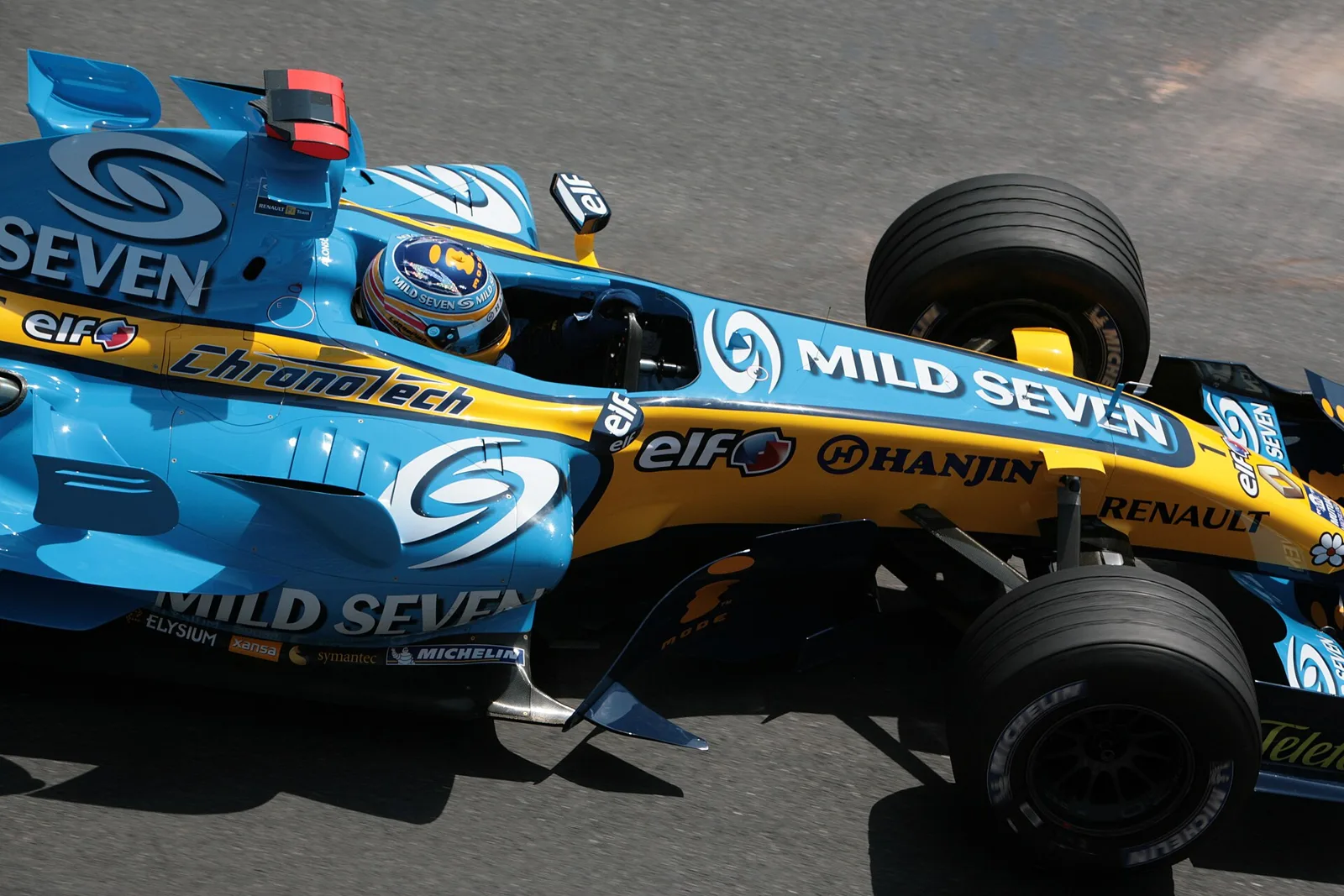
Michael Schumacher was sent to the back for stopping at La Rascasse, and Fernando Alonso converted the promoted pole into a win that owed much to the safety car periods.
Fernando Alonso won the 2006 Monaco Grand Prix for Renault, his first victory at the Monte Carlo circuit. Michael Schumacher had been sent to the back of the grid for stopping on the final qualifying lap, and he recovered to finish fifth despite a difficult circuit.
The 2006 Monaco Grand Prix was the seventh round of the Formula One season, held at the Circuit de Monaco on 28 May 2006 over 78 laps. Fernando Alonso converted his promoted pole position into a first Monaco win, Juan Pablo Montoya took second, and David Coulthard gave Red Bull Racing its first podium. Much of the attention, though, went to Michael Schumacher's stop at La Rascasse during qualifying.
What was at stake for Alonso and Schumacher?
Alonso arrived in Monaco in strong form, having finished on the podium in each of the six previous Grands Prix and won three of them. Schumacher was chasing a sixth Monaco win, which would have equalled Ayrton Senna's record for the most victories around the streets of the Principality. Both men therefore had a clear reason to fight hard for a result that weekend.
A qualifying stop, a back-row start and a long climb through the field made Monaco 2006 a race people still argue about.
What did the pre-race testing reveal?
Teams used the break between the Spanish and Monaco rounds for testing. At Paul Ricard, Alonso was fastest on the first day, less than a tenth ahead of Felipe Massa's Ferrari. Toyota tested its new TF106B, with Jarno Trulli third, and Heikki Kovalainen was fourth in the second Renault ahead of both McLarens of Raikkonen and Montoya.
Alonso topped the second day as well, with Kovalainen second in the other Renault. Jacques Villeneuve, in his BMW Sauber, was third and later on the third day beat the nearest Renault by more than four tenths. Toyota were fastest on day four, with Olivier Panis at the top of the timesheets.
Honda and Williams went elsewhere, to a circuit near Vallelunga where a new chicane had been built to mimic Monaco's character. Honda's Anthony Davidson led the first day, with Alexander Wurz's Williams about four tenths behind. Honda kept the upper hand for most of the week, with Jenson Button, Davidson and Mark Webber among the leaders, and Williams were left alone on the final day.
Which teams could run a third car on Friday?
The bottom six teams in the 2005 Constructors' Championship, together with Super Aguri, were allowed to run a third car in Friday's free practice. Those drivers took part on Friday only and did not compete in qualifying or the race.
How did the practice sessions go?
Alonso showed his intent in the opening session, setting the fastest lap at 1:16.712, a tenth quicker than Davidson, who recorded a personal best of 1:16.872. Giancarlo Fisichella was third at 1:16.88, which underlined how close the top of the order was. A marker stick knocked into the Swimming Pool caused an early red flag, and Davidson later ran wide at Ste Devote and damaged his front wing and left-front wheel.
Wurz was fastest in the second session, one tenth faster than Mondini and two tenths quicker than Juan Pablo Montoya in third. Wurz was pleased with the way the track was developing, comparing it to the Nurburgring. On Saturday morning Alonso was quickest again, with Schumacher second, two tenths slower, and Fisichella, Coulthard, Nico Rosberg and Montoya behind.
How did qualifying unfold?
Qualifying took place in warm and sunny conditions. Liuzzi was the first driver to set a time, but Felipe Massa lost control of his Ferrari at Casino Square before the others had completed their runs, which brought out a red flag. Massa started from the back, and the session restarted at 1:10pm local time with Schumacher able to set a time and advance.
The first segment eliminated Christijan Albers, Tiago Monteiro, Takuma Sato, Franck Montagny, Scott Speed and Massa, with Schumacher fastest at the end of it. In the second segment Raikkonen and Alonso battled for the top spot, while Ralf Schumacher, Klien, Liuzzi, Button, Villeneuve and Heidfeld were knocked out. David Coulthard, in his Red Bull, surprised many by reaching the final segment.
What happened at La Rascasse?
Schumacher stopped his car against the barriers at La Rascasse late in the final segment, as Alonso was on a flying lap and more than two tenths quicker at the second sector. Schumacher said he had locked the front and run wide. The paddock largely saw it as deliberate, and the matter went to the race stewards, who agreed and sent him to the back of the grid.
It was the first time two Ferrari cars had started a race from the back row together. Ferrari's managing director, Jean Todt, said he was disgusted by the decision. Steward Joaquin Verdegay said the counter-steering was unnecessary and lasted only five metres, and that the car had been travelling at 16 km/h (9.9 mph) when control was lost. Keke Rosberg, a former driver, called it the cheapest and dirtiest thing he had seen in Formula One.
Why was Fisichella penalised?
Fisichella was also punished in qualifying. He was judged to have impeded David Coulthard on a flying lap, and the stewards removed his three fastest times. He dropped behind Montoya, Barrichello, Trulli, Coulthard and Rosberg, and started the race from ninth.
How did the race open?
Alonso led into the first corner from pole, with Webber second and the McLarens of Raikkonen and Montoya behind. Nearly all 22 cars got through the first corner unscathed. Monteiro was an exception, losing his front wing after a minor collision with his team-mate Albers. By the end of lap one Schumacher had already passed Takuma Sato, having started from the pit lane, and Alonso led Webber by eight tenths of a second.
Webber ran wide at St Devote and Raikkonen went past him at Casino Square on lap two. Webber then set the fastest lap of the race in pursuit, and by lap four Raikkonen had Alonso in his sights. Pressure built at the front as the leaders reeled in the backmarkers.
How did the midfield battle develop?
Schumacher spent the early laps in 16th behind the Honda of Jenson Button, and it was not until lap 21 that he got past Button at the chicane. Albers was given a stop-and-go penalty on lap 18 for an avoidable collision with his team-mate, and he took the penalty a lap later. By lap 14 the leaders had caught the backmarkers, including the two Super Aguris and Monteiro's Midland.
When did the pit stops happen?
The first round of stops began earlier than expected, with most teams trying to come out just ahead of Alonso. Monteiro was the first driver to make a scheduled stop, on lap 21. Raikkonen followed on lap 22, and Alonso pitted two laps later, leaving Webber in the lead.
Webber made a fast in-lap and then pitted from the lead, but he did not emerge ahead of Raikkonen and kept his position. Schumacher came in for his first stop after reaching 13th on lap 34, and his stop of 9.1 seconds took him through to the flag on one fuel load. Barrichello made his only stop on lap 46, having been off the pace for most of the race.
How did Webber and Raikkonen both lose their races?
Webber's Williams suffered an exhaust failure on his 48th lap, with smoke appearing at the back of the car before it burst into flames at the exit of the pit lane. The safety car came out so marshals could move his car, and the field pitted a lap later for fresh tyres and fuel. Raikkonen's race ended after two laps under the safety car.
A heat shield that had caught fire earlier in practice caught fire again and burned through the car's wiring, cutting power to the engine. Raikkonen coasted to a halt at the exit of the Portier turn and retired, and he then went back to his private yacht while the race continued.
How did the restart change the order?
When the safety car returned to the pits, Alonso led the restart from the front, with Montoya behind him and Barrichello third. Coulthard and Schumacher were in the points too. By lap 57 Alonso had built a lead of more than 15 seconds over Montoya, and the battle behind him was tightening.
Klien retired on the following lap, which promoted Coulthard to fifth and Schumacher to sixth. Villeneuve took a drive-through on lap 59 for overtaking under safety car conditions. Schumacher closed on Coulthard at about five seconds a lap, although the Scot was more than 35 seconds ahead of him at that stage.
Barrichello was then handed a drive-through for speeding in the pit lane on lap 63, which promoted Trulli to third and Coulthard to fourth. Barrichello recovered to fifth. A hydraulic failure stopped Trulli on lap 72 on the climb up to the Casino, moving Coulthard into third, which would be Red Bull's first podium.
Who finished where?
Schumacher chased his old Ferrari team-mate Barrichello over the closing laps, but he could not pass the Honda and finished fifth. Fisichella took sixth in the sister Renault, Heidfeld was seventh, and Ralf Schumacher took the final point in eighth. The table below shows the top eight.
| Position | Driver | Note |
|---|---|---|
| First | Fernando Alonso | Pole after Schumacher's grid penalty, first Monaco win |
| Second | Juan Pablo Montoya | McLaren, his final podium finish |
| Third | David Coulthard | Red Bull's first podium, after Trulli's hydraulic failure |
| Fourth | Rubens Barrichello | Honda, drive-through on lap 63 for speeding in the pit lane |
| Fifth | Michael Schumacher | Ferrari, started from the pit lane after his penalty |
| Sixth | Giancarlo Fisichella | Renault, started ninth after his qualifying penalty |
| Seventh | Nick Heidfeld | Finished seventh on the road |
| Eighth | Ralf Schumacher | Toyota, took the final point |
Did Schumacher's qualifying stop still matter in the race?
Yes. Schumacher had to start from the back after his stop, and he began the race from the pit lane. He worked his way through the field to finish fifth on a circuit where overtaking is notoriously difficult, and he passed at least 11 cars on the way, which is why many observers consider it one of his strongest drives.
His critics tied the qualifying stop to earlier controversies, including his 1994 Australian Grand Prix and the 1997 European Grand Prix, so the stop served as ammunition for them. Schumacher never accepted that he had parked the car on purpose to block Alonso.
What did the podium look like?
Coulthard celebrated Red Bull's first podium in a Superman cape, because the team was promoting the film Superman Returns at the event. No champagne was sprayed because of the death of Edouard Michelin on the Friday, a sombre touch that marked the weekend. Coulthard's podium was also his first since the 2003 Japanese Grand Prix.
What did the result mean for Montoya and Villeneuve?
Montoya's second place was the last podium of his career, and this race was also the last Monaco Grand Prix for both Montoya and Villeneuve. For Alonso it was the first Monaco win of his career, following six consecutive podium finishes. Schumacher did not return to Monaco until the 2010 season.