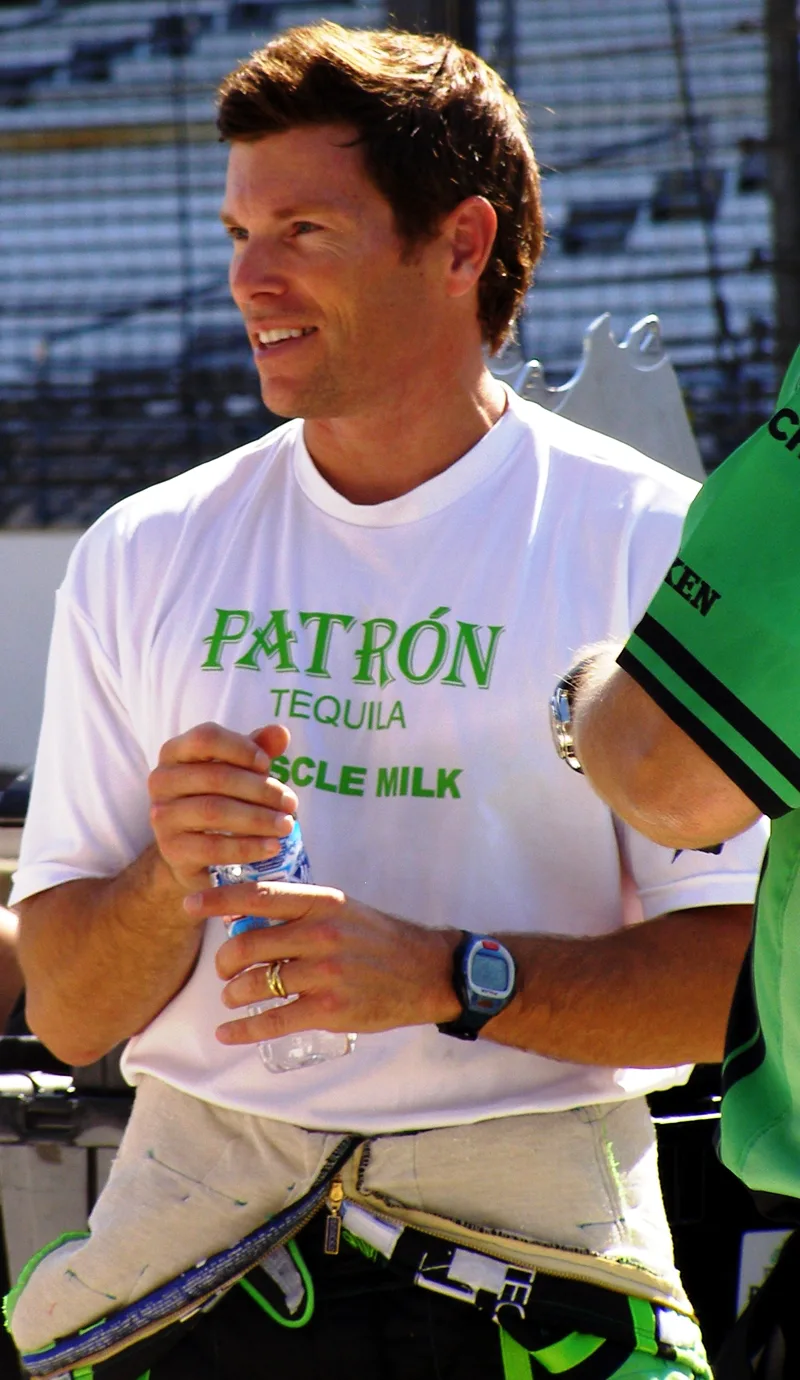
Sam Hornish Jr. started from the front row and won the first round of the 2001 Indy Racing Northern Light Series, beating Eliseo Salazar by 1.3786 seconds at Phoenix.
Sam Hornish Jr. crossed the line 1.3786 seconds clear of Eliseo Salazar to win the 2001 opener at Avondale. He had started from the front row, and at 21 he was the youngest man to win in the series.
The 2001 Pennzoil Copper World Indy 200 opened the Indy Racing Northern Light Series season on 18 March 2001 at Phoenix International Raceway in Avondale, Arizona. Sam Hornish Jr. drove a Panther Racing car to victory and became the youngest winner in the series' history. It was the first of 13 scheduled open-wheel races that year, and the first win of Hornish Jr.'s career.
What was the Pennzoil Copper World Indy 200?
The race was run over 200 laps, a distance of 320 km (200 miles), on a four-turn paved oval of 1.6 km (1 mile). The circuit has 11 degrees of banking in its first two turns and 9 degrees in the last two. It was the fifty-sixth American open-wheel race held at the track since 1964.
The Indy Racing League had organised a Test of the West at the track before the race, giving teams a chance to sort out their cars on the same surface. The sessions ran in February and were open to every entrant, which meant the field arrived at Avondale with a clear idea of its pace.
A front-row starter with no series wins to his name took the opener and became its youngest winner.
Who tested well before the race?
The Test of the West took place on 9 and 10 February. Stephan Gregoire was the fastest driver on the first day at 284.545 km/h (176.808 mph), and Greg Ray set the best speed on the second day at 281.484 km/h (174.906 mph). Both figures came from sessions that passed without an accident.
Twelve drivers took part on the first day and fourteen on the second. Each session started at 9:00 AM Mountain Standard Time and finished at 5:00 PM, so teams had the whole day to collect data on set-ups and tyres.
The entry for the race totalled twenty-seven cars, drawn from two chassis makers and two engine makers. Among them were Gil de Ferran and Helio Castroneves of Team Penske, who were regulars in the rival CART series and used the race as preparation for the Indianapolis 500.
Defending champion Buddy Lazier aimed to win the opener by focusing on his late-race speed. At Galles Racing, Al Unser Jr. had two rookies alongside him in Casey Mears and Didier Andre, and he forecast a successful season. Hornish Jr. was making his debut for Panther Racing, while Eddie Cheever was relying on a new Infiniti Indy 35A engine.
How did practice and qualifying set the grid?
The Sunday warm-up was led by Lazier, who posted 275.022 km/h (170.891 mph) ahead of Gregoire, Sharp, Hornish Jr. and Salazar. Wattles had a spin at the first corner eleven minutes in, but escaped unhurt.
Greg Ray won the pole with a time of 20.2631 seconds, his tenth career pole and his third in a row at Phoenix. Hornish Jr. qualified second, just under a tenth of a second slower, so the two drivers shared the front row.
Practice produced its own leaders. Hornish Jr. was fastest in the first session at 20.7551 seconds, Stan Wattles led the second at 20.9074 seconds, and Ray posted the quickest time of the third at 20.3917 seconds. Hornish Jr. then spun on the blend line in turn two, which caused a five-minute stoppage without damage to his car.
Jeff Ward started third in his first race for Heritage Motorsports, and Stephan Gregoire took fourth, the best qualifying result of his career. Positions five to ten went to de Ferran, Lazier, Billy Boat, Robbie Buhl, Felipe Giaffone and Scott Sharp.
Strong winds during qualifying held Cheever to 12th, while Eliseo Salazar and Stan Wattles, who started 13th and 14th, found too much downforce on their cars. Buzz Calkins had oversteer on his run, and Mark Dismore lifted off the throttle in turns three and four, which dropped him to 15th.
Boat, Robby McGehee and Sarah Fisher failed the pre-qualifying inspection and were limited to one timed lap each. Castroneves started 17th, and the closing spots were filled by Schroeder, Erwin, Hattori and Hamilton, alongside Fisher, Carlson, Dare, Mears, Unser Jr. and Andre.
How did the race unfold?
ABC covered the race live from 2:00 PM MST, with Bob Jenkins, Larry Rice and Jason Priestley in the commentary booth. Air temperature at the start was 25 C (77 F), and the track was 47 C (117 F).
Hornish Jr. took the lead at the start, and the first caution came on lap 20 after Erwin spun in turn two. Pit stops under green began on the 62nd lap, and from then on the race became as much a contest of strategy as of speed.
Ray passed Hornish Jr. for the lead on lap 68, but Hornish Jr. made a quick stop for tyres and fuel. Ray pitted six laps later and gave the lead to de Ferran. On the 77th lap, Jeret Schroeder hit the rear of de Ferran's car as it slowed for the pits, and the pair ended up in the turn-four wall and took Dismore with them, which brought out the second caution.
Castroneves and Sharp took the top two spots and made their stops on lap 82. That let Ray resume at the front when the field went back to green on lap 90, with Gregoire second and Castroneves third.
Lazier moved past his teammate Wattles for sixth place on the 102nd lap, and Hornish Jr. climbed back to fourth by lap 115. Gregoire took the lead from Ray in turn one after the two had raced side by side, and Ray's engine began to smoke soon afterwards. He pulled into the pits and retired, which brought out the third caution to clean up the oil.
All of the leaders, including Gregoire, chose to pit under that caution. Hornish Jr. came out ahead after a quick stop and took the lead for the restart on lap 131. A fourth caution followed when Lazier struggled to change gears, and Gregoire, slowing to avoid him, was hit from behind by Robbie Buhl and spun into the wall. Cheever also retired with a blown engine during the same caution.
Hornish Jr. resumed at the front on lap 138, with Castroneves and Lazier behind him. Salazar got by Lazier into third on lap 140 and moved into second a lap later when Castroneves's engine failed. Fisher's car caught fire on the 148th lap, and she parked it at the exit of the pit lane without bringing out a caution.
Salazar closed to within 0.1 seconds of Hornish Jr. by lap 150, but Hornish Jr. then pulled away and opened a 2.4-second gap two laps later. Wattles lost control at the exit of turn two on the 159th lap and hit the inside backstretch wall so hard that it cracked open, bringing out the fifth caution.
When the green came back out on the 167th lap, Hornish Jr. led Salazar and Sharp. Lazier got by Sharp into third, yet on lap 170 he reported that his car had jammed in fourth gear. Hornish Jr. held the lead for the final 33 laps to take the win.
The leader changed seven times between six drivers, with five yellow flags along the way. Hornish Jr. led 140 laps in total, more than any other competitor in the race.
Why was Hornish Jr.'s win significant?
Hornish Jr. became the youngest winner in the Indy Racing Northern Light Series, aged 21 years, eight months and 16 days. That made him the second-youngest winner in American open-wheel history, a mark that Marco Andretti later broke in 2006.
He crossed the line 1.3786 seconds ahead of Salazar and earned $124,300 for the victory. Hornish Jr. said that the car had been good enough to be driven anywhere on the track, and he gave his team the credit for that.
It was also Panther Racing's first race with Hornish Jr. at the wheel, and it ended in victory.
How did the other drivers and teams react?
Salazar joked that he had finished in every position except second, and that second was good enough for him. He added that passing was hard, because the cars were so closely matched, a view shared by several other drivers at the front of the field.
Lazier was pleased to finish third even though his gearbox problem had hurt his chances. He described the podium as a strong start to the defence of his title, and he felt the team had been blessed by the day.
Roger Penske said the team had learned a lot and needed to improve reliability. Castroneves and de Ferran both said they were looking forward to the Indianapolis 500 despite their poor finishes. Schroeder said he believed de Ferran was defending his position when they collided.
Paul Diatlovich, owner of PDM Racing, defended Schroeder. He said Schroeder had moved up 10 positions and had been on course for a top-10 finish. Ray was disappointed to retire, saying his car had been handling well and that the fuel pressure had fallen before his block cracked.
What were the final results and standings?
Hornish Jr. won, Salazar was second and Lazier third. Sharp finished fourth and Boat fifth, with Giaffone, Ward, McGehee, Calkins and Dare completing the top ten.
| Position | Driver | Detail |
|---|---|---|
| 1 | Sam Hornish Jr. | Winner, 140 laps led |
| 2 | Eliseo Salazar | 1.3786 seconds behind the winner |
| 3 | Buddy Lazier | Finished despite a gearbox stuck in fourth |
| 4 | Scott Sharp | Fourth place |
| 5 | Billy Boat | Fifth place |
After the race Hornish Jr. topped the points table on 52, a dozen ahead of Salazar and seventeen clear of Lazier in third. Sharp had 32 points in fourth, and Boat had 30 in fifth. In the Manufacturers' Championship, Oldsmobile had 11 points, four more than Nissan.
What did the result mean for the season ahead?
Because this was the first round, the win put Hornish Jr. at the head of the standings from the outset. Salazar sat twelve points back and Lazier seventeen points back, and Oldsmobile held a four-point edge over Nissan in the manufacturers' table.
Roger Penske said the team needed to lift its reliability before the next round, and both Penske drivers were looking ahead to Indianapolis.
The victory also gave Oldsmobile the early lead in the manufacturers' table, a position it held when the points were tallied after the race, four points ahead of Nissan.