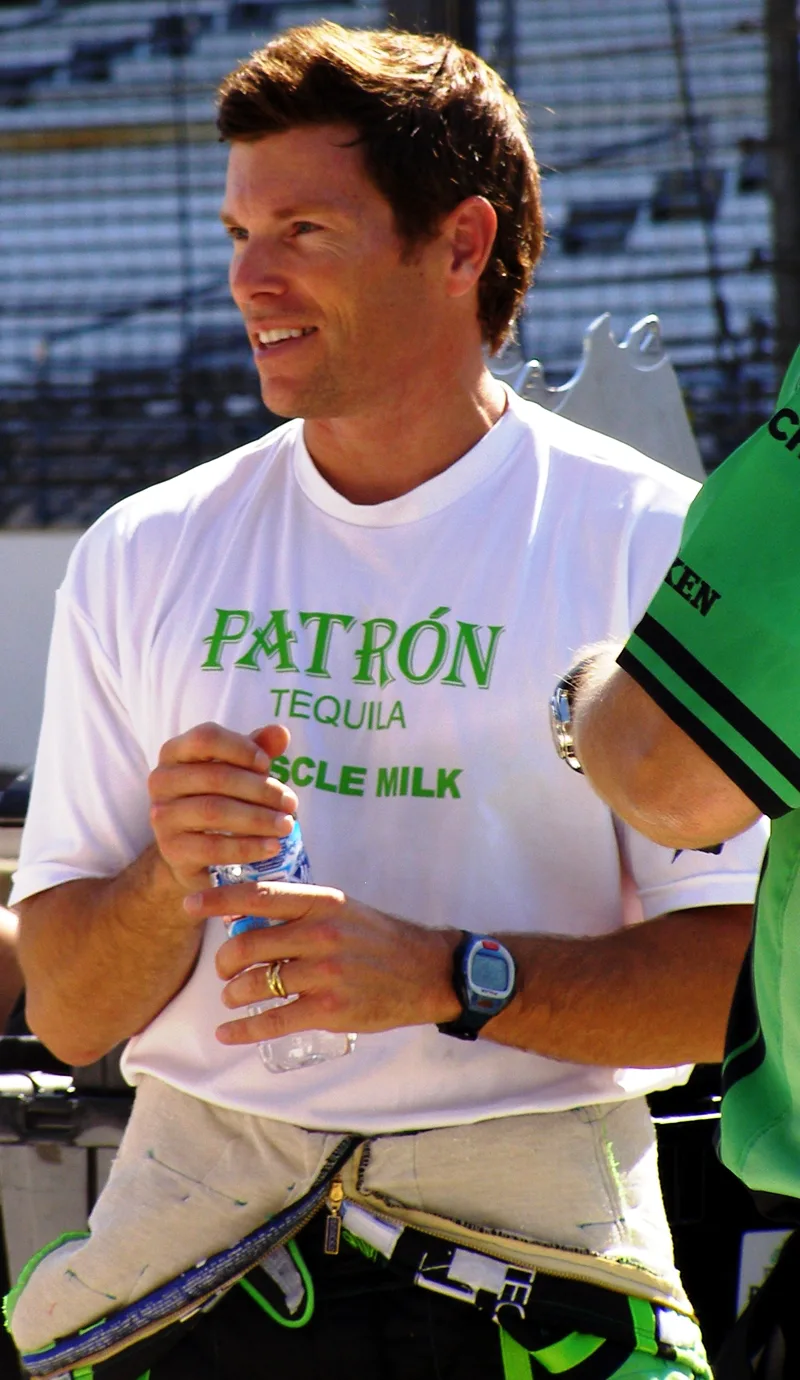
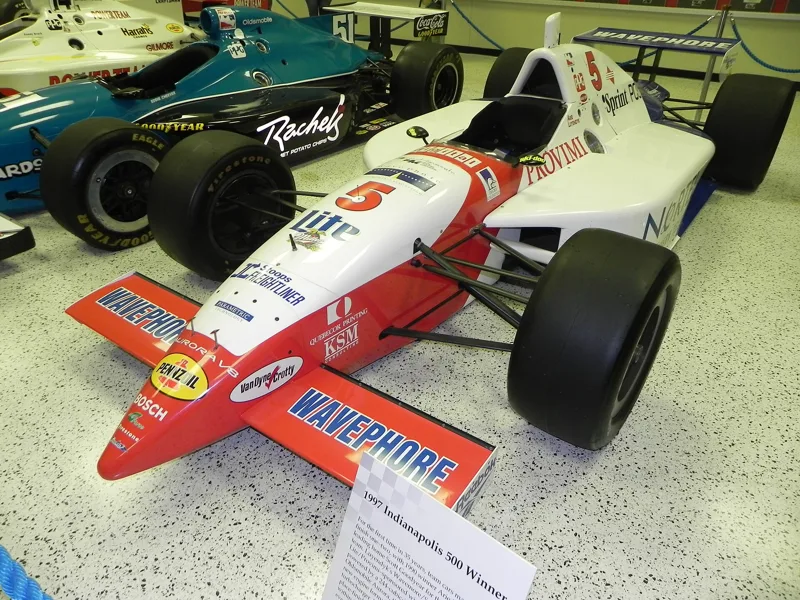
Richie Hearn won the first race at the new Las Vegas Motor Speedway after nine cautions, a red flag and a fatal support-race crash.
Richie Hearn won the 1996 Las Vegas 500K on 15 September 1996, the first race at the new Las Vegas Motor Speedway. Michel Jourdain Jr. was second and Mike Groff third in the 300-mile contest, which ran under nine cautions and a red flag.
The second round of the 1996-1997 Indy Racing League season was also the first race ever held at the new Las Vegas Motor Speedway. Richie Hearn won after a race full of crashes, nine cautions and a red flag. The average speed of 115.171 mph made it the slowest Indy car superspeedway race in decades.
When and where was the 1996 Las Vegas 500K held?
The race was held on 15 September 1996 at the Las Vegas Motor Speedway in Clark County, Nevada. It was the inaugural event at the 2.414 km (1.5 mi) oval, and it was the fifth and last IRL race of 1996. It was also the last race run under the frozen 1995 IndyCar regulations before a new chassis and engine formula arrived for 1997.
The race was a 300-mile event, which tied the record for non-500-mile Indy car oval races. It matched the 300-mile contests held at Trenton between 1969 and 1972, as well as the 1966 Atlanta 300. The event was a historic one for the speedway, even though parts of its amenities were still being finished.
A brand-new oval, a fast Lola pole and a race that barely moved faster than walking pace.
Who was in the field before the race?
The Indy Racing League christened the new track less than a month after its season opener at New Hampshire. The entry list was released on 4 September with 26 drivers, but race week brought more entries, taking the total to 29, a new high for a non-Indianapolis 500 IRL race.
Robby Gordon was the marquee name of the weekend. He was running his final race for Walker Racing before a move to NASCAR in 1997, and his entry drew the attention of the media. Other drivers were making their way back after missing the previous round, including Johnny Parsons and Michel Jourdain Jr., who returned to their regular rides.
Several rookies and substitutes had to pass the USAC rookie test first. Dave Steele, who had failed his test at New Hampshire, and Juan Carlos Carbonell were among them, and Carbonell passed his test at Phoenix on 25 August. Affonso Giaffone, the Brazilian rookie who had finished third in the 1995 Indy Lights season, was also entered by Team Scandia.
How did the track look in practice and qualifying?
The track was even dirtier than it had been during June testing when practice opened. Buddy Lazier led Friday morning practice at 221.766 mph, ahead of Richie Hearn and Eliseo Salazar. Arie Luyendyk then posted a lap of 229.768 mph, almost 5 mph clear of Mark Dismore.
Luyendyk remained the pacesetter on Saturday morning with a lap of 226.757 mph, which was 2 mph faster than anyone else. Roberto Guerrero crashed in Turn 2 an hour into that session while testing Pagan's backup car, and Dave Steele crashed between the opening turns and wrote off his Lola T92. ABF Motorsports had to withdraw because it had no back-up car.
In qualifying, Scott Sharp was the first driver over 220 mph, with a lap of 222.322 mph, before Mike Groff and then Robby Gordon edged him. Tony Stewart, who had struggled with mechanical problems on Friday, found enough speed to take the provisional pole at 224.225 mph.
Luyendyk then went quicker than anyone else. He was the only driver to break the 24-second barrier, with two laps at 226 mph or better, and he scored his third career pole at 226.491 mph. Stewart took the front row alongside him, with Gordon and Lazier making up the second row, and Hamilton and Groff qualified fifth and sixth, both career-best results.
Among the newcomers, Giaffone qualified 23rd, while Carbonell was last at 181.208 mph, six seconds off Luyendyk's time. Michele Alboreto was restricted to 18th by pop-off valve issues. Eddie Cheever's engine failed just before the green flag, which left him 27th.
The weekend was marked by tragedy. During a Shelby Pro Series support race, a 49-year-old former Las Vegas police officer, Rod Mathis, was badly hurt when he crashed at Turn 4. He was airlifted to hospital and died there at 10:49 p.m., making him the first fatality at the track.
How did the race start?
An estimated sixty-seven thousand spectators came to the unfinished speedway, despite long traffic jams that continued throughout the race. Windy conditions blew sand onto the outside line of the track. Luyendyk kept the lead at the start, while Stewart and Gordon battled for second through Turn 3.
Hamilton was out almost immediately with electrical problems. John Paul Jr. took advantage of drivers checking up and jumped from 12th to 6th before passing Groff for fifth. Gordon began to close on Luyendyk, but lapped cars allowed Stewart to retake second on Lap 8.
Johnny Parsons' engine failed on the lap after Stewart retook second, and he spun on his own oil and crashed in Turn 4. It was the last start of his Indy car career, which had begun all the way back in 1969. A long cleanup followed before the green flag came out on Lap 19, and Stewart's crew had not been aware of the restart, which cost him three places.
Eddie Cheever, running 18th, was struck from behind by Brad Murphey, a lap down in 26th place. Both drivers hit the wall, and Stephan Gregoire crashed into the wreckage. Murphey had to be cut from his car and airlifted to hospital with a broken thighbone, pelvis and hip. He recovered, but he never raced in the IRL again.
What happened in the middle of the race?
John Paul Jr. pitted from third during a caution, and Stewart followed a few laps later as a precaution after removing a punctured tyre. On Lap 55 Tyce Carlson collided with the lapped Carbonell in Turn 2, and he came to rest on the sandy surface beside the backstraight. Most of the front runners made their first stops on the ensuing caution.
On Lap 78 Stewart's car snapped sideways in Turn 2 and crashed. He broke his left collarbone and suffered ligament damage in his neck, and he was taken to hospital by ambulance. During a caution, Gordon retook the lead from Luyendyk and Richie Hearn, but then Hearn passed Luyendyk on Lap 93 and Gordon on Lap 100 with near-identical moves in Turn 4.
John Paul Jr. suffered a wheel bearing failure and retired from seventh place. Luyendyk then crashed in Turn 1 on Lap 107 after another wheel bearing failure. Stan Wattles punctured on Lap 125 and crashed in Turn 4. He was not hurt, but he lost consciousness and had to be extricated slowly from his car.
Mark Dismore was the best driver outside the lead lap when he crashed on Lap 151, and he was taken out on a stretcher with fractures to his pelvis and left hip socket. Gordon suffered his fourth wheel bearing failure of the day shortly after and retired. Johnny O'Connell had been promoted to third, but he crashed in Turn 4 with 15 laps left, and his car went upside down. Red flags were shown, and O'Connell climbed out before the medical car arrived.
How did Hearn win the race?
After a 20-minute stoppage, the race restarted for its final 15 laps. Only two cars were on the lead lap, so Michel Jourdain Jr. was the only driver in a position to challenge for the win. Hearn had a strong restart, maintained a small gap, and held on to the finish.
Hearn's win was the only Indy car victory of his career, and it was also his last podium finish. For Jourdain, the second-place finish was the only Indy car podium of his until the 2001 Michigan 500, and his best finish until the 2003 St. Petersburg race. Both drivers had raced in selected CART events that season, using the IRL as a stepping stone to full-time racing in 1997.
Who finished where at Las Vegas?
Hearn won, with Jourdain second. Mike Groff took third and the championship lead, while Roberto Guerrero overcame his handling problems to finish fourth. Michele Alboreto was fifth and Buzz Calkins sixth, and Affonso Giaffone managed to finish in the top ten in his first IRL race.
| Finish | Driver | Note |
|---|---|---|
| Winner | Richie Hearn | His only Indy car win, and his last podium |
| Second | Michel Jourdain Jr. | His lone Indy car podium until 2001 |
| Third | Mike Groff | Took the championship lead with the result |
| Fourth | Roberto Guerrero | Recovered from handling problems |
| Fifth | Michele Alboreto | Started 18th after pop-off valve problems |
| Sixth | Buzz Calkins | Finished every IRL race outside the Indy 500 in the top six, like Groff |
| Top ten | Affonso Giaffone | First top-ten finish in an IRL race |
| Retired | Johnny O'Connell | Crashed in Turn 4 with 15 laps left |
| Retired | Robby Gordon | Fourth wheel bearing failure of the day |
| Black flag | Juan Carlos Carbonell | Black-flagged on Lap 147 for spraying oil, 35 laps down |
What did the race mean for the series?
The race averaged 115.171 mph, making it the slowest Indy car superspeedway race since the 1946 Indianapolis 500, which was completed at an average of 114.820 mph on much slower qualifying speeds. No major series had run slower at the Las Vegas oval until the 2018 NASCAR Cup race.
The race counted ten lead changes among five drivers. The crashes, the cleanup and the long stoppages meant it became a test of patience for the crews, the broadcasters and the spectators alike.
How was the race broadcast?
ABC carried the race live in the United States, as the exclusive television partner of the IRL for its five races in 1996. Paul Page called the action alongside former champions Danny Sullivan and Bobby Unser, the latter in his final regular analyst role for ABC.
The slow, caution-filled pace used up ABC's broadcast window on the East Coast with about 68 laps to go, and the race could not be moved to ESPN because of scheduling. The West Coast version was tape-delayed and was edited heavily, and for many years the footage that followed was assumed lost before IndyCar uploaded its official version in December 2024.