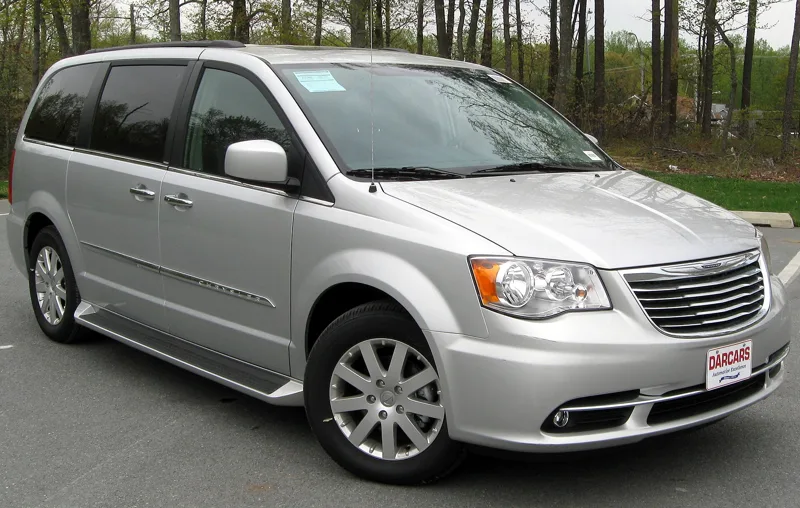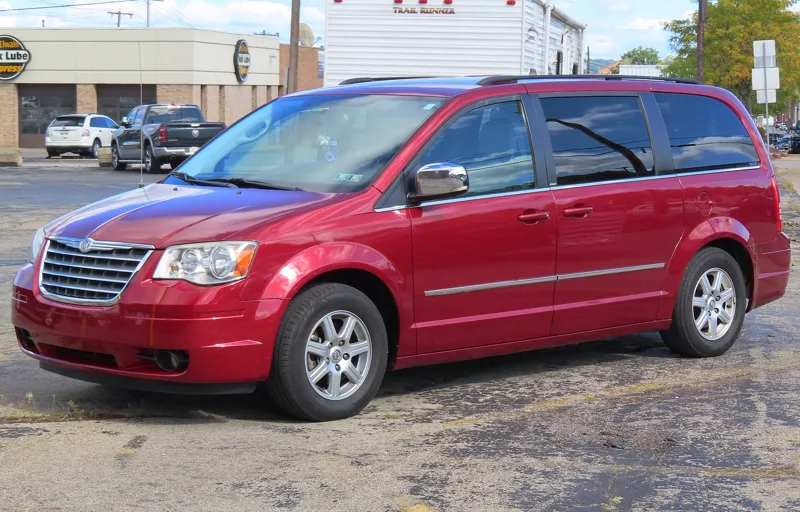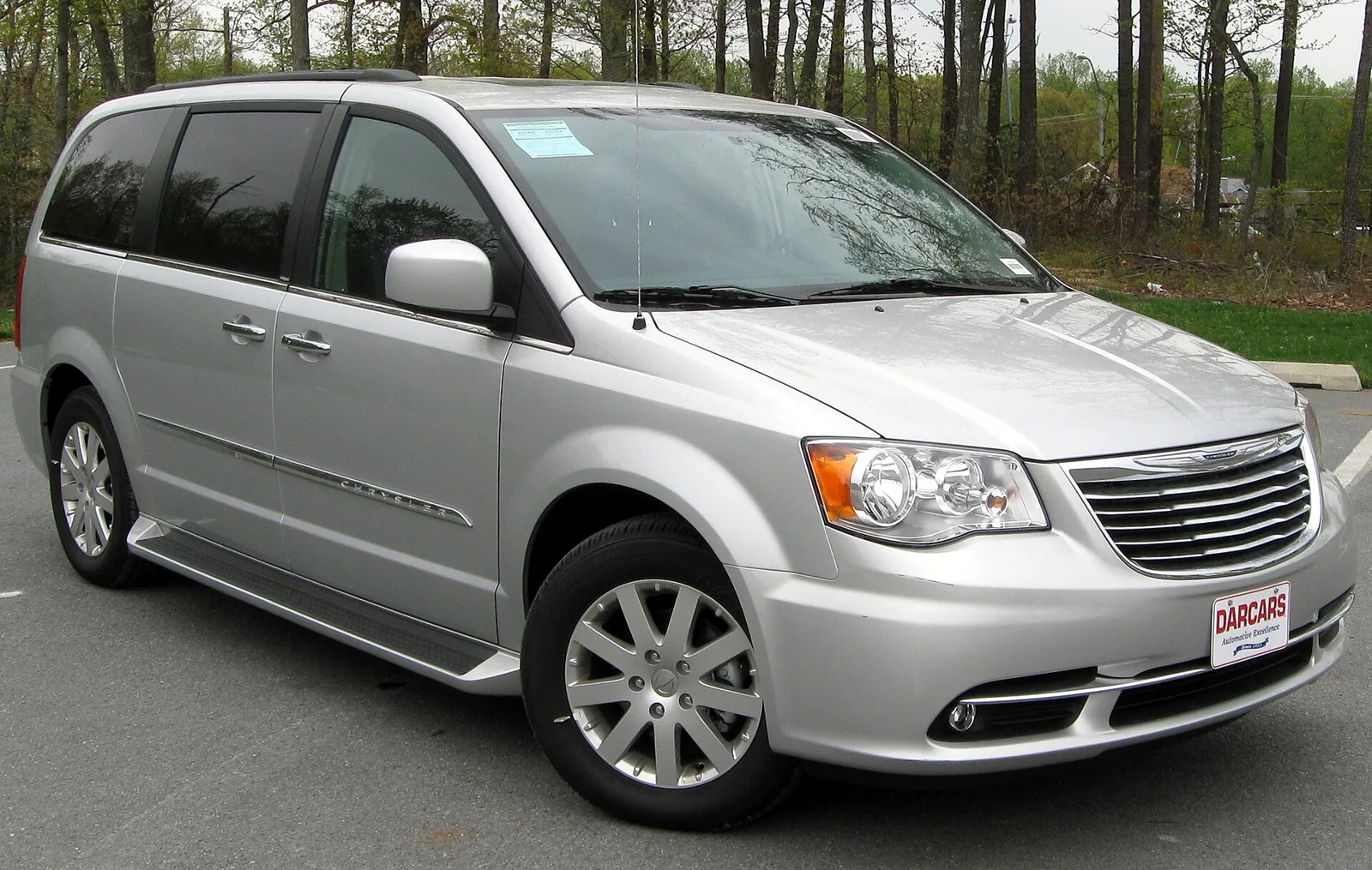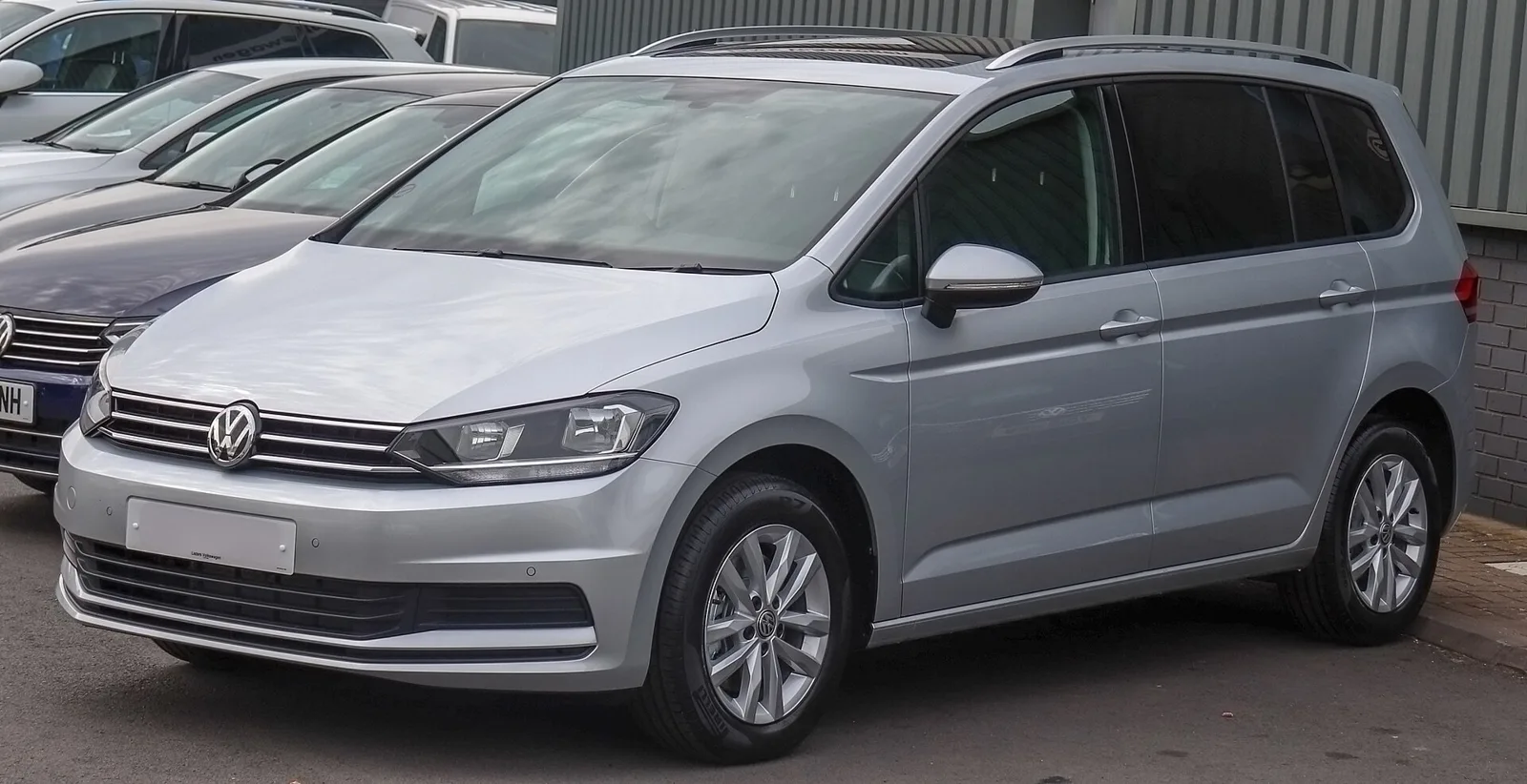
A compact MPV on Golf underpinnings that ran at Wolfsburg until April 2026, a taller Golf for five, and a Chrysler minivan wearing a Volkswagen badge.
The Touran is a compact seven-seat Volkswagen people carrier on Golf underpinnings, the Golf Plus was a raised-roof Golf for five sold from 2004 to 2014, and the Routan was a Chrysler-built minivan sold in North America as a Volkswagen from 2009 to 2014.
The Touran and the Routan sound like cousins. They are not related at all. One is a compact seven-seater built on Golf underpinnings in Germany, the other is a Chrysler minivan built in Canada and sold with a Volkswagen badge, and between them, with the Golf Plus, they show three very different ways a carmaker can answer the same family's needs.
What were the Volkswagen Touran, Golf Plus and Routan?
The Touran is a compact people carrier, an MPV in industry shorthand, that Volkswagen built from 2003 for Europe and a handful of other markets, with the second generation ending at Wolfsburg in April 2026. The Golf Plus was a taller five-seat alternative to the Golf hatchback, built from 2004 to 2014. The Routan was a seven-seat minivan sold in North America for the 2009 to 2014 model years.
Volkswagen positioned the Golf Plus below the Touran, and the Touran between the Golf and the larger Sharan, whose production ended in 2022. The Routan sat apart from that European ladder entirely.
Between them, three Volkswagens showed three different answers to what a family needs from a car.
How did the Volkswagen Touran start out?
Volkswagen announced the Touran in August 2002, started production that December and began sales in 2003. Here was Volkswagen's first MPV on a Golf platform, PQ35 rather than PQ34, and it joined a range that already held the Sharan and the Caravelle bus. Its name joins "Tour", meaning to travel, with the ending of Sharan.
The first car can be thought of as an extended Golf Plus. Its rear overhang is 200 mm (7.87 in) longer, which is what made room for a third row and a seven-seat layout. Later, the second-generation Touran is about 13 cm longer than the first and stands in the same relation to the Golf Sportsvan.
What was new under the skin?
The Touran brought electro-mechanical steering, which no rival in its class had and Volkswagen had never fitted. Rather than a hydraulic pump running all the time, an electric motor assists the driver, and it varies the weight of the steering with road speed. Because it draws almost no energy when the car idles, it also improves efficiency.
It also gave the 2.0 TDI engine its debut. Launch engines were a 1.6 FSI petrol and two diesels: a 1.9 TDI with 74 kW (101 PS; 99 hp) and a 2.0 TDI with 103 kW (140 PS; 138 hp). All met Euro 4 rules except the 1.9 TDI paired with the DSG dual-clutch gearbox. A six-speed manual was standard.
Did the Touran earn a good safety rating?
The first Euro NCAP test in 2003 gave four stars for adult protection. Volkswagen then added an intelligent reminder prompting the driver and front passenger to fasten their belts, from November 2003, and the retest scored one extra point, which lifted the rating to five stars. The Touran carried a five-star Euro NCAP rating from then on, and What Car? named it Compact Van of the Year in 2005.
How did the Touran change over time?
The 2006 facelift, shown at the Paris Motor Show in October, brought new headlights trimmed in chrome, a fresh grille and a wider lower intake, while the taillights kept their outline. The cabin took up to seven, though the third row suited children best. Both rear rows folded flat, but none of the seats could be removed.
Curtain airbags covered the first two rows, with standard front and side airbags and Isofix mounts in the second row. Compressed natural gas versions were offered in certain countries.
Park Assist arrived with the 2007 model year, the first production system of its kind in the Volkswagen Group. Below 30 km/h, sensors look for a gap 0.8 metres longer than the car. The driver stops just ahead of the space, lets go of the wheel and keeps working gears and pedals as the display instructs, while the system steers.
The August 2010 update brought Golf VI looks, adaptive suspension called DCC, Light-Assist for xenon headlights, a Park Assist that could also handle perpendicular spaces, and better aerodynamics. Downsized engines followed: a 1.2 with 77 kW (105 PS; 103 hp) plus a new 1.6 TDI at 66 kW (90 PS; 89 hp) or 77 kW (105 PS; 103 hp), some with BlueMotion economy tuning. In 2012 the 125 kW (170 PS) engine gave way to a 130 kW (177 PS; 174 hp) unit.
On fuel, diesel Tourans can return more than 60 mpg-imp (4.7 L/100 km; 50 mpg-US) in the right conditions.
What is the CrossTouran?
Volkswagen released the CrossTouran at the Bologna Motor Show in December 2006, the third Cross vehicle from Volkswagen Individual GmbH. It is distinguished by 17-inch alloy wheels, plastic guards that imitate a crossover and a suspension 15 mm (0.59 in) higher, an option that was also open to standard Tourans in Europe. All its engines met EU4 rules, from a 1.6 MPI petrol with 75 kW to a 2.0 TSI with 125 kW and diesels up to a 2.0 TDI with 125 kW.
Was there a hydrogen or hybrid Touran?
Yes, both as development projects. The Touran Hy Motion is a hydrogen concept with a nickel-metal hydride battery producing 80 kW (107 hp). It reaches 100 km/h in 14 seconds and tops out at 140 km/h (87.0 mph). In 2008 Shanghai-Volkswagen and Tongji University showed a Touran Hybrid ahead of the Beijing Olympic Games, with a 20 kW (27 hp) electric motor beside a 110 kW (148 hp) petrol engine.
What changed with the second-generation Touran?
The second generation appeared at the 2015 Geneva Motor Show on the Volkswagen Group MQB platform. Volkswagen offered more cabin space, an array of driver-assistance systems and infotainment with Apple CarPlay and Android Auto as an option. Four new engines used 19% less fuel, according to the company. Visually the car looks like a Golf Sportsvan with a longer rear section.
The last second-generation Touran left the Wolfsburg line at the end of April 2026, 11 years after production began.
How does the Touran work as a taxi in China?
In Shanghai the Touran has been the successor to the Volkswagen Santana in the taxi fleet since October 2018. Qiangsheng, one of the city's largest taxi firms, said the Touran offered more passenger comfort than the car it replaced, and 100 new electric cabs joined the fleet.
The Chinese Touran L keeps the European wheelbase and comes in 280TSI and 330TSI trims, with a 1.4-litre TSI on the first and a 1.8-litre TSI on the second. In 2016 prices ran from 155,800 to 230,800 yuan across seven trims, or 23,850 to 35,330 USD at the January 2021 exchange rate. Six- and seven-seat layouts were added from the 2018 model year, and a Cross Touran L followed that year with plastic wheel arches and a body 23mm higher.
What was the Volkswagen Golf Plus?
Volkswagen presented the Golf Plus at the Bologna Motor Show in December 2004 as a taller Golf built on the Golf Mk5 and the PQ35 platform. It is 95 mm (3.74 in) taller than the Mk5 and 150 mm (5.91 in) shorter than the Touran, which has three rows. The seating position is higher and boot space grows by 50 litres to 395 litres.
Drop the boot floor and the space expands to 505 litres. The rear seats slide by 160 mm, split 60:40 and fold into an almost level load bay, and the middle seat doubles as a fold-down drink table. A large roof console was optional.
Many parts came straight from the Golf Mk5, including engines, transmissions, headrests and exterior mirrors. One difference was standard LED rear lights, the first in the C-segment. The drag coefficient is 0.32.
How did the Golf Plus age?
A facelift revealed in December 2008 brought the horizontal grille band and new headlights with daytime running lights, matching the Golf Mk6, and reached showrooms in early 2009. It added ParkAssist and an optional rear-view camera hidden behind the Volkswagen badge. In 2014 the MQB-based Golf Sportsvan replaced it.
What was the CrossGolf?
Launched at the 2006 Paris Motor Show, the CrossGolf is a Golf Plus with black plastic cladding and a slightly higher ride. It joined the Cross family with the CrossPolo and CrossTouran and came from Volkswagen Individual, which also made the Golf R32. It was front-wheel drive only, with 1.6 and 1.4 TSI petrol engines and 1.9 and 2.0 TDI diesels from 102 PS (75 kW; 101 bhp) to 140 PS (103 kW; 138 bhp). In the UK it was called the Golf Plus Dune and used the 1.9 TDI at 105 PS (77 kW; 104 bhp). A facelifted version arrived at the Geneva Motor Show in February 2010.
What engines did the Golf Plus offer?
Across its life the Golf Plus offered seven petrol variants from 75 to 170 PS and five diesels from 90 to 140 PS, every diesel with a particulate filter. The BlueMotion version made 105 PS with a five-speed manual, lower idle speed, an underbody cover, low-friction tyres, a ride height 15 mm lower and longer third, fourth and fifth gears, for a rated 4.8 L/100 km (21 km/L; 49 mpg-US). A BiFuel LPG model made 98 PS (97 hp; 72 kW).
How did the Volkswagen Routan come about?
The Routan grew from a partnership between Volkswagen and DaimlerChrysler that began in 2005. Volkswagen had no minivan for the United States or Canada, and by buying one in rather than designing a family-sized minivan itself, it hoped to avoid the cost. The Routan was a rebadged Chrysler RT-platform van with revised styling, content and suspension tuning, built alongside Chrysler and Dodge minivans at Windsor Assembly.
Volkswagen first showed it in Chicago in 2008, and US dealers began selling it that September as a 2009 model, with Canada and Mexico following that autumn. It was Volkswagen's first van in North America since the Eurovan was dropped in 2003, and the first step in a plan for vehicles developed for the American market.
What was the Routan like to own?
Chrysler's hard-drive audio and navigation system was sold as the Joybox, and 2010 cars offered optional Wi-Fi. The Routan did not get Stow'n Go or Swivel'n Go seating. It used an Easy Out Roller Seat system for the second row, although the underfloor recesses remain, so owners could fit Chrysler or Dodge parts.
At first buyers chose between Chrysler's 3.8 L V6 with 197 hp (147 kW) and 230 lb-ft (312 N-m) and a 4.0 L V6 with 251 hp (187 kW) and 259 lb-ft (351 N-m), both with a six-speed automatic. For 2011 a 3.6 L V6 with 283 hp (211 kW) and 260 lb-ft (353 N-m) took over.
A 2011 evaluation of Canadian models praised the van and called the Volkswagen a real bargain against a well-optioned Chrysler, with a nicer interior and sportier suspension and steering.
Why did the Routan not sell?
Volkswagen Group of America projected at least five percent of the United States minivan market, or 45,000 of 700,000 sales. In January 2009, after 29,000 vans had been shipped to dealers, it asked Chrysler Canada to pause production for February. By July 2009 only 11,677 had been sold. In Canada, 335 sold in the four months of 2008.
Autotrader.com said industry watchers would not be surprised by the decision to drop the model because few shoppers saw a reason to choose it over the Dodge Grand Caravan or Chrysler Town & Country, noting a base price of nearly $28,000 against about $21,000 for the basic Grand Caravan, with less equipment than a Town & Country.
Production stopped at Windsor, Ontario in 2012 even though the contract ran to 2014. The 2013 model year was reserved for rental companies and other fleets, and Chrysler made 2,500 in that calendar year. The same held for 2014.
Was the Routan recalled?
Volkswagen recalled 20,676 examples of the 2009 and 2010 models to replace key fobs and ignition switches. A jolt to the switch could knock the key out of its Run setting, which would shut off the engine and disable the airbags, power steering and power brakes.
The three people carriers compared
| Model | Built | Seats | Based on | Aimed at |
|---|---|---|---|---|
| Touran | 2003 to April 2026 at Wolfsburg | Five or seven | Golf platform (PQ35, then MQB) | Europe, China and select markets |
| Golf Plus | 2004 to 2014 | Five | Golf Mk5, PQ35 | Europe, below the Touran |
| Routan | 2009 to 2014 model years | Seven | Chrysler RT platform | United States, Canada and Mexico |
What replaced the Golf Plus and Routan, and when did the Touran end?
Wolfsburg built the last second-generation Touran at the end of April 2026, closing 11 years of that model's production. The Golf Sportsvan took over from the Golf Plus in 2014.
For the Routan, Volkswagen revealed the CrossBlue concept SUV at the 2013 North American International Auto Show and said it was weighing a seven-passenger production SUV as a replacement. That production SUV, the Atlas, launched in 2017 as a 2018 model.