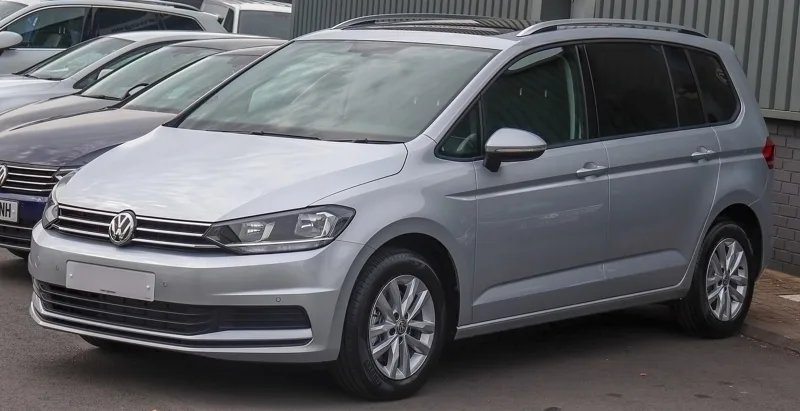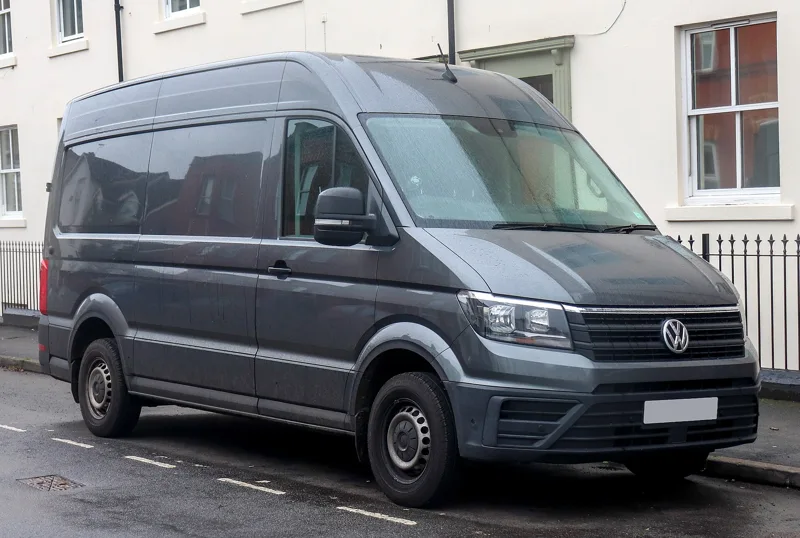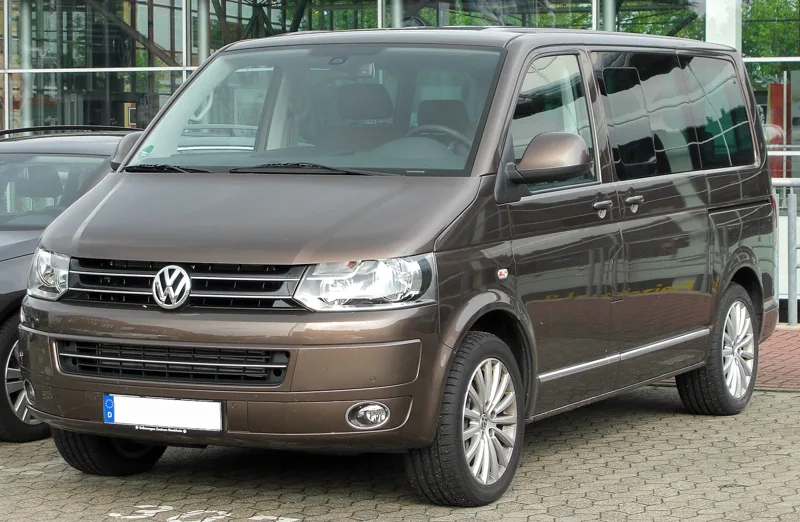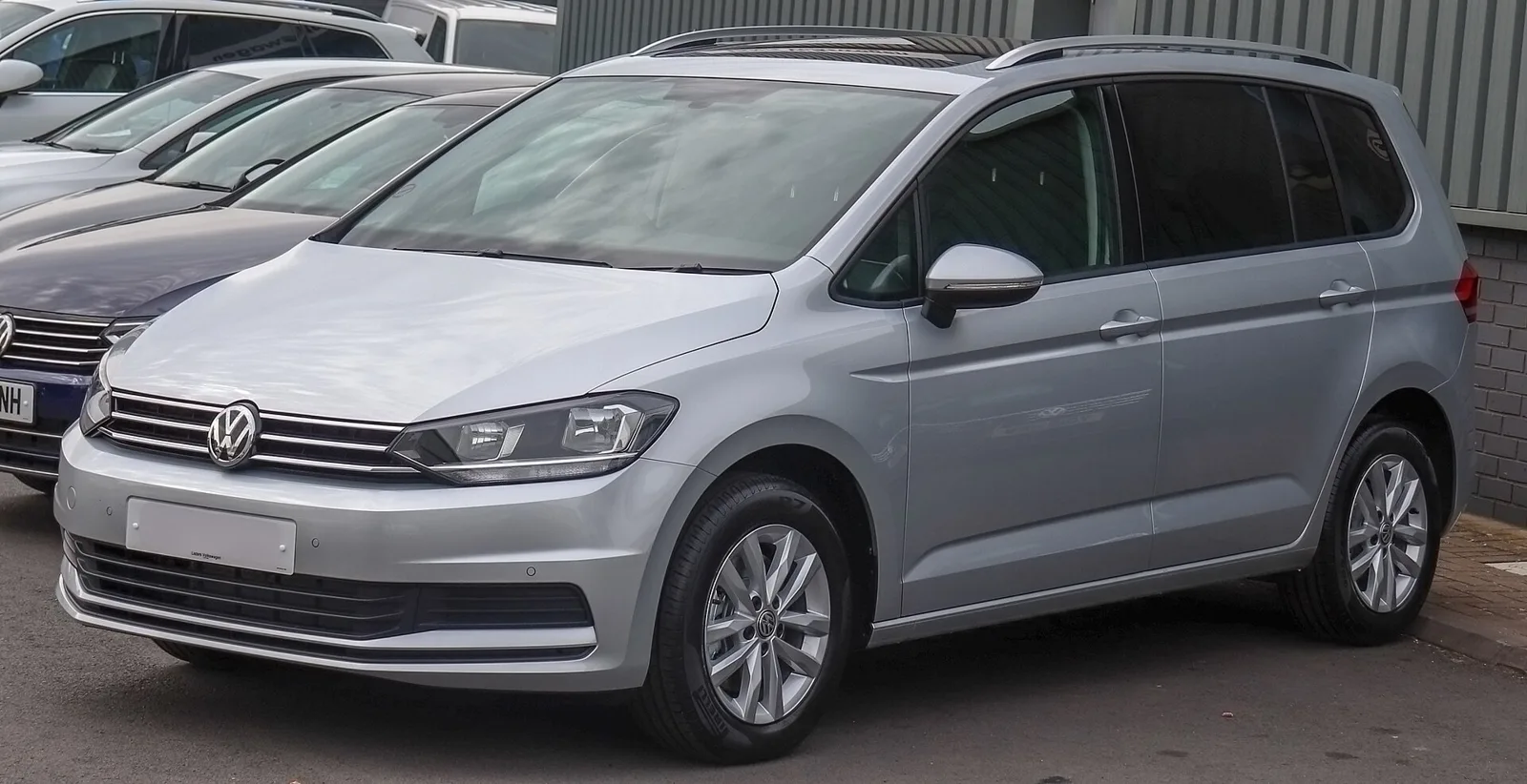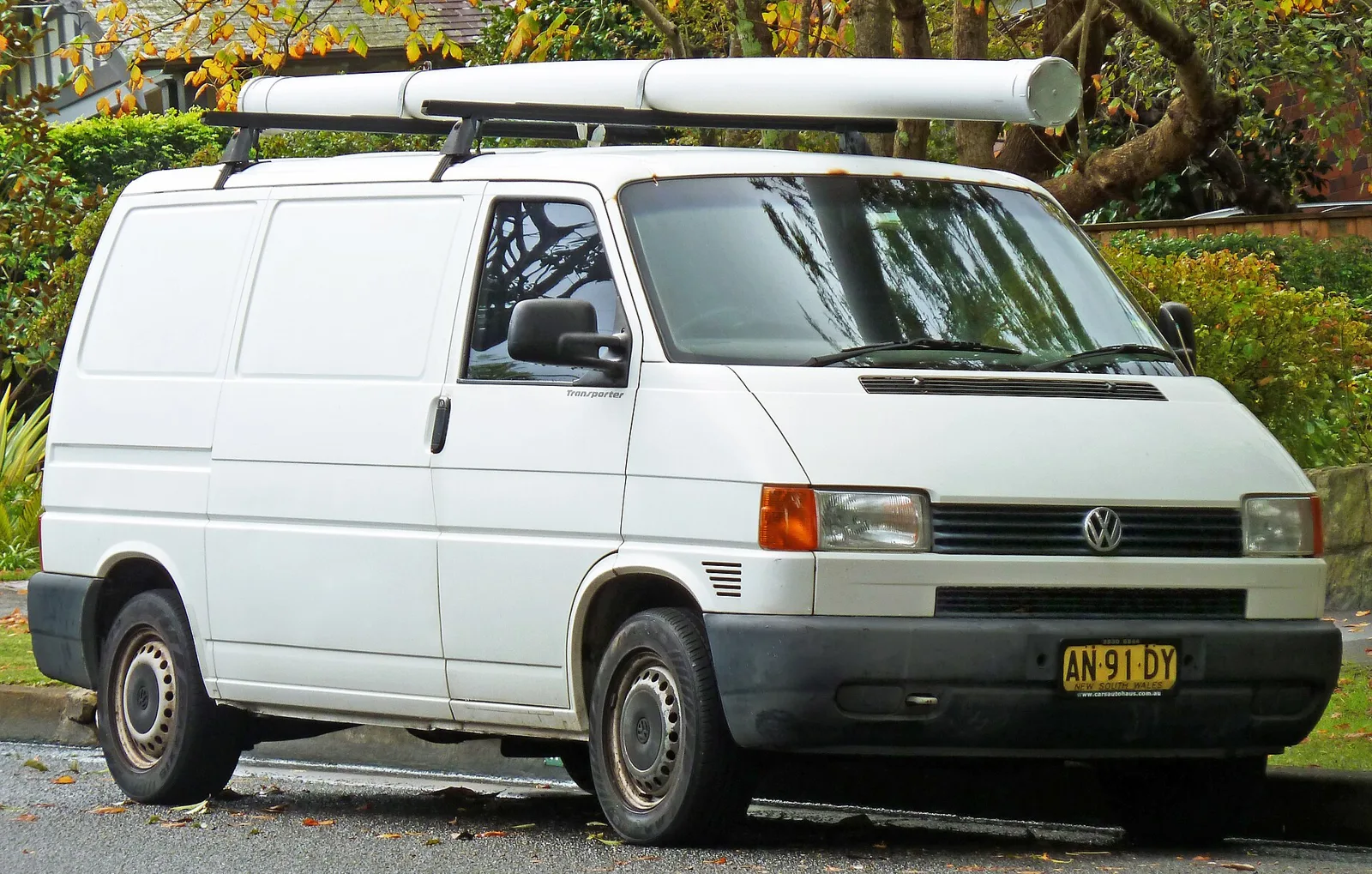
From the first front-engined Transporter in 1990 to the T6.1 and a camper that began life with Westfalia.
The Volkswagen Transporter moved to a front-mounted, water-cooled engine with the T4 in 1990, followed by the T5 from 2002 and the T6 on the same platform. The California camper, sold since 2003, was built in-house after Westfalia was sold.
Volkswagen thought about moving the engine of its van to the front in the late 1970s. In 1980 it decided to build yet another rear-engined one instead, for reasons that remain unclear, and the idea waited until 1990. That year the T4 became the first Volkswagen van with a front-mounted, water-cooled engine, and from it grew the line of Transporters and the California camper that people still buy today.
VW Transporter T4 history: the front-engined break
The T4, sold in North America as the EuroVan, was built by Volkswagen Commercial Vehicles between 1990 and 2004 as the successor to the T3 and the predecessor of the T5. Volkswagen had been prompted by the success of the same move on its passenger cars. After a run of nearly 14 years, it ranks second only to the T1 for length of production in its home market.
Versatility was the secret. The T4 came as panel van, Kombi or half-panel with two rows of seats, and as Caravelle, Multivan or EuroVan with windows all round and three rows. There were pickups too: single cab on the short chassis, a double cab (the German "Doka") on the long one, and a hydraulic-bodied Razor back built in Britain between 1998 and 2000.
Two wheelbases were standard, 2,920 mm and 3,320 mm. Panel vans had a standard roof at 1940mm or a high-top at 2430mm, and the high-top came only on the long chassis. Campervan builders often added fibreglass pop-tops to either length.
The front-engined layout waited until 1990 for the T4.
T4a and T4b: why some T4s have longer noses
There was one major facelift, in 1996, when a reshaped and longer front end arrived. The six-cylinder VR6 would not otherwise fit the engine bay. At first only Caravelles and Multivans, the models that took the VR6, got the longer nose. Commercial variants kept the short one until 2003, and campers built between 1996 and 2003 can have either. Enthusiasts call the two types T4a and T4b.
The T4 also came with permanent four-wheel drive, badged "syncro". A viscous coupling acted as the centre differential and shared torque with the rear axle. Syncro was offered with the 1.9TD, 2.5Tdi and 2.5 petrol engines, and because the rear differential occupied the usual spare-wheel position, those vans carried the spare inside the body or on a hinged external bracket.
The EuroVan in North America
Volkswagen marketed the European-built T4 as the EuroVan from 1992 to 2003, beginning with five-cylinder passenger models for the 1993 model year. It fell between sizes, too small for American delivery work yet big for a minivan, and the advertising line insisted there was nothing mini about it. Passenger EuroVans returned to the United States for 1999 with the VR6 as standard, and the manual gearbox was never offered with that engine in North America.
Winnebago Industries was the main converter of T4 campers for the US. Its EuroVan Camper, on sale from 1995, was built only on the 3,320 mm (131 in) long wheelbase and used the five-cylinder engine before moving to the VR6 for 1997 to 2003. Those small pop-top campers are unique in North America and have a cult following. Winnebago also built Class C motorhomes on the T4 cab called the Rialta, Vista and Sunstar.
VW Transporter T5 vs T6: what each one changed
The T5 was launched on 6 October 2002 and entered full production on 25 April 2003. Key markets were Germany, Britain, Taiwan, Russia, France, Turkey and Singapore. It was never sold in the United States or Canada because the T4-based EuroVan had sold poorly. Volkswagen offered the Canadian-built Routan minivan, derived from the Chrysler RT platform, in its place.
The Transporter was available in over 100 combinations, with short or long wheelbases, low, medium or high rooflines, and body styles from van to minibus, double cab to chassis truck. Payload ran from 750 kg (1,653 lb) to 1.4 tonnes, with load volumes from 5.8 to 9.3 cubic metres. People movers began with the Kombi, rose through the Shuttle and Caravelle, and peaked at the Multivan, whose six or seven seats slide on rails into any layout and accept fitted tables and refrigerators.
The T6 kept the T5's underpinnings. It sat on the T5's 7H / 7J platform, but added a new dashboard, an all-new front end, revised rear lights, with LED headlights and LED rear lights offered as options. Electric power steering and a new dashboard arrived in the mid-cycle T6.1 shown at the Geneva Motor Show in March 2019, with the fully digital Virtual Cockpit instrument cluster available as an option.
| Generation | Starting point | Notable change |
|---|---|---|
| T4 | 1990 | First front-mounted, water-cooled engine in a VW van |
| T5 | Launched 6 October 2002 | Over 100 combinations; DSG added in 2009 facelift |
| T6 | Built on the T5 platform | New dashboard and front end; electric steering in T6.1, 2019 |
The T5 facelift, the fast van and the awards
Volkswagen Commercial Vehicles relaunched the T5 in September 2009, sold under four labels: Transporter, Caravelle, Multivan and California. It brought a world-first for the segment in the Direct-Shift dual-clutch gearbox, available with 4motion four-wheel drive, plus Side Lane Assist, tyre pressure monitoring, bi-xenon headlights and a touchscreen navigation system with a reversing camera. Every engine became a 2.0 L inline-four, one petrol and four newly developed common-rail TDI diesels. Volkswagen claimed the new diesels were twenty percent more efficient than the outgoing range.
The Sportline was the top trim, with a 174 PS (128 kW; 172 bhp) diesel, 400 N m of torque at 2,000 rpm and a six-speed manual. Its suspension was lowered by 30 mm and it rode on 18-inch alloys. It appeared on Top Gear, where Jeremy Clarkson called it "the fastest van in Britain". Fifth Gear then raced it against The A-Team's GMC van and the Mercedes-Benz Vito Sport-X. It beat the GMC comfortably, and the Mercedes, despite more power, was held back by over-sensitive traction control.
The T5 collected honours: What Van? Van of the Year in 2003, International Van of the Year in 2004, a 4-star Euro NCAP crash rating in 2008 and Delivery Magazine's Medium Van of the Year in Australia in both 2005 and 2006. The 2011 Edition 25 Multivan celebrated 25 years of that badge, limited to 225 vehicles worldwide with a matte black roof and black 18-inch wheels.
VW Transporter T6.1: engines, the electric ABT and the end
At launch the T6 used engines that closely matched the T5, which were soon replaced by cleaner units, including a 110 kW (150 PS) TDI and a 150 kW (204 PS) BiTDI. All met Euro6. A 2.0 TSI petrol, new to the Transporter, joined at the end of 2017, and from 2018 the BiTDI came with 4motion four-wheel drive as standard.
Cargo models are named by payload: the T26 carries 2,600 kg (5,700 lb), the T28 2,800 kg (6,200 lb), the T30 3,000 kg (6,600 lb) and the T32 3,200 kg (7,100 lb). Trims ran Startline, Trendline and Highline. The high roof was offered only with the long wheelbase.
In 2020 Volkswagen worked with ABT e-Line on the e-Transporter 6.1, a battery-electric T6.1. Its single 83 kW (111 hp) motor drew on a 37.3 kWh battery, of which 33.6 kWh was usable, and the tested WLTP range was 132 km (82 mi). Cargo space reached 6.7 cubic metres.
The T6.1 Caravelle and Multivan gave way to the Multivan T7 in 2022. The T6.1 stayed Volkswagen's top-selling van into 2024, but European Union rules requiring certified protection against cyberattacks for new cars from 2024 led the company to end it rather than pay to redesign the electronics. The T7 sits on the MQB platform and offers hybrid powertrains, while the commercial Transporter bodies carry on using the T6 platform.
VW California camper: from Westfalia to in-house
The California is a campervan built on the mid-size Transporter panel van and sold since 2003. It was the first camper that Volkswagen Commercial Vehicles both designed and built itself. Before that Volkswagen supplied chassis exclusively to Westfalia, which built the Westfalia Camper. When DaimlerChrysler acquired Westfalia in 2001, Volkswagen decided to design and build its own range.
To keep customers on familiar ground the camper launched in 2003 as the Volkswagen Westfalia. Once Westfalia became its own company in 2005 the name changed to Westfalia California, and Volkswagen shortened it to California around 2012 or 2013, with the T5 facelift. The first VWCV camper was described as T4-based and launched in August 2003, and by 2005 buyers could order a T5-based car.
The range grew quickly. Two design studies, the California Beach and California Tramper, appeared at the Caravan Salon in Dusseldorf in 2004. The Beach reached production in 2005 as a bridge between the people carriers and the full camper, and in 2007 gained a pop-top bed.
Which T6 California to choose: Ocean, Coast or Beach
When the T6 Transporter arrived Volkswagen re-introduced the California in three equipment levels, Ocean, Coast and Beach, with the earlier Tramper becoming the Ocean. In September 2019 the T6.1 California brought a restyled front and interior and replaced the fragile concertina-style tambour doors of the Ocean and Coast with rigid ones. The biggest change was electronic steering, which gave a lighter feel and made lane assist and cross-wind assist possible.
Ocean carries an electro-hydraulic elevating aluminium roof with a bed of 200x120cm, plus a lower double of 200x116cm made from the rear seat. Coast and Beach use a manual roof on gas struts, with the same bed size. Both Coast and Ocean have a sink, a two-burner gas hob on a 2.8 kg cylinder and a 42-litre compressor fridge. The Beach uses a pull-out cooker with a single burner, and the Beach Tour seats up to seven and has no kitchen at all.
Twin 30-litre tanks hold fresh and waste water. A 250 cm awning is optional above the sliding door, a table is stored in that door and two chairs hide in the tailgate. The Coast version, introduced in 2019, was dropped across all markets in 2022.
Grand California, Caddy California and the wider family
At the 2017 International Motor Show Volkswagen showed a California XXL concept on the Crafter, 6.2 m (20 ft) long with an interior standing height of 2.2 m. The production Grand California went on sale in 2019. It comes in 600 or 680 forms, sleeps four, and has an on-board bathroom with a toilet, a sink that doubles as a shower and an outdoor shower. The downstairs bed takes two adults, while the upper one suits two children.
The Caddy California, from 2021, is the small one. It seats five, with a bed that stows behind the second row and unfurls into a double bed of 198 by 107 cm (78 by 42 in), plus a slide-out kitchenette in the boot and an optional tent for two more sleepers.
Where this goes next
The T7 Multivan was released in 2022 without a matching California. The camper has since been offered on three different vehicles under the California Universe announcement of 2023: the Multivan, the ID. Buzz and the T7 van. The California Multivan, launched in 2024, comes as a plug-in hybrid, diesel or petrol, on the long wheelbase only. An electric ID. Buzz California, also long-wheelbase only, is planned. The separate T7 Transporter van will not receive a California, because Volkswagen said it regards the California as a premium camper brand.