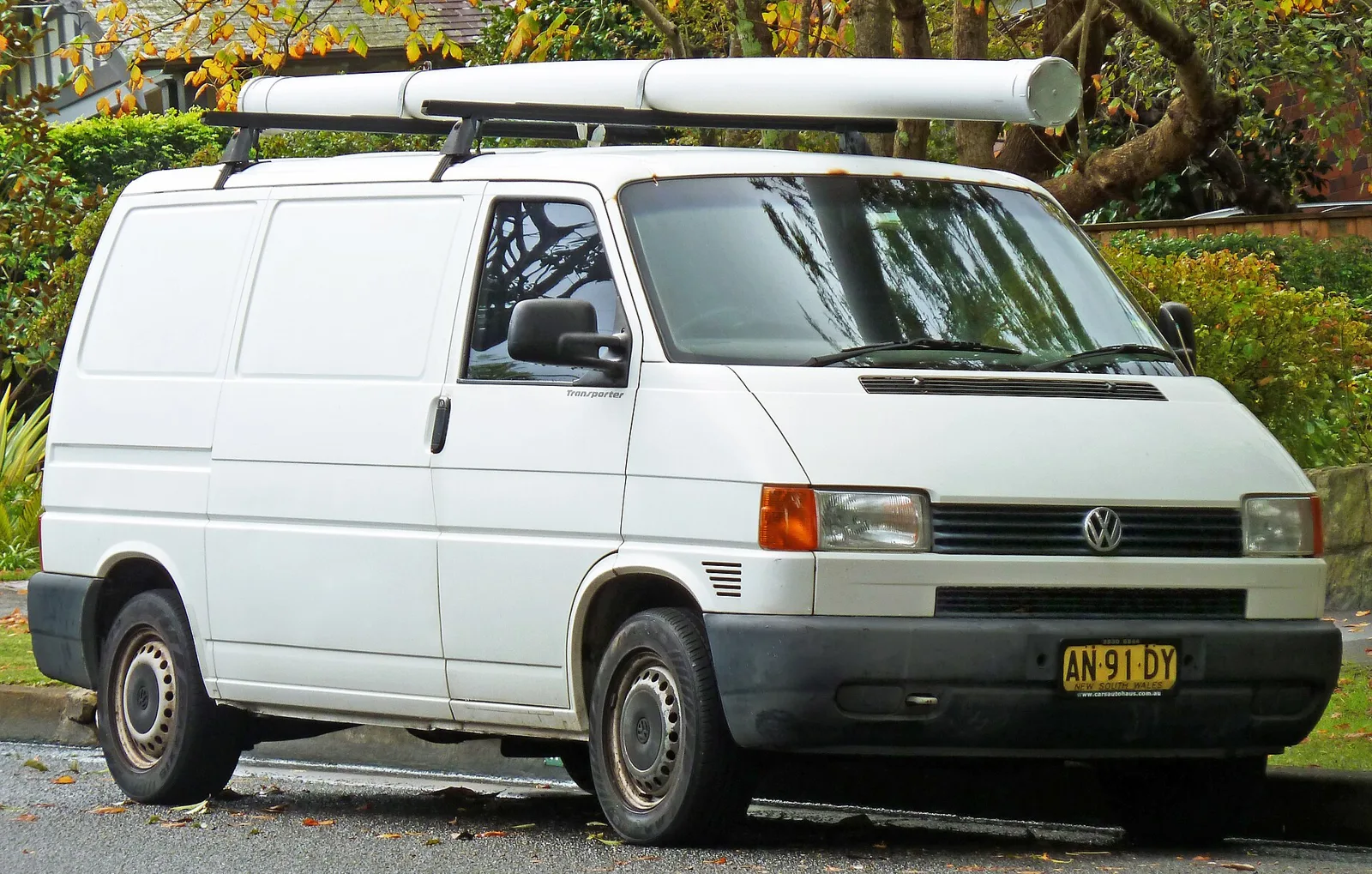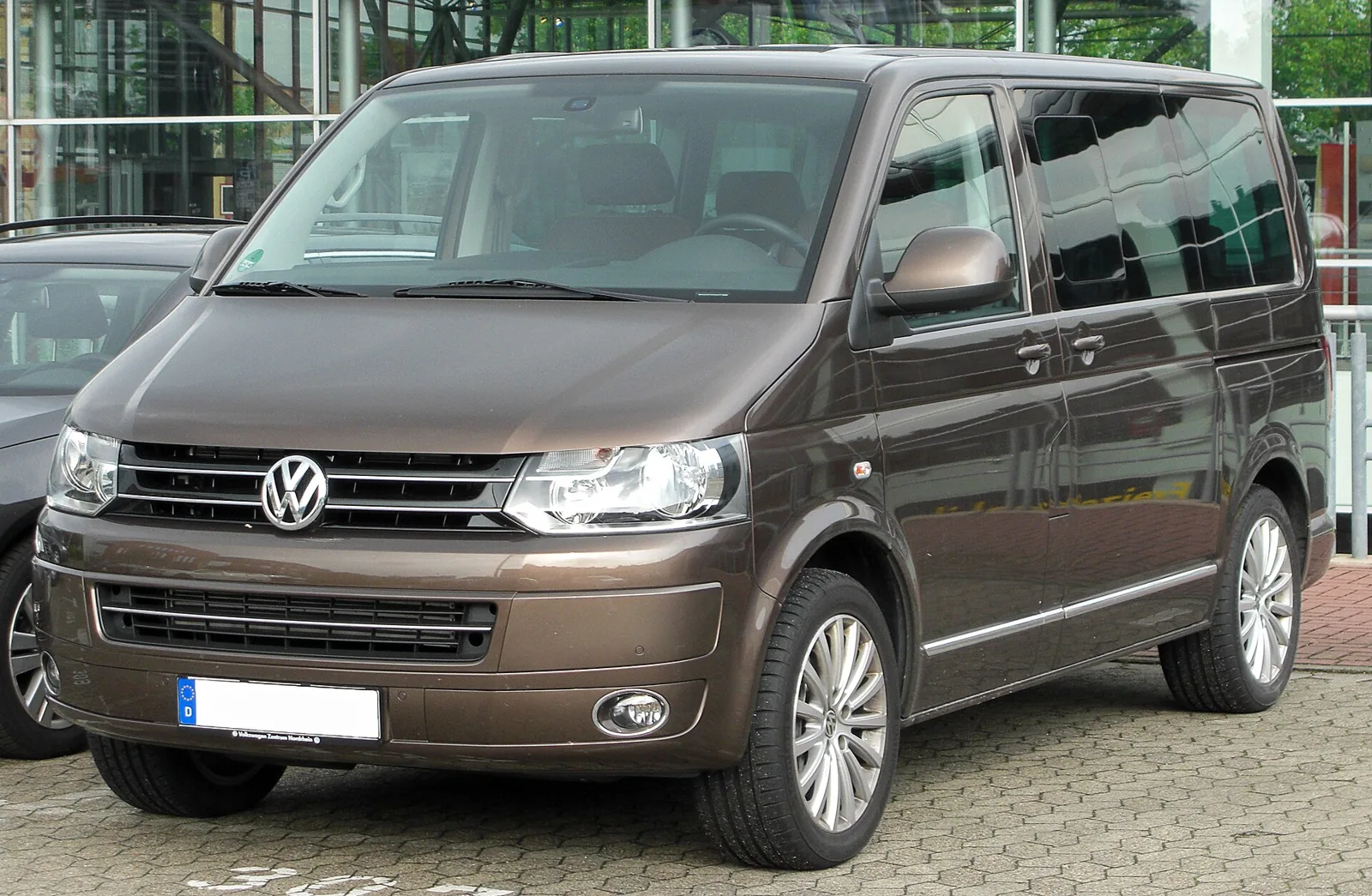
Built since 1990 as the luxury family Transporter, the Multivan gained its own platform, plug-in hybrid power and four-wheel drive in the T7 era.
The Volkswagen Multivan is the luxury family version of Volkswagen's Transporter van, built from September 1990. Across four generations it gained seating flexibility, petrol and diesel engines and, in the T7, plug-in hybrid power on a platform of its own.
Volkswagen's Multivan began in September 1990 as the plush family cousin of the Transporter T4 van. Over four generations it has moved from a van with a fold-down bed to a passenger car on its own platform, and the newest T7 model can also be bought with plug-in power and four-wheel drive.
Where did the Multivan come from?
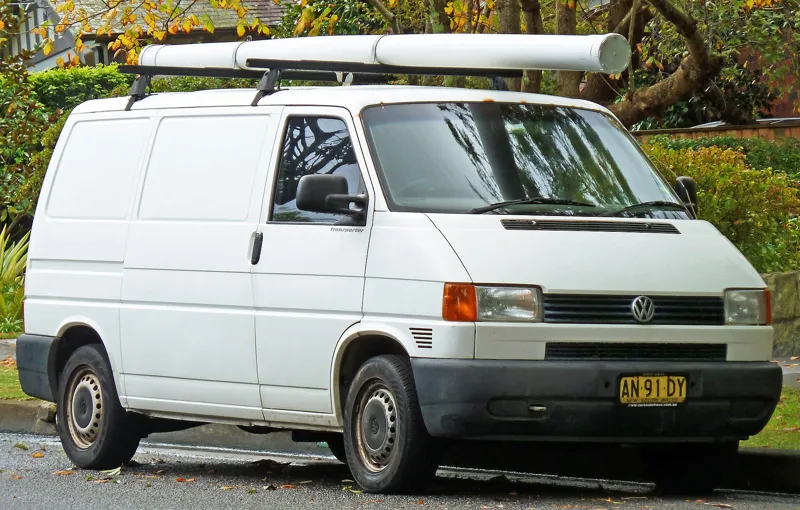
From September 1990 the Multivan was built as the luxury family variant of the T4 Transporter, and later models kept that role. It shared much of its engineering with the Transporter Kombi, but it was better equipped and more practical inside, aimed at families who also wanted a leisure vehicle.
Volkswagen developed the concept further as the Multivan Mk2 from model year 2000. That version had a sliding system for its swivelling seats, each with three-point seatbelts, and it came with a set of curtains as standard.
Turn the rear seats around, slide them forward and fold the rear bench down, and the cabin becomes a double bed. A fold-down table is built into the left side of the interior.
Dutch buyers should note that an official T4 Multivan was never sold in the Netherlands. Only from the T5 onwards did the model reach the country officially.
From a Transporter in good clothes to a passenger car with its own platform.
What did the T4 Multivan offer inside?
The standard six-seat T4 came with a fully insulated and finished interior, a hard-wearing floor in the passenger area and a rear bench with headrests that folded into a bed. Every window carried a curtain, and a sliding window, a second battery and a cool box fitted into one seat came as standard too.
The front and middle seats had armrests, and the passenger seat could turn. Until 1999 the centre seats were fixed and faced the rear. After that they could turn, which made the cabin more flexible, although the cool box built into the seat disappeared at the same time.
In 1993 Volkswagen added a richer seven-seat version, the Multivan Allstar. For its period it offered a notably high level of comfort. Power windows and mirrors, central locking and fog lamps came as standard, as did alloy wheels and a cassette stereo with speakers at both ends of the car.
The Allstar was easy to pick out. Silver-grey trim wrapped the bodywork, the upholstery came in light grey and pale pink, and few body colours were offered. A year later the Classic arrived with paint in body colour across the whole van, bumpers included, for a more timeless look.
What did the 1995 facelift change?
Volkswagen's end-of-1995 facelift lengthened the front of the Multivan, Caravelle and California by eight centimetres. That long nose made room for stronger engines and gave the passenger vans a more modern face, while Transporter commercial vehicles kept their original front until production ended.
Internally the programme was called the Grosse Produktaufwertung, or GP. The new grille followed Volkswagen's styling of the period, and the headlamps had a more dynamic shape, with white indicators.
All T4s got new wheel designs, and the rear axle now carried disc brakes. Inside, the dashboard, switches, instruments, seat upholstery and interior panels were all revised, so the T4 felt more modern and comfortable than the models before it.
One of the most important additions was a direct-injection turbodiesel: a five-cylinder unit of 2.5-litre (152.6 cu in) capacity. Its 102 PS (101 hp) gave noticeably livelier running and thriftier consumption than the older diesels, and buyers could specify a manual or an automatic gearbox.
The extended nose could also take the 2.8-litre (170.9 cu in) VR6 petrol unit, and its 140 PS (138 hp) gave the T4 a sportier character for the first time.
In 1998 a stronger 2.5 TDI arrived with 151 PS (149 hp), the most powerful diesel available in a T4 at the time. It was recognisable by a red accent in its TDI logo, standard 16-inch wheels and the longer nose. A lighter TDI with 88 PS (87 hp) came in alongside, marked by a blue accent in its type designation.
The older diesels stayed on sale. A turbo-free 2.4-litre (146.5 cu in) five-cylinder kept its following for simplicity and reliability, while the 1.9-litre (115.9 cu in) turbodiesel kept its traditional engineering.
The last big engine change came in 2000 with a new 204 PS (201 hp) VR6 that replaced the earlier unit. It shared the heavier 16-inch chassis and larger brakes of the 151 PS TDI, which made the T4 a fast and comfortable touring vehicle.
How did the T5 change the Multivan?
The T5 kept a transverse front engine and front-wheel drive, with four-wheel drive and an automatic gearbox offered on the stronger engines. The side panels were stamped from one sheet of steel, which removed the vertical join between them, and the gear lever became a short, joystick-style unit on the dashboard.
The gearbox was operated by cables. At the front, MacPherson struts and lower triangular wishbones hung from a subframe, and a stabiliser limited body roll in bends. At the rear, slanted wishbones carried compact Miniblock coil springs with separately mounted dampers.
Brakes were internally ventilated discs at both ends, paired with single-piston floating calipers. Steering used a rack and pinion with hydraulic power assistance.
The T5 was built at the Volkswagen plant in Hanover and at Poznan (Posen) in Poland. The California camper started life at Hanover-Stoecken and was then taken to Hanover-Limmer to be fitted out.
The range split into three roles. The Caravelle was the entry passenger model, the Multivan sat above it as the luxurious top version with sliding seats, and the California was the camper. The T5 was also the first Volkswagen bus generation not sent to the United States, as it had no American type approval.
What did the 2009 T5.1 update bring?
The 2009 update was the T5's visible facelift, with wider headlamps, a new grille and bumpers, and changed mirrors. Beneath the bonnet the five-cylinder diesels gave way to a new four-cylinder common-rail family whose displacement was 2.0 litres (122.0 cu in), with outputs from 62 kW (84 PS; 83 hp) to 132 kW (179 PS; 177 hp).
Some of these units ran one turbocharger and others two, the strongest being a twin-turbo set-up. Every one passed type approval to the Euro 5 emissions standard. Meanwhile the 85 kW (116 PS; 114 hp) petrol engine carried on unaltered for a while.
A TSI turbo petrol of the same 2.0-litre (122.0 cu in) size arrived in two outputs, succeeding the 3.2-litre (195.3 cu in) VR6. The seven-speed DSG dual-clutch gearbox also reached the T5 for the first time, and the Multivan could now be had with a long wheelbase.
The autumn 2006 revision had already changed the engines. The T5 became the T5.1 internally, the five-cylinder diesels changed their codes from Axx to Bxx, and a diesel particulate filter became standard. Injector, valve and exhaust manifold components were also improved.
How did the T6.1 develop?
The 2015 T6 brought a reworked front with new panels, lamps and tailgate, plus a renewed dashboard and steering wheel. The diesels moved to the new EA288 engine family, which used SCR exhaust treatment to meet Euro 6.
That SCR system injects AdBlue, a urea solution, into the exhaust to cut nitrogen oxide emissions. The T6 carried it in its own tank of 13 litres, enough for a range of about 7,000 km.
The 2019 T6.1 facelift gave the van narrower headlamps and a larger grille. Electromechanical power steering allowed driver assistance systems known from Volkswagen's cars, such as Lane Assist, Trailer Assist and Park Assist, to reach the Transporter range. The infotainment moved to the latest modular system, MIB 3.
Volkswagen also developed a fully electric version with ABT, but it was not supplied as a Multivan.
When did the T6.1 stop being built?
Orders for the T6.1 closed in March 2023. Only the California camper stayed in the range for a while, and production of the T6.1 series was definitively ended in July 2024. The T7 Multivan had been presented back in June 2021.
For a while the outgoing generation kept going beside its replacement. Transporter and Caravelle vans, plus the Multivan with the 150 kW (204 PS; 201 hp) four-wheel-drive engine, remained in build next to the new car.
The Transporter and Caravelle later got another heir: a T7 generation built on Ford's Transit Custom. It arrived in early 2025 and comes from Ford's plant in Turkey.
What is the T7 Multivan built on?
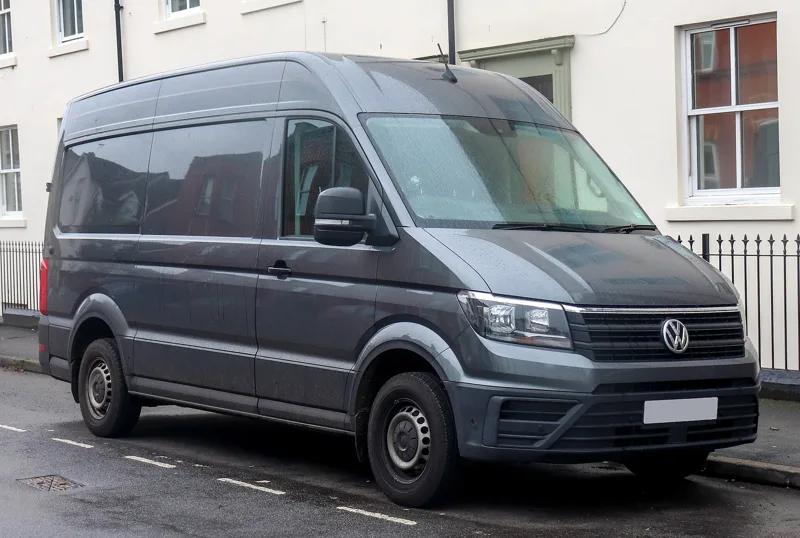
The T7 Multivan, type ST, was presented in June 2021 on the Modular Transverse Matrix platform (MQB) that also underpins several of the brand's passenger cars. Although it carried the Multivan name forward, it was a considerable break with its predecessors.
Volkswagen chose the new construction to bring the average CO2 emissions of its passenger cars down further. Several parts of the dashboard are carried over from the Golf VIII, and the T7 uses the third generation of the modular infotainment system, MIB 3.
Air resistance improves with a Cw value of 0.30, down from 0.35 on the T6.1. The body sits about five centimetres lower, and its centre of gravity is lower than before. The figures put the CO2 saving at up to 28 grams per kilometre.
Up to twenty driver assistance systems are available. The standard kit includes Front Assist, which can brake in an emergency in city traffic, plus evasive steering support with a turn-off helper, traffic sign recognition and Lane Assist. IQ.DRIVE Travel Assist allows partly automated driving up to 210 km/h (130 mph).
DSG versions use an electronic selector, the same arrangement as in the Golf VIII, so the lever no longer connects mechanically to the gearbox. The compact unit sits in the dashboard, left of the touchscreen.
Rear seats run on rails, and they can be turned to face backwards. Seat heating is an option. With a lower roof, the air-conditioning ducts, cabin lights and airbags have been relocated to the roof edges, and a large panoramic glass roof is available at extra cost.
Luggage space in the standard version reaches up to 469 litres. Take out the third-row seats and capacity rises to 1,844 litres; with every rear seat gone, the most is 3,672 litres. The longer version, twenty centimetres longer with the wheelbase unchanged, offers at least 763 litres, rising to 4,005 litres.
At the Caravan Salon in August 2023 Volkswagen showed a camper based on the T7, the new California, which was almost ready for production. The production version went on sale from May 2024.
Euro NCAP tested the T7 Multivan in spring 2022 and awarded the maximum five stars. A retest in autumn 2025 gave the model four of five stars.
How does the eHybrid 4Motion work?
Launched in November 2024, the 1.5 eHybrid 4Motion was the first T7 with four-wheel drive. The front axle is driven by a four-cylinder of 1.5 litres (91.5 cu in) rated 133 kW (181 PS; 179 hp), the six-speed DSG houses an 85 kW (116 PS; 114 hp) electric motor, and a 100 kW (136 PS; 134 hp) unit powers the rear axle.
Up to 65 km/h (40 mph) the rear motor can provide the four-wheel drive, and that still works with an empty high-voltage battery, because the front motor then generates the power. Drive can be routed wholly to either axle, as conditions require.
Combined, the system delivers 180 kW (245 PS; 242 hp) and 350 Nm (258 lb ft) of torque. The net battery holds 19.7 kWh, which gives an electric range of about 100 km. Both motors are permanent-magnet synchronous units, the battery takes 11 kW through alternating current, and CCS fast charging reaches up to 50 kW.
On battery alone the car tops out at 130 km/h (81 mph). With the whole hybrid system working, it reaches 200 km/h (124 mph). For Dutch buyers the eHybrid is the only Multivan on offer.
The earliest plug-in hybrid T7 arrived in October 2021 with the 1.4 eHybrid badge. It paired a petrol engine with electric drive, with 160 kW (218 PS; 215 hp) on tap and 350 Nm (258 lb ft) of peak torque. Its 13 kWh gross battery allowed about 50 km of fully electric driving, and the model stayed on sale until August 2023.
Key specifications
| Specification | Detail |
|---|---|
| Launch | September 1990, luxury family variant of the Transporter T4 |
| T4 engines | Five-cylinder TDI, 2.5-litre (152.6 cu in), 102 PS (101 hp); VR6, 2.8-litre (170.9 cu in), 140 PS (138 hp) |
| Late T4 engines | 2.5 TDI, 151 PS (149 hp); VR6, 204 PS (201 hp) |
| T5.1 diesels | Four-cylinder, 2.0-litre (122.0 cu in), 62 kW (84 PS; 83 hp) to 132 kW (179 PS; 177 hp) |
| T6 AdBlue tank | 13 litres, enough for about 7,000 km |
| T7 drag coefficient | Cw value 0.30, against 0.35 for the T6.1 |
| T7 luggage | 469 litres standard; 1,844 litres without third row; 3,672 litres maximum |
| 1.4 eHybrid | 160 kW (218 PS; 215 hp), 350 Nm (258 lb ft), 13 kWh battery, about 50 km electric |
| 1.5 eHybrid 4Motion | 180 kW (245 PS; 242 hp), 350 Nm (258 lb ft), 19.7 kWh net battery, about 100 km electric |
| Top speed, eHybrid 4Motion | 130 km/h (81 mph) fully electric; 200 km/h (124 mph) with full hybrid drive |
Why did the Multivan separate from the Transporter?
The Multivan and Transporter were closely related for years. The T7 changed that: it received its own technical basis and was developed far more emphatically as a passenger car, with greater focus on comfort, digitalisation and driving assistance.
The paths split in practice. The Multivan rides on MQB, while the new Transporter got a separate technical foundation, so the two no longer share underpinnings.