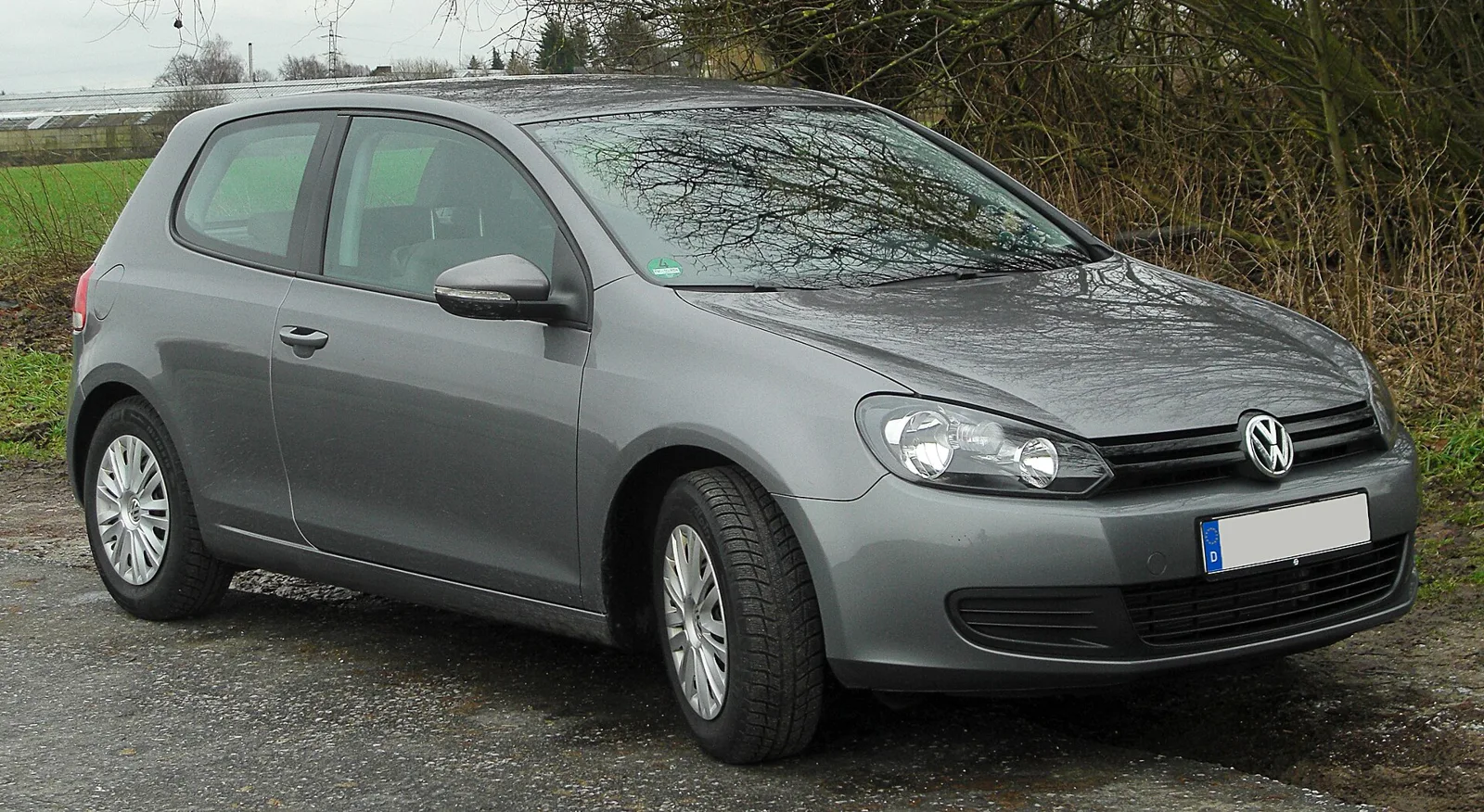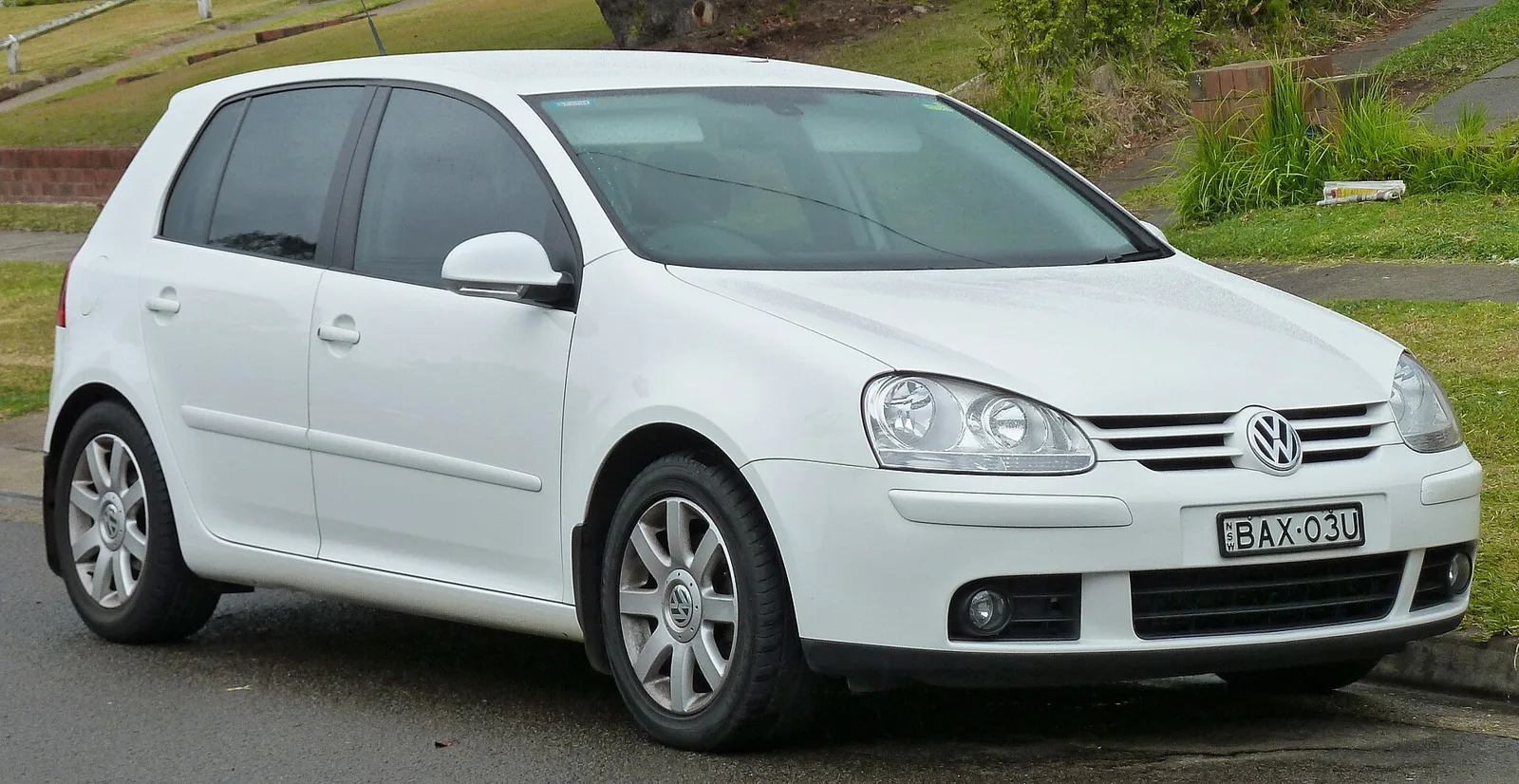
A refined Golf with more luggage room, a GTI with 200 PS and the R32 flagship, plus diesel and hybrid concepts that never reached showrooms.
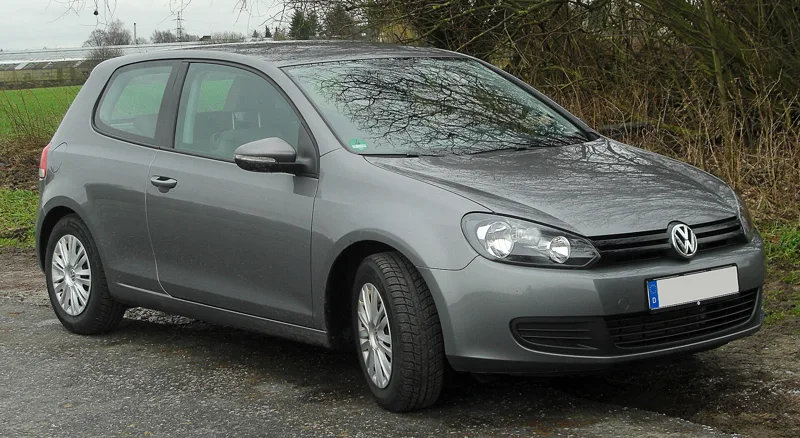
The Volkswagen Golf Mk5 was the fifth-generation Golf, shown in Frankfurt in 2003 and sold in Europe from the 2004 model year. It used the PQ35 platform, offered hatchback, estate and Jetta versions, and included the GTI and R32 performance models.
The Volkswagen Golf Mk5 is the fifth generation of Volkswagen's compact hatchback, first revealed at the Frankfurt show in October 2003. It sat on the PQ35 platform, reached European showrooms for the 2004 model year and was sold in North America as the Rabbit. Its GTI and R32 performance models kept the Golf's sporting reputation intact.
What changed compared with the Mk4?
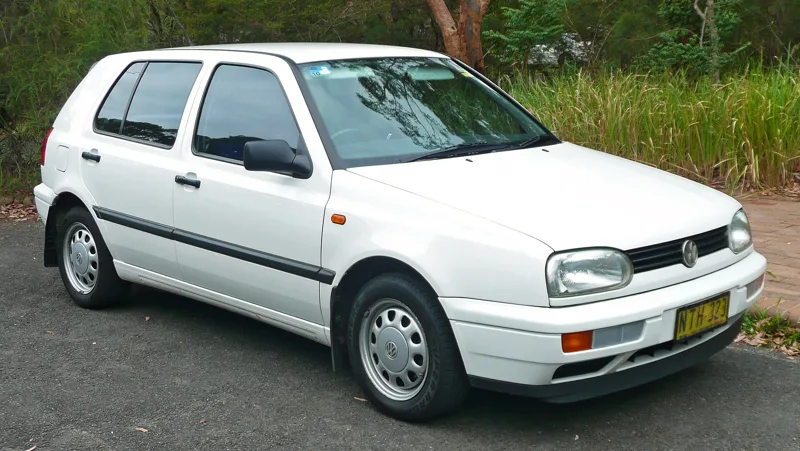
The Mk5 refined the suspension and chassis tuning and grew only slightly over the Mk4. Cargo volume rose by roughly 20 L (0.7 cu ft), and the body reached a drag coefficient of 0.32, a useful figure for a family hatchback of its day.
The changes were evolutionary. The car kept the familiar Golf outline while offering more room for luggage, so buyers who knew the Mk4 found little to relearn behind the wheel.
The successor was built on the same platform, so the Mk5 shared its underpinnings with the car that replaced it. Cargo volume and drag were the headline design numbers, while the GTI and R32 drew most of the enthusiast attention.
Refined, roomier and quicker where it counted, the Mk5 kept the Golf formula working for another generation.
How much power did the GTI make?
The original GTI used a 2.0-litre turbocharged FSI engine rated at 200 PS (147 kW; 197 bhp) between 5100 and 6000 rpm, with 280 Nm of torque from 1700 to 5000 rpm. Automatic cars reached 240 PS (177 kW; 237 bhp). Both a six-speed manual and a six-speed DSG were offered.
Reliability fixes arrived with this generation. The timing belt, which could cause severe damage when neglected on earlier cars, was replaced by a timing chain. A new high-pressure fuel pump cam follower no longer needed periodic replacement, and the air intake was moved away from the engine cover toward cooler air near the battery. The DSG gearbox shifted in 8 ms. Some late 2008 and early 2009 North American GTIs received an early EA888 engine with similar output to the EA113 it replaced.
What was the twincharger TSI?
The GT's 1.4-litre TSI combined a supercharger with a turbocharger. The supercharger disengages above a set rev range, leaving the turbocharger to supply boost at higher revs. The arrangement aimed to deliver steady power across the rev range with better fuel efficiency than a similarly powered 2.4-litre V6.
The GT was rated at 125 kW (170 PS; 168 bhp) in both TSI and TDI form, and the diesel's 350 Nm of torque exceeded the figure for the range-topping R32. The GT's petrol versions took 7.9 seconds to reach 100 km/h with a manual gearbox and 7.7 seconds with DSG, while the diesel took 8.2 seconds. Both were limited to 220 km/h (136.7 mph). In the UK the GT sport badge drew some controversy, because it promised high power and low emissions in the same breath.
What did the R32 offer?
The R32 used a 3.2-litre VR6 with 250 PS (184 kW; 247 bhp), peaking at 6,300 rpm. That was 10 PS more than the Mk4 car, while torque stayed at 320 Nm. Haldex 4motion four-wheel drive was standard, and the car reached 100 km/h from rest in 6.5 seconds, or 6.2 seconds with DSG.
Against the previous R32, the newer car was 0.1 seconds quicker to 100 km/h in manual form, yet about 40 kg (88.2 lb) heavier. The Mk6 that followed moved forward in Europe to autumn 2008 from a planned 2009 date.
Electronic limiting capped the R32 at 250 km/h (155.3 mph). Its brakes had blue-painted calipers gripping 345 mm front discs and 310 mm rear discs, and it wore 18-inch Zolder alloy wheels. The R32 reached US showrooms in August 2007 as a limited run of 5,000 cars, and each one had its production number etched onto the steering wheel.
How did the US Rabbit differ?
In the United States and Canada, the base car was sold as the Rabbit with a 2.5-litre five-cylinder petrol engine. It made 150 hp in 2006 and 2007 models and 170 hp from 2008, with 177 lb ft of torque in the later cars. Diesels were not offered on the Rabbit.
North American Rabbits came with a five-speed manual or a six-speed automatic with Tiptronic. Volkswagen never marketed the GT in the US or Canada, although the VR6-powered R32 was sold in the United States. The Jetta outsold the Golf and Rabbit by four to one in the US market.
Was there a Mk5 hybrid?
Not in production. Volkswagen showed a TDI Hybrid concept at the Geneva Motor Show in March 2008, pairing a 74 hp three-cylinder TDI with a 27 hp electric motor. A Twin Drive plug-in concept announced by chief executive Martin Winterkorn followed, but neither reached the showroom.
The TDI Hybrid combined that engine with a seven-speed DSG and a nickel-metal hydride battery in the boot. German magazine Auto Bild estimated 69.9 mpg and 90 g/km of CO2 for it. The Twin Drive used a 2.0-litre 122 PS turbodiesel and an 82 PS motor, combined to 174 PS, and could cover about 50 km on battery power. Volkswagen planned a trial fleet of 20 Golfs for 2010 but never developed the system for the Golf.
Which special editions did the Mk5 get?
The GTI Edition 30 celebrated the GTI's 30th anniversary. It went on sale in November 2006 at GBP 22,295, with a forged engine and a K04 turbo taking power to 230 PS (169 kW; 227 bhp). Volkswagen planned 1,500 cars, but 2,280 were built, and a small number continued into the 2009 model year.
The Fahrenheit Edition came in Magma Orange with orange stitching and gunmetal 18-inch wheels. The US received 1,200 of the orange GTIs and 150 went to Canada, alongside 1,200 yellow GLIs. US pricing started at $27,665. The Pirelli Edition took the 230 PS engine, 225/40R18 Pirelli P-Zero tyres and sunflower yellow paint, while Mexico sold 170 copies of a Pirelli-badged GTI finished only in black.
How did the W12-650 concept come about?
The W12-650 was a concept car shown at the GTI Festival in Austria in May 2007. It used a 6.0-litre W12 bi-turbo unit borrowed from the Bentley Continental GT, which made 650 PS (478 kW; 641 hp). Only one is known to exist, and it was rushed through in eight weeks, so some features did not work fully.
Reported figures put 0-100 km/h at 3.7 seconds and the top speed at 325 km/h (202 mph). The rear seats were removed to fit the engine behind the cabin, and the roof was made from carbon-fibre composite. On the Top Gear Power Lap it recorded 1:29.6, although Jeremy Clarkson found it struggled in high-speed corners while still being very fast on the straights. In February 2026 the car was repainted Tornado Red to mark the Golf's 50th birthday.
Did the Golf Plus, Jetta and estate change the range?
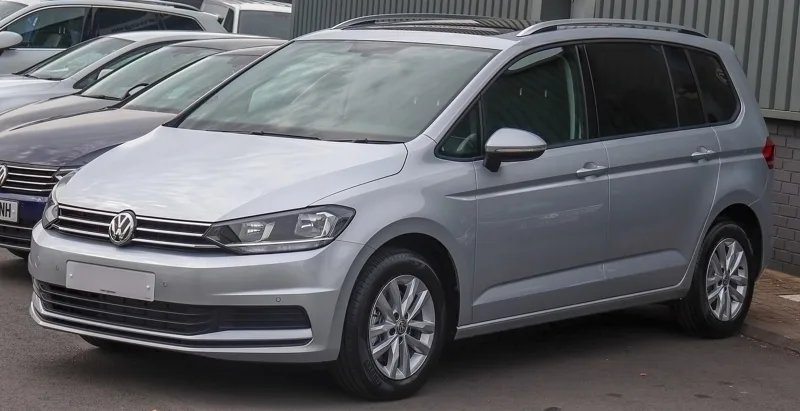
The Golf Plus, announced in December 2004, measured 95 mm (3.74 in) more in height than the Golf and sat 150 mm (5.91 in) lower than the seven-seat Touran. A CrossGolf crossover arrived in 2006, and the Jetta saloon, introduced in 2004, shared its front fascia and front doors with the Golf Variant.
The estate debuted at Geneva in March 2007. Built in Puebla, Mexico from April 2007 with a target of 120,000 units a year, it was badged Jetta SportWagen for American buyers. Volkswagen gave it the Mk6 front clip in late 2009, though the rest of the body stayed with the Mk5. The GLI variant adopted the GTI's front end.
Did the Mk5 race?
APR Motorsport's two MKV GTIs won races in the Grand-Am KONI series and in the Continental Tire Street Tuner class. Both are North American sports car series, and the wins came in the ST class, where tuned production models compete against one another.
How safe and how well received was the Mk5?
The Mk5 earned a five-star Euro NCAP rating in 2004, and Monash University gave it an excellent five-star result for occupant protection in its used car ratings. The GTI also collected awards from several publications across Europe, Australia and Japan.
Top Gear named the GTI its 2004 Car of the Year. Automobile Magazine's 2007 Car of the Year went to the GTI, and Drive magazine in Australia gave it Best Performance Car under $60k AUS in 2006, 2007 and 2008. What Car? picked the Golf as Best Small Family Car in 2004, 2007 and 2008. Not everything was praised: Jeremy Clarkson called the petrol TSI's power delivery jerky.
Where was the Mk5 GTI built and what did it cost?
The GTI was built in Germany, which pushed its price above that of earlier GTIs, some of which had been made in Brazil. The new car also carried a considerable premium over its predecessor, driven by its DSG transmission, its 200 PS TFSI engine and an exterior that had not changed so dramatically in years.
Automobile Magazine named the GTI its 2007 Automobile of the Year in December 2006, which kept the car in the spotlight as it reached dealers. In Canada, this generation alone sold the GTI under its own badge instead of as a Golf trim. When the Golf returned to North America for the 2010 model year, the GTI became a Golf trim in Canada, while it kept its own nameplate in the United States. In Mexico the GTI was sold only as a three-door hatchback.
Did the GTI get a new engine late in its run?
A redesigned EA888 engine appeared in some GTIs for North America in late 2008 and early 2009, replacing the earlier EA113. Early EA888 units made very similar horsepower and torque figures to the EA113 they succeeded. The swap came as Volkswagen readied new engines for the Mk6 GTI.
The EA113 used a high-pressure fuel pump cam follower that wore and needed regular replacement, and failure of that part could lead to catastrophic engine failure. The redesigned part no longer demanded that attention. Some Mk5s sent to North America in those years received the new engine.
What chassis did the GT get?
The GT shared its brakes with the GTI, using 312 mm ventilated front discs and 286 mm solid rear discs. Its suspension was lowered by 15 mm (0.59 in) and borrowed the GTI's damper settings, with 7Jx17 ClassiXs alloy wheels wrapped in 225/45 R17 tyres. Twin exhaust outlets finished the rear end.
That sporty chassis package sat alongside a broad engine choice. Buyers could pick the TSI petrol, the TDI diesel or the 2.0 FSI direct-injection petrol, and both the petrol and diesel versions were also available with DSG.
Mk5 specifications at a glance
| Specification | Detail |
|---|---|
| Platform | PQ35 (Volkswagen Group A5) |
| Debut | Frankfurt Motor Show, October 2003 |
| GTI engine | 2.0-litre turbocharged FSI, 200 PS (147 kW; 197 bhp) |
| GTI torque | 280 Nm from 1700 to 5000 rpm |
| GT output | 125 kW (170 PS; 168 bhp) |
| R32 output | 250 PS (184 kW; 247 bhp), peaking at 6,300 rpm |
| R32 0-100 km/h | 6.5 seconds (6.2 with DSG) |
| Top speed | 220 km/h (136.7 mph) for petrol and diesel GT |
| Drag coefficient | 0.32 |
| Cargo gain over Mk4 | 20 L (0.7 cu ft) |
| Euro NCAP | Five stars, 2004 |