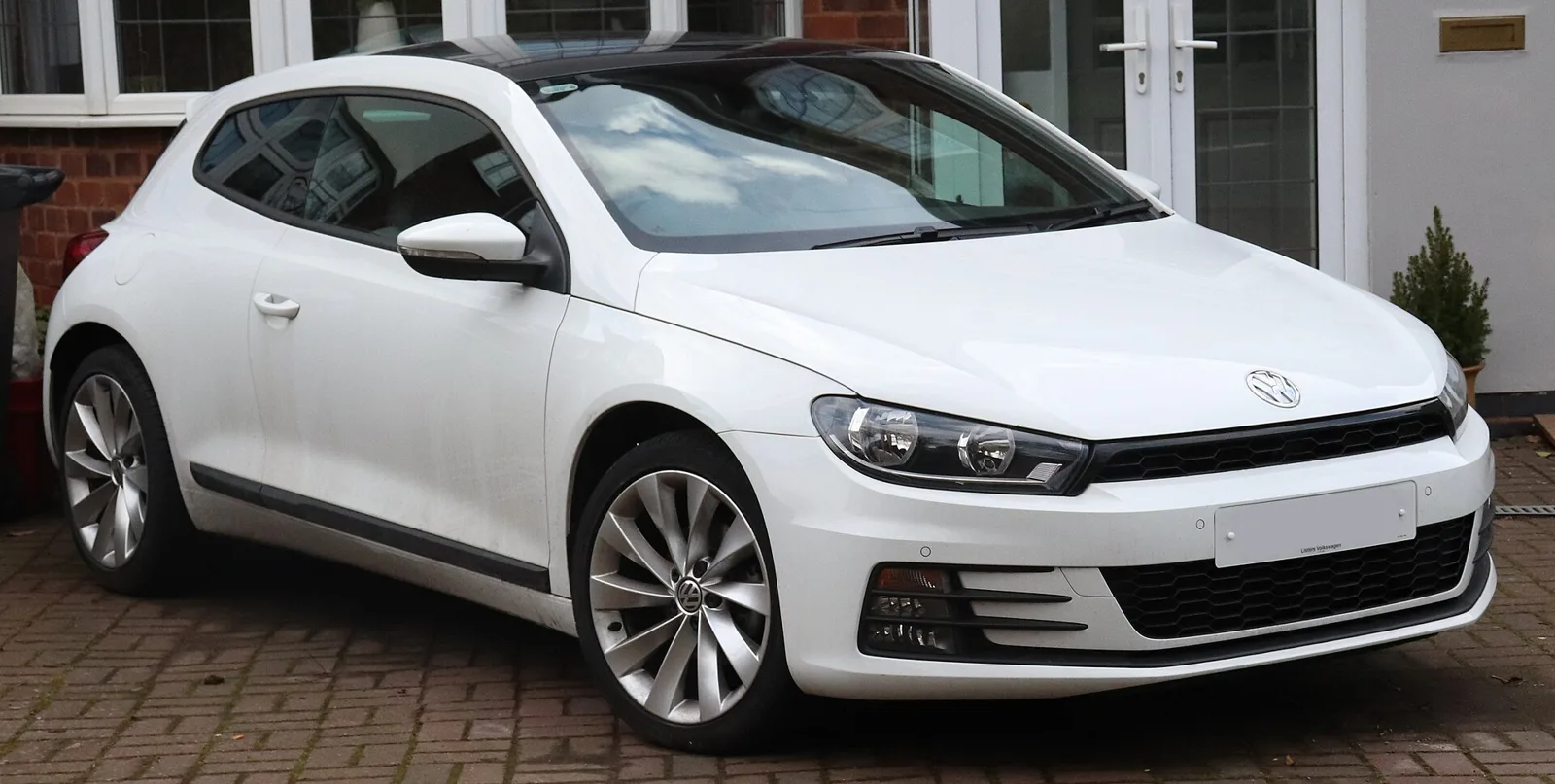
A Golf-based sports hatchback that began as a Karmann Ghia replacement, won Euro NCAP praise and left Volkswagen without a coupe in 2018.
The Volkswagen Scirocco is a Golf-based three-door sports hatchback that Volkswagen built in two generations from 1974 to 1992, then again from 2008 to 2018. Launched to replace the Karmann Ghia, it ended production without a successor, and Volkswagen has since said there is no rush for a new coupe.
The Volkswagen Scirocco was a three-door hatchback built on the Golf's platform, and it went through three generations between 1974 and 2018. The first two ran until 1992, and the third stopped in 2018 with no successor. Its name comes from a Mediterranean wind, and each generation was a sharper, sportier car than the family hatchback it shared parts with.
Where did the Scirocco come from?
The Scirocco was built to replace the ageing Karmann Ghia coupe, and Volkswagen gave it the internal designation Typ 53. Although the Golf's platform underpinned the new car, almost every part was re-engineered around a new body. Giorgetto Giugiaro penned the styling, which was sleeker and sportier than the Golf's. The car debuted at the 1973 Geneva Motor Show.
Three generations on a Golf-based platform, and no coupe left in the Volkswagen line-up.
Why did the Scirocco go on sale before the Golf?
Volkswagen launched the Scirocco six months before the Golf, so that any teething troubles could be sorted out before the high-volume hatchback started production. The Scirocco reached Europe in 1974 and North America in 1975. Its first engines were four-cylinder units of 1.1 to 1.6 litres, with a 1.7 offered in North America.
Every first-generation engine used a single overhead camshaft and two valves per cylinder. An automatic transmission option arrived in January 1975, but automatic Sciroccos were rare outside North America, where the market expected them.
Why did US Sciroccos have four round headlights?
US rules did not approve the rectangular headlights used in Europe, so every Scirocco imported to the United States had four round lamps. Two were used for low beam, and all four were switched on for high beam.
Many European owners of the smaller-engined cars copied the look, replacing their two rectangular headlights with four round ones. That removed the visual signal that a car was less powerful. Volkswagen's European TS version, rated at 85 PS (63 kW; 84 hp), was easy to tell apart from the 50 PS L and 70 PS S, which kept two rectangular headlights.
How quick was the Scirocco GTi?
The Scirocco GTi entered production in the summer of 1976, a few months before the Golf GTI was unveiled that autumn. Its 81 kW (109 hp) 1.6-litre engine used mechanical fuel injection, and it had a larger duckbill front spoiler, a red grille frame and 239 mm (9.4 in) ventilated front discs.
Anti-roll bars were fitted front and rear, and the standard car's solid front discs gave way to the larger ventilated units.
What changed during the first generation's life?
The first generation was refined rather than redesigned. From August 1975 the car had a single wiper that parked on the passenger side, which replaced the two-wiper system of earlier cars, and the driver benefited from lighter steering linkage. Air conditioning became optional on the domestic market at the same time.
In August 1977 the separate front side marker and turn signal gave way to a combined wrap-around orange lens for model year 1978. The B-pillar was painted black rather than body colour, a change the designers judged gave a better profile. Bumpers moved from chrome with rubber end caps to a one-piece plastic-coated wrap-around design.
In 1979 the one-piece flag-style outside mirror gave way to a two-piece shrouded unit. The car changed little after that before the second generation replaced it in Europe in March 1981.
Which Scirocco special editions were sold?
Several special versions appeared during the first generation's run, and most were distinguished by paint and trim. The Sidewinder pair, the Champagne Editions and the S were the best known. The Champagne Edition II came only in white with black accents and a Zender front spoiler.
North American S models were a separate story. The 1980 S came in Alpine White, Black or Mars Red, with blacked-out chrome trim, day-glow exterior details, Recaro sports seats, white-letter tyres, sport strips and a standard five-speed transmission. The 1981 S dropped the colour accents and came in Cosmos Silver Metallic, Cirrus Grey Metallic or Mars Red instead.
Steel sunroofs were an option on both the S and the standard car. Unlike the second generation's sunroofs, which slid back, these earlier units only tilted open, and they could be removed and stored in a fabric folder in the boot.
How did the Scirocco sell outside Europe and North America?
The Scirocco was sold in Japan from 1976 through Yanase dealerships, which specialised in North American and European cars with right-hand drive. The first Japanese cars were the TS trim with a 1.5-litre engine and a four-speed manual. In 1977 the GTE and LS arrived with the same 1.5-litre engine and Bosch fuel injection.
The GTE could be ordered with either a four-speed manual or a three-speed automatic, while the LS was automatic only. Later Japanese cars offered the GTi with a 1.8-litre engine, in manual or automatic form. The Japanese government's dimension rules were respected throughout, so the car stayed within the country's size limits.
How did the North American Scirocco change?
North American cars followed their own rules on transmissions and engines. From 1975 to 1978 they had four-speed manuals, and a five-speed was optional for 1979 and 1980 before becoming standard for 1981. The engine changed often, and the 1975 model used a 1.5-litre (1471 cc).
The 1976 and 1977 cars had a larger 1.6 with 76 hp (57 kW). For 1978 Volkswagen reverted to a short-stroke 1.5 (1457 cc), saying that it eased emissions compliance, and power fell to 71 hp (53 kW). For 1979 the 1.6 (1588 cc) returned with 78 hp (58 kW).
What was new in the second-generation Scirocco?
The second generation, Typ 53B, went on sale in 1981 while staying on the A1 platform. It was first shown at the Geneva Motor Show in March 1981, and Karmann in Osnabruck built it on Volkswagen's behalf in the same factory as the first car. Volkswagen's in-house design team styled it with more front and rear headroom, more luggage space and a lower drag figure.
A mid-cycle update in 1984 changed the rear badging, redesigned the air-conditioning compressor and altered the brake master cylinder. Halfway through the 1984 model year a space-saver spare wheel allowed a larger fuel tank with a second transfer pump, and two windscreen wipers returned after years of a single large wiper.
How many engines did the second-generation Scirocco offer?
Eleven different engines were offered in the second generation over its run, though not every engine was sold in every market. They included both carburettor and fuel-injected units. The first cars all had eight-valve engines, and displacements ran from 1.3 to 1.8 litres.
Tuner Oettinger developed a 16-valve head in 1981, and Volkswagen adopted the design when it showed a multi-valve Scirocco at the 1983 Frankfurt Motor Show. That car reached German showrooms and a few other markets in July 1985, and a catalysed version followed in 1986.
Power ranged from 60 to 112 PS (44 to 82 kW) for the eight-valve engines. The 16-valve engines produced either 95 or 102 PS (70 or 75 kW), depending on whether a catalytic converter was fitted.
Which limited editions did the second generation get?
The trim names changed with the model year and the market. They ran from the basic L and CL through the GLS and GT to the GTI, GTX and Scala, with 16V badges on the later cars. Most limited editions had unique colour combinations, special alloy wheels and extras such as leather, a trip computer or power windows.
Among the named editions were the California Edition of 1983 in the US, the Storm of 1984 in the UK, the White Cat of 1985 in Europe, and the Wolfsburg Edition, which ran from 1983 to 1985 in the US and Canada. A Slegato edition was sold in Canada in 1988.
When did the second-generation Scirocco end?
The second-generation Scirocco was sold until 1992 in Germany, the UK and some other European markets. It was briefly joined by the Corrado, which had been on sale since 1988 and was aimed further upmarket, and the Corrado effectively replaced it.
In North America the Scirocco sold until 1988 in the United States and until 1989 in Canada. A 16-valve model arrived in mid-1986 with full body skirts, a larger rear spoiler and teardrop-shaped wheel slots, and the Corrado replaced it in both markets.
How did the third-generation Scirocco arrive?
Volkswagen announced the third-generation Scirocco in June 2006, with production at the AutoEuropa plant in Palmela, Portugal. The new model, with the internal type numbers 137 or 1K8, was based on the PQ35 platform of the Golf V. It was unveiled at the 2008 Geneva Motor Show and went on sale in Europe that summer.
Top Gear magazine named the Type 3 Scirocco its Car of the Year for 2008. Sales in other countries began in early 2009, and UK models went on sale that same year.
How safe was the 2008 Scirocco?
The 2008 Scirocco earned a five-star rating from Euro NCAP, even though the test dummy's head struck the steering wheel after the airbag bottomed out. The tested car was a left-hand-drive three-door hatchback. Adult occupant protection scored 87% (31 points), and child occupant protection 73% (36 points).
Pedestrian protection scored 53% (19 points).
What did the third-generation trims and engines offer?
In 2011 Volkswagen added the R-line trim for all engine versions. It brought new front and rear bumpers, side skirts, grey Alcantara seats and R-line badges on the seat backs, the steering wheel and the door sills.
All models came with a six-speed manual as standard. The 1.4 TSI (162 PS) could take a seven-speed DSG, while the 2.0 TSI 200, 2.0 TSI 210, the R 2.0 TSI 265 and the 2.0 TDI were available with a six-speed DSG. The 2.0 TDI produced 140 PS, and a 170 PS version used a larger turbo.
The 140 PS 2.0 TDI also came with BlueMotion Technology, which added stop-start and regenerative braking. That brought emissions down to 118 g/km of CO2.
What made the Scirocco R special?
The Scirocco R was based on the GT24 race car and used a 1,984 cc (2.0 L) TSI straight-four rated at 195 kW (261 hp) at 6,000 rpm, with 350 Nm (258 lb ft) of torque at 2,500 rpm. It had large air intakes in the front bumper, an integrated spoiler, bi-xenon headlights, a black diffuser and dual exhausts with chrome tailpipes.
The R wore 19-inch Talladega alloy wheels. A facelift in September 2014 raised the output to 206 kW (280 PS; 276 hp).
How did the 2014 facelift change the Scirocco?
Volkswagen revealed the 2014 Scirocco facelift at the Geneva Motor Show, six years after the car's launch. The outside changes were subtle: the bumper was re-profiled slightly, the headlights were new bi-xenon units with LED running lights, and the grille was tweaked. At the rear there were restyled LED taillights and a reworked bumper and boot lid.
The Scirocco GTS arrived between 2015 and 2017 with the same engine as the Mk7 Golf GTI.
Why was there no North American Scirocco?
In April 2007 Volkswagen America's vice president Adrian Hallmark said Volkswagen preferred not to sell the Scirocco in North America, because it could hurt Golf GTI sales. The final decision was later said to rest with Martin Winterkorn, the chief executive, rather than Volkswagen of America.
In early March 2008 MotorAuthority reported that the car would not be sold in the United States because of the widening gap between the dollar and the euro. Volkswagen's sales chief, Detlef Wittig, told Bloomberg that the car would suit the market but that the exchange rate meant it would not make money there.
How did Volkswagen race the Scirocco?
In the 24 Hours Nurburgring in May 2008, three new Sciroccos competed, finishing 11th and 15th in a field of over 200 cars. Veteran Hans-Joachim Stuck drove both leading cars, Two Opel Astra H GTC cars were beaten decisively.
Johan Kristoffersson won the 2012 Scandinavian Touring Car Championship for Volkswagen Team Biogas in a Scirocco.
What concepts previewed the Scirocco?
The IROC concept previewed the third Scirocco at the 2006 Paris Motor Show. Its name came from the middle four letters of Scirocco, and it used a 200 hp (149 kW) TSI engine.
The Scirocco GT24 was a race car for the 24-hour event at the Nurburgring, with a 2.0-litre TSI rated at 325 PS (239 kW; 321 hp) and a DSG transmission. It was unveiled at the GTI Meet 2008 in Worthersee. The Studie R followed as a concept based on the GT24, after Volkswagen cancelled the Scirocco R32. It produced 270 PS (199 kW; 266 hp) and was shown at the Bologna Motor Show.
Is a new Scirocco coming?
In 2017 Volkswagen's development chief, Dr Frank Welsch, said the company was considering options for a new small coupe and was unclear how it would approach a new Scirocco. He said that if the name returned it would only be for a sporty two-door coupe, not a drastically different design.
In 2020 board member Thomas Ulbrich was asked whether a new Scirocco was planned. He said he did not think so, and that the company was in no rush to release a new coupe.
Volkswagen Scirocco generations at a glance
| Generation | Years | Platform and type | Key figures |
|---|---|---|---|
| First | 1974-1992 | Golf platform, Typ 53 | 1.1 to 1.6 litre engines; GTi 81 kW (109 hp) |
| Second | 1981-1992 | A1 platform, Typ 53B | Eleven engines; 8-valve 60 to 112 PS (44 to 82 kW); 16-valve 95 or 102 PS (70 or 75 kW) |
| Third | 2008-2018 | PQ35 platform, type 137 or 1K8 | Euro NCAP five stars; Scirocco R 261 hp (265 PS); 2014 R 280 PS (276 hp) |