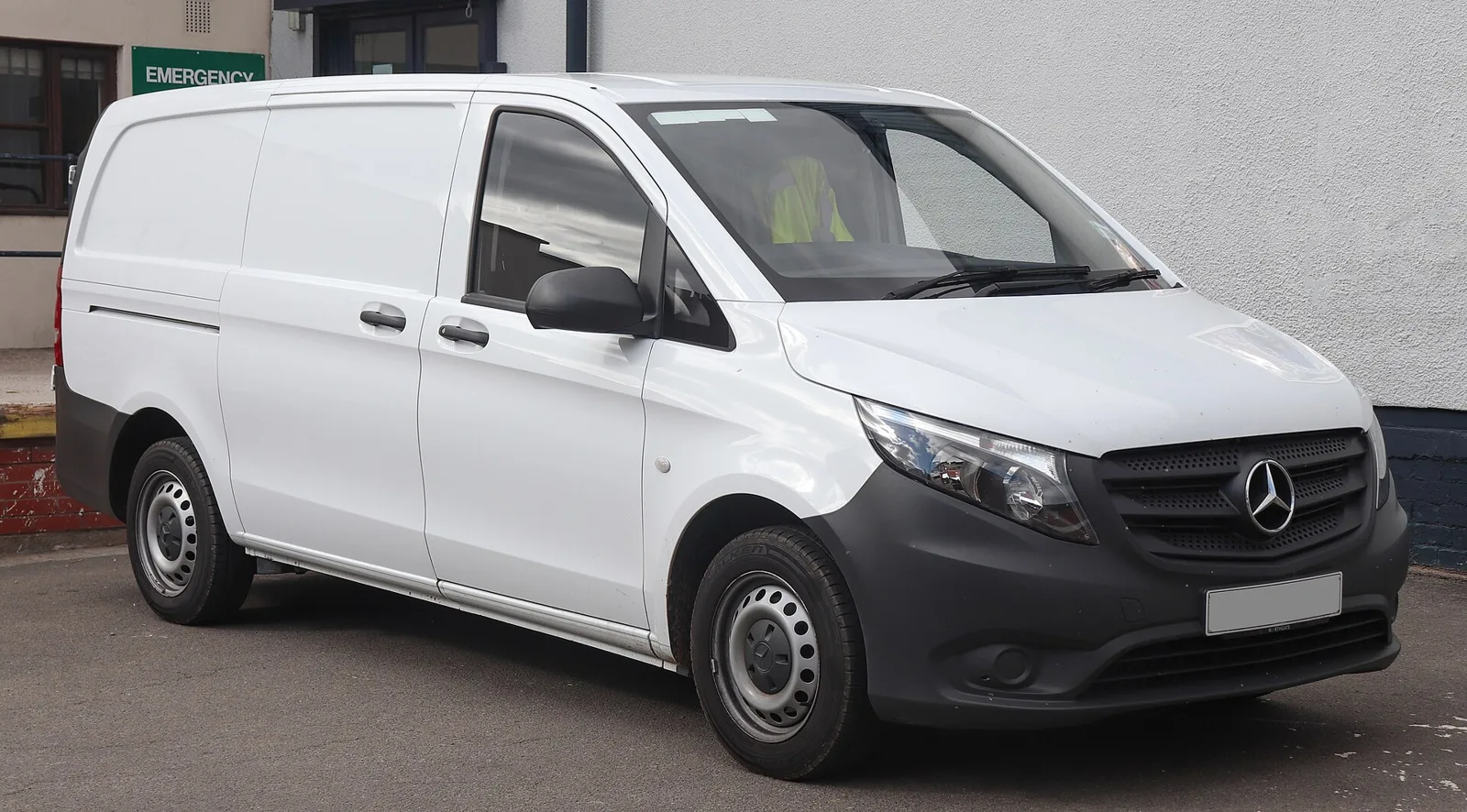
From the 1996 panel van to the 2025 electric eVito, the Vito covered cargo, passenger, camper and London taxi roles.
Built by Mercedes-Benz, the Vito is a mid-sized van first sold in 1996. It is offered as a panel van, a people carrier or a chassis cab, and passenger versions used the Viano and V-Class names. Electric models followed in 1996, 2010 and 2017.
The Mercedes-Benz Vito is a cargo van that sits between the Sprinter and the Citan in the Mercedes-Benz range. Passenger versions carry up to eight people and have used the Viano and V-Class names over the years, while the cargo variant keeps the Vito name.
What is the Mercedes-Benz Vito?
The Vito is a mid-sized light commercial vehicle built by Mercedes-Benz. It can be ordered as a panel van, a chassis cab or a multi-purpose vehicle that carries up to eight passengers. The Vito name belongs to the cargo variant, while passenger versions became the Viano and later the V-Class.
The van sits in the middle of the company's light commercial range, between the larger Sprinter and the smaller Citan. Three generations have been sold so far, beginning with the W638 in 1996 and moving to the W447 in 2014.
A cargo van that grew passenger, camper, taxi and electric versions from a single body.
How did the first-generation Vito come about?
The first generation, code-named W638, went on sale in 1996 and was built until 2003. Michael Mauer designed its body from 1989 to 1991, and the final design was patented in February 1993. Rivals included the Citroen Jumpy and the Ford Transit.
The first generation was front-wheel drive. Engines ranged from diesels with up to 120 bhp (89 kW; 122 PS) to petrol units with up to 140 bhp (104 kW; 142 PS), and the petrol range included a Volkswagen 2.8 VR6 designated M104.900.
The same body was also sold as the more luxurious V-Klasse.
Was there an electric Vito in 1996?
Yes. The Vito 108 E was a battery-electric variant unveiled in July 1996. It used a 40 kW (54 hp) motor and a molten-salt ZEBRA battery, reached 120 km/h (75 mph) and could carry 600 kg (1,300 lb).
The battery weighed 420 kg (930 lb), ran at 280 V and had a capacity of 35.6 kW-hr, while the motor's stall torque was 190 N m (140 lbf ft). The 108 E was assembled at the Mannheim plant.
The 108 E was estimated to cost three times as much as a conventional Vito. Deutsche Post ran a small fleet of them in Bremen.
The 108 E was the first electric model in the Vito story, and the later E-CELL and eVito vans built on the same idea of a purely electric delivery van.
What are the main Vito specifications?
| Specification | Detail |
|---|---|
| First generation | W638, 1996 to 2003, front-wheel drive |
| First-generation petrol | Up to 140 bhp (104 kW; 142 PS) |
| First-generation diesel | Up to 120 bhp (89 kW; 122 PS) |
| Vito 108 E motor | 40 kW (54 hp), stall torque 190 N m (140 lbf ft) |
| Vito 108 E payload | 600 kg (1,300 lb) |
| Extra-Long payload | 930 kg (2,050 lb) with seats removed |
| Towing | 2,500 kg (5,512 lb) braked; 750 kg (1,653 lb) unbraked |
| E-CELL battery | 36 kWh lithium-ion |
| E-CELL payload | 900 kg (1,984 lb) |
| Metris engine | 2.0 L turbocharged four-cylinder, seven-speed automatic |
| eVito motor | 84 kW (113 hp), 300 Nm (220 lbf ft) |
| EQV motor | 150 kW (201 hp), 362 Nm (267 lbf ft) |
What is the difference between the Vito and the Viano?
The Vito is the cargo variant, sold as a panel van or chassis cab. Passenger versions are named Viano or V-Class, and they carry up to eight people. Six or seven seats are standard in most markets, and the split between the two names has run through every generation, from the first W638 to the current W447.
The first-generation shell served both the cargo van and the more upmarket V-Klasse, so the two roles began with one body.
The London black cab shows how far the passenger range could stretch. It was built on the Traveliner body and seats six, which is why it sits at the passenger end of the Vito family rather than the cargo end.
Where were the Chinese Vitos built?
The Vito launched in China in April 2010, and Viano assembly began on 16 April 2010 at the Fuzhou plant. Forty per cent of the components in the Chinese model were made by local companies. Many W639 vans still work in China, including as ambulances in Beijing, as of 2020.
The first Chinese range used a 2.1 L OM646 turbo diesel four-cylinder, a 2.5 L M272 diesel V6 and a 3 L diesel V6. Four-cylinder models had a 6-speed manual, while the V6 diesels used a 5-speed automatic.
Passenger models sold in Japan carried the V-Class name, with the badge V 350.
Was the Vito a London taxi?
Yes. In August 2008 a Vito variant was approved by the Public Carriage Office as a licensed London black cab. The taxi seats six, has electric sliding doors and electric steps, and meets the 25 ft (7.6 m) turning circle requirement with its rear-wheel steering.
Penso in Coventry built the taxi, which was based on the Traveliner body. The rear wheel steer system was licensed from one80 and distributed through KPM-UK Taxis, a subsidiary of Eco City Vehicles.
The rear-wheel steer works only below 5 mph (8.0 km/h), so it is a low-speed manoeuvring system.
The second generation and the Viano
The second generation (W639) switched to a rear-wheel drive layout, and its passenger models were marketed as the Viano. Six or seven seats came as standard in most markets, and the van could carry up to eight passengers in total.
Rear-wheel drive gave the Viano a smaller turning circle than front-wheel rivals. The Compact and Long models turned in 11.8 m (39 ft), while the Extra-Long needed 12.5 m (41 ft).
With all the seats removed, the Extra-Long could hold 4,610 litres (163 ft3) of cargo. Its payload with the seats removed was 930 kg (2,050 lb), and it could tow a 2,500 kg (5,512 lb) braked trailer.
The Marco Polo camper and the X-Clusive
The Marco Polo was a camping version designed with Westfalia, with a galley, a 40 L fridge and storage. A pop-up roof was fitted, and an extra bed in the roof area lifted sleeping capacity to four people.
Daimler bought a controlling stake in Westfalia in 1999, and the Marco Polo rivalled the Volkswagen California.
The Viano X-Clusive was offered only in European markets from 2008 to 2010, with a V6 engine and 18-inch alloy wheels.
What changed in the 2010 facelift?
The 2010 facelift brought restyled front and rear lights and bumpers, along with engines adapted from the Sprinter range. The engine line-up ran from 100 kW (134 hp; 136 PS) to 190 kW (255 hp; 258 PS), and all Viano and Vito engines met Euro 5 standards.
The 4MATIC all-wheel drive was optional on four-cylinder diesels. It split drive 35:65 between the front and rear axles, and it added 80 kg (176 lb) to the vehicle.
The all-wheel drive set-up gave the van approach, departure and breakover angles of 20, 28 and 19 degrees.
What was the Vito E-CELL?
The Vito E-CELL was a battery-electric van built from 2010 to 2012. It used a 36 kWh lithium-ion battery and a 60 kW (80 hp) motor, and Mercedes-Benz discontinued it in 2012 because demand was low.
The E-CELL was front-wheel drive, which saved space for the battery under the cargo floor. Its motor provided 280 Nm (207 lb ft) of torque, but top speed was limited to 80 km/h (50 mph).
Production took place at Vitoria-Gasteiz in Spain, where the E-CELL became the first electric vehicle mass-produced in the country. Mercedes-Benz offered it on a four-year lease covering 80,000 km (50,000 mi).
The estimated range was 130 km (81 mi), though a realistic figure of 90 to 100 km was expected. The payload was 900 kg (1,984 lb), and a six-hour charge on a high-voltage supply roughly doubled on a 230 V domestic supply.
How did the third generation change the Vito?
The third generation, code-named W447, launched in 2014. Its passenger version returned to the V-Class name, and production of the V-Class began in Vitoria, Spain, in March 2014. The cargo Vito and the passenger range then grew through North America and into electric variants.
The W447 line-up grew over the following years. The Metris arrived in North America in 2015, the eVito followed in November 2017, and the EQV was shown as a concept in March 2019.
What was the Metris?
The Metris was the North American name for the Vito, sold in the United States and Canada from 2015 for the 2016 model year. It started at $29,945, used a 2.0 L turbocharged four-cylinder with a seven-speed automatic, and was discontinued after the 2023 model year.
The Metris was assembled in Ladson, South Carolina, alongside the North American Sprinter. The US Postal Service bought up to 30,000 right-hand drive Metris vans in 2018.
How did electric Vitos develop after the E-CELL?
The eVito arrived in November 2017 as an electric panel van, and its first battery of 41.4 kWh gave a range of 150 km (93 mi). In March 2025 a 90 kWh version arrived with a range of 480 km (300 mi).
The first eVito used an 84 kW (113 hp) motor with 300 Nm (220 lbf ft) of torque.
The EQV was shown as a concept at the March 2019 Geneva Motor Show. It has a 150 kW (201 hp) motor, 362 Nm (267 lbf ft) of torque and a WLTP test range of 350 km (220 mi), while an updated eVito Tourer reached 421 km (262 mi).
Reception, rallies and safety
The Viano received mixed to positive reviews from the motoring press. Autocar summed it up as still more van than MPV,
The Viano also took part in motorsport. It served as a support vehicle at the 2006 Dakar Rally, and in 2009 it won the SUV category at the 19th Rallye Aicha des Gazelles.
Safety scores were strong. Euro NCAP tested the Viano in 2008, and ANCAP gave it 32.66 points out of 37, making it the only van in Australasia to achieve the maximum five-star rating.