A brand sold as a different kind of car company, a plastic-panelled compact, a best-selling crossover and an award-winning sedan, and the 25 years in between.
Saturn was a General Motors brand founded on January 7, 1985, built around a new car, dealers and plant. The S-Series, Vue and Aura carried it until GM ended production on October 7, 2009, after a sale to Penske Automotive Group collapsed.
Twenty-five years after General Motors put the Saturn name on a company, Saturn was gone, and the best-selling car it left behind was still rolling out of a Mexican factory with a Chevrolet badge. The brand had been sold to the American public as something new. It ended as a rack of cars borrowed from other divisions.
The story hangs on three models. The S-Series proved that a clean-sheet idea could sell in numbers, the Vue gave Saturn its biggest seller, and the Aura arrived in 2006 to some of the warmest reviews the brand ever earned, only three years before production stopped.
Saturn car company history: a small-car idea that became a company
It started in June 1982, when Alex C. Mair opened discussions on a small-car project codenamed Saturn. By November 1983 GM chairman Roger B. Smith and president F. James McDonald were talking about it in public, and a year after that the first demonstration vehicle appeared. The Saturn Corporation was formally founded on January 7, 1985.
It was not originally going to be a brand at all. The mid-1980s Saturn concept car looked much like the first SL, but GM planned to sell the production version under one of its existing badges, which then meant Chevrolet, Pontiac, Oldsmobile, Buick, Cadillac or GMC. The plan changed in 1985 and Saturn became its own marque, with the SC coupe and SL sedan as its first cars.
The target was clear: Japanese imports and the Japanese-owned plants being built in the United States, starting in the compact class. GM presented Saturn as a different kind of car company and ran it at arm's length from the parent, with a new car, a new dealer network, a new pricing structure, a new workforce and its own plant at Spring Hill, Tennessee. Customers were offered a no-haggle price, which was unusual in American showrooms.
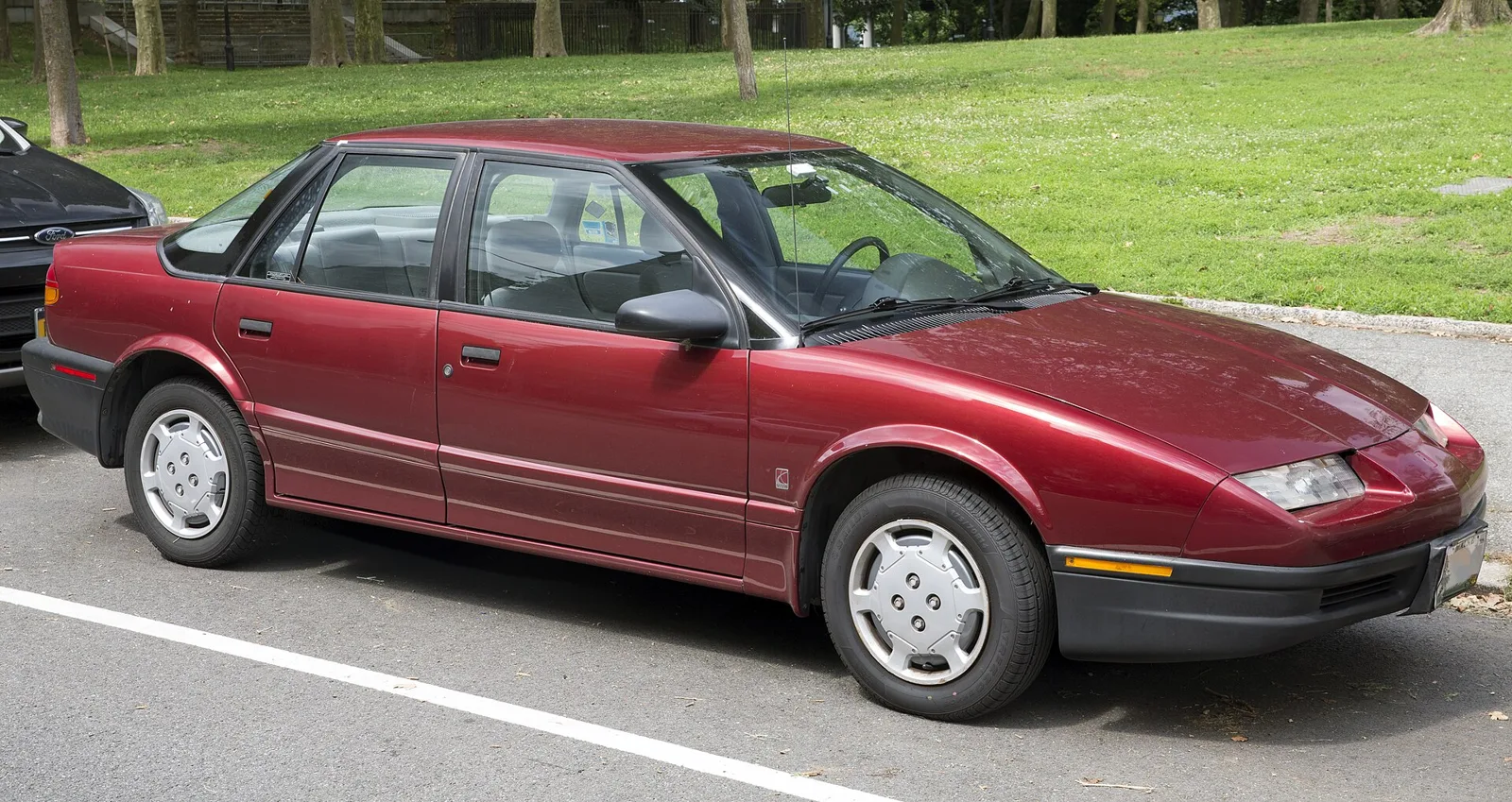
The first car came off the line on July 30, 1990. It was maroon with a tan interior. The first dealership opened in Memphis, Tennessee.
Saturn was sold as a different kind of car company, and it ended as a brand of borrowed parts.
How the Saturn S-Series was put together
Underneath, the S-Series sat on a platform called the Z-body, developed inside Saturn and sharing little with other GM cars. It used a spaceframe, an idea tried earlier on the Pontiac Fiero. Think of a bicycle with a fairing: the frame carries the loads and the shell on top is only skin. The plastic side panels bore no structural weight, and because the polymer could take a knock without denting, it became Saturn's main selling point for years.
Saturn also said the panels made restyling cheap, and it used the freedom. The SL and SW were reskinned for 1996, the SC for 1997, and the whole range in 2000.
The engine was a 1.9-litre four-cylinder designed in-house, built in single-cam and twin-cam forms. The single-cam version made 85 hp (63 kW), later 100 hp (75 kW) after fuel injection arrived in the mid-1990s. The twin-cam was rated at 124 hp (92 kW) throughout the S-Series run.
The S-Series trims and what separated them
The 1991 line-up was a sport coupe and a sedan. The coupe came only with the twin-cam engine, while the sedan could be had with either, as the SL1 or SL2. A station wagon, the SW, was added for 1993 in SW1 and SW2 forms, and the coupe gained a single-cam SC1 beside the renamed SC2.
The 1 and 2 badges meant more than the engine. Level 1 cars had taller gearing aimed at economy, level 2 cars had shorter, closer ratios, and the level 2 trims added 15-inch wheels in place of 14s, quicker steering, a rear anti-roll bar and a longer options list. Outwardly it was hard to tell them apart, apart from the SC2's retractable headlamps, which lasted through the 1996 model year.
The economy was real. A level 1 car with a manual gearbox reached 40 mpg-US (5.9 L/100 km; 48 mpg-imp) in the EPA highway test of the day, which would be nearer 36 mpg-US (6.5 L/100 km; 43 mpg-imp) under current methods. Owners of the base model report 38 to 41 mpg-US (6.2 to 5.7 L/100 km) on the highway. With a 12.8 US gallon (48 L) tank, a driver could cover roughly 384 miles (618 km) between fills.
The third door
For 1999 Saturn gave the SC coupe a small extra door on the driver's side, hinged at the rear, which let passengers reach the back seat while the driver's seat slid forward. Saturn called it the world's first three-door coupe. Extended-cab pickups had used the layout before, and Mazda's RX-8 concept showed it again in late 1999, with doors on both sides.
Early success, and the doubts around it
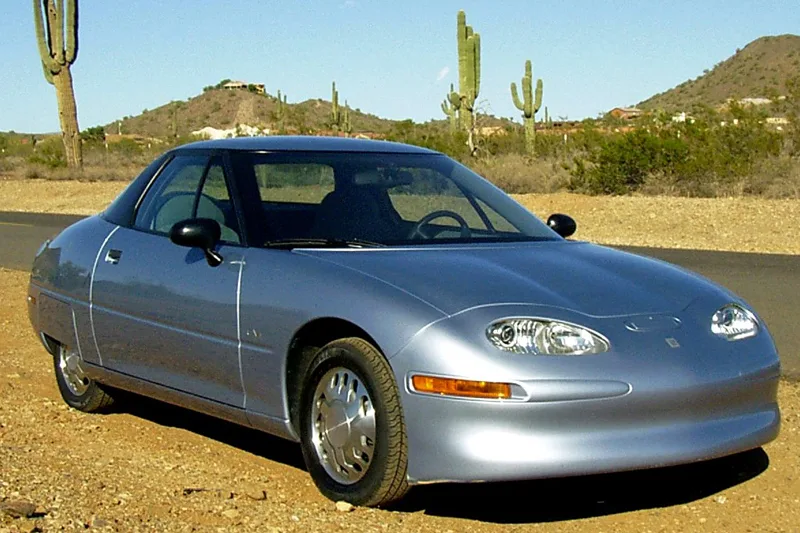
The early sales figures were strong. Annual sales peaked in 1994, only three years after the first deliveries, at 286,003 vehicles. The 500,000th Saturn, a car nicknamed Carla, was built in 1993; the millionth followed in May 1995, and the two millionth in January 1999. In 1996 Saturn dealers also handled the electric GM EV1.
Inside GM the picture was less happy. According to The Wall Street Journal, the project was simply too ambitious: the car, plant, workforce, dealers and manufacturing process were all new, when even Toyota takes on no more than two new things at once. Saturn customers formed a strong attachment to their cars, yet sales never reached the targets, partly because of the recession of the early 1990s. Some 41% of Saturn buyers already owned a GM car, so the brand was taking customers from its own family. It had also drawn $5 billion from other GM projects, which angered other divisions, and it opened at a higher cost than the Japanese transplants it was chasing.
Taking Saturn abroad
Taiwan took Saturns from June 1992 to 1996, chosen as a small test market with few domestic brands. Japan followed from 1997 to 2001 with right-hand-drive second-generation cars, and in 1997 Saturn became the first GM North American product built with right-hand drive on the same line as left-hand-drive cars.
The timing was poor. Japan's economy had slumped after the asset price bubble burst in 1990, and in July 1998 Saturn was reported to have sold about 1,400 vehicles there in sixteen months. The Japanese SC2 was 30 mm too wide for the compact tax bracket, so buyers paid extra. The leftover right-hand-drive wagons were reworked as the SWP, a mail wagon for rural carriers sold to the United States Postal Service, and 450 were built in 1999.
Saturn Vue: the best seller arrives
The Vue was Saturn's first sport utility vehicle and its best-selling model. Designed by Saturn and introduced in 2001 for the 2002 model year, it was the first car on GM's Theta platform, a unibody it shared with the Chevrolet Equinox, the Pontiac Torrent and the European Opel Antara. It was built at Spring Hill.
Buyers could choose a four-cylinder or a V6, a manual or an automatic, and front-wheel or all-wheel drive. The four-cylinder was an Ecotec. The V6 began as a GM unit with an Aisin five-speed automatic, but from 2004 every six-cylinder Vue used Honda's 250 hp (190 kW) J35A3 engine and a Honda transmission. The continuously variable transmission offered with four-cylinder Vues drew reliability complaints that ended in a class action settlement.
Red Line and Green Line
The Red Line trim of 2004 took the Honda V6 and added a body lowered by an inch, different steering calibration, 18-inch wheels, ground-effect bumpers. A facelift in 2006 brought a better interior, a new bumper and grille, and standard OnStar, cruise control and automatic headlights.
The Green Line, added for 2007, was a mild hybrid. GM's belt alternator starter put an electric motor on the crankshaft, driven by an accessory belt. A 36-volt nickel metal hydride battery pack under the load floor fed it and stored energy from braking. The engine switched off at a standstill and restarted when the brake pedal was released, and the motor helped at launch and under hard acceleration.
GM quoted a 20% fuel saving: the sticker moved from 22 mpg-US (11 L/100 km) in town and 27 mpg-US (8.7 L/100 km) on the highway to 27 and 32 mpg-US (8.7 and 7.4 L/100 km). The hybrid used a 170 hp (127 kW) 2.4-litre engine in place of the 144 hp (107 kW) 2.2, cut the 0-60 mph time by a second, and cost about US$2,000 more than a comparable Vue. It was first shown at the Detroit show on January 8, 2006.
On safety, the Insurance Institute for Highway Safety gave the Vue a good rating in the frontal offset test. Side-impact results depended on equipment: acceptable with side airbags, poor without them.
The second-generation Vue
The second Vue arrived for the 2008 model year as a rebadged Opel Antara built at Ramos Arizpe in Mexico. GM badges appeared on the front doors. The trims were XE, XR, Red Line and Green Line, with a 2.4-litre four, a hybrid version of it, a 3.5-litre V6 or a 3.6-litre V6. In Mexico and South America the same car was sold as the Chevrolet Captiva Sport. By 2010 the choice was down to XE and XR, plus a front-drive hybrid.
Saturn Aura: the car that won the awards
The Aura, a five-seat, front-wheel-drive mid-size sedan, ran for a single generation from 2006 to 2009. It appeared as a concept at the Detroit show in January 2005, reached production in summer 2006 for the 2007 model year, and was built at Fairfax in Kansas City, Kansas. It replaced the L-Series on GM's Epsilon platform, which was also used for the Saab 9-3, and it was part of a plan to make Saturn profitable and competitive with European imports.
The top XR carried a 3.6-litre V6 of 252 hp (188 kW) at 6,200 rpm and 251 lb ft (340 Nm) at 3,100 rpm. That made the Aura the first front-drive GM passenger car with the new Hydra-Matic 6T70 six-speed automatic, with paddles behind the steering wheel. The XE used a 3.5-litre V6 of 219 hp (163 kW) with a four-speed automatic. A 2.4-litre four came later, and for 2009 it was paired with a six-speed that lifted highway economy from 30 to 33 mpg-US (7.8 to 7.1 L/100 km).
The Aura Green Line used the same mild-hybrid system as the Vue, with 164 hp (122 kW) and a Saturn claim of up to 30% better economy than the XE. It qualified for a $1300 federal tax credit. GM had planned a new hybrid system for the summer of 2010, but cancelled it in mid-2009.
What reviewers thought
The interior moved to a European look, a break from the much-criticised Ion. Without polymer body panels, and with extra soundproofing and triple-pane front glass, the Aura was quieter than earlier Saturns. Reviewers praised the styling, fit and finish and ride, and noted that a loaded XE cost less than a base Toyota Camry V6.
The complaints were just as specific. Materials looked cheap, the steering wheel was large for some drivers, rear headroom was tight with the sunroof, and the car was noisy over bumps. Robert Cumberford of Automobile magazine called it a good car watered down by GM's cost cutters. In a Car and Driver test it came fourth of six, behind the Honda Accord but ahead of the Chrysler Sebring and the Camry, though it was the best performing car in the group.
It won the 2007 North American Car of the Year award, which led Saturn to send a copy of the trophy to early buyers.
| Model | Years | Platform | Engines | Built |
|---|---|---|---|---|
| S-Series | 1991 to 2002 model years | Z-body, developed at Saturn | 1.9-litre four, 85 to 124 hp (63 to 92 kW) | Spring Hill, Tennessee |
| Vue, first generation | 2002 to 2007 model years | GM Theta | Four-cylinder, Honda V6 of 250 hp (190 kW), mild hybrid | Spring Hill, Tennessee |
| Vue, second generation | 2008 to 2010 model years | Opel Antara | 2.4-litre four and hybrid, 3.5 and 3.6-litre V6 | Ramos Arizpe, Mexico |
| Aura | 2007 to 2009 model years | GM Epsilon | 3.5-litre V6, 219 hp; 3.6-litre V6, 252 hp; 2.4-litre hybrid, 164 hp | Fairfax, Kansas |
Why did GM shut down Saturn?
There was no single cause. The brand began with higher costs than its rivals, drew money from other GM projects and sold to many buyers who were already GM customers. In 2004 GM and the United Auto Workers dissolved the special labour contract for Spring Hill, so Saturn work could be folded into the rest of the company.
The product changed too. The Relay minivan, new for the 2005 model year, was the first Saturn based on models from other GM brands. Later cars were built mostly or wholly from existing GM parts, and when the 2008 recession hit, GM cut Saturn's development budgets and left it to badge-engineer other divisions' products, among them federalised Opels. The Astra replaced the Ion in 2008, and the Flextreme concept shown that year was a rebadged Opel. With that, Saturn lost the unique pitch that had defined it, and the market lost interest.
A sale that never closed
On December 2, 2008, GM told Congress it would concentrate on four core brands, Chevrolet, Buick, Cadillac and GMC, and sell, merge or close the rest. On February 17, 2009, Rick Wagoner said Saturn would stay open until its current products reached the end of their planned lives, in 2010 or 2011.
In June 2009 GM announced the sale of Saturn to Penske Automotive Group, which would have distributed the cars much as it handles Smart in the United States. Penske did not plan to buy the factories. GM would have built the Aura, Vue and Outlook for two years while Penske looked for another manufacturer, and it talked to Renault Samsung Motors and the Renault-Nissan Alliance. Those talks ended mainly because of objections from the Nissan side.
On September 30, 2009, Penske withdrew. Saturn production ended on October 7, 2009, and the remaining franchises ended on October 31, 2010. All 46 Canadian dealerships were closed by the end of 2009. The last models were the Aura, Outlook, Sky and Vue.
What came after Saturn
A second-generation Aura based on the Opel Insignia had been due, but the Insignia became the fifth-generation Buick Regal instead. Of the 36,602 Auras built in the final model year, only 3,707 were made in calendar year 2009. In 2012 GM reintroduced the Vue, little changed and without a hybrid, as the Chevrolet Captiva Sport. Production for Mexico and South America continued until 2015, and fleet sales in the United States ran from late 2011 until imports ended in 2014.
For existing owners, GM offered up to US$2,000 in incentives in February 2010 toward a new Chevrolet, Buick, Cadillac or GMC, provided they had owned the Saturn for at least six months. Service and warranty work moved to Saturn Authorized Service Providers at GM dealers.
Owning a Saturn today
Early S-Series cars with the single-cam engine and manual gearbox are the frugal ones, and some enthusiasts fit the tall-geared manual to a twin-cam car for better highway economy. The CVT in four-cylinder Vues was the subject of a class action over reliability that was later settled. And in September 2012 GM recalled 473,841 vehicles, including the Aura from 2007 to 2010 with four-speed automatics, because a car could roll while in park. The total was 426,240 in the United States, 40,029 in Canada and 7,572 elsewhere.