From horse-drawn hackneys in 1605 to an app that moves 42 million trips and orders a day, and the lawsuits, bans and strikes in between.
Ridesharing companies such as Uber use apps to match passengers with drivers, quote the fare in advance and keep a commission, whereas traditional taxis can be hailed from the street or pre-booked under their own licences. The model has been challenged over legality, driver status, safety and congestion.
In 2019, 8,000 Australian taxi drivers filed a class action against Uber, claiming lost income and the lost value of their taxi and hire car licences. Uber agreed to settle by paying AU$271.8 million. It was one of many fights triggered by a simple idea: tap a phone, and a stranger's car arrives.
How does ride-hailing work?
A ridesharing company, also called a ride-hailing service, uses websites and mobile apps to pair passengers with drivers of vehicles for hire. Where a traditional taxi can be flagged down, these cars legally cannot be.
As a rule the company, not the driver, sets the fare. Prices can move with local supply and demand at the moment of booking, the customer is quoted the amount in advance, and the company keeps a commission from every booking. Uber reported a take rate, meaning revenue as a share of gross bookings, of 29.9 percent for mobility services in the fourth quarter of 2025.
The matching itself is algorithmic. Studies have found that the pairing software made vehicles for hire more efficient, with gains in pricing, in allocating resources and in transaction costs. On the driver's side, some apps demand a tap on the phone screen to accept a job, usually within 15 seconds of the alert, a requirement that is illegal in some jurisdictions because it could lead to distracted driving.
Ridesharing or ride-hailing?
The names are contested. In January 2015, the Associated Press Stylebook adopted "ride-hailing", arguing that "ridesharing" is inaccurate because not every ride is shared, and "ride-sourcing" fits only when drivers earn an income. Elsewhere, "ride-sharing" refers to on-demand carpooling, while "ride-hailing" means hiring a private driver for personal transport.
Taxis could be hailed from the street. Ride-hailing cars, legally, cannot.
How is that different from a taxi?
A taxi is a vehicle for hire that carries passengers point to point, usually on an exclusive rather than shared basis. Types of vehicle, regulation, hiring, dispatch and payment differ from country to country, but there are recognisable families.
| Service | How you hire it | Licence position |
|---|---|---|
| Hackney carriage (street taxi) | Hailed in the street | Licensed for hailing throughout communities |
| Private hire vehicle (minicab) | Pre-booked | Licensed for pre-booking only |
| Limousine | Pre-booked | Licensed for pre-booking |
| Taxibus (jitney, jeepney) | Boarded on a set route | Multiple stops, multiple independent passengers |
| Ridesharing app | Matched through an app, not hailed | Usually regulated separately from taxis |
The legal line is the key difference. Where ridesharing sits depends on jurisdiction. In some places it is treated as illegal taxi operation; elsewhere it is regulated, with rules that can cover driver background checks, fares, caps on how many drivers may work an area, insurance, licensing and minimum wage. Bans, or rules so strict that no ridesharing firm operates, have been imposed in Bulgaria, Germany, Denmark, Hungary and Jamaica.
Where does taxi history begin?
The first documented public hackney coach for hire ran in London in 1605. By 1625 carriages could be hired from innkeepers, and from 1636 a rank for them stood outside the Maypole Inn on the Strand. Parliament passed a Hackney Carriage Act in 1635 to legalise horse-drawn carriages for hire, approved an ordinance regulating the coachmen in 1654 and saw the first hackney-carriage licences issued in 1662. Nicolas Sauvage started a similar service in Paris in 1637; his vehicles were called fiacres, after a shrine opposite the depot.
Joseph Hansom, an architect from York, patented the hansom cab in 1834. It was fast, light enough for a single horse, nimble in the gridlock of nineteenth-century London and stable in corners thanks to its low centre of gravity. Hansoms soon replaced hackneys and spread to Paris, Berlin, St Petersburg and New York.
Meters, engines and radios
Gottlieb Daimler built the Daimler Victoria, the first motorised taximeter cab, in 1897, and it began operating in Stuttgart in June that year. London saw electric cabs, nicknamed Hummingbirds for their hum, on 19 August 1897. Paris taxis carried meters from 9 March 1898. Petrol taxis followed: 1899 in Paris, 1903 in London and 1907 in New York, where Harry Allen imported the first 600 from France.
Technology moved in steps. Two-way radios appeared in cabs in the late 1940s, letting dispatch offices serve customers faster than callboxes had. Computer-assisted dispatching followed in the 1980s.
The taxi also had a famous wartime job. On 7 September 1914 Joseph Gallieni, military governor of Paris, assembled about 600 taxis to carry soldiers to the front. Within a day some six thousand soldiers and officers had been moved, five to a taxi, with drivers following the tail lights ahead. The meters ran throughout, and the French treasury eventually paid the fare of 70,012 francs.
How did Uber begin?
Uber started in 2009 as Ubercab, founded by Garrett Camp, a co-founder of StumbleUpon, and Travis Kalanick. The founders had spent $800 on a private driver on New Year's Eve and thought it excessive, while Camp had also struggled to hail a cab on a snowy Paris night. Camp built the prototype app with friends Oscar Salazar and Conrad Whelan, and Kalanick acted as adviser.
Ryan Graves became the first employee in February 2010 and chief executive by May, then Kalanick took over as CEO in December. After a beta in May 2010, the service launched publicly in San Francisco in 2011, initially hailing only a black luxury car at about 1.5 times the price of a taxi. The company shortened its name to Uber that year after complaints from San Francisco cab operators.
From black cars to everyday drivers
In April 2012 in Chicago, users could request either a regular taxi or an Uber driver. In July 2012 UberX arrived, a cheaper option in non-luxury vehicles, though drivers still needed commercial licences. In April 2013, after Wingz, Lyft and Sidecar had obtained licences to operate as rideshare firms, Uber announced it would add regular drivers with personal cars to UberX, provided they passed a background check and met insurance, registration and vehicle requirements. By December 2013 Uber operated in 65 cities.
Rivals were nearly as early. Sidecar launched in 2011, and its founder Sunil Paul had patented hailing a ride by mobile app in 2002. Lyft launched in the summer of 2012 out of Zimride, an intercity carpooling company founded in 2007. Careem began in July 2012 and Bolt was founded in 2013. In 2013 California was the first state to regulate such firms, treating them as public utilities under its Public Utilities Commission.
How big has Uber become?
Uber says it works in roughly 70 countries and 15,000 cities. More than 202 million people use it each month, and it has 10 million active drivers and couriers. On average it coordinates 42 million trips and deliveries every day, and it has handled 72 billion since 2010.
Growth involved deals as much as driving. In August 2016, after losing about $2 billion, Uber sold its China business to DiDi in exchange for an 18 percent stake. In March 2018 it merged its Southeast Asian operations into Grab for a 27.5 percent stake. It bought Careem for $3.1 billion in January 2020, Postmates for $2.65 billion in December 2020 and Car Next Door, an Australian car-sharing company, in January 2022. It became a public company in May 2019 and posted its first operating profit in 2023.
Elsewhere in the field, Freenow covered 150 European cities when Lyft acquired it in 2025, and other apps include Cabify (Spain and South America), Go (Japan) and Grab (southeast Asia).
What disputes followed?
Operating first, asking later
Uber was accused of entering cities on a loose reading of local rules, or ignoring them, and then lobbying to change the regulations. In 2016 it paid an $11.4 million fine for running in Pennsylvania with no permission.
Taxi companies in court
Taxi companies sued in Boston, and the courts ruled for Uber. Across the United States, Uber won every case, even though some courts accepted that it had deliberately broken taxi rules; one case went to trial, and Uber won that too. In 2016 Flywheel, the biggest taxi operator in San Francisco, accused Uber of antitrust breaches and predatory pricing. A federal judge dismissed most of the case in 2021, and Uber settled the rest by building Flywheel taxis into its app.
The Australian class action ended in the AU$271.8 million settlement. Taxi owners felt the squeeze in other ways too: the value of taxi medallions, the transferable permits to pick up passengers, fell significantly, and in 2018 that led to the failure of credit unions that had lent against them.
Employees or contractors?
Unless the law says otherwise, ridesharing companies classify drivers as independent contractors, arguing that they gain flexible working hours. The classification affects taxation, minimum wage, working time, paid leave, benefits and overtime, so it has been challenged repeatedly.
The Netherlands, New Jersey, Switzerland, New Zealand and the United Kingdom (after the Supreme Court decided Aslam v Uber BV) require drivers to be treated as employees. California passed Assembly Bill 5 in 2019 to force the same result, but the companies won an exemption through the 2020 ballot measure Proposition 22 after spending tens of millions of dollars. In 2025 California signed AB 1340, giving rideshare drivers the right to bargain collectively while still classed as contractors. Drivers struck in March and May 2019 over low wages, long hours and a lack of benefits, and again in February 2023 in the US and UK.
In the United States, drivers do not control the fares they charge. A lawsuit alleging that this broke the Sherman Antitrust Act was refused class action status and dropped in March 2024.
What about safety, jobs and congestion?
Crimes have been committed by rideshare drivers and by people posing as drivers. In one case Samantha Josephson was murdered, and Sami's Law followed. Companies have been accused of not doing enough to prevent sexual assault and have been fined for failures in background checks. Pick-up and drop-off by ridesharing cars often blocks bicycle lanes.
On jobs, studies published in 2017 found that ridesharing created net jobs, and a National Bureau of Economic Research study in November 2024 said it dramatically increased the pace of workers entering the taxi industry. Studies published in 2025 found no statistically significant rise in absolute job numbers at city level, but a change in the structure of employment towards part-time and temporary work.
On congestion, the research disagrees. A study published in March 2016 found passenger occupancy for Uber higher than for taxis in Los Angeles and Seattle. Others, from July 2018 onwards, found that Uber and Lyft create more traffic, and one from September 2019 found taxis had lower waiting times and less empty driving. A 2021 study found that moving private car trips to ride-hailing can reduce air pollution costs, but crash risk, congestion, climate and noise costs outweigh the gain. Some cities now tax rides taken through the companies.
Fairness to riders
Audit studies show some rideshare drivers discriminate against riders, though less than taxi drivers do. A 2017 Los Angeles study found taxi drivers were 73 percent (11 percentage points) more likely to cancel on Black riders than on White ones, while the equivalent gap for Uber was 4 percentage points. A late 2015 to 2016 study in Boston found riders with African American sounding names were cancelled on more than twice as often. A 2024 Carnegie Mellon model of Chicago found fast rematching reduced the effect on wait times, yet Black riders still waited about 50 percent longer on average.
What does this mean for the cars on the road?
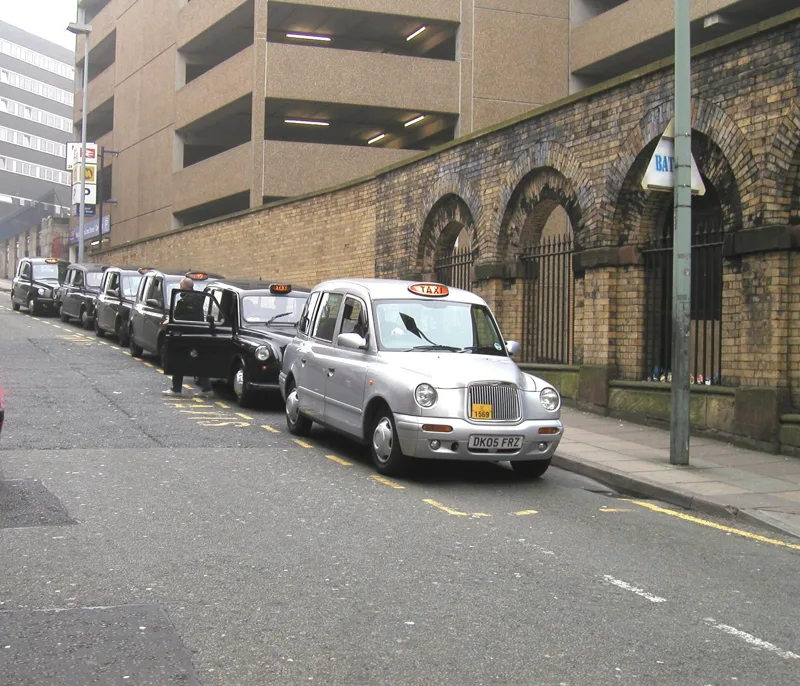
Taxis are mostly ordinary automobiles, although the choice varies by place. Mercedes-Benz saloons are a common sight as taxis in Western Europe and, to a degree, Australia, usually four-cylinder turbodiesels with modest equipment, chosen for reliability and warranty. London's Conditions of Fitness rules set size, fuel efficiency, emissions and accessibility standards stricter than for private cars, which produced the LEVC TX, and Tokyo has the Toyota JPN Taxi. London taxis have all been wheelchair-accessible since January 2000.
For the ridesharing driver, the car is their own, subject to the vehicle standards, insurance and registration a given jurisdiction demands. Uber committed in September 2020 to carbon neutrality worldwide by 2040 and to rides offered exclusively in electric vehicles in most countries by 2030.
Where does ride-hailing go next?
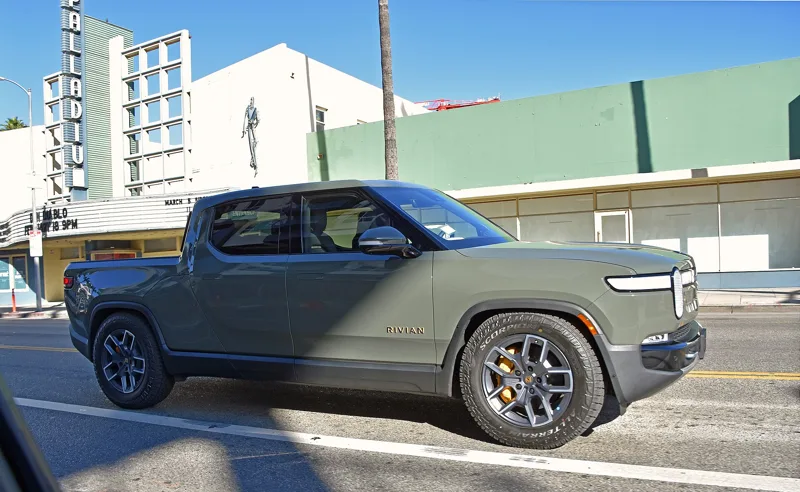
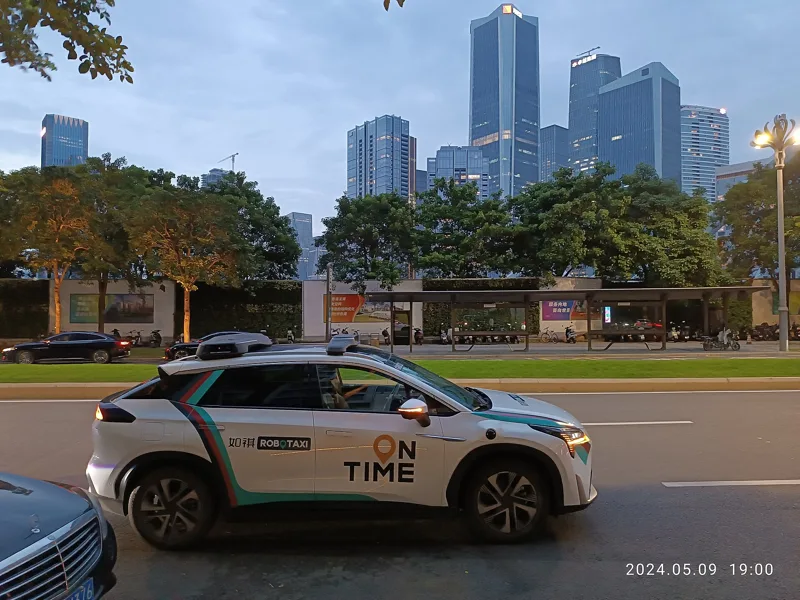
Robotaxis are the company's stated direction. Uber has launched or is launching robotaxi services with partners that include Nvidia, Wayve, Stellantis, Zoox, Rivian, Nissan, Avride, Pony.ai, Baidu, Nuro and Lucid Motors. In February 2026 it created Uber Autonomous Solutions covering robotaxis, autonomous trucks and sidewalk delivery robots. In March 2026 it committed up to $1.25 billion to Rivian, in a deal aimed at putting as many as 50,000 robotaxis on the road through 2031, and the same month partnered with Nvidia to use its Drive software.
The business is also changing shape. Uber agreed in July 2026 to buy Delivery Hero, for $14.8 billion, and in September 2026 it announced plans to cut its 34,000-person workforce by 10 percent to simplify management.