A motor now does the pulling, but a cable lever worked even when the hydraulics failed. Here is what changed, and what auto-hold and hill-hold add.
An electric parking brake replaces the hand lever with a button and a motor. The motor either pulls the traditional cable or clamps each rear caliper directly. It reached the mainstream with the 2001 BMW 7 Series and now underpins auto-hold and hill-start assist.
The first mainstream car to swap its handbrake lever for a switch was the 2001 BMW 7 Series (E65), and the part it retired had one quality that a button cannot copy without extra engineering: it worked by cable, so the driver could apply it even if the main hydraulic brakes had failed completely.
That trade, a mechanical certainty for electronic convenience, is the heart of the electric parking brake. The motor holds the car, auto-hold and hill-start assist grew out of it, and the whole system sits at the mild end of a wider move to brake-by-wire.
What does a parking brake actually do?
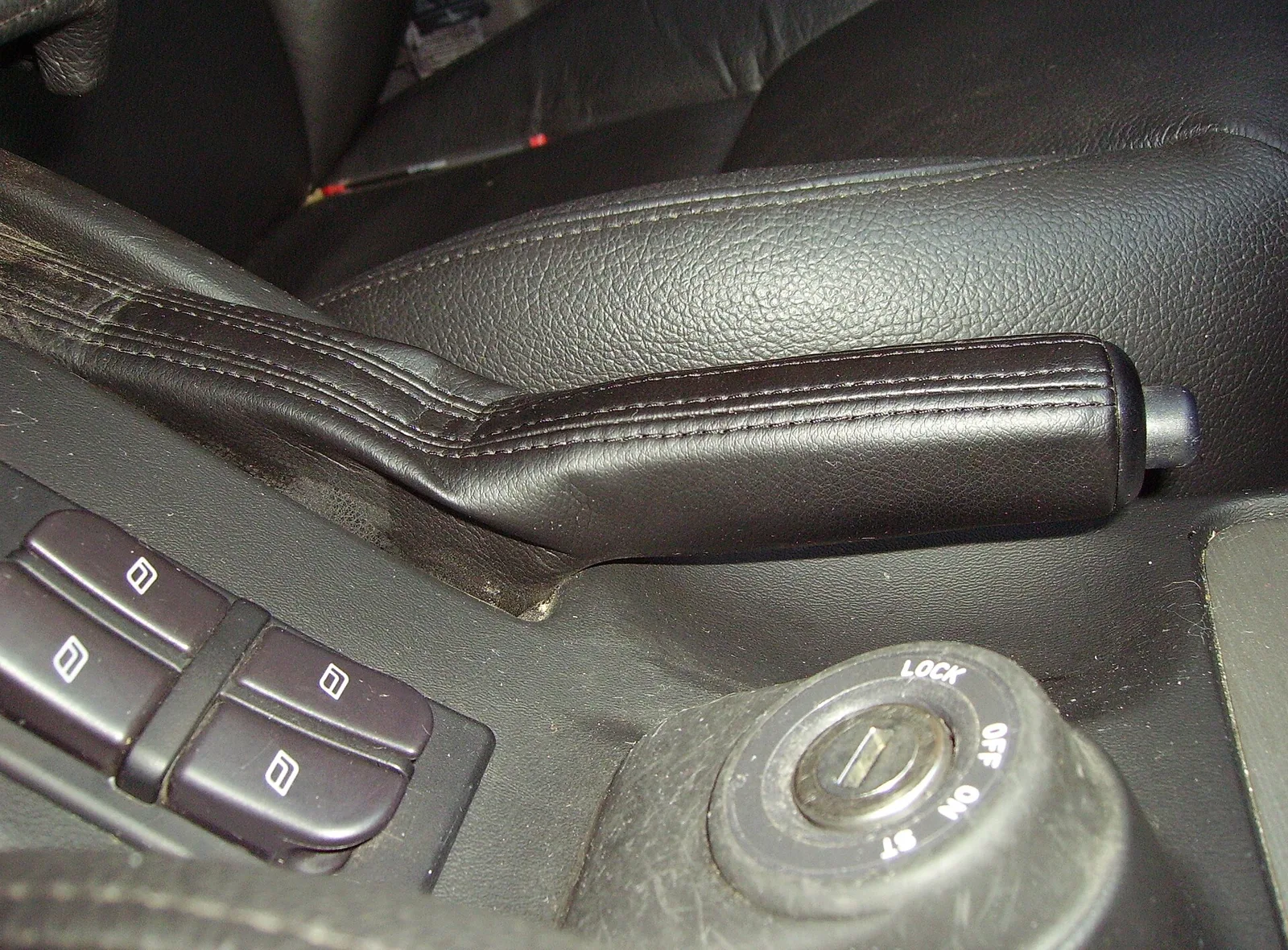
A parking brake, also called an emergency brake, e-brake or handbrake, keeps a vehicle securely still while it is parked, and can be used to try to stop it in an emergency. In most cars it is a cable running to the brakes at two wheels. In most vehicles the brakes in question are the rear ones, which have reduced traction while braking. The control may be a hand lever, a straight pull handle by the steering column or a small foot pedal beside the others.
Most parking brakes are still entirely mechanical. You pull a lever or push a button, the cables engage part of the braking system, and the brake holds. The cable gives them an independence that the foot brake lacks. Because it does not rely on hydraulic pressure, the driver can still apply it when the main system has failed, and the lever should then be pulled slowly to avoid locking the wheels.
The brake is also useful when nothing has failed. In a manual car it holds the vehicle on an incline, and many drivers add first or reverse gear as a second precaution. An automatic has a Park position that locks the transmission with a pawl, yet the parking brake is still recommended, because that pawl can fail under stress or if another vehicle strikes the car. Parked uphill, the front wheels should face away from the kerb so the kerb stops the car if the brake lets go. Parked downhill, they should face the kerb. A manual car left in first gear, or reverse if it points downhill, adds the engine as a backstop.
A cable lever worked even when the hydraulics failed; a button needs engineering to match that.
How does an electric parking brake work?
An electronic parking brake, also called an electric park brake, replaces the lever or pedal with a button and a motor. It reached the mainstream market in 2001 on the BMW 7 Series (E65), and it comes in two forms.
The simpler is the cable-pulling type. An electric motor does the pulling that your arm would do, tugging the same parking brake cable when you push or pull a switch. Nothing else about the brake changes, and the rear brakes still receive the cable's force.
The more complex form puts a computer-controlled motor on each of the two rear brake calipers, a layout called Motor on Caliper, or MoC. It first appeared on the 2003 Audi A8. The motors sit on the calipers themselves rather than pulling a cable from the cabin, and software decides when to apply them.
What the motor pushes on depends on the rear brakes. With rear discs, a parking brake either operates the disc calipers, though with much less force than the foot brake, or works a small drum brake housed inside the hub, often using the inner surface of the disc as the drum. That drum is known as a banksia brake. It is usually paired with multi-piston calipers, which are harder to operate mechanically than single-piston ones. Another route is a separate, smaller cable-operated caliper used only for parking, such as the Wilwood MC4.
What are auto-hold and hill-start assist?
Once a motor is applying the brake, the button itself becomes optional. Volkswagen, Subaru, Renault, BMW, Land Rover and Jaguar all sell models that apply the parking brake automatically when the car comes to rest and release it when the throttle is pressed, so the driver never touches a control. An extension of the same idea, called hill-hold or hill-assist, stops the car rolling back when you prepare to pull away uphill.
Hill-hold is older than the electric brake by decades. Wagner Electric invented the hill-holder, and the Bendix Brake Company of South Bend, Indiana, manufactured it. It appeared in 1936 as an option on the Studebaker President, and by 1937 Bendix was selling it as NoRoL on Hudson, Nash and many other cars. Cadillac offered it as NoRol before the Second World War, Stutz as Noback. Parts stores sold the mechanism to owners across the late 1930s, 1940s and 1950s, yet it demanded hydraulic brakes, which ruled out Ford products before 1939. Factory-built Fords got it in 1949.
The first version was beautifully simple. A ball bearing sat in the hydraulic brake line as a check valve. Facing uphill, the ball rolled back and blocked the line, trapping pressure. On the level or facing downhill, it rolled out of the way. The clutch linkage nudged the ball clear when the clutch was released, so the car could move off.
Modern versions use two sensors working with the brake system: one measures the forward incline of the car, nose higher than tail, and the other is a disengaging mechanism. In a manual car, the driver stops on a slope and presses the clutch fully down with the brake applied. The driver can then lift off the brake pedal while keeping the clutch down. To move away, select first gear, press the throttle gently and release the clutch slowly, and at some point in its travel the clutch lets the brakes go.
An automatic is simpler. A tilt sensor measures the angle, and when it passes a threshold it tells the brakes to stay clamped for a few seconds after the driver lifts off the pedal, which gives time to reach the accelerator. Also known as hill-hold control, hill-start assist or hill-start assist control, the function has appeared on the Volkswagen Passat, Jetta, Phaeton and Touareg, on Subaru's Forester, Impreza and Legacy, on the Dodge Challenger SRT8, and in similar form on cars from Alfa Romeo, Citroen, Fiat, BMW, Skoda, Lancia, Mercedes-Benz, the Lamborghini Aventador, Saab and Smart.
It helps most when the driver is new to manual shifting, or in heavy traffic on steep hills. A skilled driver can do the same job with the manual parking brake lever, coordinating brake, clutch, gear shift and accelerator, a standard technique in most countries where manuals remain popular, the UK for one. Cars with a foot-operated parking brake are poorly suited to it unless the brake is released by hand, as in the Citroen XM.
What types of parking brake are there?
| Type | How it is applied | Notes |
|---|---|---|
| Centre lever | Pulled up on a ratchet until tension is felt | Most common position; released by holding a button |
| Pedal or pull handle | Pedal pressed to apply; handle pulled to release | Many cars combine a pedal to engage with a handle to release |
| Electric, cable-pulling | Motor pulls the parking brake cable at the press of a button | Mainstream from 2001 |
| Motor on Caliper | Computer-controlled motor on each rear caliper | First seen on the 2003 Audi A8 |
| Transmission brake | Separate drum on the driveline | Independent of other brakes; stops all driven wheels at once |
| Line lock | Traps pressure in the hydraulic lines | Locks all four wheels; used off-road and on steep grades |
Can you still do a handbrake turn?
Pulling the parking brake on a moving car is not advised unless the main brakes have a problem, because it can lock the rear wheels and cause a skid. A handbrake turn deliberately does exactly that: street racers and rally drivers use it to start rear-wheel drift.
Hudson tried something different. Its unusual hybrid system operated the rear brakes through the conventional mechanical parking brake when a hydraulic failure let the pedal travel beyond its normal limit. A line lock, by contrast, borrows the standard hydraulics, trapping pressure in the lines so all four wheels lock together.
How does the electric parking brake relate to brake-by-wire?
Brake-by-wire means controlling the brakes electronically, with no mechanical connection carrying force from a pedal or lever to the physical brakes. Three types are recognised. Electronic parking brakes have become more common since the start of the 21st century. Electro-hydraulic brakes, which can sit alongside conventional hydraulic brakes, had found small-scale use in the car industry by 2020. Electro-mechanical brakes, which use no hydraulic fluid, had not yet been successfully introduced in production vehicles at that point.
The parking brake is therefore the one by-wire brake most people already own. The wider family matters because it shows what is required when a mechanical backup disappears. By-wire systems need fail-operational redundancy as specified in ISO 26262 level D, which means redundant power supplies, sensors and communication networks. Electro-hydraulic systems have traditionally achieved safety through a mechanical linkage between the pedal and the master cylinder, so the car still brakes hydraulically if the electronics or power fail.
Hybrid and electric cars are where brake-by-wire has spread furthest, because regenerative braking requires it. The Toyota Prius followed earlier cars such as the GM EV1 and the Rav4 EV, and Ford and General Motors use the same general design, with Honda notably different. In the Toyota-style arrangement the pedal's hydraulic force merely tells the computer what the driver wants, unless a catastrophic failure such as the loss of 12-volt power intervenes. An electric pump supplies the pressure, and valves feed each caliper.
The brake computer reads the pedal stroke to spot a panic stop and checks the wheel speed sensors, the yaw sensor, the steering angle and the state of charge of the traction battery. Above about 7 mph, the motor-generator acts as a generator and slows the car while storing energy. If the driver brakes harder, hydraulic friction brakes add more. Below about 7 mph, the hydraulic system takes over completely, since regeneration does not work effectively at that speed.
The fully electro-mechanical brake goes a step further. In one electro-mechanical architecture, a controller creates four separate commands for four electric calipers, each driven by a DC motor with permanent magnets and energised at 42 V, while pedal sensor data also travels to every caliper along a separate bus in case the main network fails. The benefits claimed are less volume and weight, less maintenance, easier links with active safety systems and no toxic brake fluid, yet novel actuation methods such as wedge brakes had kept them out of production cars as of 2020. A clamp force sensor in each caliper is also a relatively expensive part.
How safe is a system with no mechanical link?
Redundancy is the answer designers give. Three kinds usually appear: duplicated sensors on safety-critical parts such as the pedal, duplicated copies of important signals, and duplicated hardware such as several processors in the control unit. Voting methods then compare the results.
Not everyone is convinced the arrangement is proven. One critical account holds that the highest risk of brake failure has proved to be the Brake Control System software, citing recurring failures in over 200 cases documented by the NTSB. Manufacturers guard the design and software as confidential, so there is no independent validation. As of 2016, the NTSB had not directly investigated passenger-car or light-truck brake-by-wire accidents, and manufacturers have maintained that their cars are entirely safe, putting reported accidents down to driver error.
What about trucks, buses and trains?
Large vehicles show a different philosophy. Heavy commercial vehicles with air brakes usually have spring-applied parking brakes: air pressure holds the brake off and powerful springs hold it on. A cab lever or button operates a valve, and on some modern vehicles that valve works electrically. If air pressure is lost, the springs apply the brakes, and the system will not let the parking brake release if there is too little air to operate the foot brake. The drawback is towing, which needs an external air supply or manual winding off of the shoes against the springs.
Heavy commercial vehicles also carry an electronic braking system, EBS, a form of brake-by-wire that still relies on compressed air and only controls it through valves. It improves precision and shortens stopping distances, and if the electronics fail it falls back to ordinary air control pressure. Railways keep manual hand brakes on virtually all rolling stock, and newer locomotives replace the chain winding mechanism with an electric motor.
What does this mean for owners?
Three things follow. First, the basic habits do not change just because the lever has become a switch: park with the wheels turned to the kerb on a slope, and leave a manual in gear. Second, auto-hold and hill-start assist are conveniences that suit stop-start traffic and steep streets, and they are no substitute for knowing the manual technique, which remains standard where manuals are popular. Third, the further a brake moves from a mechanical cable towards software, the more it relies on redundancy, power supply and code that the owner cannot see.