A 1990s economy hatchback, a short-lived retro electric car and a crossover now sold across Asia, Europe, the Americas, Africa and Oceania.
The Honda Logo was a 1996 to 2001 supermini replaced by the Fit. The Honda e was a rear-drive electric hatchback sold from 2020 to 2024 with a 35.5 kWh battery. The ZR-V, built since 2022, is a compact crossover sharing the Civic platform, with turbo petrol and e:HEV hybrid options.
Honda expected to sell around 10,000 examples of the e every year in Europe. In three years it found about 12,500 buyers across the whole world, and in late 2023 the company announced that production would end in January 2024 with no second generation planned. Beside it sit the Logo, a 1990s placeholder supermini, and the ZR-V, a crossover sold from Japan to Brazil.
What are the Honda Logo, e and ZR-V?
The Honda Logo is a supermini hatchback made from 1996 to 2001. The Honda e is a five-door battery-electric supermini, sold in Japan from 2020 to 2024 and in Europe from 2020 to 2023. The Honda ZR-V is a compact crossover SUV built since 2022.
The e was meant to sell 10,000 a year in Europe; in three years it sold about 12,500 worldwide.
Where does the Honda Logo fit in Honda's range?
The Logo is a B-segment supermini that arrived in 1996 as a three- or five-door hatchback. It replaced the second-generation City and was in turn replaced by the Fit, known in Europe as the Jazz. In Honda's line-up of the time it sat between the smaller kei-class Life and the larger Civic.
Honda built it in Japan and assembled it at the Suzuka factory in Mie. In Japan it was sold through Honda Clio dealerships. Two other cars grew out of its platform: the Honda Capa, and the first-generation HR-V, whose marketing leaned towards a younger buyer.
The Logo was meant to be practical and economical, and its conservative design and modest ambition were reflected in the showroom. It never sold as well as Honda had hoped and remained a single-generation model. In just under five years, Japanese domestic sales reached 202,601.
Europe saw it only briefly, between 1999 and 2001. Sales in left-hand-drive continental markets began after the facelift in September 1999, and only a three-door version with a 65 PS (48 kW; 64 hp) engine was offered. In the United Kingdom it went on sale in the latter half of 2000 and lasted a mere nine months. Honda treated it in Europe as a placeholder, a way to gain a toehold in the supermini class ahead of the Jazz. It did top a customer satisfaction survey in December 2001, although its sales were never strong.
What engine did the Honda Logo use?
The Logo ran on the D13B, a single-cam inline-four of 1.3 litres (1,343 cc) with fuel injection and two valves per cylinder. It produced 66 PS (49 kW; 65 hp), and Honda tuned it for fuel economy using lessons from its CRX HF models, with peak torque at 2,500 rpm.
The low-rev pull was the point. Some 90 percent of the torque was on tap at 1,300 rpm, just above idle, so the car could potter about town without much work from the driver.
Sporty buyers could choose the TS, whose sixteen-valve version of the D13B produced 91 PS (67 kW; 90 hp) at 6,300 rpm and 114 Nm at 4,800 rpm. The TS also gained a leather three-spoke steering wheel, suspension lowered by 10 mm and stabiliser bars at both ends.
Three transmissions were offered: a five-speed manual, a three-speed automatic and a CVT sold as Multimatic. The CVT went to better-equipped cars and was the only choice on the four-wheel-drive model. In November 1998 it became the Multimatic S with Grade Logic Control, a system that detects when the car is climbing or descending a hill and holds a suitable ratio.
Special editions and adapted cars
The Logo had a busy life for a car that sold modestly. In September 1997 every trim received an antimicrobial steering wheel, the G grade could be upgraded to the G-allfa with anti-lock brakes and a passenger airbag, and Honda launched the Logo Almas with adapted controls for disabled drivers. A January 1998 special edition called the Lachic had body-coloured bumpers, ABS and a passenger airbag, while another adapted version in March 1998 added a swivelling passenger seat and a mount for carrying wheelchairs.
In November 1998 a minor change to meet new exhaust regulations added a "GF" to the model code, the monocoque was stiffened to improve crashworthiness, the TS arrived and Real Time four-wheel drive became available. Further special editions followed: the Sportic in September 1999, offered in Super Sonic Blue Pearl; the fully body-coloured Coloris that December; and the Topics in November 2000, with keyless entry, a height-adjustable driver's seat and electrically retractable, body-coloured mirrors. A second facelift came in April 2000, and the Logo was discontinued in June 2001 when the Fit took over.
What critics and crash tests said
Reviews were not kind. What Car? criticised the ride, handling and build quality. The RAC found it well equipped but already out of date against other superminis by the time it reached Britain. Parker's Car Guides called the interior "cheap and nasty" and criticised the noise, vibration and harshness, while admitting that forward visibility was good. Japanese and German reviewers also found it outdated and anodyne.
Euro NCAP tested a left-hand-drive three-door car in 2000 and gave it three out of five stars for adult occupants, with an overall score of 17 (six in the frontal test and 11 in the side impact test), plus two out of four stars and a score of 14 for pedestrians.
What is the Honda e?
The Honda e is a supermini with a five-door hatchback body and a battery-electric powertrain driving the rear wheels. Its retro styling recalls the first-generation Civic. The Urban EV Concept of 2017 previewed it, and the production car was first shown publicly in 2019.
Yuki Terai styled the concept's exterior and Fumihiro Yaguchi its interior, aiming to evoke friendly and comforting feelings. The press called it an adorable homage to the diminutive Civic hatchbacks of the 1970s and set it against other city cars of the era, including the Volkswagen Golf and Polo, Peugeot 205, Fiat 126 and 127, and Honda's own N600. The concept had a predecessor in the EV-N concept.
The pre-production Honda e made its world debut at the Geneva Motor Show in March 2019. It carried flush-mounted door handles and compact cameras in place of door mirrors, to simplify the profile and improve aerodynamics, and the charging port sat in the middle of the bonnet so the car could be plugged in from either side. The production version arrived at IAA in Frankfurt in September 2019. Unlike the three-door concept, it came only as a five-door. Honda confirmed the name in May 2019.
Kohei Hitomi led the project, with Ken Sahara in charge of exterior styling and Akinori Myoui the interior. Hitomi says the e met strong resistance inside the company: other executives worried about range and argued for a bigger battery, but the team insisted on a small one to match the car's size and urban role. Positive reaction to the concept won approval for production.
How does the Honda e drive and charge?
The e sits on a dedicated rear-motor, rear-wheel-drive platform. Its water-cooled battery lies under the floor within the wheelbase, which gives a 50/50 weight distribution and a low centre of gravity. Rear drive eliminates torque steer, and torque vectoring helps agility. MacPherson struts feature on all four wheels.
Because the front wheels do not have to drive, they can turn through a greater angle. The turning radius at wheel centre is about 4.3 metres (14 ft), or 4.6 metres (15 ft) at the body, a turning circle of 9.2 metres (30 ft). That turning circle of 9.2 metres is 1.6 metres wider than the 7.6 metres of a London black cab.
The motor produces either 100 or 113 kW (134 or 152 hp), with 315 Nm of torque in both cases. Honda's own testing gave 0-100 km/h in 8.3 seconds. A Sport mode sharpens the throttle, and Single Pedal Control lets the driver slow the car by lifting off the accelerator, as regenerative braking does the work without the brake pedal. Rumours of a faster variant were dismissed when the car debuted in Frankfurt.
A 35.5 kWh lithium-ion battery was claimed to deliver about 220 km (140 mi) of range, according to Honda's internal data. The e has a CCS Combo 2 connector for AC and DC fast charging, and DC charging takes the battery to 80 percent in 30 minutes. A Power Charger offers up to 7.4 kW single-phase, which fills the battery in around 4 hours. Three-phase charging at 22 kW was not available.
Inside the e
The dashboard runs the full width of the cabin and carries five screens. A 220 mm (8.8 in) instrument display sits in front of the driver, two 310 mm (12.3 in) touchscreens handle infotainment, and two 150 mm (6 in) screens at the edges serve Honda's Side Camera Mirror System. The two central displays can run separate applications, can be swapped, and support Android Auto and Apple CarPlay. The Honda Personal Assistant uses machine learning to train its voice recognition, and commands are prefixed with "OK Honda".
How much did the Honda e cost, and why did it end?
On 10 September 2019 Honda announced German prices from 29,470 euros for the base model with the 100 kW motor, including a local subsidy, and 26,160 pounds after a subsidy in the UK. Advance, the stronger grade with the 113 kW motor, started at 32,470 euros in Germany and 28,660 pounds in the UK. Deliveries began in summer 2020.
Interest ran high before launch. From 20 May 2019, customers in the UK, Germany, France and Norway could order with a refundable deposit of 800 pounds, and Honda received over 25,000 expressions of interest across Europe, 6,500 of them from Britain. By September the total had reached 40,000.
The sales did not follow. The German launch price of 29,470 euros included a local subsidy; the base starting price was 39,900 euros ($44,100). Together with limited electric range on the WLTP cycle and impractical interior ergonomics, that left the car short of customers' expectations, and rivals in the class offered a better package for less money. It still said its first battery-electric car had brought many new customers to the brand in Europe, and it pointed to the newer e:Ny1 as the continuation of its electrification plans. The e was never sold in the United States.
Reception was positive for the retro styling and the mix of design and functionality, but critics marked it down for its range and price. Reviewing the prototype for Car, Jake Groves said it showed how electric cars should drive, though on a German test track. James Attwood of Autocar praised handling that suited a versatile urban runabout. The e won Red Dot: Best of the Best 2020, was named German Car of the Year for 2021, the first Japanese car to win, and took World Urban Car of the Year at the 2021 World Car Awards.
What is the Honda ZR-V?
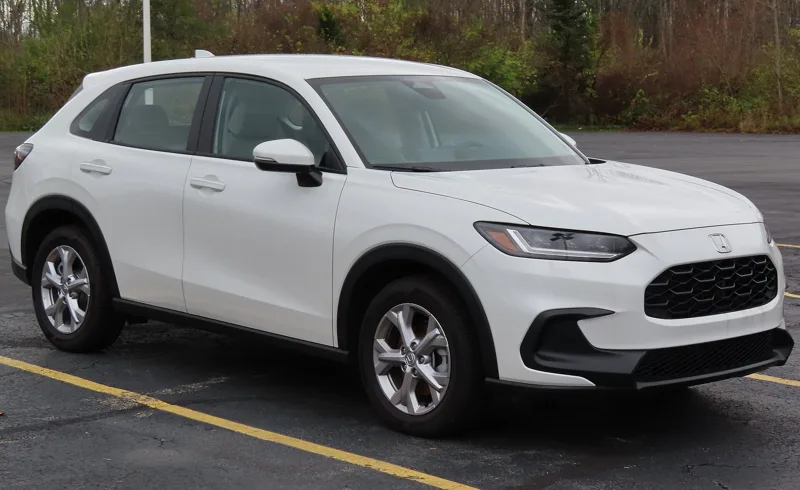
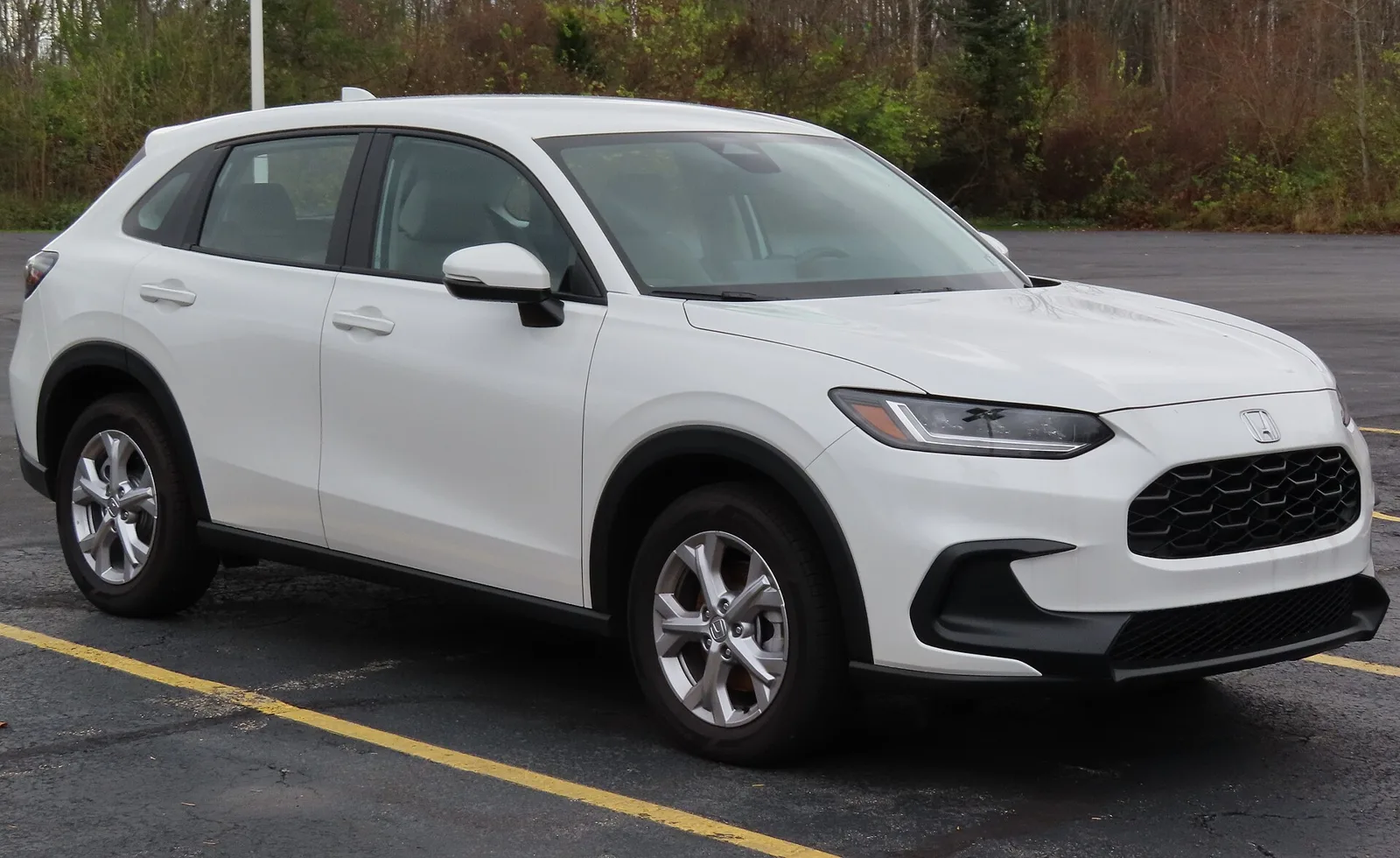
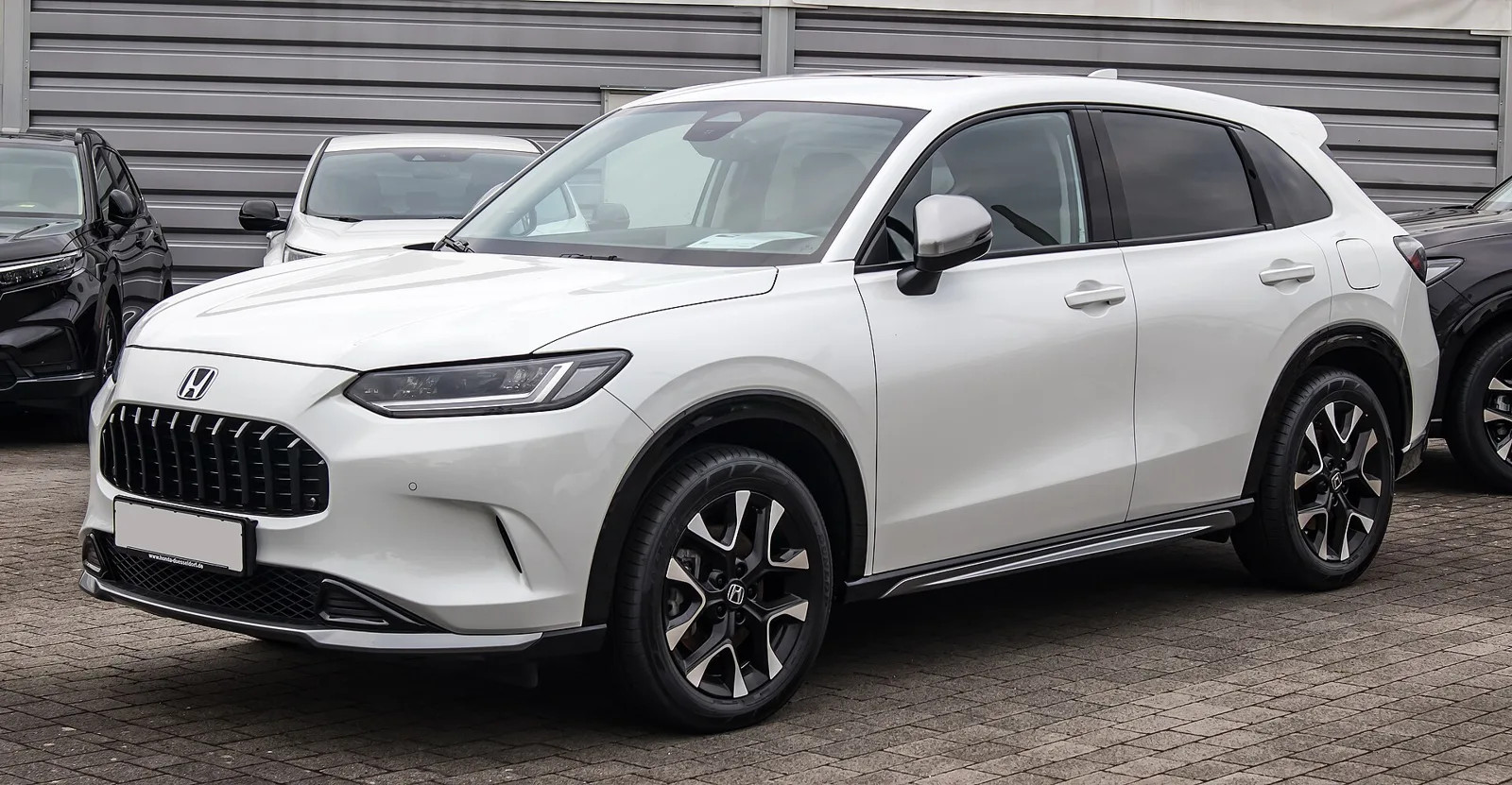
The ZR-V is a compact crossover SUV in the C-segment, called the HR-V in North America and China. It sits between the global HR-V, Vezel or XR-V and the larger CR-V, and shares its platform with the eleventh-generation Civic. Shuichi Ono led development.
The car made its debut in America on 4 April 2022, badged as the third-generation HR-V and set apart from the global model to suit US customers. Sales there began on 7 June 2022 for the 2023 model year. Later launches in China and Europe used the ZR-V name because it is sold alongside the global HR-V in those markets. The name stands for Z Runabout Vehicle, according to Honda, a reference to Generation Z and unrelated to the Honda Z microcars.
Where a car is built depends on where it is sold. Chinese models come from GAC Honda as the ZR-V and from Dongfeng Honda as the HR-V, and European cars, which use a full hybrid powertrain as standard, are built at GAC Honda's Huangpu plant in China. North American cars are built in Celaya, Mexico.
What engines does the Honda ZR-V use?
Two engines cover most of the world: a 1.5-litre turbocharged petrol and a 2.0-litre e:HEV petrol hybrid. Some Latin American and North American cars use a plain 2.0-litre petrol instead.
In North America the 2.0-litre engine makes 158 hp (118 kW; 160 PS) at 6,500 rpm and 138 lb ft (187 Nm) at 4,200 rpm, with optional all-wheel drive, in LX, Sport and EX-L trims. The 2026 model-year HR-V update, in May 2025, brought refreshed styling and a 9-inch touchscreen with wireless Android Auto and Apple CarPlay, plus wireless charging as standard. The 2023 HR-V earned a Top Safety Pick+ from the Insurance Institute for Highway Safety.
Elsewhere the mix varies by market:
- Japan: announced in July 2022, with sales from 8 September 2022 that temporarily replaced the CR-V. X and Z trims offer the turbo petrol or the e:HEV, with front-wheel drive or all-wheel drive. The Black Style trim arrived in June 2024, and in March 2026 the turbo petrol was dropped, leaving the line hybrid-only. A Cross Touring was added the same year.
- United Kingdom: launched on 4 July 2023 in Elegance, Sport and Advance trims, with the 2.0-litre e:HEV as the only powertrain.
- Australia: launched on 22 May 2023 in X, L and LX trims, with the hybrid initially exclusive to the LX. In May 2026 the hybrid reached the X and L, and the turbo was dropped on every trim except the X.
- India: the e:HEV arrived on 22 May 2026, and on 25 July 2026 Honda launched the flagship as a fully imported car at 47,99,000 rupees ex-showroom. Honda confirmed that the first two batches allocated to India had sold out.
- Egypt: a single EX trim with the 1.5-litre turbo, producing 180 hp (134 kW; 182 PS) and 240 Nm, from 8 July 2024.
- Hong Kong, Singapore and Brunei: sold only as the e:HEV, launched on 27 April 2023, 26 January 2026 and 5 September 2026 respectively.
China received a 1.5-litre turbo when the ZR-V was unveiled in May 2022, and the Dongfeng-built HR-V followed in February 2023. The GCC markets got the LX and EX with the turbo from 2 June 2023. Argentina (28 September 2023) and Brazil (30 October 2023) use the 2.0-litre petrol, as does Mexico, where sales began on 14 June 2022 in Uniq, Sport and Touring trims. New Zealand has Turbo and Sport variants.
How do the Honda Logo, e and ZR-V compare?
| Feature | Logo | e | ZR-V |
|---|---|---|---|
| Built | 1996-2001 | 2020-2024 (Japan) | From 2022 |
| Body | Supermini hatchback | Five-door electric supermini | Compact crossover SUV |
| Power | 66 PS (TS 91 PS) | 100 or 113 kW | 158 hp (North America 2.0-litre) |
| Fuel | 1.3-litre petrol | 35.5 kWh battery | Petrol or 2.0-litre hybrid |
| Drive | Four-wheel drive offered | Rear-wheel drive | Front-wheel or all-wheel drive |
| Fate | Replaced by the Fit in 2001 | Ended January 2024 | Still on sale |
What is left of the Logo and the e, and where is the ZR-V still launching?
For the Logo and the e, the story is closed. The Logo gave way to the Fit in June 2001. Honda announced in late 2023 that the e would end in January 2024 with no plans for a second generation, and it has since continued its European electrification with the e:Ny1, the battery-electric version of the HR-V.
The ZR-V is still spreading. Brunei and India have both received the e:HEV in 2026, Japan's line-up is hybrid-only, and Australia has widened its hybrid range. The Black Style trim in Japan was updated in February 2026 with a honeycomb grille and darker alloy wheels.