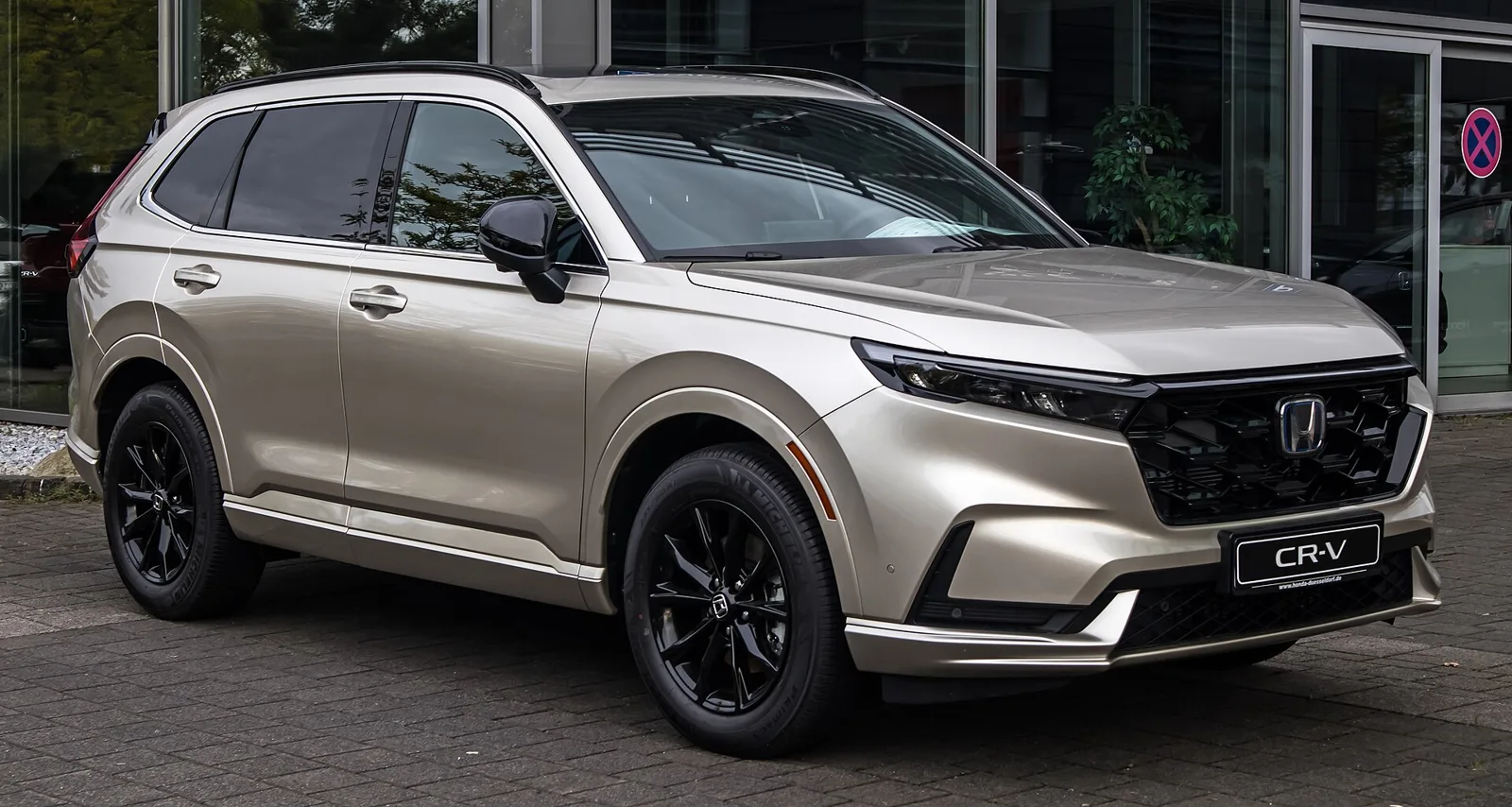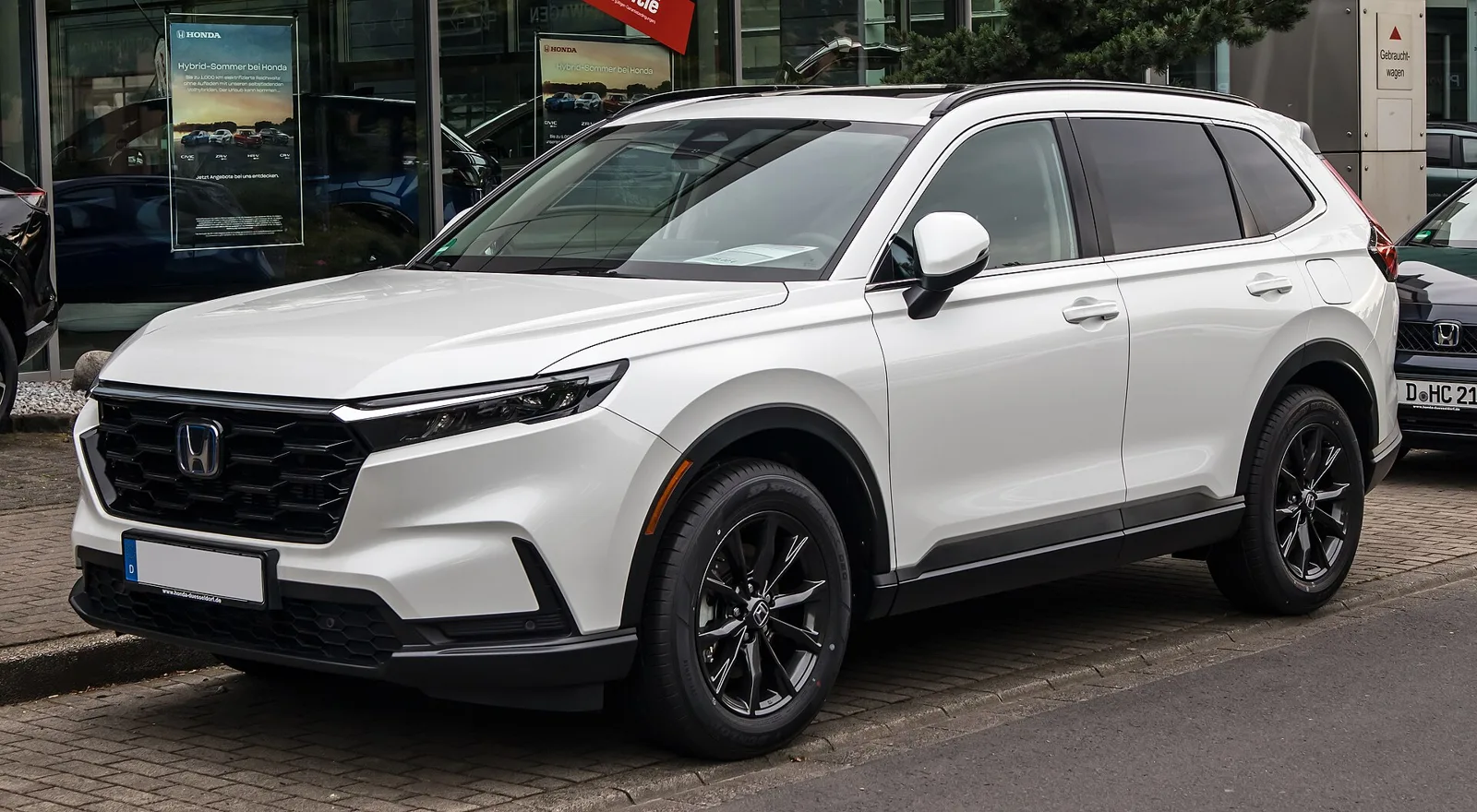
Honda Architecture platform, a 1.5-litre turbo petrol or three electrified powertrains, and a rollout across Asia, Europe and the Americas.
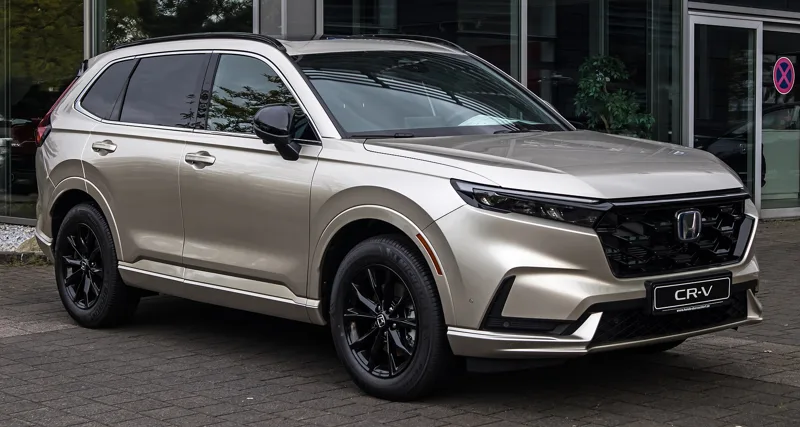
Built from 2022, this compact crossover rides on the Honda Architecture platform shared with the eleventh-generation Civic. It offers a 1.5-litre turbo petrol and three electrified powertrains, and it replaced the fifth-generation model in markets across Asia, Europe and the Americas.
Honda's sixth-generation CR-V is a compact crossover built on the Architecture platform it shares with the eleventh-generation Civic. It replaced the fifth-generation model, and its line-up now runs from a 1.5-litre turbo petrol to a hydrogen fuel cell version.
Two strategies run through the rollout. Canada, Mexico and Argentina kept a turbocharged petrol option, while Europe, Brazil and Thailand moved to hybrid power only.
Production started in September 2022 at Honda's plant in Ontario, Canada, where the prototype design and production process had been completed. The car was unveiled on 12 July 2022 and then shared with Honda plants worldwide.
What changed in the sixth-generation CR-V?
The car gained 69 mm (2.7 in) in overall length and 40 mm (1.6 in) in wheelbase. Mechanical changes included a stiffer front subframe and a new hill descent system, while the electrified versions added a fresh layer of choice for buyers.
US plants began production shortly after the Ontario start, so the model reached North America and Canada on a short timetable.
A compact crossover that went hybrid-only in several markets while keeping a petrol option elsewhere.
Why does the shared platform matter?
The Honda Architecture platform is shared with the eleventh-generation Civic, so the two cars draw on one engineering base. That is why the CR-V and Civic share so much of their basic structure, and a shared base lets Honda spread development work across models.
The same architecture stretches to different seating needs. The CR-V is offered in 5-seater and 7-seater layouts, although the 7-seat version is not sold in the Americas, Japan or Europe.
Regional demand therefore shapes the range as much as engineering does, and the line-up differs sharply from one market to the next.
Size, seats and the longer hood
The extra length gave the cabin more room where it counts. Second-row legroom increased by 15 mm (0.6 in), and the seats can recline up to 10.5 degrees, a useful adjustment on long trips.
Honda moved the A-pillars rearward by 119 mm (4.7 in) to create a longer hood, a visual choice similar to the one it made on the eleventh-generation Civic. The base of each A-pillar also sits 71 mm (2.8 in) further outward and 35.6 mm (1.4 in) lower than the previous CR-V's.
How did the chassis and all-wheel drive change?
A stiffer front subframe and a repositioned steering rack improved feel and accuracy. The rear subframe was also stiffened to support a retuned multi-link suspension, with a 15 percent higher spring rate for the upper spring mount. Honda used these changes to sharpen the car's handling.
Buyers can add all-wheel drive, branded Real Time AWD with Intelligent Control System, which can send up to 50 percent of engine torque to the rear wheels. That helps traction in slippery conditions such as snow and mud, which is where a driver most needs it.
What is hill descent control on the CR-V?
Hill descent control is new for the CR-V with this generation. It holds the car at a chosen speed when descending, and the driver can set that speed below 19 km/h (12 mph). That matters most off road.
TrailSport styling and equipment
The TrailSport arrived in April 2025 for the 2026 model year in North America. It rides on 18-inch Shark Gray alloy wheels with all-terrain tyres, along with black exterior trim accents and orange TrailSport badges on the grille and tailgate.
The TrailSport uses the 2.0 e:HEV hybrid powertrain and Real Time AWD with Intelligent Control System.
Outside North America, the TrailSport name does not appear in the line-up.
Which electrified powertrains does the CR-V use?
The CR-V is offered with a 2.0-litre Atkinson-cycle four in the e:HEV hybrid, a plug-in e:PHEV and a hydrogen e:FCEV. Its gasoline alternative is a 1.5-litre turbocharged petrol engine. Honda sells three electrified versions globally.
In North America the hybrid is marketed simply as Hybrid.
How does the e:HEV hybrid work?
The e:HEV pairs a 2.0-litre Atkinson-cycle four with an e-CVT and one or two electric motors. A 1.06 kWh battery supports the system, which produces 152 kW (204 hp; 207 PS) in total.
The hybrid was available from the model's introduction, which makes it the most established of the electrified routes.
The e:HEV is a power-split hybrid, so the engine can drive the wheels directly or generate electricity for the motors. That flexibility is what lets the system stay efficient across a range of speeds.
The e:PHEV and the hydrogen e:FCEV
The e:PHEV debuted in China in April 2023 and carries a larger 17.7 kWh lithium-ion battery. It has since been exported to Europe, where Honda wants electrified models only.
The larger battery is what separates the plug-in from the standard hybrid.
The e:FCEV was unveiled in February 2024 at the H2 and FC Expo in Japan. It carries two high-pressure hydrogen tanks, 4.3 kg (9.5 lb) in total, alongside a 17.7 kWh battery.
Its EPA estimated range is 435 km (270 mi), with a battery electric range of 47 km (29 mi). Compared with the regular CR-V it has a different front fascia, clear taillight lenses and e:FCEV badging.
Production began on 5 June 2024 at the Performance Manufacturing Center in Marysville, Ohio. In the US the e:FCEV is available only by lease, through 12 dealerships in California, and Honda includes hydrogen fuel credits in the agreement.
Japan received the e:FCEV in July 2024, again on a lease-only basis.
The hydrogen version is therefore a limited test rather than a mass-market product.
Did the diesel engine survive?
The diesel option of the outgoing CR-V was dropped for this generation. Diesel had been sold in markets such as Europe, Thailand and the Philippines, but it no longer appears in the sixth-generation line-up.
The 1.5-litre turbocharged petrol stayed as the non-hybrid alternative, so buyers now choose between a turbo petrol and an electrified version rather than a diesel.
Dropping diesel simplified the range, leaving the hybrid and the turbo petrol as the two real choices.
What trims did North America get?
The US model started with EX, EX-L, Sport and Sport Touring trims, and the LX base trim arrived later in 2023. Canada offered LX, Sport, EX-L and Touring, and all Canadian variants came with all-wheel drive as standard.
The US Sport-L hybrid arrived for the 2024 model year and was priced under the Sport Touring.
In Canada the gasoline-only EX-L was dropped in May 2024 for the 2025 model year. Mexico began with Turbo, Turbo Plus and Touring trims, and a hybrid Touring variant followed later.
Europe goes electrified only
Honda committed to offering only electrified models in Europe, so the CR-V there is available only with the e:HEV hybrid and the e:PHEV plug-in hybrid. There is no pure petrol version to choose from.
The car was unveiled in Germany on 12 May 2023, and UK sales began on 10 August 2023 in Elegance and Advance trim levels. The Advance grade could also be specified with the e:PHEV plug-in hybrid as an option.
Dongfeng Honda's plant in China also supplies e:HEV and e:PHEV models to more than 20 European countries, so the European cars are part of a wider export chain.
What did the Asian rollout look like?
China's version is built by Dongfeng Honda, and GAC Honda sells a related Breeze variant launched on 13 December 2022. In Southeast Asia, Thailand debuted the car on 20 March 2023 and later became hybrid-only.
Thailand also supplies the cars for Japan and Australia. Unlike earlier generations, the Japanese CR-V is imported from Thailand, and the Australian car comes from the same plant.
Japan's launch came on 26 February 2026 with e:HEV RS and RS Black Edition variants. The RS uses front-wheel drive with all-wheel drive as an option, while the Black Edition is all-wheel drive only.
Taiwan launched the car on 19 July 2023 with VTi-S, S and Prestige variants, all powered by the 1.5-litre turbocharged petrol. A hybrid S and Prestige followed in June 2026.
Thailand's line-up became hybrid-only in November 2025, and Indonesia followed in February 2026. Two large Southeast Asian markets therefore no longer sell a petrol CR-V at all.
How did Latin America and the Middle East receive the car?
Argentina opened on 10 January 2024 with LX and EX (2WD) grades, and an Advanced Hybrid arrived in October 2024. The EXL (AWD) with the 1.5-litre turbo petrol was added in January 2025.
Brazil launched on 26 February 2024 after a two-year hiatus, with only the Advanced trim using the 2.0-litre e:HEV. The one-trim approach kept the Brazilian line-up simple.
The Middle East got the car on 15 November 2023 with a 1.5 turbo and CVT, available in DX, EX, LX and Touring trims. Honda Sensing came standard across the range.
Oceania and Southeast Asia
Australia went on sale on 1 September 2023 in X, L, LX and RS trims, with the e:HEV hybrid exclusive to the RS at launch. 7-seat versions were offered on the X and LX.
Australian buyers therefore choose from four grades that mix petrol and hybrid power.
New Zealand followed in October 2023 with Sport AWD, Sport 7 and RS variants, while Brunei opened on 24 August 2023 with one grade.
Indonesia launched the car on 10 August 2023 with 1.5 Turbo and 2.0 RS e:HEV variants, and the car became hybrid-only there in February 2026. Malaysia followed on 14 December 2023 with S, E and V AWD grades, and the 2.0 e:HEV RS arrived a month later.
That staggered launch let the hybrid follow the petrol grades rather than arrive alongside them.
The Philippines launched on 13 September 2023 with three grades, Singapore on 11 January 2024, and Vietnam on 25 October 2023 with four grades. Vietnamese petrol models are assembled locally, while the e:HEV was imported before local assembly began in February 2026.
Did the CR-V need any product updates?
A product update was issued on 6 November 2024 for CR-V models built in 2024 that might develop power steering gearbox issues. The Malaysian case is a reminder that new platforms still need early fixes, even from a mature maker.
Honda Sensing remained standard on every Malaysian grade, so the safety kit did not depend on trim choice. The Accord is not sold in Malaysia, which made the CR-V the flagship in that market.
Key figures for the sixth-generation CR-V
| Specification | Detail |
|---|---|
| Platform | Honda Architecture (HA), shared with the eleventh-generation Civic |
| Unveiled | 12 July 2022 |
| Length and wheelbase | 69 mm (2.7 in) longer; wheelbase 40 mm (1.6 in) longer |
| Second-row legroom | 15 mm (0.6 in) more; seats recline up to 10.5 degrees |
| Gasoline engine | 1.5-litre turbocharged petrol |
| e:HEV hybrid | 2.0-litre Atkinson-cycle four, 1.06 kWh battery, 152 kW (204 hp; 207 PS) |
| e:PHEV battery | 17.7 kWh lithium-ion |
| e:FCEV hydrogen | 4.3 kg (9.5 lb) in two high-pressure tanks |
| e:FCEV range | 435 km (270 mi) EPA estimate; 47 km (29 mi) battery electric |
| Hill descent control | Selectable under 19 km/h (12 mph) |
| Rear torque split | Up to 50 percent of engine torque with Real Time AWD |