A sloping-roof Accord crossover that sold slowly and a factory CNG Civic that earned awards but never found a mass audience.
The Honda Crosstour was a sloping-roof crossover built on the Accord platform from 2009 to 2015, criticised for its looks and outsold by rivals. The Civic GX was a factory compressed-natural-gas Civic sold from 1998 to 2015, winning Green Car of the Year for 2012.
When Honda posted two studio photos of the Accord Crosstour on Facebook, The Truth About Cars reported that the reaction was universally negative, with many people calling the car "ugly". Honda replied that its research suggested the styling tested well among crossover shoppers. Honda dropped the Crosstour after the 2015 model year because it sold slowly.
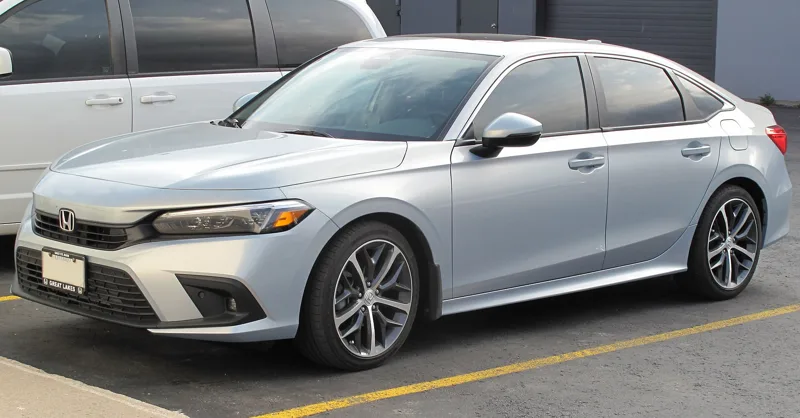
Another Honda from the same years, the Civic GX, looked like an ordinary Civic. What set it apart was what went into the tank, and it earned a Green Car of the Year award for it.
Honda Crosstour: a sloping-roof Accord crossover
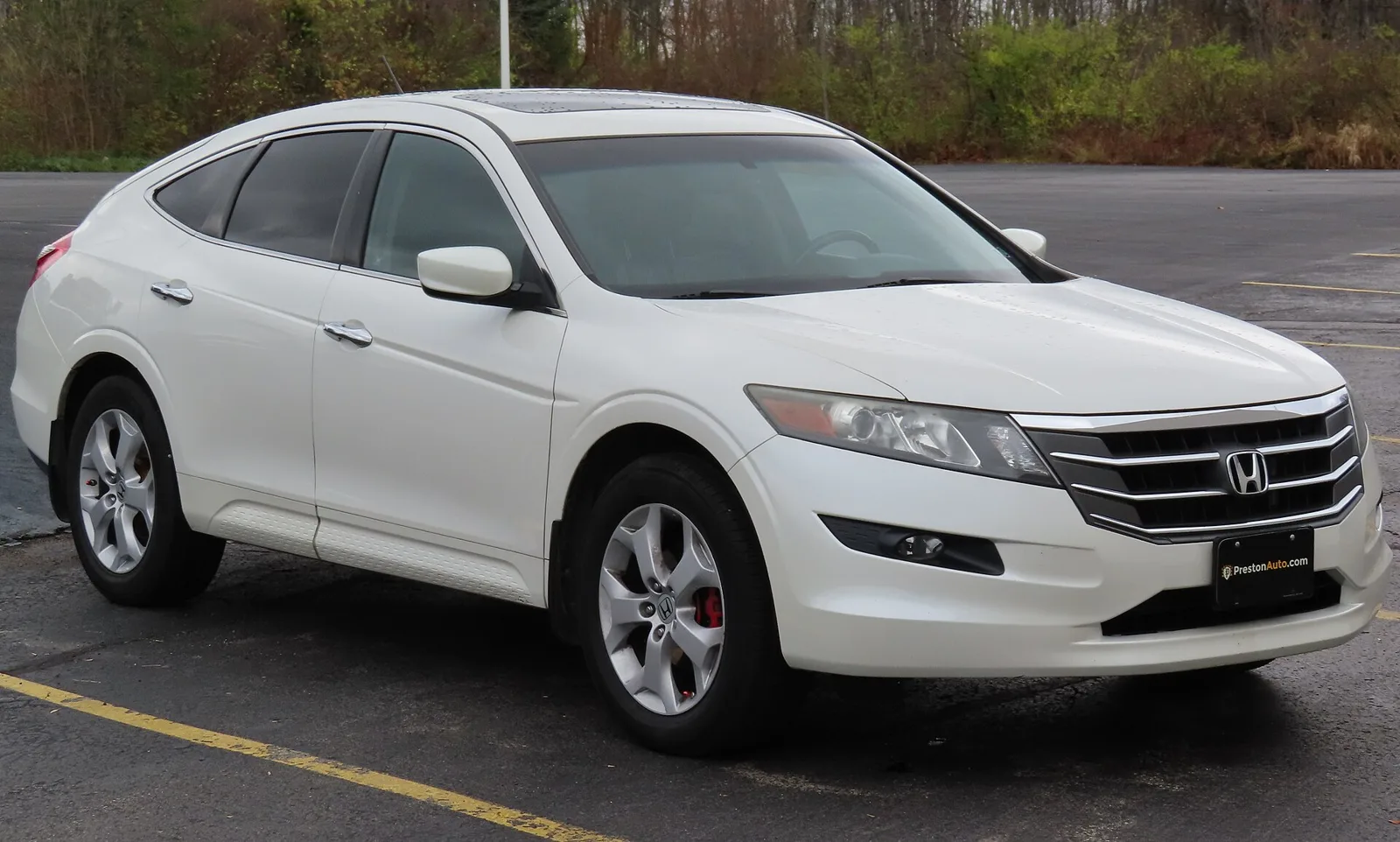
The Honda Crosstour, called the Accord Crosstour at first, is a mid-size crossover SUV with a sloping rear roofline, built on the platform of the North American eighth-generation Accord. Sales began in November 2009 for the 2010 model year. Honda sold it as a "hatchback" or "wagon" version of the Accord.
There were two engines. A 3.5-litre V6 came with front-wheel or all-wheel drive, and a 2.4-litre four-cylinder with front-wheel drive only. Prices started at $29,670, well above the Accord sedan, which started under $23,000. For the 2012 model year Honda dropped the "Accord" prefix and restyled the grille. The four-cylinder for front-drive models was released in late 2011 and went on sale in early 2012.
The Crosstour's main rival was the Toyota Venza, a crossover wagon built on the Camry, the Accord's perennial competitor. Like the Venza, which was meant to replace the Camry wagon, it was seen as the successor to the Accord wagon.
In Honda's crossover range it sat between the compact CR-V and the full-size Pilot. Next to the Pilot it was longer, but had two rows of seats rather than three and roughly 50 cubic feet less interior space. The similarly styled Acura ZDX, launched at the same time, did not share its platform: that car used the Pilot and Acura MDX base. The Crosstour was sold in the United States, Canada, Mexico, China, the Middle East, Southeast Asia and Russia, and Guangqi Honda built and sold it in China.
Honda Crosstour 2013 facelift
Honda refreshed the car for the 2013 model year. A concept version was shown at the New York International Auto Show on 4 April 2012, and the revised car went on sale on 20 November 2012 with a $500 price cut and more standard equipment. The interior was redesigned. A more powerful, more efficient J35Y1 V6 with a six-speed automatic replaced the J35Z2 V6 and five-speed automatic. The EPA rated V6 models at 20 city, 30 highway and 23 combined miles per gallon for front-wheel drive and 19, 28 and 22 for all-wheel drive. Every trim gained a 10-way power driver's seat, with two-way lumbar adjustment, and an auto-dimming rear-view mirror.
Safety equipment grew as well. The 2013 Crosstour could be ordered with Forward Collision Warning and Lane Departure Warning. A reversing camera was standard on all 2012 models, with a fancier one offering wide and top views as an option, and for 2013 every trim except the base EX got a LaneWatch camera in the passenger-side mirror.
Why the Crosstour divided opinion
Numerous publications and online polls criticised the shape. Honda had tried to make the car sleek by stretching an Accord coupe to fit rear doors, and critics found an abnormally long bonnet, an awkwardly short tail and an ungainly rear overhang that looked unattractive from the rear three-quarter angle. The grille was derided as alligator-like.
Some supporters argued the Crosstour influenced fastback sedans such as the tenth-generation Civic and the Audi A7, which had better proportions. Others noted that coupe-style crossovers such as the BMW X6, BMW 5 Series GT and Acura ZDX had also been criticised for looks, but were luxury cars costing far more than the Honda. The 5 Series GT and ZDX were also poorly received in North America.
The car had plenty going for it. It rested on the well-reviewed Accord, and its hatchback gave it almost double the sedan's storage space. Passenger room was largely the same as the roomy Accord sedan. The drawback was that the sleek profile made the load area less practical than the boxy Toyota Venza and Subaru Outback, which were based on the Camry and Legacy. Price was the other issue. Honda first offered a single trim, the EX-L V6, with only all-wheel drive and navigation as options, so the entry price was considerably higher than the Venza's or Outback's, which offered many trims and a base four-cylinder. The Venza and Outback went on to outsell the Crosstour in the mid-size two-row crossover class.
The price gap was real. A Crosstour started at $29,670 while the Accord sedan it was built on started below $23,000, a large gap for extra cargo room and a hatchback. Buyers who valued load space could find it in the Venza or Outback for less, and those who wanted an Accord's driving manners could take the sedan.
The end of the Crosstour
On 8 April 2015 Honda announced that it would end Crosstour production at the end of the 2015 model year because of slow sales. The final car was built on 31 August 2015. Honda also wanted production line space for the CR-V, Acura RDX and, in 2017, the Acura MDX.
The Crosstour was dropped worldwide, but in 2016 Honda introduced the Avancier in China, which effectively became its spiritual successor there. The Avancier is a mid-size crossover developed by the Guangqi Honda joint venture for the Chinese market alone, previewed by the Honda Concept D at the 2015 Auto Shanghai. Unlike the Crosstour's fastback shape, the production Avancier has a more conventional SUV body, is positioned as a premium offering and has turbocharged engines available.
In North America, Honda filled the gap in the mid-size two-row segment with the Passport, introduced for the 2019 model year. It is powered only by the 3.5-litre V6, with front-wheel or all-wheel drive.
Honda said its research suggested the styling tested well among crossover shoppers.
Honda Civic GX: a Civic that ran on natural gas
The Honda Civic GX was the only car built by a manufacturer to run on compressed natural gas, or CNG, and sold in the United States to buyers who were not fleets. Honda sold it to fleets in all 50 states. At first it was available at retail in only four states, California, New York, Utah and Oklahoma, but later retail sales reached 35 states. Honda made the GX at its Greensburg, Indiana plant alongside regular Civics from late 2009, after earlier production at East Liberty, Ohio. The last model year was 2015.
How the Civic GX began
The Civic GX first appeared in 1998 as a factory-modified Civic LX built to run only on CNG. In 1998 it cost $4500 more than a comparable LX. It looked and drove like an ordinary Civic LX but could not run on petrol. In 2001 the EPA rated it the cleanest-burning internal combustion engine in the world.
The city of Los Angeles first leased GXs for parking enforcement officers and other employees, as a live pre-production test. The car followed the LX's model year changes until 2001, when a continuously variable transmission replaced the four-speed automatic. In 2006 a five-speed automatic returned, which improved fuel economy and stretched range to 250 miles. Special orders were open to consumers in a few states in 1998, notably California and Colorado.
The GX never made big numbers. Fewer than a thousand a year were built. The 2007 Civic GX reached New York retail buyers in October 2006, the public in Utah in July 2009 and Oklahoma in April 2010. Natural gas prices were favourable in Oklahoma and filling stations were plentiful, and natural gas producers headquartered there promoted conversions. State incentives also led United Parcel Service to convert part of its delivery fleet to CNG. After December 2010 the GX could be bought by fleets in all 50 states, and in the autumn of 2011 retail sales grew to 35 states.
Civic GX specifications
| Period | Engine | Transmission |
|---|---|---|
| Original GX, 1998 | 1.6-litre inline-four | Four-speed automatic |
| 2001 makeover | 1.7-litre inline-four | Continuously variable |
| From 2006 | 1.8-litre inline-four | Five-speed automatic |
The GX's compression ratio is 12.5:1, higher than most petrol cars sold in the United States. Detonation does not trouble it, because natural gas is rated at about 120 octane. The price of that efficiency is performance. The 2012 Civic Natural Gas made 110 hp against 140 hp for the equivalent four-door LX, and weighed 2848 lbs against 2705 lbs. It has been timed from rest to 60 miles per hour (100 km/h) in 12.6 seconds.
The fuel sits in a high-pressure cylinder in the boot that holds 8.0 gasoline gallon equivalents at 3,600 psi (250 bar). A gasoline gallon equivalent is the amount of gas that carries the same energy as a gallon of petrol, which is what lets fuel economy figures for the two fuels be compared. Honda estimated 225 to 250 miles (362 to 402 km) from a full tank, a figure that improved for 2012, but independent tests found 180 to 200 miles (290 to 320 km) and "just over 200 miles" (about 320 km). The EPA rated the 2009 Civic GX at 24 equivalent miles per gallon in the city and 36 on the highway, while independent mixed driving gave "nearly 32" and 26.8. On CNG at an average of $1.93 per gasoline-equivalent gallon, driving 40 km (25 miles) in mixed conditions was estimated to cost $1.47. The GX also qualified for high-occupancy vehicle lanes in California, Arizona, Utah and other states.
Home refuelling
Owners could refuel at home with the Phill Home Refueling Appliance, which attaches to a natural gas supply at a house or business and compresses the gas into the tank through a hose. It needs a 240-volt supply and draws 800 watts in use. Honda did not recommend it because some gas supplies can carry moisture and chemical contamination, and it reserved the right to void the warranty on a car whose fuel system showed contamination when inspected.
Awards and the end of the GX
In 2000 the American Council for an Energy-Efficient Economy rated the Civic GX the greenest vehicle of the year, cleaner than the General Motors EV1, before the SULEV-rated Honda Insight hybrid took over a year later. The GX returned to first place after the Insight went out of production, until the Mitsubishi i-MiEV beat it in 2012. In 2014 it ranked tenth, behind several hybrids and electric cars. The third-generation GX won the Green Car Journal's 2012 Green Car of the Year in November 2011 at the Los Angeles Auto Show.
Honda said it had sold about 16,000 natural-gas vehicles since launch, mostly to taxi and commercial fleets. John Mendel, executive vice president of American Honda Motor Company, said Honda was phasing out natural-gas development to concentrate on hybrids and electric cars. He blamed the lack of CNG fuelling infrastructure, saying that even after improvements it was never as convenient as petrol, and that Honda had given the car a long run.