A modular pickup shown as an ambulance and a jeepney, a three-row SUV tuned for Southeast Asian roads and a revived Datsun city car with a safety problem.
The Toyota Hilux Champ is a simple, affordable two-door pickup and chassis cab sold since 2023, mainly in emerging markets. The Mitsubishi Destinator is a three-row compact SUV launched in 2025. The Datsun Go was a Nissan-built city car and mini MPV sold from 2014 to 2022 in India, South Africa and Indonesia.
Before it sold a single one, Toyota had shown its newest pickup as a mobile cafe, an ambulance, a camper and a modern jeepney. The Hilux Champ is a deliberately plain truck for emerging markets, and it has company here: the Mitsubishi Destinator, a three-row SUV tuned for Southeast Asian roads, and the Datsun Go, a revived-brand city car that earned a zero-star crash rating.
What is the Toyota Hilux Champ?
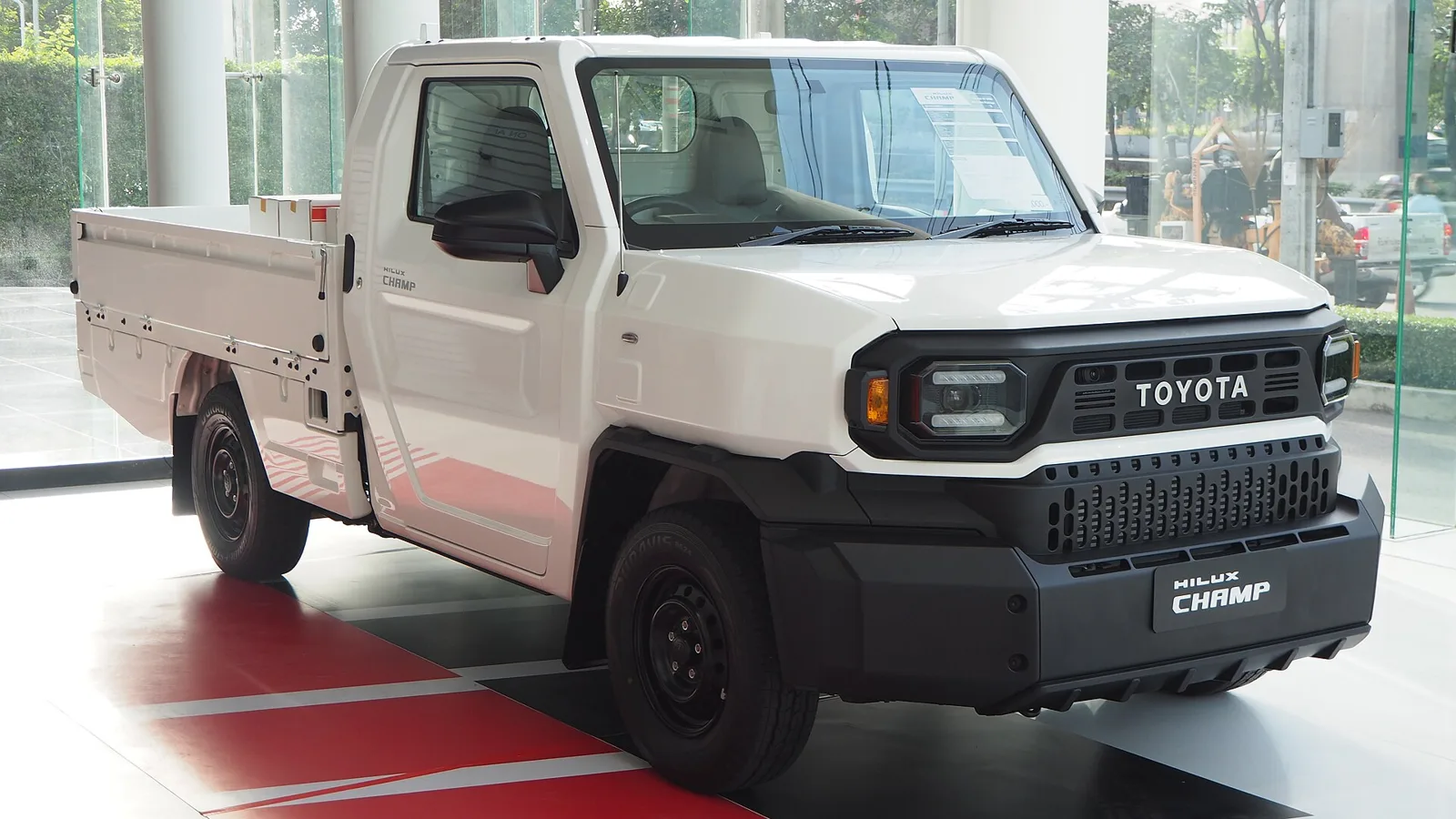
The Hilux Champ is a light commercial vehicle that Toyota has built since 2023. Based on the Hilux, it sits below it as a simpler, more affordable alternative. It comes as a two-door pickup or a two-door chassis cab, and it mainly targets emerging markets.
The IMV platform underpins it. Toyota Daihatsu Engineering and Manufacturing engineered the design together with teams in Japan and Australia, under chief engineer Jurachart Jongusuk, who also ran the Hilux facelifts of 2020 and 2024 and the Fortuner's 2020 update.
The styling is rugged and boxy. The car was conceived around modularity, so that body builders can bolt a customised rear section onto the chassis, which makes conversions easier. Underneath it shares the Hilux's ladder frame, with leaf springs at the rear axle, but it has a shorter bonnet and cab for city use and a modified steering rack. The short-wheelbase version turns in a circle of 4.9 metres (16.1 ft).
Toyota showed the same pickup as a mobile cafe, an ambulance, a camper and a modern jeepney.
How was the Toyota Hilux Champ revealed?
As a concept called the IMV 0, shown on 14 December 2022 as part of the 60th anniversary celebrations of Toyota Motor Thailand, with Akio Toyoda as host. He told guests that the company used the IMV 0 name internally, that the official launch was over a year off, and that he wanted them to see it first.
It then toured. Indonesia saw it as the Rangga Concept during the 30th Gaikindo show, which ran from 10 to 20 August 2023. On 22 August 2023 the Philippines met it as the Next Generation Tamaraw Concept, at the 35th birthday of Toyota Motor Philippines. It also appeared at the Japan Mobility Show between 26 October and 5 November 2023.
Along the way Toyota demonstrated the modularity with a mobile cafe, a cargo truck, an ambulance, an off-road conversion, a flat-deck street truck inspired by racing, a camper and a modern jeepney. Thailand hosted the reveal of the production version on 27 November 2023.
What engines does the Toyota Hilux Champ have?
Buyers can pick a 2.0-litre or 2.7-litre petrol engine, or a 2.4-litre diesel. None is new: they come from Toyota's other IMV models, including the Hilux, Fortuner and Innova.
Thailand received it first, on 27 November 2023, with all three engines. It comes in short- and long-wheelbase forms, and the long wheelbase is offered only with the 2.4-litre diesel.
Where does the Toyota Hilux Champ sit in the Toyota range?
Below the regular Hilux. Toyota positions the Champ as the simpler and more affordable alternative. In the Philippines, for example, alloy wheels, power windows, power door locks and power mirrors are available only on the 2.4 GL Dropside long-wheelbase variant.
What is the Hilux Champ called in other countries?
The name changes with the market, and in some places so do the engines and bodies on offer.
| Market | Name | Sales began | Bodies and engines |
|---|---|---|---|
| Thailand | Hilux Champ | 27 November 2023 | Short and long wheelbase; 2.0 petrol, 2.4 diesel, 2.7 petrol |
| Peru | Hilux Stout | 29 August 2024 | Short wheelbase only; 2.4 diesel |
| Indonesia | Hilux Rangga | 15 October 2024 | Short wheelbase only; 2.0 petrol, 2.4 diesel |
| Philippines | Tamaraw | 6 December 2024 | Short wheelbase with 2.0 petrol; long wheelbase with 2.4 diesel |
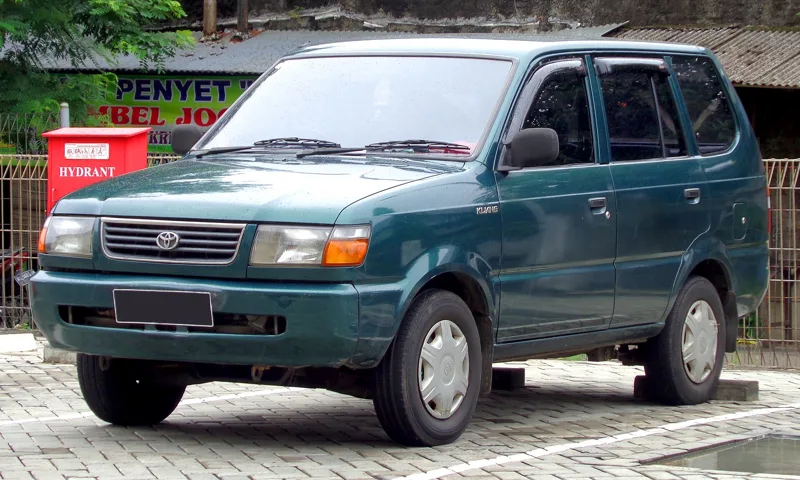
Peru's Stout name comes from the Toyota Stout. Indonesia's Rangga previously named a Kijang variant of the fourth generation, sold from 1997 to 2000, and derives from the Javanese ronggo, meaning hero. The Philippine Tamaraw revives a nameplate last used on the Philippine Kijang from 1976 to 2005, although the vehicle still carries Hilux on its doors and instrument cluster.
The finalised Indonesian model was shown in February 2024 at the 31st edition of the Indonesia International Motor Show, in Standard and High variants. A three-row SUV prototype, the Hilux Rangga SUV Concept, was shown at the nationwide launch. Local coachbuilder New Armada built its entire rear section by full pressing, and the mirrors and tail lights came from the Land Cruiser 79 wagon. It was due to enter production and reach Toyota dealers from 2025.
The Philippine model was revealed in Davao in May 2024 at Toyota's 17th Road Trek, with sales beginning on 6 December 2024 for the 2025 model year. The short-wheelbase 2.0 petrol has a five-speed manual, while the long-wheelbase 2.4 diesel has a five-speed manual or six-speed automatic. It is assembled at Santa Rosa, Laguna, where production began on 28 November 2024 with the 2.4 diesel long-wheelbase cars. The 2.0 petrol short-wheelbase model, announced at launch, slipped to February 2025 while the plant built up capacity.
What is the Mitsubishi Destinator?
Mitsubishi Motors has made the Destinator, a compact crossover SUV with three seating rows, since 2025. It is aimed mainly at emerging markets in Southeast Asia, Latin America, the Middle East, South Asia and Africa. Mitsubishi chose the name hoping it would help drivers and their families pursue new destinations with confidence.
The DST Concept previewed it on 24 October 2024, at the 2024 motor show in the Philippines, with a honeycomb Dynamic Shield grille, vents in the bonnet, T-shaped LED lights, high ground clearance, a panoramic sunroof and a flat dashboard carrying large screens. The production car was unveiled in Jakarta on 17 July 2025, as the third strategic Mitsubishi model for Indonesia after the Xpander and Xforce.
What does the Mitsubishi Destinator look like?
Its design theme is "Gravitas and Dynamism", and it resembles the Xforce, especially in the Dynamic Shield nose, though it keeps most of the DST Concept's elements. A honeycomb acrylic grille leads the front. Along the side are 18-inch alloy wheels, blacked-out pillars and a decorative trim on the C-pillar.
At the back, the Hexaguard Horizon motif from the Xforce, a hexagonal pattern inspired by the Pajero's tailgate-mounted spare tyres, is combined with T-shaped lights. The interior layout is also close to the Xforce. It has an 8-inch digital instrument cluster, a 12.3-inch Smart-link Display Audio touchscreen, ambient lighting in 64 colours, a panoramic sunroof and dual-zone automatic air conditioning that blows from ceiling-mounted vents. Entry-level versions make do with a 4.2-inch display, analogue dials and a smaller 8-inch touchscreen.
The second row folds 40/20/40 and the third row 50/50. Both rows have seatback tables, pockets and under-seat storage trays.
What engine does the Mitsubishi Destinator use?
A single powertrain: the 1.5-litre 4B40 MIVEC turbocharged petrol four, producing 120 kW (161 hp; 163 PS). It runs on the Atkinson cycle with a water-cooled intercooler and feeds a continuously variable transmission that drives the front wheels. Active Yaw Control and five selectable drive modes complete the package.
The suspension is MacPherson struts at the front and a torsion beam at the rear, heavily retuned for road conditions in Southeast Asia, with disc brakes at both ends. Ground clearance is 244 mm (9.6 in) without the undercover, and the approach, breakover and departure angles are 21, 20.8 and 25.5 degrees.
Where is the Mitsubishi Destinator sold, and how safe is it?
Sales in Indonesia began on 23 July 2025 at the 32nd Gaikindo show, in GLS, Exceed and Ultimate trims. A Premium package for the Ultimate adds the Yamaha sound system, powered front seats and a powered liftgate that opens hands-free.
- Philippines, 20 November 2025: GLX, GLS and GT.
- Vietnam, 1 December 2025: Premium and Ultimate.
- Brunei, 20 December 2025: one variant.
- South Africa, 17 March 2026: GLS and Exceed.
Six SRS airbags are standard, and the Mitsubishi Motors Safety Sensing package, called Diamond Sense in Indonesia, adds adaptive cruise control, automatic high beam, blind spot warning, forward collision mitigation, leading car departure notification, an all-round camera monitor and rear cross traffic alert. ASEAN NCAP tested the Destinator in October 2025 and gave it five stars out of five.
What is the Datsun Go?
The Datsun Go and Go+ were a city car and a mini MPV with "5+2" seating, built by Nissan from 2014 to 2022 under the Datsun brand, which Nissan revived in 2013. The name recalls the Dat-Go, Datsun's first car of the early twentieth century. Buyers in India, South Africa and Indonesia were the main targets.
The Go is built on the V platform of the K13 Nissan Micra/March and inherited much of its hardware. In 2018 Nissan added a crossover derivative, the Datsun Cross, which was previewed in 2015 as the Go-cross Concept and was sold only in Indonesia.
Delhi hosted the global unveiling of the Go on 15 July 2013, and Indian sales started in early 2014. Jakarta saw it on 17 September 2013, and it reached Indonesian showrooms in mid-2014 under the government's Low Cost Green Car (LCGC) programme. Its engine is a 1.2-litre (1,198 cc) three-cylinder with twin overhead camshafts and electronic fuel injection, shared with the Micra, giving 67 hp (50 kW; 68 PS) and 104 N.m (77 lbf ft).
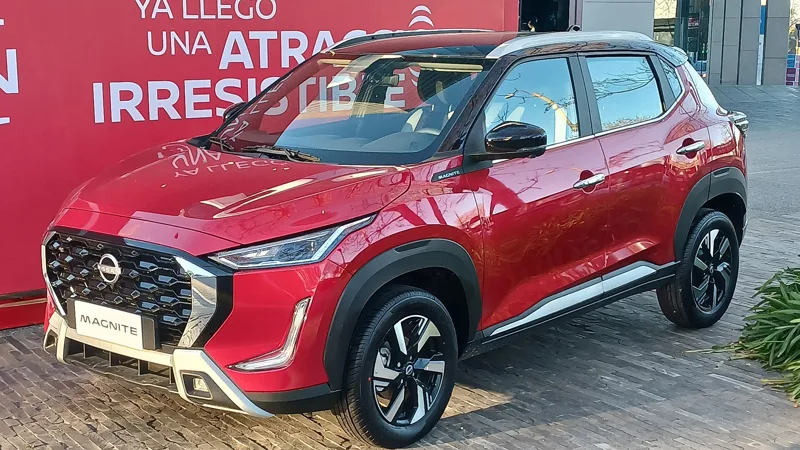
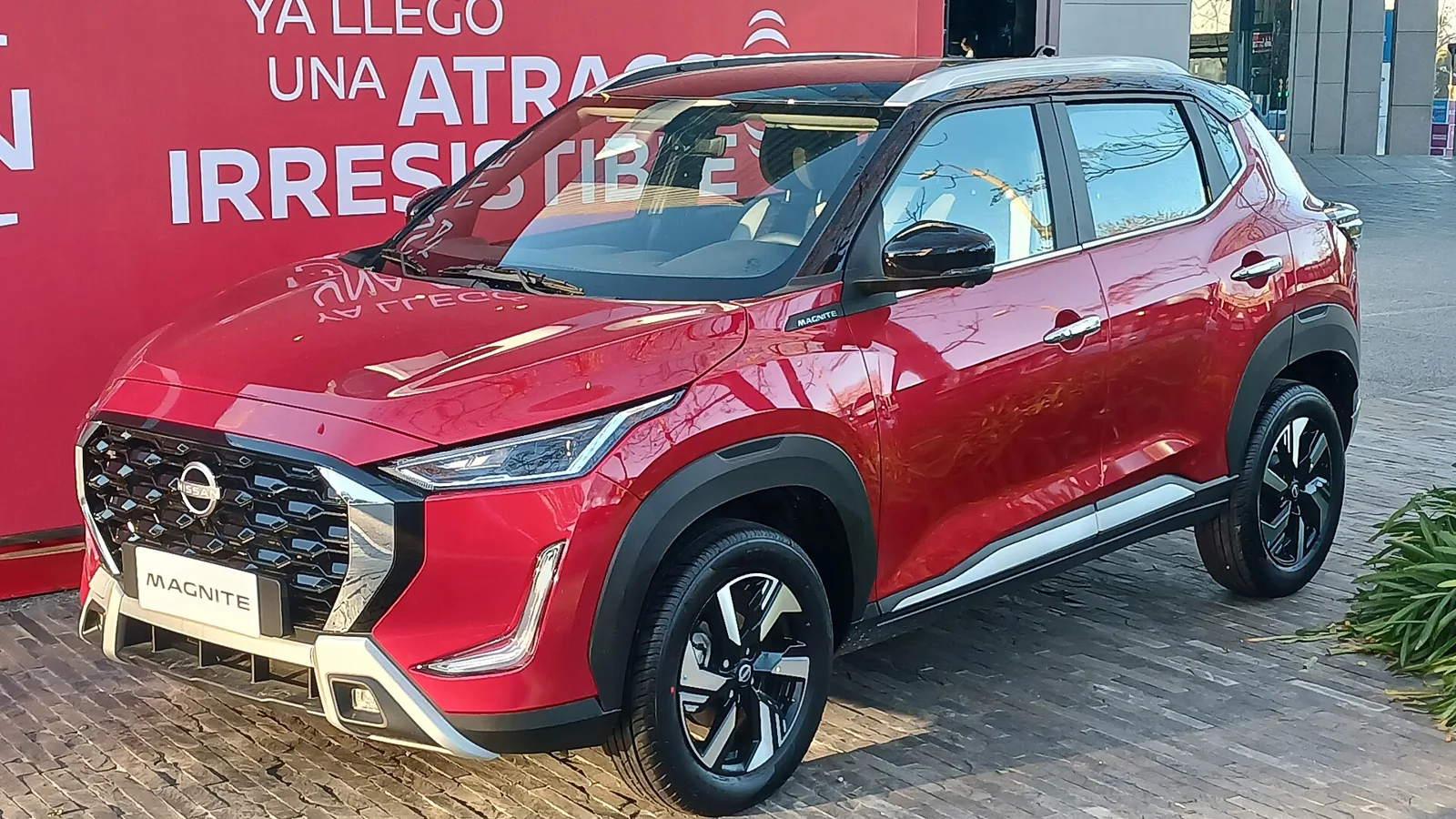
Nissan stopped building the Indonesian Go series in 2020, and the Magnite crossover SUV succeeded it in early 2021. Worldwide production finished in 2022, when Nissan shut down the Datsun brand for a second time.
How did the Datsun Go sell in Indonesia and India?
In Indonesia the Go+ (marketed as Go+ Panca) came first, in May 2014 under the LCGC programme, in five trims named D, A, A Option, T and T Option, joined on 6 August 2014 by a T Style at the top. The Go hatchback (Go Panca) followed that August. By 2015 it came in T, T Option and T Active, and the T Style and T Active both had body kits as standard.
From its launch to May 2015, the Go and Go+ together sold almost 30,000 units in Indonesia, 70 percent of them the Go+. In 2016 Frost and Sullivan named the Go+ its Indonesian value-for-money car of the year, citing market share, product innovation and marketing strategy.
On 7 May 2018 the facelifted Go and Go+ arrived with a CVT automatic and the Cross's dashboard. The CVT cars were briefly left out of the LCGC incentive because of their lower local parts content, which meant a luxury tax. The Go Live special edition with aerokits followed on 2 August 2018, and gained Vehicle Dynamic Control in 2019.
India received the Go+ in 2015 in four trim levels. The maker claims 20.62 km/L (58.2 mpg imperial; 48.5 mpg US), a figure certified by ARAI.
The Datsun Cross reached Indonesia on 18 January 2018 following previews as the Go-cross Concept at Tokyo in October 2015, at India's Auto Expo in February 2016 and at the Indonesian show in August 2016. Its price put it outside the LCGC programme's bracket, so it received no incentive.
How safe was the Datsun Go?
Not very. In a 2014 crash test in India, a Go with no airbags and no ABS scored zero stars from Global NCAP. The structure was so completely wrecked that NCAP's chairman, Max Mosley, wrote to Renault-Nissan CEO Carlos Ghosn asking for the car to be withdrawn from the market.
In 2017 Global NCAP rated a South African Go+ with a driver airbag and no ABS at one star for adult occupants and two stars for infants.