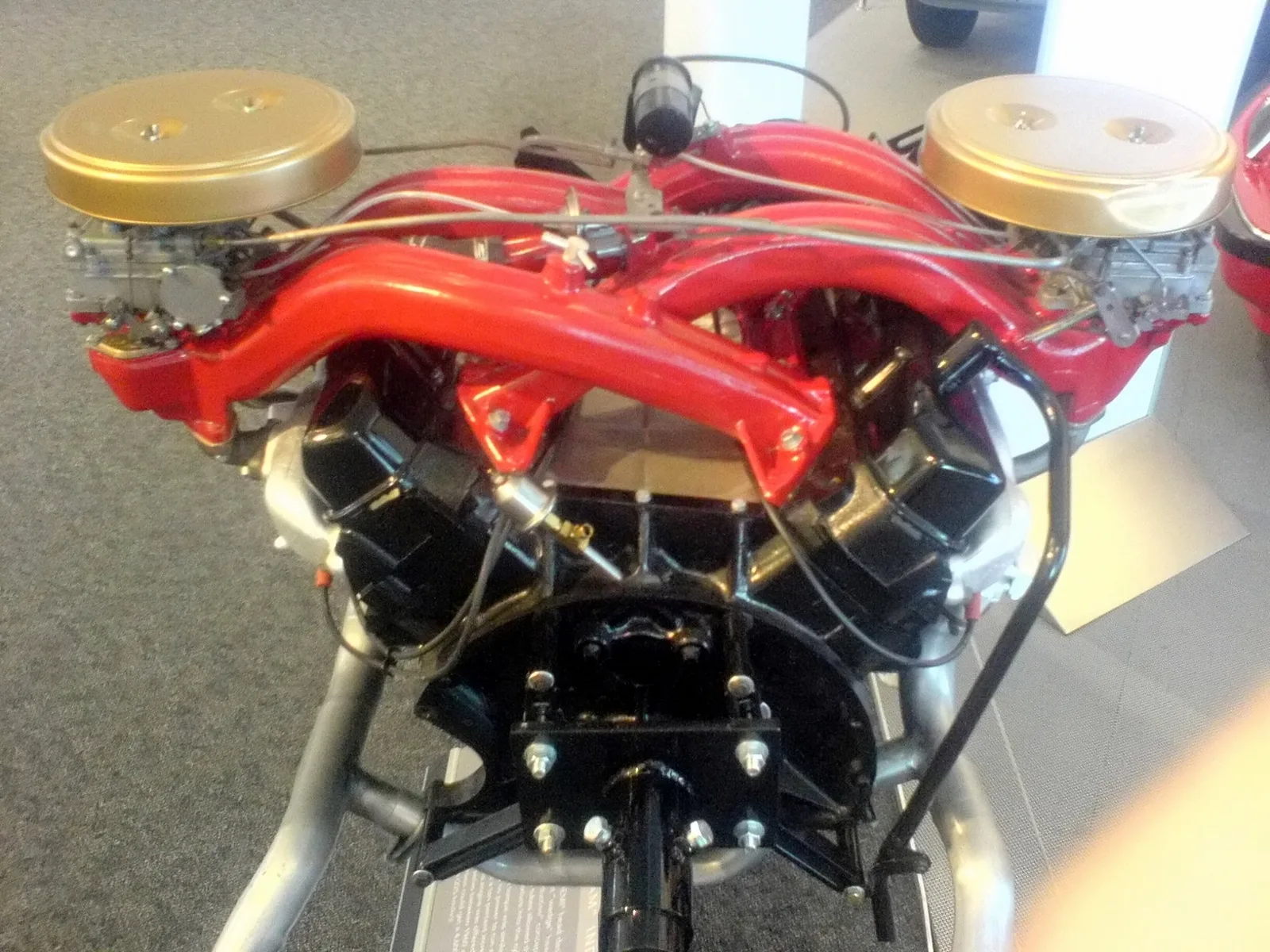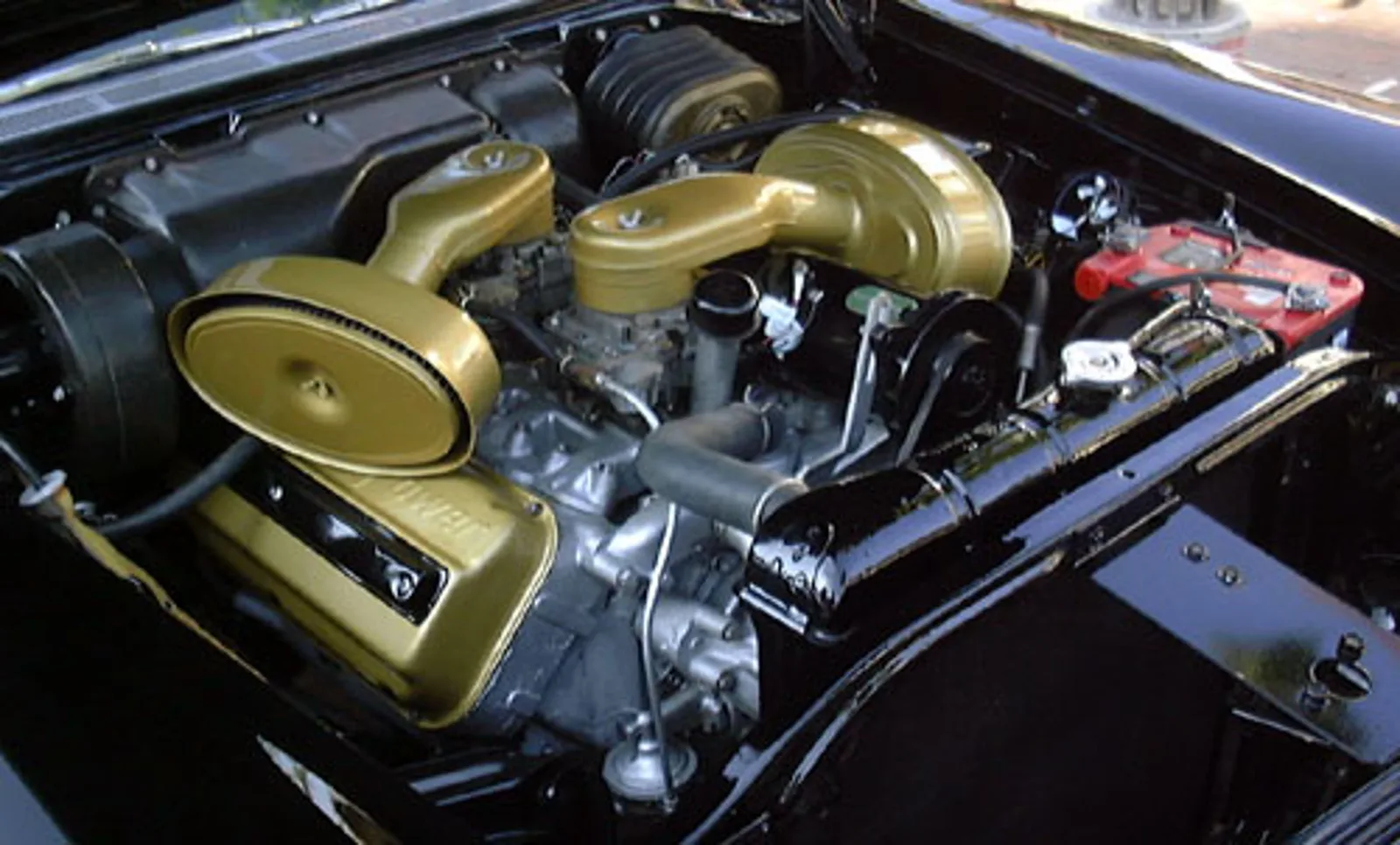
A dome-shaped combustion chamber made big valves and strong breathing possible, and it came with weight, width and fuel demands that kept most makers away.
A Hemi is an engine with hemispherical combustion chambers: a dome in the cylinder head that allows two large valves and strong breathing. Chrysler built three generations, from the 1951 FirePower V8 through the 426 Hemi of 1964 to 1971 to the modern family from 2003.
The first Chrysler V8 with hemispherical heads never wore the Hemi name. When it reached showrooms for the 1951 model year it was called FirePower, and the word that later became one of the most recognisable in American motoring was a trademark that Chrysler began leaning on in its advertising in the 1960s. Behind the label sits a genuine piece of engineering, a dome-shaped combustion chamber, and it explains both why these engines made so much power and why most manufacturers chose to build their engines differently.
What is a Hemi engine?
Strictly, it is any engine whose cylinder head has a domed recess in the roof of the combustion chamber. Put that dome together with the shaped top of the piston and the space they enclose approximates half a sphere, which is where the name comes from: hemi plus sphere. Think of an upturned cereal bowl sitting over each piston. Real engines rarely use a perfect half-sphere. Designers usually settle for less than a full hemisphere, and many flatten or facet parts of the profile.
Chrysler is the company everyone connects with the word. It trademarked Hemi and has built three generations of these V8s: the FirePower engines of 1951 to 1958, the 426 of 1964 to 1971, and the modern family introduced in 2003. FirePower displacements spanned 3.9 to 6.4 L (241 to 392 cu in). The 426 cu in (7.0 L) engine served as both a race and a street unit. The current generation spans 5.7 to 6.4 L (348 to 391 cu in), with the modern engine listed as built from 2003 to 2024.
Plenty of others used the shape too. In the 1970s and 1980s Chrysler even applied the name to an Australian-built six, the Hemi-6, and to a Mitsubishi 2.6 L four-cylinder sold in North America.
The most famous engine name in America began life as a trademark, and the engine it described was called FirePower.
How does a hemispherical combustion chamber work?
Power is the whole point. A hemispherical chamber has an excellent surface-to-volume ratio, which means little of the heat from combustion leaks into the cylinder head, and it leaves room for two very large valves. Those valves sit on opposite sides of the chamber, with the intake on one flank and the exhaust on the other. That arrangement is called a cross-flow head.
The valves also splay apart rather than standing parallel. In a conventional wedge-head engine the two valves sit side by side with their stems running the same way, so their combined diameter cannot exceed the bore of the cylinder. Splay them and that limit loosens, so the valves can be larger in total than the cylinder is wide. The seats tilt too, and a tilted seat gives the intake and exhaust a straighter run between port and chamber. Bigger valves and straighter ports both help an engine breathe at high revs.
The spark plug sits at or near the centre of the dome, which encourages a strong, evenly spreading flame front. And because the chamber eats into the space above the piston, the piston crown has to be domed to poke up into it at the top of the stroke. Without that dome, a flat-topped piston would deliver only a low compression ratio unless the stroke were very long.
Hemi vs non-Hemi: what does the shape cost?
Everything that helps breathing makes the hardware harder to build. Because the valve stems point in different directions, the head must be wide and the rocker arm geometry complicated, whether the camshaft sits in the block or on top of the head. Chrysler's own 1950s advertising called the arrangement the Double Rocker Shaft head, a clear hint at that complexity. The width also limits which vehicles an engine can be fitted into.
| Feature | Hemispherical head | Wedge head |
|---|---|---|
| Valve layout | Opposite sides, stems splayed | Side by side, stems parallel |
| Valve size | Combined diameter can exceed the bore | Combined diameter limited to roughly the bore |
| Valve train | Complex, with extra rocker or cam hardware | Simpler actuation |
| Weight | About 25% heavier, according to Chrysler's engineers | Lighter |
| Fuel sensitivity | Needs higher octane for a given compression ratio | More tolerant |
Octane matters more than you might expect. When the hemisphere has the same diameter as the piston there is almost no squish, the squeezing of the mixture at the top of the stroke that stirs fuel and air together. Without it, a hemi needs a higher octane rating than a wedge or bathtub chamber to run at the same compression ratio without detonation.
The airflow advantage also has a flip side. Large valves and straight ports suit peak-power breathing but slow the intake flow at ordinary revs, which is not ideal for emissions, economy or midrange power. Domed pistons lengthen the distance the flame has to travel. Flame temperatures run very high, producing a lot of nitrogen oxides that may demand exhaust gas recirculation to meet modern rules. Together these drawbacks pushed the hemi out of favour until Chrysler's 2003 redesign proved popular.
Where did the hemispherical head come from?
Chrysler did not invent it. Hemispherical heads have been in use since at least 1901, and the Belgian maker Pipe fitted them in 1905. Fiat's 130 HP Grand Prix racer of 1907 used one. Peugeot's 1912 Grand Prix car and Alfa Romeo's 1914 car both had four-valve versions, and Stutz started building four-valve engines in 1912.
The family tree kept growing. BMW produced a double-pushrod design later adopted by Bristol, Peugeot used the layout in the 403, Toyota in its T engine and its first V8, and Miller in racing engines. Jaguar's XK engine, introduced in 1949, powered cars as different as the D-Type, which won at Le Mans, and the XJ6.
The FirePower years, 1951 to 1958
Chrysler's road to the hemi car engine ran through the military. Its first experimental hemi was the XIV-2220, an inverted overhead-valve V16 with 2,500 hp (1,860 kW) on tap, designed as a possible upgrade for the Republic P-47 Thunderbolt fighter. It flew successfully in trials in 1945, but with the war ending it never reached production. Chrysler also worked with Continental Motors on the air-cooled AV-1790-5B V12 used in the M47 Patton tank. Both programmes gave its engineers hands-on experience with two-valve hemi chambers.
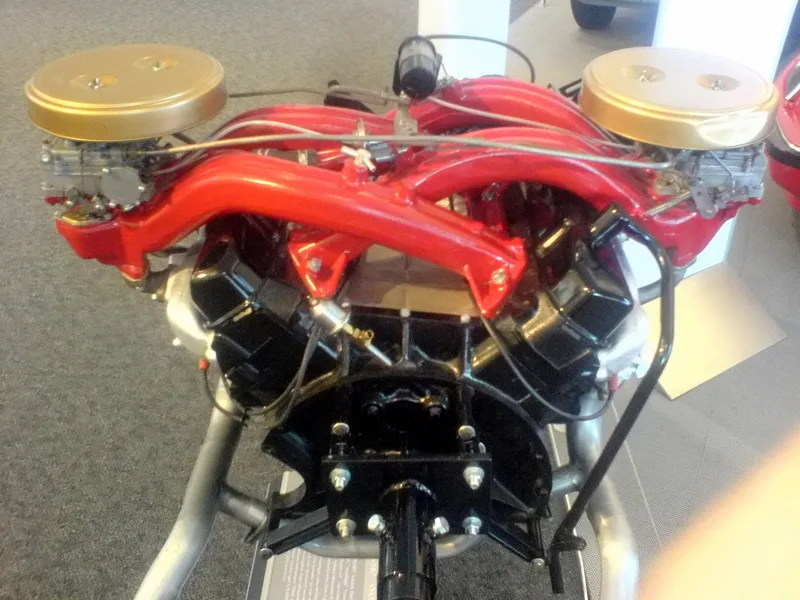
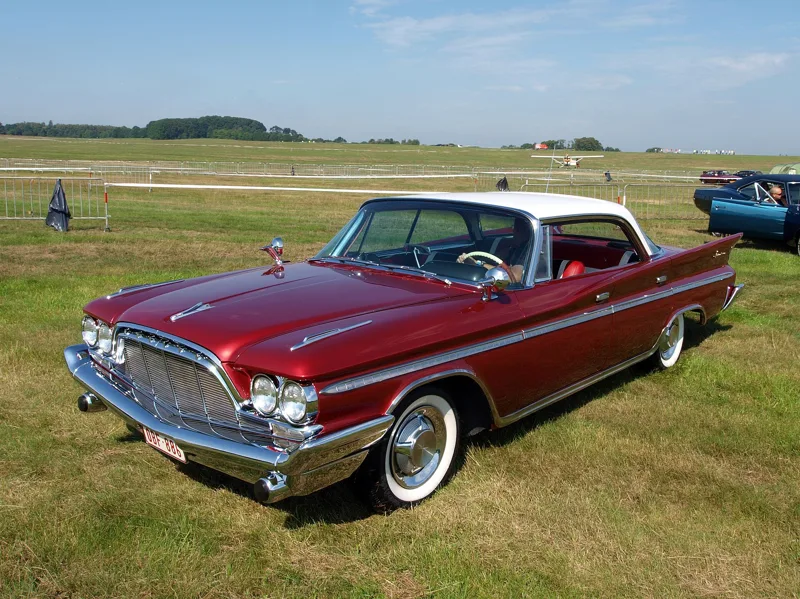
The first car engine appeared in 1950 for the 1951 model year. It was a 5.4 L (331 cu in) V8 producing 180 bhp (134 kW), sold as the FirePower. Eventually three of Chrysler's four divisions had their own versions, with almost no parts in common, partly because each used a different spacing between cylinders. Chrysler and Imperial kept the FirePower name. DeSoto called its engine the FireDome. Dodge had a smaller one, the Red Ram. Plymouth never received a hemi in this era and stayed with Dodge's poly-head engines, so there was no Plymouth Hemi until the 1964 426.
Racing gave the engines a profile. Briggs Cunningham used the Chrysler V8 in some of his sports racers, and a Cunningham C-5R with Chrysler power took its class in 1953. Carl Kiekhaefer fielded Chrysler engines in his NASCAR cars in 1955 and 1956, and won the Grand National Series championship both years. Then, in 1959, Chrysler stepped away from the hemispherical concept in favour of the wedge-head B engine, and Cunningham switched too. The hemi stayed away until 1964.
Two details identify a first-generation engine on sight: the distributor sits at the rear, and the spark plugs run in a row down the middle of wide valve covers.
Chrysler's 331, 354 and 392
| Engine | Years | Displacement | Bore x stroke | Output |
|---|---|---|---|---|
| 331 | 1951 to 1955 | 5,425 cc (331.1 cu in) | 96.8 x 92.1 mm | 180 bhp (134 kW); 300 hp (224 kW) in the C-300 |
| 354 | 1956 | 5,787 cc (353.1 cu in) | 100 x 92.1 mm | 280 bhp (209 kW) to 340 bhp (254 kW); 355 hp (265 kW) optional |
| 392 | 1957 onward | 6,435 cc (392.67 cu in) | 101.6 x 99.21 mm | 325 to 375 bhp (242 to 280 kW) |
The 1955 Chrysler C-300 turned the basic 331 into a headline car. Fitted with two four-barrel Carter carburettors, it carried a 300 hp (224 kW) rating. The bigger 354 followed in 1956, and the 300B variant with the optional 355 hp (265 kW; 360 PS) rating made it the first American V8 rated at one horsepower for every cubic inch. A caution applies to numbers from this era: before 1972 horsepower was quoted as SAE gross, close to a maximum output, while later ratings use SAE net, measured after accessories, emission controls and the exhaust system take their share. Dodge also offered a heavy-duty 354 in its heaviest-duty models as the Power Giant V-8 from 1957 through 1959.
The 392 arrived in 1957 on a block 13 mm taller than before. So that older manifolds would still fit, the castings carried wider intake ports. For 1958 it came in a 325 bhp (242 kW) form with 9.25:1 compression and a 345 bhp (257 kW) form at 10:1. Twin four-barrel versions in the 300C and 300D were rated at 375 bhp (280 kW). The rarest option on the 1958 300D was Bendix Electrojector injection, which lifted output to 390 bhp (291 kW). The primitive onboard computer proved unreliable, and 15 of the 16 injected cars were recalled and returned to carburettors.
Drag racers took to the 392 in the late 1950s and early 1960s, and some were still running it competitively in the 1970s.
DeSoto and Dodge went their own way
DeSoto introduced its FireDome in 1952 as a 4.5 L (276.1 cu in) V8 with 160 bhp (119 kW). It sold well, with 50,000 vehicles using it before it was replaced in 1954. Capacity rose to 4.8 L (291 cu in) in 1955, with 185 bhp (138 kW) from a two-barrel carburettor and 200 bhp (149 kW) from a four-barrel in the Fireflite. A further stretch to 5.4 L (330 cu in) in 1956 lifted those figures to 230 bhp (172 kW) and 255 bhp (190 kW).
The flagship was the Adventurer, DeSoto's counterpart to the twin-carburettor Chrysler 300. In 1956 its 5.6 L (341.1 cu in) engine ran 9.5:1 compression with a camshaft profile made for hydraulic lifters, and made 320 bhp (239 kW). For 1957 the Adventurer used a 5.6 L (344.6 cu in) square-dimension engine, with bore and stroke both 3.80 in, rated at 345 bhp (257 kW). That made it the first American car to reach one horsepower per cubic inch as standard equipment, a claim worded differently from the 300B's, which offered the figure as an option.
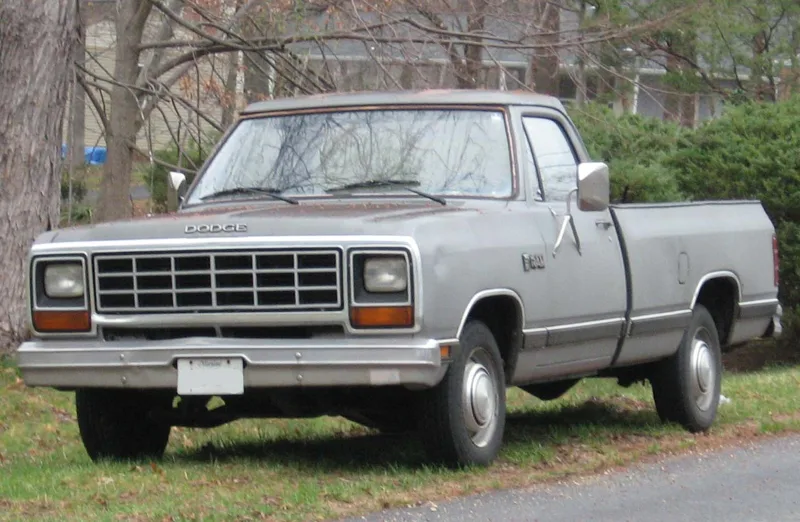
Dodge launched the Red Ram in 1953. It had no V8 before, and engineers based the new engine on the 1951 Chrysler design but shrank it. It has the smallest spacing between cylinders of any hemi, 106.4 mm, and shares no major parts with the Chrysler or DeSoto engines. The first, a 4.0 L (241.3 cu in), ran 7.0:1 compression and made 140 bhp (104 kW), while a senior 1954 version at 7.5:1 produced 150 bhp (112 kW). It lasted only two years before a 270 replaced it. Dodge Trucks sold their version as the PowerDome, and from 1955 to 1958 cheaper poly-head alternatives with a single rocker shaft sat alongside the real hemis in lower-line DeSotos, Dodges and Plymouths.
The 426 Hemi and the NASCAR argument
The second generation, the 426 cu in (7.0 L) engine, was developed for NASCAR in 1964 and built through the early 1970s. It also gave Plymouth its first hemi.
Its rivals shaped the story. Ford built a single-overhead-cam hemi in 1964, derived from its FE V8: the 427 SOHC, known as the Cammer. Engineers designed it in 90 days for racing. No production Ford ever carried it; it was sold instead over the parts counter. Period dynamometer results claim almost 700 hp (522 kW) from a crate engine, which is 100 hp per litre. Its overhead cams freed it from the rev limits of Chrysler's pushrod Hemis with their heavy, complex valve gear. Chrysler had already shown NASCAR chief Bill France that a dual-overhead-cam 426 was on the way, and the Cammer was banned from NASCAR while remaining legal in certain drag racing classes.
Who else built a hemi?
Almost everyone, at some point. Some rate Alfa Romeo's Busso V6 among the finest-sounding production engines, helped by hemispherical heads that allowed an almost straight exhaust port, so the note is less muddied. Aston Martin's double-overhead-cam V8 used the chamber from the late 1960s until the late 1980s, and its 5.3 L version made 315 hp (235 kW) gross. BMW's M10 four, best known in a 2 L form in the 2002 saloon, helped make the company a worldwide marque. Lamborghini's V12, designed in 1963 and built for more than 50 years, used the chamber, and so did Porsche's air-cooled flat-six from 1963 to 1999; in 1973 form its 2.7 L version made 56 hp per naturally aspirated litre.
Toyota's V family, longitudinally mounted V8s in the Century from the 1960s through the 1990s, is often called the Toyota Hemi because its head resembles Chrysler's, though most of the rest differs completely. Toyota worked with Yamaha on the first Japanese full-aluminium-alloy block.
Not every attempt succeeded. The MGA Twin-Cam of 1958 to 1960 suffered pre-ignition and oil loss, and engineers cut compression from 9.1 down to 8.3 by fitting redesigned pistons, but sales fell away so fast that MG ended production. In the 1970s Ford designed a small-block Windsor with hemispherical heads and ahead-of-its-time direct injection, but could not make its emissions clean enough. Ford's 1980s CVH four-cylinder solved the valve-gear problem with complex valve angles and a cam-in-head layout that let a single camshaft operate hemispherically arranged valves.
What the modern Hemi shares with the old one
The third generation arrived with Chrysler's redesign of 2003. The modern family, from 5.7 to 6.4 L (348 to 391 cu in), is called the new Hemi, listed as built from 2003 to 2024. Its head is not a true hemisphere. It uses part of an oblate spheroid, a flattened sphere, a shape intended to improve combustion efficiency over the pure dome.
That change reflects a wider trend. In the emissions era the hemi chamber has become more sophisticated, built to wring more power from each combustion event with fewer emissions. Many current engines use active chambers that tumble and swirl the mixture, with shapes like kidney beans or two merged small hemis surrounded by flat quenching areas above the pistons. Multi-valve heads with four or even five valves per cylinder, together with the spread of overhead cams, have also changed the old trade-offs.